Best Condensate Pump for a Furnace, AC, Mini-Split or Dehumidifier
By Cal Dunwoody · Updated October 2026
Independent editorial guide. We never accept payment for coverage, though we may earn a commission if you purchase through our links.
Quick Take
For a furnace, air handler, central AC coil or basement dehumidifier, buy the Little Giant VCMA-15ULS and plan on lifting water no more than about 10 ft with it. The "15" in the name is the height where its flow stops, not working lift. If the water has to climb 10-15 ft, step up to the VCMA-20ULS. If the water is coming from a wall-mounted mini-split head that can't drain downhill, you need a different kind of pump altogether, a compact one like the Aspen Silent+ Mini Orange.
Whichever you buy, get the version with the overflow switch and make sure the switch is connected to something: the equipment's controls, an alarm, or both. A switch with its leads hanging loose protects you about as well as no switch at all. Don't shop on gallons per hour; in a house, the lift, the switch and a cleaning every six months matter far more.
Our picks cover the default tank pump, the bigger one for tall lifts, a dual-voltage alternative, and the mini-split pump we would use when gravity is not an option. See picks ↓

A condensate pump is a cheap plastic box that stands between a drain line and a wet floor. Furnaces, AC coils and dehumidifiers make water for hours at a time. When that water can't run downhill to a drain, it falls into the pump's tank, a float switches the motor on, and the pump pushes it up a 3/8 inch tube to somewhere it can go. Nobody thinks about the pump until the floor is wet.
Most listings lead with a big lift number and a gallons-per-hour figure. Neither tells you what you need to know. The lift number on a Little Giant is the height where water stops moving, and almost any tank pump moves water many times faster than a house makes it. What decides whether you'll be happy is how high the water climbs, whether the overflow switch gets connected, and whether you need a floor tank pump at all.
Our picks lean on Little Giant's spec sheet and owner's manual, the published claims for the alternatives, and owner reports from people whose pumps flooded a finished basement, could be heard on the second floor, or ran for 26 years.
Check for a gravity drain first
A pump is a moving part you add only when water can't fall to a drain. If there's a floor drain, a sump pit or a laundry standpipe below the equipment's drain outlet, gravity costs less and has nothing to wear out. One owner's new furnace came with a pump whose discharge tube was routed into a vertical waste pipe and sealed with silicone, even though the old furnace had drained by gravity to a floor drain about three feet away. Nobody could explain why a pump went in at all.
There's one good reason an installer might skip an existing floor drain. A condensing furnace makes acidic condensate, and Little Giant's manual asks owners of its pumps to keep the condensate in a gas furnace application from falling below an average pH of 3.4 by routinely cleaning or flushing the tank with fresh water. And that water will eat a metal floor drain unless a neutralizer goes in first. If you have a high-efficiency furnace, we'd add a neutralizer whether the water drains by gravity or by pump, especially if it ends at metal drain pipe.
You need a pump when:
- Basement equipment has no drain below it, so the water has to climb to a ceiling run, a utility sink or a standpipe.
- An air handler or coil drain has to rise before it can leave the house.
- A dehumidifier sits where there's no floor drain or sump nearby. Our guide to the best dehumidifier with a pump covers whether a built-in pump or a separate one makes more sense.
- A mini-split head is on an interior wall, or the drain would have to run uphill. That's a different pump, covered next.
Skipping the question entirely is how houses get damaged. One owner had an upstairs air handler that had only ever run electric heat, so it had no drain. A contractor hooked up air conditioning to it without a drain or a pump, and the condensate came through the ceiling below. The water has to go somewhere, every time the AC or a condensing furnace runs.
Tank pump or mini-split pump: two different tools
A tank pump like the Little Giant VCMA series sits on the floor or hangs on a wall by its mounting slots. The VCMA-15 has a half-gallon tank and three 1-1/8 inch inlets, so a furnace, an AC coil and a dehumidifier can all drain into one pump. Little Giant's manual says to install it with the inlet below the coil drain. That's the catch for a wall-mounted mini-split head: its drain would have to fall into a box on the floor before anything gets pumped.
Mini-split pumps are a separate class. They're compact units that mount at or near the indoor head, often tucked behind it or just below it. The Aspen Silent+ Mini Orange listing describes ceiling and floor installation. They're built for one head's water. Aquastrong's mini-split pump listing, for example, claims 9.6 GPH and 33 ft of lift. Compare that with the 65 GPH the VCMA-15's spec sheet shows at 1 ft.
Mixing them up goes badly. One owner had a small mini-split-style pump under a central air handler for three years, because there was less than an inch of clearance and a Little Giant wouldn't fit. When it started air-locking, the verdict was that it was the wrong class of pump for a whole-home system. In fairness, rerouting the tubing got it pumping again, at least for the first hours the owner reported back, which says as much about tubing layout as about pump size.
Our view on mini-split pumps is less enthusiastic than the listings. They work, and when the head is on an interior wall they're the only option. But people who do their own mini-split installs will go out of their way to drain to a Little Giant in the basement instead, tiny-pump failures are a common service call, and one owner has had the internal pumps fail on two mini-split heads. If you can run the head's drain downhill by gravity, even to a tank pump one floor down, do that.
If your mini-split is already dripping indoors, start with our guide to a mini-split leaking water, which covers the drain side first. A clogged line or a bad slope is a cheaper fix than a pump.
Read the lift chart, not the number on the box
Little Giant publishes a flow chart for the VCMA-15, measured through the check valve: 65 GPH at 1 ft of vertical lift, 50 GPH at 5 ft, 25 GPH at 10 ft, and 0 at 20 ft, with a 15 ft shut-off head. That shut-off is the height where the pump can no longer move water upward, and it matches the model number. The manual adds a planning rule: route the outlet tubing straight up, "not exceeding 75% of total dynamic head capacity of the pump."
Run that rule across the pumps you're likely to compare:
Pump | Shut-off (zero flow) | Planning lift (shut-off x 0.75) | Notes |
|---|---|---|---|
VCMA-15 | 15 ft | About 11 ft; we plan on 10 | A little inside the rule, because the chart is vertical-only and a long sideways run adds resistance it doesn't show |
VCMA-20, 115 V | 20 ft, per the manual | About 15 ft | The listing claims 80 GPH and a 1/30 HP motor, against the 15's 1/50 HP |
VCMA-20, 230 V | 17 ft, per the manual | Just under 13 ft | The 230 V version gives up some lift |
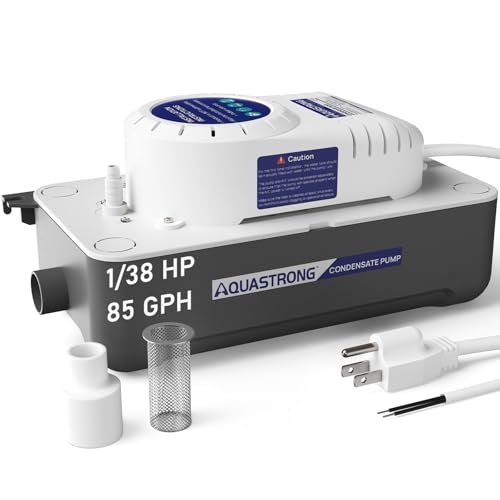
Aquastrong 85 GPH | Listing claims "20 FT Lift" | About 15 ft, if that's a shut-off figure like Little Giant's 15 | We haven't seen a published curve for it, so we'd treat it like the VCMA-20 and not push it further |
Now the number listings lead with. By one rough estimate, a furnace and AC make a couple of gallons a day in heating and 5-10 gallons a day in cooling, depending on humidity. Take the high end: 10 gallons over 24 hours averages about 0.42 gallons an hour. A dehumidifier running at a 50-pint-a-day rating makes 6.25 gallons (50 / 8), or about 0.26 gallons an hour. Even at 10 ft, where the VCMA-15 has dropped to 25 GPH, it has dozens of times the capacity either one needs, and it would move a full 50-pint day of water in about 15 minutes. Little Giant's manual does say total inflow must not exceed the pump's rated output, but in a house you'd have to try hard to get there. Pick on lift. Then check that the tubing route doesn't eat the margin.
One more chart caution. If you're replacing a pump, match or beat the old one's lift. One owner whose mini-split pump has to push water up to roof level found the replacement cycling about every 50 minutes with the AC off, and suspects it can't clear the line, so the water runs back into the tank. The usual culprits are a replacement with less head than the original, or a check valve left out during the swap.
Buy the overflow switch, then decide what it should do
The VCMA-15 comes with or without a high-water switch, and the switch version costs only a little more. The S suffix adds it: a second float that, as shipped, is wired to the normally open and common terminals so it opens (breaks) a low-voltage circuit when water rises too high in the tank. Connected to the equipment's controls, that stops the furnace or AC from making more water while the pump is down. The manual also describes reconfiguring it to close a circuit instead, to drive an external alarm or relay sold separately.
Little Giant's manual is direct about when you need it: where property damage might result from a pump that stops or leaks for any reason, "a backup system(s) (e.g. auxiliary switch) and/or alarm should be used and monitored." A finished basement qualifies. So does any basement with something you care about sitting near the furnace.
The owner reports make the case on both sides of the same switch. One owner's six-month-old VCMA-15UL, the version without the switch, failed on a high-efficiency furnace in a finished rental basement during a cold winter, and the furnace kept making water until the room was soaked. On the other side, an owner who hooked up the switch when finishing their basement credits it with saving them from expensive repairs the one time the pump float stuck.
There's a real tradeoff for a furnace, and we'd rather you hear it before the install than after. One HVAC tech says they were taught not to wire the switch to shut off a furnace unless the customer asks, because in a cold climate frozen pipes do more damage than water on the floor. That's a fair point for a house that sits empty in January. In a finished space, have the switch stop the equipment, and add a Wi-Fi leak alarm next to the pump so you hear about it either way. Owners and installers alike recommend exactly that kind of leak sensor. In a house that could freeze while you're away, ask your installer about using the alarm configuration instead of a shutdown, or both.
A plug-in dehumidifier is the exception. It usually has no low-voltage control circuit for the switch to open, so on that setup the switch mostly buys you the alarm option, and a standalone leak alarm beside the pump does the job with no wiring at all.
Connecting the switch means working inside the equipment's low-voltage control circuit, which the manual says should be a Class II circuit. We don't give wiring steps. If you aren't comfortable with control wiring, have an HVAC tech or electrician do it; it's a short job for them, and our VCMA-15 review covers what one owner learned the hard way when the switch leads touched a metal drain pan.
Install it so the chart holds up
Pump trouble that isn't dirt usually traces to the install. These points come from Little Giant's manual unless we say otherwise:
- Level, with the inlet below the coil drain. The manual's troubleshooting table lists an unlevel pump as a cause of overflow, because the pump may not activate.
- Pull the cardboard insert. Failure to remove it will cause the pump to overflow, per the manual.
- Its own circuit. The pump should be on a circuit with no other receptacles or equipment, not connected to a fan or anything that runs intermittently, and the manual says not to use an extension cord. It also calls for a GFCI where code requires one. If there's no suitable outlet near the drain, that's a job for a licensed electrician.
- Tubing: 3/8 inch ID maximum. Route it straight up from the pump, then slope it down slightly toward the drain. The manual says ending the line, where possible, at a drain below or about level with the bottom of the pump creates a siphon that improves the pump's efficiency; if you can't slope it down, it calls for an inverted U at the high point.
- No up-down-up runs. One owner with an air-locking pump re-ran the discharge straight up the wall to about 18 inches above the laundry drain and sloped it down into it, and the pump started working again.
- A trap on an air handler drain. The drain from an air handler generally needs a trap before the pump, because the blower can pull air back through the line. Check your equipment's install instructions for its trap requirement.
- A proper drain at the end. A laundry standpipe, utility sink or floor drain. A tube siliconed into a waste pipe, like the furnace install above, is the wrong answer; a trapped drain like a washing machine standpipe is the usual right one, with an air gap if you can. Anything that ties into drain piping is a question for a plumber.
- Indoors, and not too hot. The VCMA-15 is for indoor use only and is rated for water up to 140°F, so check the drain temperature of anything like a steam humidifier before you route it in.
How pumps fail, and the six-month check that catches it
Lifespans in these reports run from months to decades. A Beckett ran 26 years and was replaced only because the tank cracked, and a Hartell lasted nearly 20. On the other end, one VCMA-15UL failed at six months, and a Diversitech malfunctioned eight months after installation. The failures in these reports trace to a short list of causes:
- Water running back from the line. Water draining back from the line into the pump shows up three ways: a new Little Giant that seems to leak as a result, a new pump that came without its check valve and kept re-pumping the same water, and a replacement pump on a mini-split that cycles with the AC off. The check valve is what stops it, so check that yours is there before you install the pump.
- Sludge and stuck floats. Floats stick, float-less pumps muck up terribly, and goop, sludge or mold is the first thing to check when a pump runs nonstop or gets loud.
- Too much lift. A pump at the edge of its chart runs longer, and a replacement with less head than the original can't clear the line at all.
- Clogged tubing. A small clear discharge tube full of slime makes the pump look dead when the motor is fine.
The manual's maintenance schedule covers all of it: "Inspect and test the condensate removal system condition and operation every 6 months (more frequently in heavy-use applications)." With the pump unplugged, make sure the floats move freely, remove and backwash the check valve, clean the tank with warm water and mild soap, flush it with fresh water, and check the tubing for kinks and slime. Then plug it back in and lift each float by hand: the pump should start before its float touches the cover, and the high-water switch should trip. Some owners run vinegar or diluted bleach through theirs; bleach foamed up and set off one owner's alarm sensor, and vinegar or acidic condensate is suspected of rusting a Little Giant. We'd stick with what the manual says.
In a finished basement or a rental, we'd also keep a spare pump on the shelf. It's a small cost next to a soaked floor, and swapping a like-for-like pump is one of the easier HVAC jobs a homeowner can do when no switch wiring is involved.
Noise: what's normal and what isn't
A tank pump makes a short whir when it empties the tank. You shouldn't hear it upstairs. One new homeowner said theirs sounded like an airplane taking off and could be heard on the second floor; it turned out to be mounted against thin sheet metal. It was also running about 45 seconds a cycle, which points to a sticking float. Pumps also get very noisy when they run empty.
- Rattling or droning: check the mounting. A pump bolted to a furnace cabinet uses it as a speaker. Set it on a level surface or isolate it from the sheet metal.
- Running long and loud: a float that sticks lets the pump run dry. Clean it.
- Gurgling: usually air pulled through the drain line, which is the missing-trap problem above.
- Still loud after cleaning and remounting: one owner padded their pump, cleaned and then replaced the check valve, and ran vinegar through it, decided the motor was worn, and bought a new pump. Pumps are cheap enough that we would do the same.
Mini-split pumps are a bigger noise risk because they sit in the room you're trying to keep quiet. One installer had a customer with a pump hung under a mini-split head complain it woke them up at night. The Aspen Silent+ listing claims 16 dB(A). That's the maker's figure, not ours; we don't measure sound.
Which pump we'd buy
- Furnace, air handler or dehumidifier, rise up to about 10 ft: the VCMA-15ULS. It's the default for a reason, and our full review goes deeper on it.
- Rise of 10-15 ft, or a long run: the VCMA-20ULS (115 V).
- You want 115 V or 230 V in one pump: the Aquastrong 85 GPH, which its listing says runs on either, accepting that we haven't seen an owner report on it and its listed cord is 3.3 ft.
- A mini-split head that can't drain by gravity: a compact mini-split pump such as the Aspen Silent+ Mini Orange.
- A basement dehumidifier with no drain: a separate pump under a pumpless unit, or a unit with a built-in pump. Our basement dehumidifier guide weighs the two.
The picks
Products we recommend for this guide.

Little Giant VCMA-15ULS Condensate Pump (554405)
Our default for a furnace, air handler or dehumidifier lifting water up to about 10 ft: 65 GPH at 1 ft and 25 GPH at 10 ft on the spec sheet, a half-gallon tank, three inlets, and the overflow switch the bare UL version lacks.
Read our full review: we scored it 7.3/10


What owners say
Real owner reports from the threads and editorial sources we drew on for this guide.
“Just had a flood in my basement because my 6-month-old Little Giant VCMA-15UL overflowed. It’s on a high-efficiency furnace and it’s a finished basement/rental unit. The pump they put in doesn't have the auxiliary safety switch, so when it clogged/failed, the furnace just kept dumping water until the floor was soaked.”
“Didn't have one installed on my system in an unfinished basement but hooked one up when we finished it..saved me from expensive repairs on one occasion when the pump float stuck.”
“Do use vinegar. Aggressively. Mine mucked up terribly. If you're going out of town, buy a leak sensor.”
“I had a Beckett condensate pump for 26 yrs. Just replaced it cause the tank developed a small crack, but the pump still works.”
“Re ran the lines, with the pump on the floor so the inlet line is mostly flat on the ground. Went straight up the wall with the discharge line to about 18 inches above the laundry drain and sloped down into it. Pump has been working for the last two hours without an issue now.”
“The internal pumps on two of our mini splits have failed. We have been recommended to install external condensate pumps instead, which has worked well for our neighbors who have had similar issues (houses were all built together).”
“Anyone know why our condensate pump sounds like an airplane taking off when it turns off? It’s so loud we can hear it all the way on the second floor!”
“It has a float inside to turn off after it pumps the water out. Mine gets very noisy when running empty. Also make sure it is level. It should only run for 15 seconds or so.”
