Little Giant VCMA-15 Condensate Pump Review: Buy the S, Plan on 10 Feet
By Cal Dunwoody · Updated October 2026
Independent editorial review. We never accept payment for coverage, though we may earn a commission if you purchase through our links.

Spec sheet
| Flow vs lift (through check valve) | 65 / 50 / 25 GPH at 1 / 5 / 10 ft |
| Shut-off head | 15 ft (0 GPH at 20 ft); the "15" is not working lift |
| Tank | 1/2 gallon, three 1-1/8 in inlets |
| Safety switch | ULS/ULST: float overflow switch, NO/NC, factory set NO; UL: none |
| Electrical | 115 V, 60 Hz, 1.0 A, 1/50 HP; 6 ft grounded cord |
| Discharge | 3/8 in OD barbed adapter, built-in check valve |
| Max water temperature | 140°F |
| Applications (maker) | AC, refrigeration, dehumidifiers, condensing furnaces and boilers |
| Warranty | 12 months from original purchase |
| Owner-reported gripes | Motor noise; check-valve drain-back; float/tank fouling |
Verdict
Owner reports come from r/hvacadvice threads about Little Giant condensate pumps. Most owners name the brand and post a photo rather than the model number, so we treat these as evidence about Little Giant standard tank pumps, of which the VCMA-15 is one. Commenters, including one who installs them, say they last and are easy to swap; owners complain about motor noise, and the failures they describe trace mostly to sludge, clogged tubing and leaking check valves. Two owners call their pump loud, two describe check-valve drain-back, and four commenters point first to float and tank fouling. The cards below are limited to owners describing their own pumps; advice from installers and other commenters is summarized in the text.
Read full take ↓Similar condensate pumps


For the job most homes need, the Little Giant VCMA-15ULS is the condensate pump we'd buy. It's the pump you'll find under a lot of basement furnaces and air handlers: a half-gallon tank, a float, a small fan-cooled motor and a check valve on a 3/8 inch barbed outlet. It's cheap and it's everywhere. Just don't read the "15" on the box as working lift. On Little Giant's own chart, 15 ft is the height where the flow stops.
The series comes in three versions you'll see side by side. The UL is the bare pump. The ULS adds a float-operated overflow switch. The ULST is the ULS plus 20 ft of 3/8 inch ID vinyl tubing. Same motor, same tank, same flow chart. We'd buy the S version, and we'd connect the switch. That second step is what keeps a stuck float from turning into a wet floor.
Installers vouch for these pumps' reliability. The owners who need help describe noise and failures that tend to start with dirt: a gummed-up tank or float, a clogged discharge tube, a check valve that lets water run back. Those are maintenance problems more than design flaws, but they're the reason the safety switch earns its few extra dollars.
Buy it for a rise of 10 ft or less
Buy the VCMA-15ULS if your condensate has to climb 10 ft or less to reach a drain, and you have a furnace, air handler or basement dehumidifier making the water. Step up to a bigger pump if the climb is longer, and pick a different kind of pump entirely for a wall-mounted mini-split head.
Little Giant lists the VCMA-15 for air conditioning, refrigeration and dehumidification, and says it's also suitable for high-efficiency oil and gas condensing furnaces and condensing boilers. Owners use it the same way: most of the pumps we hear about serve a furnace or air handler, one sits beside a furnace in a vacation home, and one takes the hose from a basement dehumidifier.
- Great fit: a basement or utility-room furnace or air handler where the condensate line rises a few feet to a ceiling run, a laundry standpipe or a sink drain.
- Great fit: a condensing (90%+) furnace, as long as you keep up with flushing. The manual warns about condensate acidity, covered below.
- Great fit: a basement dehumidifier on hose drain, when the floor drain is across the room or there is no floor drain at all.
- Pick something else: if the vertical climb is over about 10 ft, or you have a long run on top of a tall rise. The bigger VCMA-20 in the same series is the next step; its Amazon listing rates the 20ULS at 80 GPH with a 1/30 HP motor against the 15's 65 GPH and 1/50 HP.
- Pick something else: for a wall-mounted mini-split head. The VCMA-15 is a floor-standing tank pump, so the head's drain would have to fall into a tank on the floor before anything gets pumped. A compact pump made to mount at the head or in the line set is the usual answer. If your mini-split is dripping indoors, our guide to a leaking mini-split covers the drain side first.
- Pick something else: if the water is hot. The spec sheet caps water temperature at 140°F, so check the drain temperature of anything like a steam humidifier before you route it in.
- Pick something else: if you need it outdoors. The manual says indoor use only.
What we like
- An honest chart: published flow of 65 GPH at 1 ft, 50 GPH at 5 ft and 25 GPH at 10 ft, measured through the check valve, so the chart already accounts for the fitting you will use.
- The overflow switch: the S and ST versions add a float-operated overflow switch that can shut down the equipment when water rises too high in the tank.
- Range of uses: rated for condensing furnaces and boilers as well as AC and dehumidifiers, with three 1-1/8 inch inlets so more than one drain can feed it.
- Easy to replace: a common, inexpensive part. Replacing like for like is one of the easier HVAC jobs a homeowner can take on.
What we'd change
- The name: it suggests 15 ft of lift. Usable flow falls to 25 GPH at 10 ft and reaches zero at the 15 ft shut-off head.
- Noise: owners call the motor loud, one hears theirs throughout a small house, and a worn one gets louder.
- Warranty: it runs 12 months from purchase.
- Cleaning: sludge in the tank, a sticking float or a clogged discharge tube is behind most of the trouble owners describe.
The specs that matter
Spec | VCMA-15 |
|---|---|
Flow vs lift (spec sheet) | 65 GPH at 1 ft, 50 GPH at 5 ft, 25 GPH at 10 ft, 0 GPH at 20 ft. Little Giant notes that GPH is measured through the check valve. |
Shut-off head | 15 ft, where the pump can no longer move water upward, matching the model number. The manual lists the 115 V VCMA-20 at 20 ft. |
Tank | 1/2 gallon, with three 1-1/8 inch inlets (two shipped with removable caps) |
Discharge | 3/8 inch OD barbed adapter with a built-in check valve. The T versions include 20 ft of 3/8 inch ID vinyl tubing. |
Electrical | 115 V, 60 Hz, 1.0 A, 60 W, 1/50 HP, on a 6 ft three-conductor cord with a grounded plug. The motor is thermally protected and fan-cooled. |
Safety switch (ULS, ULST only) | Float-activated overflow switch, dual function NO and NC, set to NO at the factory for equipment shutdown, with two 5 inch leads |
Max water temperature | 140°F |
Warranty | 12 months from the date of original purchase, per the manual |
The box leaves the math to you. Draw a straight line between the published points and a 7 ft climb lands near 40 GPH. That's an estimate between two of Little Giant's figures, not a number they publish. At 5 ft, a full half-gallon tank takes about 36 seconds to move at the rated 50 GPH. At 10 ft it takes about 72 seconds at 25 GPH. Above 10 ft the spec sheet's plotted curve keeps falling toward the 15 ft shut-off, and the manual gives a planning rule: "Route outlet tubing straight up, not exceeding 75% of total dynamic head capacity of the pump." For a 15 ft shut-off, 75% works out to about 11 ft. So we'd treat 10 ft of vertical rise as the working ceiling for the VCMA-15, a little inside the manual's limit, and less if the line also runs a long way sideways or goes through a lot of bends, which add resistance the vertical-only chart doesn't show.
One furnace pump makes a useful reality check: its line climbs about 7 ft, then runs about 8 ft horizontally to exit the house. The owner doesn't say which Little Giant model it is, but even the VCMA-15's chart covers a 7 ft rise, and the pump handled it for a year. When it failed, it couldn't lift water more than about a foot. That's a pump problem, not a sizing problem, and it's the kind of failure the overflow switch exists for.
UL, ULS or ULST: what the letters buy you
All three share the same motor, tank and flow chart on the spec sheet. The differences:
Version | What you get | When it makes sense |
|---|---|---|
VCMA-15UL | The pump alone, no safety switch, no tubing | Fine where an overflow would land on a bare concrete floor near a drain and nobody would care |
VCMA-15ULS | Adds the float-operated overflow switch | The version we recommend |
VCMA-15ULST | The ULS plus 20 ft of 3/8 inch ID vinyl tubing | Worth it if you are running a new line and do not already have tubing. See the ULST. |
The switch's purpose, from the manual: it ships wired to the normally open and common terminals, so that when high water lifts its float it opens (breaks) a low-voltage control circuit. In plain terms, if the pump stops pumping and the tank keeps filling, the switch tells the furnace or AC to stop making water before the tank spills. The spec sheet lists it as dual function (NO and NC), which is what leaves room to use it to drive a separate high-water alarm instead.
You'll hear that the switch is optional unless the equipment sits in a finished room. We disagree. A tank that overflows in an unfinished basement still soaks whatever is stored beside the furnace, and the switch is the only part of this pump that does anything when the pump itself has failed. If the pump also serves a condensing furnace, the shutdown has to stop heating as well as cooling, because the furnace makes condensate all winter. That's a question to settle with whoever does the hookup.
Where the switch helps less: a plug-in portable dehumidifier typically has no low-voltage control circuit for the switch to open. On that setup the ULS mostly buys you an alarm option, and you should weigh whether the dehumidifier's own full-bucket shutoff can be used instead. Read your dehumidifier's manual on hose-drain mode.
If you're tempted to save a few dollars with the bare VCMA-15UL, it makes sense as a like-for-like swap where nothing was ever connected and the floor can take a spill. Everywhere else, buy the S.
What the install involves
Replacing one is about as simple as HVAC work gets when the old pump was installed well: drain tubes go into the tank inlets, the discharge tube goes on the barbed outlet, and the cord plugs in. It's a few-minute job, and plenty of owners swap their own. A first install, or a replacement on a switch that was wired into the equipment, takes more care.
- Pull the cardboard insert. The manual is blunt about it: failure to remove the cardboard insert will cause the pump to overflow.
- Power. The manual says the pump should be on its own circuit, with no other receptacles or equipment on it, and not connected to a fan or any device that runs intermittently. Many pumps get plugged into whatever outlet sits by the furnace. If yours can't meet the manual's requirement, that's a job for a licensed electrician, not a power strip.
- The safety switch connects to the equipment controls. That low-voltage hookup is where DIY replacements go wrong. One owner who replaced a Little Giant with the same model let the switch wires touch the metal drain pan and blew the 5 A low-voltage fuse in the air handler. If you are not comfortable with control wiring, have an HVAC tech connect it. We do not give wiring steps.
- Tubing. Keep the 3/8 inch tube free of kinks and sharp bends, do not cinch it with zip ties, and make sure it ends somewhere it cannot freeze or back up.
If the pump serves a condensing furnace, the manual asks you to keep the condensate's acidity from dropping below an average pH of 3.4 through routine flushing. A neutralizer ahead of the pump is the common fix for acidic condensate. We'd add one on a high-efficiency furnace, especially if the discharge ends at metal drain pipe.
Reliability and living with it
The VCMA-15 is a durable pump that fails in predictable, mostly preventable ways. One caveat: owners rarely name the exact model; they say "Little Giant" and post a photo. We read their reports as evidence about Little Giant's standard tank pumps, of which the VCMA-15 is one, rather than as VCMA-15-only data.
- Noise. The most common gripe. Owners call their Little Giant loud, across an open studio or throughout a 1,500 sq ft house, and these pumps do tend to be loud. Replacing a worn, noisy pump with a Little Giant Pro model made things quieter for one owner, while a new pump came out noisier than the old one for another. A pump that has gotten noticeably louder is often a pump on its way out.
- Check valve drain-back. Water draining back from the line into the tank makes the pump short-cycle or leak, and in one case the valve kept leaking even after cleaning. New pumps have also shipped with the check valve missing from the box, so check that yours is there before you install it.
- Float and tank fouling. When a Little Giant leaks or runs nonstop, a sticking float or a sludgy tank is the first thing to check. Crud in the tank and float was behind both of one person's pump failures, and yearly cleaning has kept their current one going for six years.
- Clogged discharge line. A small clear tube full of gunk makes the pump work harder and can make it look like the pump failed. Techs often clear the PVC drain and ignore the tube.
- Safety switch failure. One owner reported a leak, and their HVAC company said the safety shut-off switch was not working. That is a single report, and the spec sheet lists the switch as its own replacement part (950337).
On the other side, people who install a lot of these vouch for them: they're called very reliable, a pump that dies within a year is treated as a surprise, and one installer who puts them on high-efficiency furnaces all the time says they last.
The 12-month warranty is short. Some Little Giant pumps carry longer terms, so read the manual that comes with yours; for the VCMA-15 it says 12 months from the date of original purchase. Our maintenance advice follows the manual, which says to "Inspect and test the condensate removal system condition and operation every 6 months (more frequently in heavy-use applications)." Every six months, clean the tank, float and check valve, blow out the discharge tube, and pour water into the tank to confirm the pump runs. Then, with the tank cover off, lift the overflow float by hand to confirm the switch trips, which is the manual's own test. Timing one of those checks just before cooling season is a good habit.
How it compares
- VCMA-20ULS: the same idea with more pump: 80 GPH and a 1/30 HP motor per its Amazon listing, and a 20 ft shut-off for the 115 V model per the manual. Buy it when the climb gets close to the 15's 10 ft working ceiling or the line is long. For a typical basement furnace, the 15 is enough.
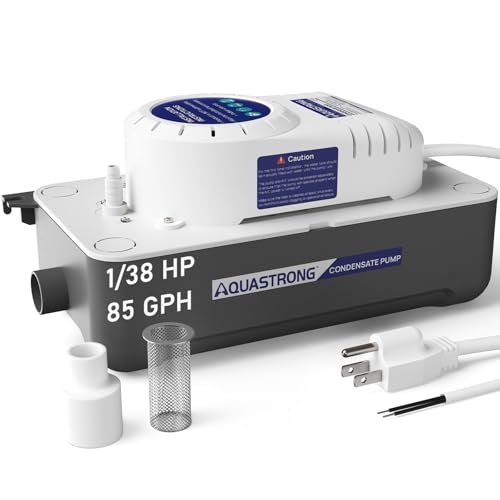
- Aquastrong 85 GPH: an alternative sold on Amazon whose listing claims 85 GPH, 20 ft of lift, a built-in safety switch and 115 V or 230 V operation. That 20 ft is likely a shut-off figure like the Little Giant's 15, not working lift. We haven't seen enough owner reports to rank it against the Little Giant, and its 3.3 ft cord is a little over half the length of the VCMA-15's.
- Aspen Silent+ Mini Orange: a different class of pump for a different job: a compact unit made to serve a mini-split head. It costs several times as much and is built for mini-splits, not furnaces. Buy it only when the drain problem is at a mini-split.
Our verdict on the VCMA-15
For a furnace, air handler or basement dehumidifier that needs its water lifted up to about 10 ft, the VCMA-15ULS is the pump we'd buy. The chart is honest once you read it, the overflow switch costs little, and replacement parts and whole pumps are easy to find. Plan around 10 ft, not 15. Hook up the switch so it can stop the equipment, put a cleaning and test on the calendar every six months, and expect a motor you can hear.
Score breakdown
Little Giant publishes 65 GPH at 1 ft, 50 at 5 ft and 25 at 10 ft, measured through the check valve, which is plenty for a furnace, air handler or basement dehumidifier. The 15 ft in the name is shut-off head, so plan on about 10 ft of rise. The half-gallon tank and three inlets suit multi-drain basement setups.
Installers vouch for these pumps lasting, and the failures owners describe are mostly preventable: sludge on the float or in the tank, clogged discharge tubing, a check valve that lets water drain back. Noise is the most common complaint. The warranty is 12 months, and the S version adds the overflow switch that limits the damage when a pump does fail.
It is inexpensive for a name-brand pump, and the safety-switch version costs only a little more than the bare UL. Several owners swapped their own, which saves a service call. Check the current price on Amazon.
Little Giant VCMA-15 Condensate Pump on Amazon.
The Evidence Behind Our Verdict
Owner reports come from r/hvacadvice threads about Little Giant condensate pumps. Most owners name the brand and post a photo rather than the model number, so we treat these as evidence about Little Giant standard tank pumps, of which the VCMA-15 is one. Commenters, including one who installs them, say they last and are easy to swap; owners complain about motor noise, and the failures they describe trace mostly to sludge, clogged tubing and leaking check valves.
Two owners call their pump loud, two describe check-valve drain-back, and four commenters point first to float and tank fouling. The cards below are limited to owners describing their own pumps; advice from installers and other commenters is summarized in the text.
Our rating above is our own editorial call. What follows is the field evidence we weighed to reach it: first-hand reports from owners on Reddit and independent HVAC and DIY forums, which we lean on more than manufacturer-influenced published reviews because unsponsored owners tend to be the more candid signal.
What Reddit Is Saying
“EDIT: I'm pretty sure contact was made between the wire(s) and the edge of the metal drain pan. EDIT: replaced 5A low-voltage blade fuse inside the handler and all is working again, thanks much y'all”
“Because of the house configuration, the condensate line runs vertically from the pump about 7 feet up and then about 8 feet horizontally to exit the house. It has never struggled with the length before. Now, however, it doesn’t seem able to push the vinegar mixture more than a foot vertically above the pump.”
“Think it’s just a worn motor. I cleaned check valve, replaced check valve, cleaned the underside of pump, checked hose for kink and ran some vinegar through system. Still the same.”
“Pump is brand new, as is the line. The pump does function. I can hear it, and I can see it expell the condensate water The line does stay full after pumping but I'll come back to check it and the line will be emptying so I think it's draining back and leaking out of the machine”
Frequently asked questions
Is the Little Giant VCMA-15 Condensate Pump worth it?
It is inexpensive for a name-brand pump, and the safety-switch version costs only a little more than the bare UL. Several owners swapped their own, which saves a service call. Check the current price on Amazon.
How reliable is the Little Giant VCMA-15 Condensate Pump?
Installers vouch for these pumps lasting, and the failures owners describe are mostly preventable: sludge on the float or in the tank, clogged discharge tubing, a check valve that lets water drain back. Noise is the most common complaint. The warranty is 12 months, and the S version adds the overflow switch that limits the damage when a pump does fail.
How well does the Little Giant VCMA-15 Condensate Pump perform?
Little Giant publishes 65 GPH at 1 ft, 50 at 5 ft and 25 at 10 ft, measured through the check valve, which is plenty for a furnace, air handler or basement dehumidifier. The 15 ft in the name is shut-off head, so plan on about 10 ft of rise. The half-gallon tank and three inlets suit multi-drain basement setups.
What do real owners say about the Little Giant VCMA-15 Condensate Pump?
Owner reports come from r/hvacadvice threads about Little Giant condensate pumps. Most owners name the brand and post a photo rather than the model number, so we treat these as evidence about Little Giant standard tank pumps, of which the VCMA-15 is one. Commenters, including one who installs them, say they last and are easy to swap; owners complain about motor noise, and the failures they describe trace mostly to sludge, clogged tubing and leaking check valves.

