Best Basement Dehumidifier: Real Pint Ratings, Drains and Pumps
By Ingrid Tamsett · Updated October 2026
Independent editorial guide. We never accept payment for coverage, though we may earn a commission if you purchase through our links.
Quick Take
For most basements, buy the Midea Cube 50 Pint and run its hose to a floor drain or sump. ENERGY STAR certifies it at 49.67 pints a day on the current 65°F DOE test, the same class as the Frigidaire and Honeywell 50-pint units, and it usually costs less than either. Set it to 45-50% and let it run.
Three situations change the answer. With no drain below the unit and no spare circuit for a separate pump, a built-in pump is the simpler setup; the Honeywell TPFIT50PWK's is rated for 15 feet, but its licensee is now out of business, so buy it for the pump, not the warranty. If the basement falls below 41°F in winter, every portable here is outside its rated range, and the AlorAir Sentinel HD55S, rated down to 33.8°F, is the one to buy. If water comes in after rain, no dehumidifier fixes that; extend the downspouts and check the grading first.
Our picks are matched to those situations, plus the condensate pump and hygrometer we would add to a pumpless unit. See picks ↓

Most damp basements need less machine than the marketing suggests and more thought about plumbing. A 50-pint portable rated on the current DOE test should hold a typical damp, not wet, basement under EPA's 60% humidity ceiling, provided it can run all day. It only runs all day if the water has somewhere to go. A unit that fills its bucket by lunchtime and shuts itself off isn't drying anything in the afternoon.
For most basements we'd buy the Midea Cube 50 Pint and run its hose to a floor drain or sump. Two things shaped our picks. Brands don't all rate pints the same way, so a box that says 70 can remove less water than one that says 50. And the claim that every cheap dehumidifier dies in two years doesn't match what most long-time owners describe. Most of these carry only a one-year warranty, though, so plan for the chance that yours dies early.
Fix the water before you size the machine
A dehumidifier pulls moisture out of air. It can't keep up with water running down a foundation wall. If you see puddles or a wet line on the floor after rain, start outside: downspouts that dump at the foundation and soil that slopes toward the house are the usual causes, and fixing them costs less than any machine on this page.
Buying bigger doesn't get you out of it. One owner put in a commercial AlorAir rated at 170 pints a day, oversized for the space by their own description, and still had a musty basement and a film of water on part of the floor, with the gutters emptying next to the foundation. Manufacturers say the same thing in their own way: Santa Fe's Compact70 manual tells you to deal with water intrusion and excessive outside air infiltration before you install the unit.
What a dehumidifier does well is the basement that's dry underfoot but sits at 65-80% humidity and smells musty by midsummer. One owner's basement ran 75-80% before a Midea brought it down to 40%; others sit near 80% with no leaks or cracks at all. That's the basement this guide is about.
Compare pint ratings at 65°F, not 80°F
DOE changed the dehumidifier test in June 2019 (compliance was required from June 13, 2019). Portable units are now rated at 65°F and 60% relative humidity instead of 80°F, and whole-home units at 73°F. ENERGY STAR explains that cooler air holds less water, so the same machine will likely report a smaller capacity on the new test. Its rough conversion table maps an old 50 to about 30 pints a day, an old 55 to 30-35, and an old 70 to 40-45, with a warning that the actual change varies by model.
Here is what each brand publishes, next to the current-test figure where one exists:
Unit | Rating on the box or spec sheet | Pints/day at 65°F (current DOE test) |
|---|---|---|
Midea Cube 50 | 50 pint | 49.67 per ENERGY STAR, non-pump and pump versions |
Frigidaire FHDD5034Y1 | 50 pints, no test condition given | 49.71 per ENERGY STAR |
Honeywell TPFIT50PWK | 70 pints, labeled "2019 DOE Standard" in Honeywell's spec table | 49.66 per ENERGY STAR |
hOmeLabs 50 Pint | 50 pints at 80°F and 60% RH (the old condition) | None published; we couldn't find the 50-pint models in ENERGY STAR's certified list |
Santa Fe Compact70 | 70 pints at 80°F | 43.7 per Santa Fe |
AlorAir Sentinel HD55S | 55 pints at 80°F; 120 at saturation (90°F, 90% RH) | 36.33 per ENERGY STAR |
AprilAire E070 | 70 pints at 80°F | None published |
Honeywell's label has it backwards: the 2019 test produces the lower number. Put everything on the same footing and the order changes. The Santa Fe's "70" is 43.7 pints at 65°F, about 6 pints a day, or 12%, less than the Frigidaire "50" at 49.71. The AlorAir HD55S, sold under 55- and 120-pint numbers, comes to 36.33, about 27% below the Cube's 49.67. If the hOmeLabs lands where ENERGY STAR's table puts an old 50, around 30 pints, it removes roughly 40% less water a day than a current-test 50. The Santa Fe and AlorAir earn their price in other ways, covered below; at 65°F, raw capacity isn't one of them. AprilAire publishes only an 80°F rating for the E070, so it can't go on the same footing.
The numbers hide one more thing: a basement colder than 65°F gets less than the rating from any of these machines. Santa Fe's manual says the Compact70 removes little to no water at 55°F or below, and Frigidaire publishes no capacity below the test point. If your basement sits in the 50s in spring, expect less than the label.
When a 50-pint portable is enough, and when to step up
A current-test 50-pint portable is the right size for most basements that stay above 41°F all year, are damp rather than wet, and have a drain within reach. The Midea Cube, the Frigidaire 50 Pint with Wi-Fi and the Honeywell TPFIT50PWK all list 41°F as the bottom of their operating range. Skip the 20- and 35-pint sizes for a whole basement. One owner fought constant wet-floor problems in a utility room with a small unit for a couple of years, then moved to a 50-pint unit on a floor drain and got the room from 50-60% down to 40%. Ignore the square-footage claims on the boxes, too. The Cube claims 4,500 square feet, the hOmeLabs 7,000 and the Honeywell 4,000, and the hOmeLabs, rated on the old test, is likely the smallest machine of the three.
Step up from a portable in these cases:
- The basement drops below 41°F in winter. The portables are out of their rated range, and coils can frost. The AlorAir Sentinel HD55S is rated to run from 33.8°F with auto defrost. Don't assume a pricier unit handles cold better: the Santa Fe Compact70's floor is 49°F and the AprilAire E070's is 50°F.
- You want five years of coverage on a unit you will run for a decade. The Santa Fe Compact70 warranty covers defects for 5 years and components for 6, with Santa Fe choosing whether to send a part or a new unit. The AprilAire E070 manual gives 5 years. Neither covers labor.
- You want dry air sent to finished rooms. The Compact70 and E070 take 8-inch duct collars, so they can be ducted. Portables only dry the air around them.
- A 50-pint unit runs nonstop and still cannot get under 60%, after the water is fixed. That's the point to look at a bigger unit. Fresh drywall and paint add a lot of moisture, so judge a newly finished basement after the construction moisture has dried out.
Those dedicated units cost several times as much as a portable, and for the two that publish a 65°F number, the Santa Fe and the AlorAir, the pint math above shows the extra money doesn't buy more water removal (AprilAire publishes only an 80°F rating for the E070). It buys a longer warranty, a filter that matters (Santa Fe ties its warranty to running a MERV-8, MERV-11 or MERV-13 filter), ducting options and, in AlorAir's case, cold-weather operation. For a moderately damp basement above 41°F, we'd buy the portable.
Gravity drain, built-in pump or a separate pump
The tank is the weak point. The Frigidaire FHDD5034Y1 has a 2.7-gallon bucket, or 21.6 pints. At its rated 49.71 pints a day, that fills in about 10 hours. One owner in a hot, humid area pulls almost 2 gallons every 8 hours, about 6 gallons a day. Nobody empties a bucket that often for long, and a full bucket stops the machine.
Use gravity first. If there's a floor drain, a sump pit or a laundry standpipe lower than the unit's drain port, run a hose to it. Frigidaire's manual asks for a 1/2-inch or larger hose with no kinks or rises; hOmeLabs warns that hoses longer than 5 feet may not drain properly; AlorAir's manual wants at least a 1-inch drop per 10 feet. Keep it short and downhill. If the drain is across the room, move the dehumidifier to the drain instead of the other way around. In an open basement the air mixes, a fan helps it along, and that move costs nothing, so try it before you spend money on a pump.
Draining into the sump pit is fine. Owners do it for years without trouble, one of them for 35, and a 50-pint day is 6.25 gallons, which barely moves the water level in a pit. A waste drain is a little better, since water in an open pit can evaporate back into the room, so if you have a standpipe or a floor drain handy, use it. A sump is still a perfectly good outlet.
No drain below the unit? Then the water has to be pumped, and you have two choices.
- A built-in pump. The Honeywell TPFIT50PWK's product page rates its pump at 15 feet (the manual says 16.4), the Cube's pump version is rated at 14 feet, and Frigidaire's FHDP5033Y1 at 16.4 feet. Owners with built-in pumps mostly report them working, one for about 12 years. The downside is serviceability: when an internal pump fails, the whole dehumidifier goes in for repair or gets replaced. One owner expects the pump to fail within a year and buys the extended warranty for that reason.
- A separate condensate pump under a pumpless unit. The Little Giant VCMA-15ULS is rated at 50 gallons an hour at 5 feet of lift and 25 at 10 feet. The "15" in the name is its shut-off head, where flow stops, so plan on 10 feet of rise. At 25 gallons an hour it moves a full 50-pint day of water in about 15 minutes. If it fails, you replace the pump and keep the dehumidifier.
We like the separate pump better, but it isn't plug-and-forget either. Little Giant wants the pump on its own circuit, with nothing else on it, so it can't share the outlet your dehumidifier uses. Its overflow switch is built to break a control circuit on high water. A plug-in dehumidifier usually has no control circuit for it to shut off, so plan on connecting it to an alarm (sold separately). If there's no spare circuit near the drain, that's a job for a licensed electrician. If you'd need new wiring, a built-in pump saves you that job; the Honeywell TPFIT50PWK is one option, bought for the pump and not the warranty, for reasons below. If you have a free circuit, a pumpless Cube or Frigidaire plus a Little Giant is the setup we'd rather own.
Whatever drains it, check the line now and then. Drain lines crud up or sag to a bad angle and clog, and one owner only caught it because the humidity changed. The hOmeLabs manual also warns against running its pump when it's 32°F or colder outside, because the water freezes, so don't route a pump hose out a window for the winter.
Set it to 45-50% and check it across the room
Start at 50% and drop to 45% if the musty smell hangs on. EPA's mold guidance says to keep indoor humidity below 60%, ideally between 30% and 50%, and its indoor air guide gives the same 30-50% range. DOE's Building America guide to closing crawlspaces uses 30-50% too, for crawlspaces specifically. Santa Fe's dial marks 45-55% as its recommended setting, and the compact Frigidaire FHDD5033Y1's Auto mode holds 45-55% on its own. Owners who give a number mostly run theirs at 45% or 50%.
Going lower costs money. One owner says holding 40% added about $50 a month to their electric bill and plans to try 45-50%. Others settle at 55% because anything lower made the unit run much more often and heated the basement, and some call theirs a hog on electricity. For scale: the Frigidaire is rated at 470 watts, so 24 hours of nonstop running uses about 11.3 kWh. Multiply that by your electric rate for the worst case; a unit that reaches its setpoint and cycles off uses less. The Cube and Honeywell share the same 2.01 rating, and the Santa Fe's 1.96 at 65°F is no better.
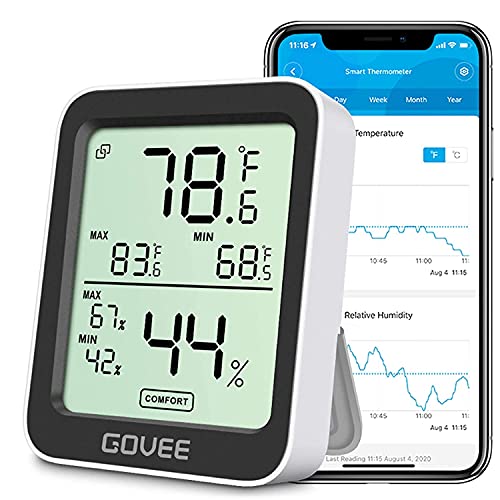
Check the reading somewhere other than the dehumidifier. Its humidistat reads the air around the unit, which is the driest air in the room. EPA notes that a small, inexpensive humidity meter will measure it, and one that also reads temperature, such as the Govee H5075 hygrometer, tells you whether the basement stays above 41°F in winter. One owner's unit read true against a separate sensor; you won't know about yours until you check.
How long they last, and what the warranty covers
The story that every big-box dehumidifier dies in two or three years is louder than the evidence. Twelve owners describe a consumer portable running five years or longer: a Frigidaire on a gravity drain at five years, a GE at eight, a unit with a built-in pump that lasted about 12. Five more had units or pumps fail inside about three years, one of them after going through about four Frigidaire, GE and other units that lasted around 13 months each. Some of that tilt comes from people answering a question about units that had survived three summers, so read it with care. Five years is a realistic hope, not a guarantee, and the one-year warranty on most of these won't cover you if yours is the exception.
Before you call a unit dead, check the filters. As one owner with two units at six years puts it, many of these machines have small hidden filters that clog and stop the unit until they're cleaned, and dust packed into the coils makes a unit run hot and its drain clog. Clean the filters on the schedule in your manual. Santa Fe's manual, for one, warns that running with a dirty filter reduces capacity and efficiency.
There's less to go on for premium units. One Santa Fe Compact70 owner got 6.5 years from their last one and bought another, while a different Santa Fe is dead after a refrigerant leak. An AprilAire 1820 has run five years in a crawl space with only filter cleaning, and an AlorAir commercial model has run about 2.5 years without problems for an owner who gave up on cheap units. That's not enough to prove dedicated units outlast portables. What they do carry is a longer warranty, and that's the clearest thing extra money buys:
Unit | Warranty | Fine print |
|---|---|---|
Frigidaire, Midea Cube and hOmeLabs 50-pint | One year | |
Honeywell TPFIT | Everything for one year; sealed-system parts (compressor, evaporator, condenser, refrigerant tubing) for four | Original purchaser of a unit bought new from an authorized seller. The licensee behind it says it's out of business; claims now go through a Honeywell Store form. |
AlorAir Sentinel HD55 line | Two years full coverage, then refrigeration-system parts only through year six | Orders from May 14, 2026, with purchases back to April 14 also covered. No labor, return shipping on you after six months, no in-home service; bought from AlorAir or an authorized dealer. No owner track record for this model yet. |
Santa Fe Compact70 | 5 years on defects, 6 on components | Santa Fe's choice of part or product; labor excluded |
AprilAire E070 | 5 years in the manual | Labor excluded |
On paper the Honeywell stands out, because it puts the expensive failure, the compressor, under four years of coverage at a portable price; its pump isn't part of the sealed system, so the pump gets the one-year term. We wouldn't pay extra for that coverage. No owner report names a TPFIT model yet, and owners of earlier Honeywell portables describe the same warrantor pushing back on claims. That licensee now says it's out of business. Claims go through a Honeywell Store form whose terms exclude unauthorized sellers, the featured Amazon offer comes from a third-party seller we can't confirm is authorized, and the unit is sold out on Honeywell's own site. Our Honeywell TPFIT review has the details. As for the hOmeLabs 50 Pint, it has an old-test rating and thin owner evidence on the current models; we'd buy it only when a sale puts it well under the Cube or you need more than the Cube pump model's 14 feet of lift.
Noise and placement in a finished basement
Put it in the utility area near the drain, not in a bedroom, and leave the door open so air can move between rooms. Frigidaire's manual asks for at least 12 inches of clearance around the FHDD5034Y1 and says not to run it in an enclosed small space like a closet. Expect the room it's in to run warmer: a dehumidifier turns the electricity it uses into heat.
Noise figures are patchy. Frigidaire publishes 47, 49 and 51 dBA by fan speed for the FHDD5034Y1. Honeywell gives only a 51 dBA minimum for the TPFIT50PWK. Santa Fe lists the Compact70 at 55 dBA average, and AlorAir puts the HD55S under 52 on its spec sheet. Midea doesn't publish a noise figure for the US Cube. Some owners find theirs loud enough to switch off while they watch TV in the basement. A single Cube owner calls it quieter than any model they'd seen.
Where we would spend the money
- Damp basement above 41°F, floor drain or sump nearby: the Midea Cube 50 on a hose. If the Frigidaire FHDD5034Y1 is priced at or below the Cube when you shop, it's an equal choice with published noise figures, though its 2.7-gallon bucket is smaller than the Cube's (the Cube's Amazon listing says 4.2 gallons, and Midea's older Canadian sheet gives 16 liters; Midea's US documents don't state it).
- No drain and no spare circuit: a built-in pump such as the Honeywell TPFIT50PWK's, bought for the pump rather than a warranty whose licensee is out of business.
- No drain, but a spare circuit: a pumpless unit plus a Little Giant VCMA-15ULS.
- A basement that dips under 41°F: the AlorAir HD55S.
- A long-haul unit you might duct into finished space: the Santa Fe Compact70 or AprilAire E070, after the water problem is solved and knowing the extra money buys warranty and build. The Santa Fe's pints at 65°F are no higher, and AprilAire publishes only an 80°F figure.
The picks
Products we recommend for this guide.

Midea Cube 50 Pint Dehumidifier
Our default for a damp basement that stays above 41°F: ENERGY STAR certified at 49.67 pints/day on the 65°F DOE test and usually cheaper than the Frigidaire. This listing has no pump, so plan a hose to a floor drain or sump.
Read our full review: we scored it 7.0/10

Honeywell 50-Pint Dehumidifier with Pump (TPFIT50PWK)
For a basement with no drain and no spare circuit: 49.66 pints/day at 65°F and a built-in pump (plan on 15 ft). Buy it for the pump, not the warranty: the licensee is out of business and the Amazon seller may not be authorized.
Read our full review: we scored it 5.3/10

Frigidaire 50 Pint Dehumidifier with Wi-Fi (FHDD5034Y1)
The Cube’s closest rival: 49.71 pints/day at 65°F, a 2.7-gallon bucket and published 47-51 dBA noise. Buy it when it’s priced at or below the Cube. No pump, and Frigidaire’s warranty is one year, parts and labor.
Read our full review: we scored it 6.4/10

AlorAir Sentinel HD55S Dehumidifier
For a basement that drops below the portables’ 41°F floor in winter: rated to run from 33.8°F with auto defrost. ENERGY STAR lists 36.33 pints/day at 65°F, well under the 55 on the box. Gravity drain only.
Read our full review: we scored it 7.0/10

Little Giant VCMA-15ULS Condensate Pump
Puts a pumpless Cube or Frigidaire on an uphill drain: 25 GPH at 10 ft of lift. It wants its own circuit, and a plug-in dehumidifier usually has no control circuit for its overflow switch to shut off, so add an alarm (sold separately).
Read our full review: we scored it 7.3/10
What owners say
Real owner reports from the threads and editorial sources we drew on for this guide.
“i got a professional grade dehumidifier but my basement still smells. (ALORAIR 170 PPD and it is oversized for my basement)”
“Midea cube here for 3-4 years so far. No issues.”
“I've had a Frigidaire for 5 years now, no issues. No integrated pump, just gravity drained. FFAD5033W1 is the model”
“Depends how hard it’s working. My house is very air tight so mine work a lot, but longest big box dehumidifier lasted 2.5 years.”
“The hosense units seem to be the best. I have had 2 units running for 6 years. FYI, most of these dehumidifiers have small hidden filters that need to be cleaned in order to make unit function again. They get plugged. The failures that you see could be just a dirty filter.”
“Don't buy a Santa Fe, they're not the same. I now own a $1,500 brick because it leaked Freon.”
“Buy the biggest one with a pump to pump the water to a drain. BUY THE EXTENDED WARRANTY!!!! when the pump fails in a year, it will. Return to get a new dehumidifier and spend the $20 bucks on new extended warranty. Rinse and repeat pretty much yearly.”
“I’d suggest buying a normal dehumidifier and then connecting a piece of 1/2” clear vinyl tubing between the dehumidifier and a condensate pump. Then run a longer piece of tubing from the pump to your floor drain. I set up this arrangement years ago and it works great.”


