Best Mini-Split Stand: Height for Snow and What It Sits On
By Cal Dunwoody · Updated October 2026
Independent editorial guide. We never accept payment for coverage, though we may earn a commission if you purchase through our links.
Quick Take
Buy a stand that lifts the bottom of the outdoor unit above your deepest normal snow, plus 8 inches, and set it on concrete. For most snow-belt houses that's an 18-inch stand, and the DiversiTech QSMS1801 is the one we'd buy: 400 lb rating, adjustable feet and rubber isolators in the box. Go to 24 inches on a north wall, beside a fence or anywhere drifts pile up. Where snow rarely tops a few inches, a 12- to 16-inch stand is plenty.
Load rating is rarely the limit; DIY outdoor units weigh roughly 52 to 152 pounds. Fit is. Check that your unit's foot-bolt spacing falls inside the stand's mounting range before you order, and put the stand in before the line set is connected, because moving a connected unit later is installer work.
Our picks run from a 12-inch trade stand for light snow to a 24-inch stand for drift country, with a budget option and a tall, inexpensive one in between. See picks ↓
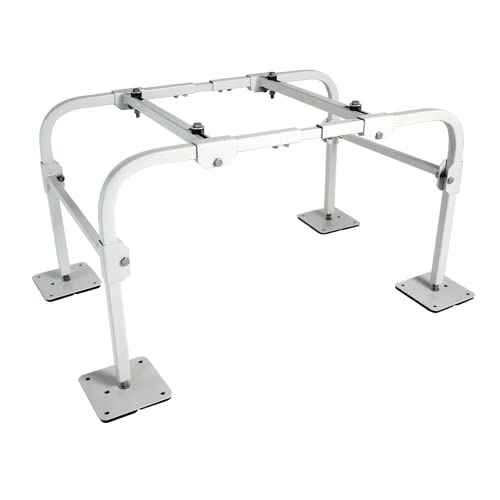
A mini-split's outdoor unit has to breathe and drain all winter. In heating mode it pulls heat out of cold air, frosts its coil, then melts the frost with defrost cycles that dump water out of the base. If snow buries it, it can't move air; if the meltwater has nowhere to go, it freezes into a mound that climbs back into the coil. A stand fixes both by lifting the unit into open air with a clear drop underneath.
Our wall bracket guide covers the choice between a bracket, a pad and a stand. This one assumes you've picked a stand, which is what we'd pick for most houses with snow and no masonry wall, and answers the next questions: how tall, which one fits, and what it sits on. Our short answer: size it by Mitsubishi's rule of snow depth plus 8 inches, which puts most snow-belt houses on an 18 inch stand and north walls or drift-prone spots on a 24, set it on concrete, and check the unit's foot-bolt spacing before you order.
How tall: your snow depth plus 8 inches
The DIY manuals don't give a number. Della's says to install the unit above the seasonal snow level, MrCool's says to build a shelter over a unit exposed to heavy snow, and LG's winter install sheet says to use a stand higher than the maximum snowfall you expect and above possible drifts. Mitsubishi Electric is the exception, with a formula in its cold-climate install sheet: the stand's height should be the highest snowfall depth plus 8 inches.
We think that's the right rule, and it turns stand heights into something you can check against your own winters:
Stand height (nominal) | Snow it handles by the snow-plus-8 rule | Where we'd use it |
|---|---|---|
12 in | About 4 in | Light, occasional snow; mid-Atlantic and similar |
16-18 in | About 8-10 in | Most of the snow belt, open ground |
24 in | About 16 in | North walls, lake-effect areas, beside fences or anywhere drifts form |
That's our arithmetic from nominal heights; DiversiTech's drawings put its stands about an inch taller overall, and the feet adjust up another 1.25 inches. Use the snow you see in a normal winter, not the record. Then add for drifts: snow piles against houses, fences and corners, and a unit tucked beside a wall on the north side sees more of it than the yard does. Owners in Maine and Colorado settle on 18 inches, and one owner went to 24 specifically because the unit sits on the north side of the house.
You'll hear that 6 inches off the pad is enough because the unit melts the snow around itself. The coil may stay clear on a mild day, but meltwater still has to get out from under the unit, and that's what height buys. A stand also keeps the coil above lawn-mower debris, flooding and the defrost ice that builds up under a unit sitting low.
Load ratings are easy; fit is where stands go wrong
Every stand in our picks is rated at 400 to 440 lb, against DIY outdoor units that weigh about 52 to 152 pounds. The manuals' four-times-weight rule is written mainly for walls, though Klimaire also applies it to the surface the unit sits on. Hold a 400 lb stand to it anyway and it covers units up to 100 lb: every 9,000-18,000 BTU unit in our bracket guide's weight table plus the Pioneer and Della 24K, but not the Klimaire or MrCool 24k or MrCool's 36k. A ground stand carries the unit straight down instead of cantilevering it off a wall, so we treat the maker's rating as the number to check; with a 24k or bigger unit, it's one more reason to set the stand on concrete and anchor it. What decides whether a stand works is where its rails land under your unit's feet.
Stand | Height | Load rating | Unit mounting range | Source |
|---|---|---|---|---|
DiversiTech QSMS1801 (wide) | 18 in nominal; feet adjust 1.25 in | 400 lb | Mounting-hole depth 11-1/2 to 17-1/8 in | DiversiTech |
DiversiTech QSMS2401 (wide) | 24 in nominal; feet adjust 1.25 in | 400 lb | Mounting-hole depth 11-1/2 to 17-1/8 in | DiversiTech |
VIVO STAND-MSAC1 | 11.8-15.7 in adjustment range | 440 lb | Length 9.25-29 in, width 9.25-15 in | VIVO |
Eastrexon (9,000-24,000 BTU) | Raises the unit 16.2-21.4 in | 400 lb | Length 4.7-27 in, width 6.5-16 in | Amazon listing only |
DiversiTech QSMS1201 (wide) | 12 in nominal; feet adjust 1.25 in | 400 lb | Mounting-hole depth 11-1/2 to 17-1/8 in | DiversiTech |
Find the foot-bolt spacing on your outdoor unit's dimension drawing in the install manual, front to back and side to side, and make sure both fall inside the stand's range. DiversiTech sells each Quick-Sling height in thin, wide and extra-wide versions for this reason, and its online product selector doesn't include MrCool, Pioneer, Senville, Della or Klimaire, so DIY owners have to match the numbers themselves. A dual-fan outdoor unit needs DiversiTech's dual-fan stands, the models ending in 02, not the single-fan ones here.
The Quick-Sling is what installers in snow country tend to use, and owners who chose it over a cheaper stand describe it as beefy. One owner with a 4-to-5-ton unit passed on a cheaper stand because no professional installs used it. If your snow is light and your unit small, the budget stands are a reasonable trade.
What goes under the stand
Put a stand on concrete. DiversiTech lists its stands for a roof or a concrete pad, and its own guidance is that a pad under a stand gives a more stable, level base, that a stand on soft ground can drift out of level, and that in high wind the unit should be anchored to concrete. RectorSeal's instructions for its condenser stand say to attach it with anchor bolts and secure it for wind, and VIVO ships concrete anchors in the box. MrCool's ground-mount steps call for four expansion bolts into the ground or a concrete platform.
- A poured or precast concrete pad: the best base. It stays level, takes anchors, and doesn't creep.
- Patio pavers or flagstones on compacted gravel: work for plenty of owners, as long as the base is firm and level; anchoring into them is less certain.
- A plastic equipment pad: fine for a unit set directly on it where snow isn't an issue, but a poor base for a stand: you can't anchor a stand into it properly, and owners see plastic pads settle out of level over a few years.
- Wood: owners build stands and platforms from 4x4s and strut, and they work. We'd still put rubber between the unit and the frame, keep the frame open underneath, and set the posts on concrete.
The DiversiTech drawings carry a note worth reading twice: the installer is responsible for tethering and bolting the unit to withstand wind and seismic loads. Its instruction sheet doesn't include an anchoring step, so plan that part yourself or with your installer. We don't give anchor-installation steps; the anchor type depends on your concrete.
Open frames drain; solid platforms ice up
Defrost water comes out of the bottom of the unit all winter, and it needs to fall straight through to the ground. Mitsubishi's sheet says to use a steel-framework stand that lets water drain, and that the stand's base must not be wider than the unit, because water freezes on any part of the stand top it lands on. That rules out a solid platform, a plank deck or a plastic pad laid on top of the rails. It's the same problem our defrost mode guide describes with plastic pads on the ground: water that can't get away refreezes into a mound under the unit.
- Keep it off walkways: Mitsubishi and LG both warn that defrost water freezes into a slip hazard on sidewalks and driveways.
- Drain hose, if any, straight down: Senville's and Pioneer's manuals say a cold-climate drain hose should run as vertically as possible so it doesn't freeze; Pioneer's adds that the drain joint isn't needed on a slab, and MrCool's says units with a multi-hole base pan don't need it.
- Clear the top: LG says to brush snow off the top of the unit once it reaches 4 inches.
- Watch the roof line: a unit under a roof edge gets ice and snow sliding onto it; MrCool says to build a shelter that does not block airflow.
Why a stand beats a wall bracket for most houses
A wall bracket gets the unit up just as well, and it's cheaper. The catch is noise: an inverter compressor ramping up and down carries through a wood-frame wall, and owners who've lived with both say the ground-mounted unit is the one they can't hear. That's why our bracket guide sends wood-frame walls and bedroom walls to the ground first, and keeps brackets for solid masonry or for heights a stand can't reach. If your HOA or your yard rules out a stand, a small concrete patio you can shovel around is the fallback some owners use.
Setting the unit on the stand
Order matters. The base goes in first, then the stand, leveled and anchored, then the unit is set on the rails and bolted down through rubber isolators, and only then are the lines connected. DiversiTech's kit includes four 3/8 x 1 inch rubber isolators for the bolts between the unit and the rails; VIVO's manual lists no rubber pads, so plan on the isolators your unit's manual allows. LG's winter instructions say to bolt all four corners of the unit to its base.
If you're installing a pre-charged quick-connect system yourself, the stand is part of that job: set it before the line set is connected, so you're never lifting a unit with copper attached. MrCool's manual says that disconnecting and reconnecting its refrigerant couplings "could cause it to leak" and will void the warranty, and that relocating a unit is a job for experienced service technicians. On a flare install, your installer sets the unit; buy the stand ahead and have it in place when they arrive. If you have kids or a dog that climbs, a strap or brace from the top of the unit to something solid is cheap insurance.
Which stand we'd buy
- Most snow-belt homes: the DiversiTech QSMS1801, 18 inches, on a concrete pad.
- North walls, lake-effect snow, drifts: the DiversiTech QSMS2401, 24 inches.
- Light snow, small budget: the VIVO STAND-MSAC1, with its concrete anchors and 3-year warranty.
- Taller on a budget: the Eastrexon, whose listing claims 16.2-21.4 inches and 400 lb; there's no maker spec sheet behind it.
- Light snow, the installer-grade build: the DiversiTech QSMS1201, the same 400 lb Quick-Sling at 12 inches.
Still choosing the unit itself? Our cold-climate mini-split guide covers the units that keep heating when the snow arrives.
The picks
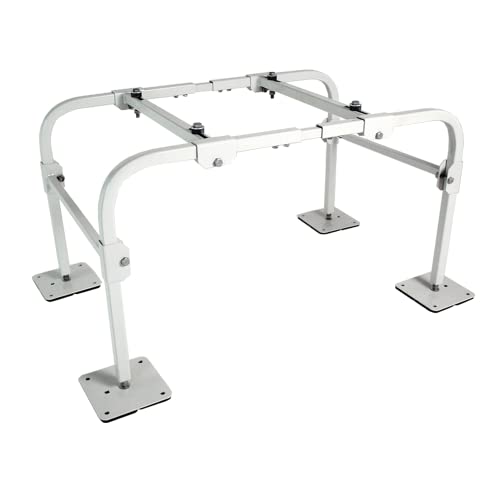
Products we recommend for this guide.


What owners say
Real owner reports from the threads and editorial sources we drew on for this guide.
“Also in Maine. I've had several installed and looked at several installations because I'm "that" guy before I spend money on something. Every single one was on this 18 inch bracket. I shovelled one unit out the first year due to a drift, but that's more because there was a fence to catch the snow and still I probably didn't need to do it.”
“I have a 24" one, specifically requested that instead of 18" because it's on the north side of the house. Only one snowfall so far but it looks like it would handle the worst snowfalls I've seen easily.”
“Suffolk county NY here, 12" diversitech quick-slings on 2 of my condensers (30k btu multis hyperheats) worked fine in open area.”
“When I was shopping staff options I seriously considered the stand you posted... But I didn't see any "pro" installs using it and I was worried that the build quality would be inferior so I bit the bullet on a Quicksling. It is definitely beefy.”
“I put 2x 3 ton Senvilles (virtually the same unit) on virtually the same stand (Senville branded). These were installed on flagstones on compacted dirt. Don't use a wall mount. They're fine mechanically, but transmit noise into the house. As long as that stand is the same one I have (I'm assuming they are both Midea), it's a pretty tough unit. It's held up for 2 years now, with ample snow and ice. One of the units got absolutely buried in freezing ice/rain from an overflowing gutter, and held up just fine.”
“I put a 3 ton mr cool condenser on that same stand. Bolted directly into concrete pad. Added some rubber pads between the unit and the stand. Also have a brace made from 1/2 steel tubing that's screwed to the top of the unit to prevent it from falling over if pushed or climbed on. Installed 9 months now, no issues. Can't hear it from inside unless the windows are open.”
“I made a stand out of rough cut white oak 4x4s. I do wish I had used rubber between the stand and the unit. Even with all the mass of the stand and the base, a tiny bit of vibration comes through, or maybe coming through the lineset.”
“You're better off with a stand/rack than a wall mount. I can hear the condenser ramping up and down with our wall-mounted one in our insulated garage. It's mounted about 2.5 feet off the ground in Alberta.”
“I get lake effect but I also wanted to put a trash can under my unit so about 48" off the ground right to the block wall. IMO ground mount is better (no noise) but it's more expensive.”
“HOA bylaws prevent stands. I have 2 mini splits - one for partially finished basement and one for a 2-story shop. I effectively installed a small patio for the condensers so I can fairly easily shovel snow from around them.”
“My minisplit is 36 inches above grade on a home built wooden platform supported on 4x4 posts which are on concrete blocks in gravel. Works fine.”
“Still too close to the house and too low. Raise it up to the siding. 6 inches of snow and wind and drifting snow can exceed 2 ft' around the unit. I already learned this the first year I installed mine.”


