Best Cold-Climate Mini-Split: Real Heat at 5°F and Below Zero
By Wendell Asaro · Updated October 2026
Independent editorial guide. We never accept payment for coverage, though we may earn a commission if you purchase through our links.
Quick Take
For most people heating through winters that reach 5°F or colder, we'd buy the Senville Aura 12k and pay a licensed contractor to install it. NEEP's cold-climate list certifies the current R-454B 12k at 11,500 BTU/h at 5°F, 96% of its 12,000 BTU/h rating at 47°F, and Senville publishes heat down to -22°F. No other unit in our picks keeps that much of its rating at 5°F. The Amazon listing we link (SENA-12HF-16) carries an efficiency figure that matches the older R-410A Aura, which NEEP rates at 12,000 BTU/h at 5°F, so confirm the model and refrigerant before you pay.
Two catches. Senville's warranty requires a licensed HVAC install, and the Aura is a vacuum install, so if you plan to do the work yourself, buy the MrCool DIY 5th Gen instead and accept 8,400 BTU/h at 5°F and a -13°F floor on the 12k. And no single unit sized for your 5°F load carries the -22°F night alone: size to the 5°F number, then plan backup heat for the hours below it.
Our pro-install pick, the two quick-connect units we'd install ourselves, a cheaper flare unit for winters that stay above zero, and the bracket that lifts the condenser over the snow are below. See picks ↓

Buy a cold-climate mini-split by its 5°F number, never by the number on the box. Two units can both carry a 12,000 BTU label, both sit on NEEP's cold-climate heat pump list, and still behave nothing alike in January. One keeps 96% of its rated heat on a 5°F night and publishes output down to -22°F. The other keeps 55% at 5°F and stops publishing data right there. The box number can't separate them, because it's measured at 47°F.
So we ranked the units we've reviewed by what NEEP's AHRI-sourced listings say they make at 17°F, 5°F, -13°F and -22°F, and then checked who's allowed to install each one. The Senville Aura came out on top for most cold-climate buyers: among the best 5°F retention you can order on Amazon, a heating floor of -22°F, and, when we checked, a price about the same as or below the quick-connect DIY units it beats in the cold. MrCool's Olympus E Star carries the same published ratings, value for value, but we didn't find the current version on Amazon.
The install is where this category gets hard. The units that hold the most heat at 5°F and below are vacuum-and-flare systems whose warranties expect a contractor. The units built for owner installs give up heat below zero, and one of the two has warranty paperwork that contradicts itself. Below, we place each one, size a real room against the numbers, and put the backup heat in watts.
Why the box number misleads in January
Nameplate heating capacity is a 47°F rating. As the outdoor air gets colder, a heat pump has less heat to pull from it, and output falls. For a cold climate, compare the figures at 17°F and 5°F, and below zero if your town goes there.
We take those figures from NEEP's cold-climate air-source heat pump list, which carries the AHRI-certified ratings for each matched indoor and outdoor pair. At 17°F and 5°F, NEEP lists a rated figure and a maximum, and we quote them as NEEP labels them. Below that, at -13°F or -22°F, NEEP publishes a maximum only. Where a manufacturer's own sheet disagrees, we go with the certified listing and say so. Klimaire's spec sheet prints 11,000 BTU/h at 17°F for its DIY 18K, against NEEP's 15,000, and MrCool's submittal for the Olympus 12k prints 9,800 BTU/h at 17°F, against NEEP's 12,000. Both sources agree on the Olympus at 5°F, which is one more reason we size at 5°F.
Two labels get confused here. ENERGY STAR's cold-climate criteria for a ductless split call for at least 70% of the 47°F heating capacity at 5°F, a COP of at least 1.75 at 5°F, and an HSPF2 of at least 8.5. NEEP's specification (version 4.0) asks for the 1.75 COP at 5°F at maximum capacity but has no capacity-retention requirement for mini-splits; the 70% rule is ENERGY STAR's. NEEP also says the specification targets IECC climate zone 4 and colder, and that meeting it doesn't mean a unit suits every application. So a NEEP listing alone tells you little. The 115V Senville Leto 12k is on the list and makes 6,600 BTU/h at 5°F, 55% of its rating.
Then check how cold the published data goes. The Aura and the Olympus E Star publish to -22°F. The MrCool DIY 5th Gen, the Klimaire DIY 5th Gen (9K through 24K) and Gree's Livo R32 stop at -13°F. The current Pioneer Diamante Pro stops at -4°F. The Senville Leto, Della Serena and Cooper & Hunter MIA stop at 5°F. Below a unit's floor, you're relying on whatever backup you planned.
The cold-climate field, by the numbers
The 12,000 BTU class, side by side. The 47°F figure is the rating; the rest are NEEP's.
12K unit | 47°F | 17°F | 5°F (share of 47°F) | Coldest published point | Install |
|---|---|---|---|---|---|
Senville Aura 12k (current R-454B, 208/230V) | 12,000 | 12,000 rated | 11,500 (96%) | 5,900 maximum at -22°F | Vacuum; warranty needs a licensed contractor |
MrCool Olympus E Star 4th Gen 12k (R-454B) | Same as the Aura 12k | Same | Same | Same | MrCool says an HVAC professional must install it; current version not found on Amazon |
Klimaire DIY 5th Gen 12K (115V) | 12,400 | 10,000 | 8,900 (72%) | 6,680 maximum at -13°F | Pre-charged quick-connect |
Pioneer Diamante Pro 12K (230V) | 12,000 | 10,000 | 9,000 rated (75%) | 6,800 maximum at -4°F, where heating ends | Flare; not ENERGY STAR |
MrCool DIY 5th Gen 12K (115V) | 12,000 | 8,500 | 8,400 (70%) | 3,800 maximum at -13°F | Pre-charged quick-connect |
Senville Leto 12k | No figure | No figure | 6,600 on 115V, 8,000 on 230V | Senville says it is designed to heat down to 5°F | A mild-winter unit |
The Aura posts 25.4 SEER2 per Senville and 10.5 HSPF2 per NEEP. The older R-410A Aura 12k that our Amazon link matches is rated 12,000 at 5°F and 10,000 at 17°F. The Leto is covered in our Aura vs Leto comparison.
Move up a size and the order changes below zero. On the 18K, the MrCool DIY 5th Gen makes 12,800 BTU/h at 5°F and holds a 12,200 maximum at -13°F, while the Klimaire DIY 5th Gen 18K makes more at 5°F (13,600) and less at -13°F (9,000). On the 24K it flips back: NEEP lists the Klimaire at 18,600 BTU/h rated at 5°F and a 17,000 maximum at -13°F, against MrCool's 16,100 and 10,100, and NEEP's listing shows the MrCool 24K without ENERGY STAR's cold-climate flag. The Aura 18k makes 18,000 at 5°F with an 8,000 maximum at -22°F, and the Aura 24k 24,200 at 5°F with an 11,900 maximum at -22°F.
Gree's premium Sapphire R32 24K lists 24,000 BTU/h at 5°F and a 17,000 maximum at -22°F, the strongest deep-cold number in our coverage at that size, and the Gree Livo R32 30K lists 23,000 at 5°F and a 16,900 maximum at -13°F. Both carry a warranty that applies only to a state certified or licensed HVAC contractor's install, and both Amazon listings need a model-number check, which we cover below. The Della Serena 18K publishes a strong 13,500 BTU/h at 5°F, but nothing below it, and we couldn't find it on NEEP's list.
Size it to your 5°F load: a worked example
Start with a heat-loss number, not a square-footage chart. A Manual J load calculation (or a careful heat-loss estimate from a contractor or energy auditor) gives you the room's loss at your town's design temperature. Rules of thumb are rules of thumb. Use the air temperature, not the wind chill: wind raises a leaky house's heat loss, but the outdoor unit only cares how cold the air is.
Here's an illustration. Say a load calculation puts a bedroom addition at 10,000 BTU/h of heat loss on a 5°F night, held at 70°F inside. That's about 154 BTU/h for each degree of difference between inside and outside. Using the common simplification that heat loss rises in proportion to that difference, the same room loses about 12,800 BTU/h at -13°F and about 14,200 at -22°F. Your contractor's numbers will differ; the method won't.
Outdoor air | What's left to cover in that room |
|---|---|
5°F (load 10,000) | The Aura 12k's 11,500 covers it with 1,500 to spare. The Pioneer 12K comes up 1,000 short, the Klimaire 12K 1,100 short, the MrCool 12K 1,600 short, and the 115V Leto 12k 3,400 short. |
-13°F (load about 12,800) | About 6,100 BTU/h after the Klimaire 12K's 6,680 maximum, and about 9,000 after the MrCool 12K's 3,800. NEEP publishes no -13°F point for the Aura 12k. The Pioneer has stopped heating by then. |
-22°F (load about 14,200) | About 8,300 BTU/h after the Aura 12k's 5,900 maximum. Nothing else in the 12K class publishes data that cold. |
So the Aura 12k is the right size for this room, and it still needs help on the coldest nights. The tempting fix is a bigger unit, and the published minimums show why we'd skip it. The Klimaire 24K would carry this room at -13°F with its 17,000 maximum. But NEEP lists its minimum output at 10,100 BTU/h at 5°F, 9,700 at 17°F and 8,700 at 47°F. This room needs about 8,150 BTU/h at 17°F and about 3,500 at 47°F, so the 24K can't turn down to the load on any night warmer than about 5°F. It would cycle on and off through most of the heating season, and an oversized unit pulls less humidity in summer. The MrCool 18K has the same problem in a milder form: its 17°F minimum is 8,000, right at this room's 17°F load, so it starts cycling on any warmer night. Compare the Klimaire 12K, which can throttle to 3,100 BTU/h at 47°F. Even the Aura 12k bottoms out at 3,800 at 47°F, a little above this room's mild-day load, so expect some cycling in spring and fall from any of them.
Put the backup in watts. One watt of resistance heat makes 3.412 BTU/h, so covering the Aura 12k's 8,300 BTU/h gap at -22°F takes about 2,400 W, about 1.6 times what a 1,500 W heater puts out. If the gap is that size for a few nights a year, a backup heater is a far cheaper answer than a heat pump that's oversized for the rest of the winter.
Backup heat for the nights below the curve
Plan on backup heat. Most owners who heat through real winters keep a second source for the coldest days, and it's usually whatever the house already had: electric baseboard, an electric boiler fired a few days a year, a propane fireplace on 5-10°F days, a gas furnace kept for an upper floor, or a wood stove that takes over below 30°F in northern Wisconsin. One owner of two older Pioneer Diamante 12k units keeps a propane furnace because it gets colder there than the units' -13°F limit. The owners who skip backup in sub-zero weather are all on hyper-heat systems, with a wood stove kept only for power outages, a heavily insulated new ADU, or, in one New York home, multi-zone hyper-heat mini-splits as the only heat.
The good news is that cold-climate units do keep running well below zero, and owners report it often enough to rely on: Mitsubishi Hyper Heat systems, an ADU, a Boston home and a New York home on systems whose brand wasn't named, a MrCool Olympus Hyper Heat 24K that heated a garage down to -6°F, and a self-installed Pioneer 24K (line not named) that kept a garage at 70°F at -10°F. MrCool, Mitsubishi, Samsung and Sharp heat pumps come up doing the same in reports that don't say whether the unit was a mini-split. Notice who's missing: none of those reports is on an Aura, a Klimaire or a MrCool DIY 5th Gen, and the Olympus in that garage is the older R-410A version. The published numbers carry the Aura's case more than owner reports do.
Pick the backup by what you already have. A furnace, boiler or baseboard that stays in place costs nothing extra. One commercial building runs gas furnaces behind three Pioneer heat pumps, set a few degrees below the heat pumps' setpoint so they only kick on when the heat pumps fall behind; that's a simple way to run the two together. For a single room, electric baseboard or a plug-in heater sized in watts works, and any new circuit for it is a licensed electrician's job. If your backup burns fuel, CPSC recommends battery or battery-backup CO alarms on every level and outside sleeping areas, and says never to use unvented fuel-burning appliances where people sleep.
Plan around one more limit: a wall head heats the room it's in. Heat that never reaches the bathrooms or the laundry room is a common complaint, and so is heat that piles up near the ceiling, where under a 10 ft ceiling the head's own sensor reads warmer than the chair below it. In a cold climate, size each head to its room, and expect closed doors and far rooms to need their own heat.
Defrost, and where the outdoor unit goes
Every air-source heat pump has to melt the frost that builds on its outdoor coil in heating mode. MrCool's service manual for the Olympus E Star describes what happens: the compressor keeps running, the indoor and outdoor fans stop, the defrost light comes on and the display shows "df." Defrost ends after at most 15 consecutive minutes, or sooner once the outdoor coil warms. The DIY 5th Gen service manual describes the same sequence, with one of its exit conditions capped at 10 minutes. White mist from the indoor or outdoor unit when heat resumes is normal, per the DIY 5th Gen owner's manual, and its service manual lists "DF" on the display as a normal status, not an error. MrCool doesn't publish a typical defrost length, so we won't give you one.
How often a unit defrosts, and how long it stops heating, varies more than a spec sheet admits, so leave margin in your sizing. A 3rd Gen MrCool 18k struggling to bring a garage from 40°F to 60°F defrosted about once an hour; the Olympus 24K above ran defrost often in its 45°F freeze-protection mode. Daikin units in Texas stop heating for 5-10 minutes each, which is why that owner likes having two. A Senville owner who didn't name the line calls its cold-weather defrost logic very poor, and one 3rd Gen MrCool DIY unit, in a room kept cool, shut down in extreme cold until it could defrost.
All that melted frost has to go somewhere, and in January it freezes where it lands. The DIY 5th Gen manual notes that units with built-in base pan drain holes don't need the drain joint installed. Keep the outdoor unit away from walkways, steps and decks, and in snow country we'd lift it on a wall bracket or a tall stand so drifts don't bury the coil and meltwater can fall clear. Cooper & Hunter lists a 150 W base pan heater on its MIA line; we didn't see one in the spec data for the other units here, so ask the seller if it matters to you. There's a trade-off: Leto and Pioneer owners have found that a wall-mounted condenser carries noise through the wall, so over a bedroom we'd pick a ground stand tall enough to clear your snow. Our wall bracket guide matches brackets and stands to unit weight.
Quick-connect DIY or a pro install: the warranty trade
This is the decision that splits the field. The units with the best numbers below zero, the Aura, the Olympus E Star and the Gree Sapphire, are flare-and-vacuum systems, and their makers want a professional on the job. The units built for owner installs keep less heat below zero at the 12K size.
- Senville Aura: Senville's product FAQ answers "Can I install the system myself?" with "No." The warranty certificate is valid only when a licensed professional completes the install, and Senville's spec tables list 10 years on the compressor and 5 on parts. The Amazon listing we link gives 2 years parts and 7 compressor, so confirm the term when you register. Labor is excluded.
- MrCool Olympus E Star: MrCool's FAQ says "No, an HVAC professional must install the Olympus mini-split system." Its warranty runs 5 years on parts and 7 on the compressor with no registration.
- Gree Sapphire and Livo R32: coverage applies only to installs by a state certified or licensed HVAC contractor, and claims go through that contractor.
- MrCool DIY 5th Gen: the warranty allows owner installs, runs 5 years parts and 7 compressor with no registration, and lists the pre-charged line sets as covered parts. The manual says the line sets are designed to be installed once, and reconnecting them voids the warranty.
- Klimaire DIY 5th Gen: the current DIY warranty allows owner installs on DIY-designated models (5 years parts, 7 compressor if registered within 45 days), but its claim procedure asks for an installation invoice from a licensed HVAC technician, and it excludes refrigerant line sets. Get Klimaire's answer for your model in writing before you buy.
- Pioneer Diamante Pro: no licensed-installer requirement, but faulty installation and refrigerant loss are excluded, and its manual calls for a nitrogen-assisted evacuation to 500 microns with a 4-hour hold by qualified personnel.
None of these warranties pays labor. On a cold-climate system that's the expensive part of a failure, so ask your installer what labor warranty they put on their own work.
There's a federal question on the DIY side, and EPA hasn't answered it. EPA's Section 608 Q&A says "Any person servicing, installing or disposing of stationary appliances (except the disposal of small appliances) must be a section 608 certified technician." EPA has not published a plain statement on whether connecting a factory-charged quick-connect line set counts as that kind of installing, and we won't tell you it does or it doesn't. On a flare system the evacuation means attaching hoses and gauges to the refrigerant circuit, one of the activities EPA's technician definition names, which is why we'd hand that step to a certified tech if you don't hold the card.
The money gap is what makes the Aura worth the trouble. One shopper comparing a DIY four-zone system with a Mitsubishi Hyper Heat priced the Mitsubishi's commissioning alone at $400 to $600 per zone for a tech, on top of equipment that cost about twice as much, and noted the DIY unit drops to about half its capacity at -13°F on NEEP's list. Another, in climate zone 6b, had four local quotes for Mitsubishi-class systems between $6,000 and $9,500 and chose to compare budget units by their NEEP 17°F and 5°F figures instead. Those are two buyers' local prices, not ours. The Aura sits in that gap: published 5°F output close to its nameplate, at an Amazon price well below those quotes, as long as you can find a contractor who'll install equipment you supply. Call around before you order, because many shops won't.
Make sure you are buying the current model
Cold-climate listings on Amazon are full of older stock, and the refrigerant change makes it matter. Check these before you check out.
- Senville Aura 12k: our link reports model SENA-12HF-16 with a 16 ft line set, and its 25.5 efficiency figure matches the older R-410A Aura 12k on NEEP's list, not the current R-454B unit (25.4 SEER2). The older unit's 5°F rating is still 12,000 BTU/h. Ask the seller for the refrigerant before you pay.
- MrCool Olympus: the Amazon "18k BTU 20 SEER" listing (model O-HH-18-HP-230E) matches the R-410A Olympus Hyper Heat, and its 20 SEER is from the old test. The current E Star 4th Gen is R-454B, with outdoor model numbers ending in -230C-O1. The words "E Star" don't prove it: MrCool's 2023 manual pairs O-ES condensers with R-410A charging tables.
- MrCool DIY 5th Gen: model numbers start DIY- and end D25-O, on R-454B. DIYS- is the cheaper DIY Select (6,200 BTU/h at 5°F on the 12k), and EZPRO- is the Easy Pro (6,700).
- Klimaire DIY 5th Gen: look for "23 SEER2 Quick Connect" in the title, a -45T model suffix and R-454B. The Entrada (17 SEER2) is a flare system whose spec sheet stops its heating range at 5°F.
- Gree Livo: Amazon's 18K listing titled "Gree R32 LIVO+" reports the old R-410A LIVO+ model, and we don't link it. On any Gree listing, confirm both model numbers end in R32AO and R32AH (SAP24HP230V1R32AH/AO for the Sapphire 24K).
- Pioneer Diamante Pro: SI20RL is the current R-454B line, rated to heat down to -4°F. FI19RL is the older R-410A line, rated to -13°F.
Older R-410A stock isn't illegal. EPA's current rule lets residential split systems on R-410A still be installed when all the specified components were made or imported before January 1, 2025, and existing systems can still be repaired. Parts are the risk you take: one owner of an older R-410A Olympus couldn't find MrCool R-410A equipment to match their condenser.
What we would buy for your winter
Winters that reach single digits or below, and a licensed contractor doing the job: the Senville Aura, sized to your 5°F load, with backup heat for the nights past what it makes. If a contractor who sells MrCool quotes the Olympus E Star for less, take it; the published ratings are the same, and the warranty is 7 years on the compressor where the Aura's spec table says 10.
Installing it yourself in a single-digit climate: the MrCool DIY 5th Gen, the quick-connect unit with the cleanest DIY warranty. On a 115V circuit, the 12K works if your 5°F load sits under about 8,400 BTU/h. If your nights go well below zero and you're shopping the 12K, the Klimaire DIY 12K holds 6,680 BTU/h at -13°F against the MrCool's 3,800; get Klimaire's DIY warranty terms in writing first.
A big open zone in sub-zero country that you'll install yourself: the Klimaire DIY 24K, if your 5°F load is close to its 18,600 BTU/h. Don't put it in a room that needs a 12K; its minimum output is too high to settle down.
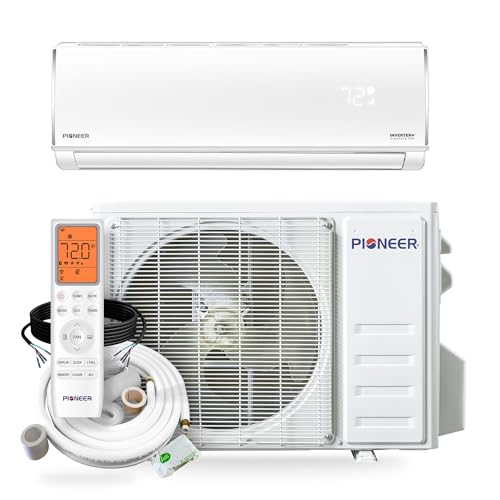
Winters that bottom out above 0°F: the Pioneer Diamante Pro 12K (230V) makes 9,000 BTU/h at 5°F for far less money, as long as you'll hire the evacuation and accept that it stops heating at -4°F. And if you're trying to heat a whole house through -20°F snaps, one wall unit is the wrong tool; that's a multi-zone design for a contractor, with backup kept in place.
The picks
Products we recommend for this guide.
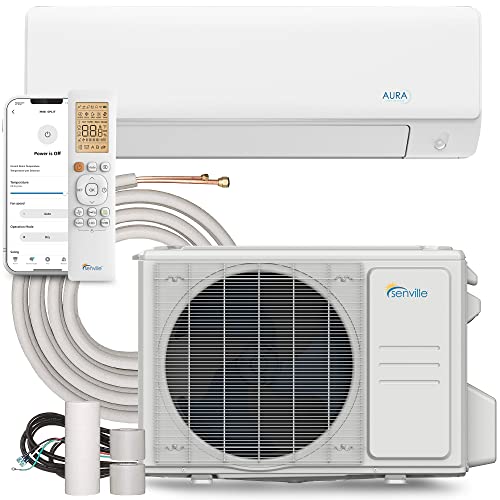
Senville AURA 12,000 BTU Mini-Split Heat Pump
Our default for 5°F winters: the current R-454B 12k is rated 11,500 BTU/h at 5°F and heats to -22°F. This listing's efficiency figure matches the older R-410A Aura, so confirm model and refrigerant, and budget a licensed install.
Read our full review: we scored it 7.5/10

MRCOOL DIY 5th Gen 12,000 BTU 115V Mini-Split
The cold-climate unit to install yourself: pre-charged quick-connect lines and a warranty that allows owner installs. It makes 8,400 BTU/h at 5°F but only a 3,800 max at -13°F, so plan backup heat for sub-zero nights.
Read our full review: we scored it 6.9/10


What owners say
Real owner reports from the threads and editorial sources we drew on for this guide.
“I have a 130 year old house, with limited insulation with 5 minisplit heads for supplemental heat and AC in some rooms that have no ductwork. The Mitsubishi hyper heat works fine down to -13f for us. It was -7f last week and my office was easily staying at 70f. The catch is my electric bill can get pretty high to generate that heat.”
“We have a well insulated new ADU with a two head hyper heat without heat strip. Been down to 8 below and not above 10 for a while and it has no problem maintaining our preferred temp at 69-70. House sitter turned it up to 71 and no problem. The hyper heats are pretty amazing, but we also insulated well with good thermal breaks throughout.”
“Mitsubishi hyperHeat mini splits- no heat strips, no backup beyond a wood stove for outages. I has been above freezing one day in the month and no thaws predicted, and no issues. Most nights below zero.”
“We leave ours at the set point and it holds to within 1-2degF all the time, even at below 0F outdoor temps (we're in Boston). Sounds like your system is undersized or perhaps not a cold-climate (hyper-heat, etc) heat pump.”
“My Mitsubishi mini split claims to heat down to -13F. My house was built in 1975 with electric baseboard heat that was kept as backup when the mini split was installed in 2018. I expect to use electric baseboard heaters as backup in the garage.”
“I have a couple 12k BTU Pioneer Diamante units, and live in an area where it's bound to get colder than the -13F limit for at least some of the winter. I have a propane furnace as backup so no big deal, but I have no idea what the units will do when it gets that cold, and whether it's bad for them if I leave it on.”
“However, if you're looking to get the government rebate, you have to make sure your system is adequate to heat the whole house, including the basement. This is something I did not do, and if I really wanted to be comfortable, I would add a third unit with three more heads to handle the basement and two rooms that I currently use fans for to move the warm air around.”
“I also believe they were simply installed wrong, and should never have been be the sole (main) heat source for the house. They do NOT reach the bathroom or laundry room and barely touch the kitchen.”
“my unit also defrosts typically once per hour. the condenser freezes solid and then it urinates profusely lol and kicks back up. I will not be using a mini split for heat on my next build.”


