Best DIY Mini-Split (No Vacuum Pump Needed)
By Wendell Asaro · Updated October 2026
Independent editorial guide. We never accept payment for coverage, though we may earn a commission if you purchase through our links.
Quick Take
Only pre-charged quick-connect systems let you skip the vacuum pump, and the one we'd buy is the MrCool DIY 5th Gen. Its 25 ft line set arrives sealed and charged, the warranty allows owner installs with no registration (5 years on parts, 7 on the compressor), and the 12K publishes 8,400 Btu/h of heat at 5°F. The Klimaire DIY 5th Gen is the close runner-up: slightly better cold-weather numbers on paper, but a warranty whose claim process still asks for a licensed installer's invoice.
"Pre-charged" on a listing doesn't mean no vacuum. Della, Pioneer, Senville and Cooper & Hunter ship refrigerant in the outdoor unit, but the lines are flared and have to be evacuated, and Senville and Cooper & Hunter tie their warranties to a licensed installer. If you'd hire out the startup anyway, a flare unit like the Pioneer Diamante Pro costs far less and can be the smarter buy. Either way, the circuit that feeds it is a job for a licensed electrician.
Our quick-connect picks, the flare unit we'd buy if you're hiring the evacuation, and the pad that keeps defrost water off your deck are below. See picks ↓

For a garage, shop or single room you'll install yourself, buy the MrCool DIY 5th Gen. It isn't the cheapest quick-connect unit, and it doesn't win every column on paper. It's the one where the line set, the manual and the warranty all agree that you, the owner, are allowed to install it, and where the warranty covers the pre-charged line set as a part. That agreement is rarer than it should be.
Most mini-splits sold online as "DIY" still need a vacuum pump. The ones that don't are pre-charged quick-connect systems: the refrigerant is sealed into the outdoor unit and the line set at the factory, and you join the lines with couplers instead of flaring copper and pulling a vacuum on it. On Amazon right now, that list is short: three single-zone MrCool quick-connect lines (the DIY 5th Gen, the cheaper Easy Pro and the even cheaper DIY Select) and Klimaire's DIY 5th Gen. Zone Air and Perfect Aire come up in DIY discussions as quick-connect brands too; we haven't verified their specs, so they don't appear in our picks.
Some readers shouldn't pay the quick-connect premium at all. If you were going to call a pro for the startup no matter what, a flare-fitting unit plus a hired evacuation can cost less in total and heat a little better at 5°F. The arithmetic for that is below, along with the warranty fine print that decides which route is safer for your money.
What "no vacuum pump" means, and what it doesn't
Every split system has refrigerant sealed in the outdoor unit when it ships. The difference is the line set. On a flare system, the copper lines arrive empty and full of air, so after you tighten the flare nuts you have to evacuate the lines with a vacuum pump before you open the valves. On a quick-connect system, the lines are pre-charged too, and the couplers join them with no vacuum step, which MrCool and Klimaire both state for their DIY lines. Listings blur that distinction constantly.
Della is the clearest example. Its 18K Della Serena listing says "Pre-Charged" in the title, while Della's own product FAQ says the condenser and lines are not pre-vacuumed and that you'll need to vacuum the system during installation. The Pioneer Diamante Pro manual calls for a nitrogen-assisted triple evacuation ending at 500 microns with a 4-hour hold, done by qualified personnel. Senville's manuals for the Leto and Aura require evacuating the lines with a vacuum pump, and its product FAQ answers "Can I install it myself?" with "No." The Cooper & Hunter MIA manual calls for a vacuum pump and manifold gauge. None of these is a no-vacuum kit.
You'll read that every mini-split is DIY-able because every unit comes pre-charged. We disagree. A pre-charged outdoor unit tells you how many feet of line the factory charge covers; it doesn't remove the evacuation step, and it doesn't change who the warranty covers. A Senville Leto owner in their second year says so plainly: you do need to vacuum the lines with the Senville.
There's a legal question here too, and EPA hasn't settled it. EPA's Section 608 Q&A says "Any person servicing, installing or disposing of stationary appliances (except the disposal of small appliances) must be a section 608 certified technician," and the federal definition of a technician turns on activities like attaching or detaching hoses and gauges, adding or removing refrigerant, and cutting the refrigerant line. The rule restricting refrigerant sales has been stayed since 1995 as it applies to pre-charged split systems, so anyone can buy one. EPA has not published a plain statement on whether connecting a factory-charged quick-connect line set counts as technician work, and we won't tell you it does or it doesn't. On a flare system, the evacuation means attaching hoses and gauges to the refrigerant circuit, one of the activities the definition lists, which is why we'd hand that step to a certified tech if you don't hold the card.
The quick-connect systems you can buy
Heat figures are from NEEP's cold-climate heat pump listings. At 5°F, NEEP's rated and maximum figures are the same number for the MrCool 12K and the Klimaire 12K and 18K; at -13°F, NEEP publishes a maximum only.
Line | Sizes and voltage | Included line set; maximum run | 12K efficiency | 12K heat at 5°F (share of rating) | Warranty |
|---|---|---|---|---|---|
MrCool DIY 5th Gen | 9K, 12K, 18K, 24K, 36K; 9K and 12K are 115V, 18K and up 208/230V | 25 ft pre-charged Quick Connect; the install manual lists 75 ft for every size (MrCool's product data says 82 ft for the 12K; we'd plan around the manual) | 23.5 SEER2, 10.2 HSPF2 | 8,400 Btu/h (70% of 12,000); listed as heating down to -13°F, where NEEP shows a 3,800 maximum | 5 years parts, 7 compressor, no registration |
Klimaire DIY 5th Gen | On Amazon: 12K (115V); 18K, 24K, 36K (230V) | Factory pre-charged; 25 ft on the 12K and 18K, 16 ft on the 24K and 36K per the Amazon listings; spec sheet maximum 49 ft on the 12K, 65 ft on the 18K | 23.0 SEER2, 10 HSPF2 | 8,900 Btu/h (72% of 12,400 at 47°F); 6,680 maximum at -13°F | 5 years parts and 7 compressor if registered within 45 days, with a claim catch covered below |
MrCool Easy Pro (current version, suffix 11511DE or 23011DE) | 9K to 24K | 11.5 ft pre-charged; 75 ft maximum | 19.5 SEER2; only the 9K is ENERGY STAR | 6,700 Btu/h (56%) | 3 years parts, 5 compressor; the parts definition excludes line sets |
MrCool DIY Select | MrCool's lowest-cost DIY line | 11.5 ft quick-connect | Up to 17.5 SEER2; no ENERGY STAR | 6,200 Btu/h | 1 year parts, 2 years compressor |
At 18K the two leaders stay close at 5°F. The MrCool 18K makes 12,800 Btu/h at 5°F (71%) and holds up to 12,200 at -13°F. The Klimaire 18K lists 19,000 Btu/h at 47°F, 13,600 at 5°F (72%) and a 9,000 maximum at -13°F.
Watch two traps. First, the Easy Pro has an earlier version with a 16 ft line set (suffix 11516D or 23016D), and some Amazon listings still advertise a 16 ft line set. MrCool's warranty for that version is 1 year on parts and 2 on the compressor, and it's void unless the unit was bought from an authorized dealer and installed in line with applicable codes, permits and licensing. Check the model number before you buy. Second, the line set in the box sets your layout. MrCool sells optional pre-charged line sets in 16, 25, 35 and 50 ft lengths, and a Quick Connect coupler to combine two standard sets, per its Easy Pro brochure; a longer run is possible, but those sets cost extra. MrCool's DIY 5th Gen and Easy Pro manuals both say the quick-connect line sets are for one-time installation and that reinstalling them voids the warranty, so decide the length before you buy, plan the route, make each connection once, and don't kink the line.
We'd pay for the 5th Gen over the Easy Pro and DIY Select, because the price gap is smaller than the spec gap. On the 12K, you trade 8,400 Btu/h at 5°F for 6,700 or 6,200, give up ENERGY STAR, lose more than half the included line set, and drop to a shorter warranty that, on the Easy Pro, doesn't cover the line set at all.
Cold-weather output: do the arithmetic
The number on the box is the 47°F rating. In a northern garage in January you need the 5°F number, and below that, how far down the unit keeps running. Say a load calculation puts an insulated one-car garage at 10,000 Btu/h of heat loss on a 5°F night (an illustration; your number comes from a Manual J or a solid heat-loss estimate). Here's the 12K class against it, from the same sources as above:
12K unit | Heat at 5°F (Btu/h) | Below zero | Against a 10,000 Btu/h load at 5°F |
|---|---|---|---|
Pioneer Diamante Pro 12K (230V, flare) | 9,000 rated (NEEP) | 6,800 maximum at -4°F, the bottom of its heating range | 1,000 short |
Klimaire DIY 12K (115V) | 8,900 | 6,680 maximum at -13°F | 1,100 short |
MrCool DIY 5th Gen 12K (115V) | 8,400 | 3,800 maximum at -13°F | 1,600 short |
MrCool Easy Pro 12K (115V) | 6,700 | 3,400 maximum at -13°F | 3,300 short |
MrCool DIY Select 12K (115V) | 6,200 | No figure | 3,800 short |
The MrCool 18K's 12,800 covers that garage with 2,800 to spare. That doesn't mean "buy bigger to be safe." An oversized unit short-cycles through spring and fall and does a poor job pulling humidity out in summer, which matters most in exactly the small rooms and garages these units go into. Size to the load at your design temperature, then check the 5°F line.
The gap opens wider below zero, and it doesn't always favor the same brand. At -13°F, the Klimaire 12K's 6,680 Btu/h maximum is well ahead of the MrCool 12K's 3,800. At 18K the order flips: MrCool lists a 12,200 maximum at -13°F against Klimaire's 9,000. If your winters regularly go below zero, that column should pick your brand for you, and you should plan on backup heat either way.
The warranty when you install it yourself
The DIY brands earn their price here, and the fine print matters most. Read each document, not the headline.
- MrCool DIY 5th Gen: 5 years parts, 7 years compressor, no registration, and the pre-charged line sets are listed as covered parts. The warranty applies to systems installed per the instructions and local codes and permits, and it says that "When required by law or when required for diagnostic testing as directed by MRCOOL, a State or province certified or licensed HVAC contractor may be necessary." MrCool may also require written diagnostic proof from a licensed or certified tech. Labor isn't covered. Disputes go to binding arbitration unless you opt out by email within 30 days of purchase.
- Klimaire DIY 5th Gen: the warranty-information page and Klimaire's current DIY warranty both allow owner installs on DIY-designated models (following local code), with 3 years of parts unregistered per the page and 5 years parts, 7 compressor if you register within 45 days. The catch is the claim procedure: it asks for an installation invoice from a licensed HVAC technician, and it requires proof of maintenance at least twice a year. Labor and refrigerant aren't covered, and the warranty excludes refrigerant line sets, where MrCool's DIY 5th Gen warranty lists its pre-charged line sets as covered parts. We'd get Klimaire's answer for your model in writing before buying, screenshot the warranty page, and register right away.
- MrCool Easy Pro (current): 3 years parts, 5 compressor, DIY allowed on the same terms as the DIY 5th Gen, line sets excluded. The earlier 16 ft version: 1 and 2 years, and it requires an authorized-dealer purchase and an install in line with applicable codes, permits and licensing.
- Della Serena (flare): Della's current web policy gives a registered DIY install free replacement parts at Della's discretion. Labor and refrigerant are excluded, and so are failures from faulty installation.
- Pioneer Diamante Pro (flare): no licensed-installer requirement, but claims start with an installer or contractor's diagnosis, faulty installation is excluded, and lost refrigerant isn't covered at any time.
- Senville Leto and Aura, Cooper & Hunter MIA (flare): valid only with a licensed HVAC install. Cooper & Hunter also wants the installer's license number at registration within 60 days.
No warranty here pays labor, and that's the line item that bites. A Blue Ridge owner whose compressor failed after two years was asked for $200 to ship the warranty part, with a tech install on top costing hundreds more, so replacing the unit looked cheaper. On the other side, a self-installed unit whose compressor died just over a year in got it replaced free, on a warranty that covered parts only. Same deal both times, and it's the deal every DIY warranty offers: parts, sometimes; labor, never. Budget for a service call even on a covered failure.
Do quick-connect couplers leak?
No owner reports a 5th Gen quick-connect coupler leaking. The sample is small, so that isn't proof, but it's a different picture from what installers warn about. Six people describe installing a pre-charged quick-connect system themselves, five on MrCool DIY systems and one on a Zone Air, and none reports a leak. The longest record is two years. Three MrCool DIY 3rd Gen units seemed fine at that point for one owner. A MrCool 18K's compressor died at two years; MrCool covered it under warranty, though its owner had to reinstall the outdoor unit and lines and paid for shipping. A MrCool 24K whose fittings went on with no leaks detected wouldn't cool, so MrCool sent a new outdoor unit and new pre-charged lines, and it worked after that. The rest, including the Zone Air installed with no vacuum pump or gauges at all and an owner who summed up the line connection as plugging tab A into slot B, haven't said how theirs held up.
The sweeping leak warnings come from people who don't say they own one: that MrCools last a year and then leak, or that homeowner installs leak in the first one to three years. Neither names a generation or describes a coupler failing. The MrCool refrigerant failures owners do report are all on older generations, and none involved a quick-connect coupler or a 5th Gen unit: a 4th Gen DIY multi-zone system on the older R-410A refrigerant that threw a low-pressure code with icing lines and was recharged without the cause ever being found; a 4th Gen DIY 36K whose failed low-pressure switch leaked the entire charge, fixed with a replacement outdoor unit and a new pre-charged line set under warranty; and a Mr. Cool installed about ten years ago whose indoor wall unit developed a leak four years in, which MrCool replaced completely under warranty.
Flare systems carry the concrete failure stories. A Blue Ridge 18K installed by handymen needed refrigerant added a week later because a line connection wasn't torqued enough, and our Della review covers two bad installs that started at a skipped or fumbled vacuum. A quick-connect kit takes the flare, the torque and the vacuum off your plate. It doesn't take away the ways you can still damage a line: kinking it, or reconnecting a line set the manuals say is designed to be installed once.
When a flare system plus a hired evacuation is the better buy
The quick-connect premium pays for one thing: not needing a tech or the tools. If you'd hire someone regardless, a flare unit can win. The Pioneer Diamante Pro 12K (230V) makes 9,000 Btu/h at 5°F, a little more than the MrCool 12K, costs far less on Amazon, and its warranty doesn't require a licensed installer. The Della Serena 18K publishes 13,500 Btu/h at 5°F and gives a registered DIY install free parts.
Run the numbers for your own area. Take the price difference between the quick-connect unit and the flare unit in the same size, and compare it with a local quote for evacuation and startup on customer-supplied equipment. One installer prices a full install of customer-bought equipment at about $700, with a pressure test and a vacuum checked on a micron gauge, and charges more if the homeowner has already had a go at it. If the price gap beats the quote, buy the flare unit and hire the startup. If it doesn't, buy the quick-connect.
Doing the evacuation yourself is the other path, and it isn't cheap the first time. One DIYer who installed a flare system tallied $671.07 in vacuum and test gear (a sparkless dual-stage pump, a manifold, a nitrogen regulator and tank, a digital vacuum probe and more), not counting the tube bender, torque wrench and hole saw any install needs. The tools do pay off over several installs: one owner who bought a vacuum pump went on to install two single-zone units and a three-head system, and called it easy once the hole in the wall was done. If you're doing one unit, the tools cost close to what the hired startup does.
The catch with hiring is finding the person. HVAC companies often won't install or service equipment a homeowner bought, and owners and pros both say so. An owner trying to fit a mini-split to a travel trailer couldn't line up a local installer, partly for that reason, and a MrCool buyer couldn't find a local tech comfortable with the units at all. Call around before you order the flare unit, and ask specifically for an evacuation and startup on customer-supplied equipment. If nobody will take the job, the quick-connect premium buys you a unit you can finish yourself.
If you're installing it yourself, leave Senville and Cooper & Hunter off the list. Both void their warranties without a licensed install. The Aura's cold-weather output is excellent, so buy it with a contractor's install if that's the unit you want.
Electrical, mounting and drainage to plan before you order
A quick-connect kit skips the refrigerant work, not the electrical work. Here's what the picks require, from the manufacturers' spec tables:
Unit | Voltage | Minimum circuit ampacity | Maximum breaker or fuse |
|---|---|---|---|
MrCool DIY 5th Gen 12K | 115V | 18 A | 20 A breaker |
MrCool DIY 5th Gen 18K | 208/230V | 18 A | 20 A breaker |
Klimaire DIY 12K | 115V | 16 A | 25 A fuse |
Klimaire DIY 18K | 208-230V | 12 A | 20 A |
Pioneer Diamante Pro 12K | 208-230V | No figure | 15 A double-pole breaker |
In most garages that means a new circuit from the panel, and whether an existing circuit can carry the unit is a licensed electrician's call, not ours. Klimaire's manual says electrical connections must be done by a qualified or licensed electrician where required, and your town may want a permit. Plenty of DIYers who do everything else themselves hire out the electrical. Get that quote before you buy, because it can change which unit is cheaper.
Plan where the water goes. A heat pump's outdoor unit drips water in heating mode, especially during defrost, and the indoor head drains condensate in cooling season. That's why we'd keep the outdoor unit off a wood deck. Owners split on wall mounts: some hear vibration or noise from a wall-mounted outdoor unit through the wall, and others have never had a vibration problem. A ground pad avoids the question; a bracket or risers keep the unit above snow. Leave the clearances the manual asks for on every side.
Plan for the end of the unit's life too. You'll hear that a dead unit can go out on the curb. EPA's Section 608 Q&A puts disposing of stationary appliances in the same certified-technician category as installing them, so budget for proper disposal rather than the curb.
Which one we would buy
For most garages, shops and single rooms, buy the MrCool DIY 5th Gen in the size a load calculation gives you. It's the quick-connect unit with the cleanest DIY warranty, and its 25 ft line set is covered by that warranty and more than twice the length the Easy Pro and DIY Select include.
Buy the Klimaire DIY instead if your winters go well below zero and you're shopping the 12K, where its -13°F number is far stronger, or if the price gap favors it the week you buy. Get its DIY warranty terms in writing first.
Buy a flare unit like the Pioneer Diamante Pro if you can line up a certified tech for the evacuation and the price gap covers the bill. Skip the Easy Pro and DIY Select unless the budget leaves no other choice; the money you save comes straight out of your 5°F heat and your warranty.
The picks
Products we recommend for this guide.

MRCOOL DIY 5th Gen 12,000 BTU 115V Mini-Split
Our pick: a 25 ft sealed quick-connect line set, 8,400 Btu/h at 5°F, heat listed down to -13°F, and a 5-year parts, 7-year compressor warranty that allows owner installs with no registration. Labor is never covered.
Read our full review: we scored it 6.9/10
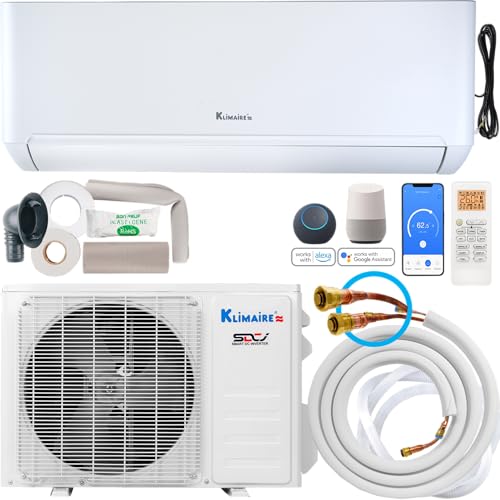

Klimaire DIY 18,000 BTU 23 SEER2 Quick Connect Mini-Split (230V)
For a bigger shop where a load calculation says 12K falls short: a 13,600 Btu/h max at 5°F with the same 25 ft quick-connect lines. It needs a 230V circuit, and the same warranty-paperwork caveat as the 12K applies.
Read our full review: we scored it 6.7/10

What owners say
Real owner reports from the threads and editorial sources we drew on for this guide.
“The lineset is precharged, to simplify it looks like plugging tab A into slot B, and do not kink the line!! (That’s been grilled into my brain). I guess i need to check my city codes but assumed it wouldn’t need inspections. Other than maybe the electrical which I’ll be hiring a professional to do.”
“for a 100sqft office/garage space id go zone air, did my own install with their precharged quick connect lines and skipped the vacuum pump and gauges entirely, way less intimidating for a first timer.”
“I moved from central air to mini splits and DIY'd them all. It really is easy to do. The hardest part was putting a hole in the wall to the outside. Once I got over that issue it's really easy. Bought a vacuum pump and now I've installed 2 single units and a 3 head unit.”
“Needed a refrigerant refill a week after the install, as the line connection was not adequately torqued (takes a LOT of torque; handymen did not have a leak/pressure meter, which is essential for the install). Has worked fine for over 10 years.”
“I've tried to hire a local guy, but I understand not many installers want to install homeowner supplied equipment, and we're having a heat wave so everybody is busy on "real" jobs.”
“Negative, warranty only kicks in for my unit if it was installed by a licensed contractor and i sent back paperwork so that is the iffy part. I didn't have that so its all out of pocket for me in the end.”
“If the unit was professionally installed then they will cover parts AND labor, if it was self installed, then the warranty only covers parts. My compressor died just a little over 1 year after I installed it. They sent me a replacement one for free.”
“The compressor in my Blue Ridge mini split failed after 2 years. Their customer service wanted to charge me $200 to ship the replacement part under warranty. Then would have to pay hundreds more to have a tech install. Warrant is basically useless because it’s just cheaper to buy a new one.”
“Zone Air's diy warranty held up fine and you deal straight with the company, not some distributor.”

