Dehumidifier Freezing Up: Why the Coils Ice and What to Do
By Ingrid Tamsett · Updated October 2026
Independent editorial guide. We never accept payment for coverage, though we may earn a commission if you purchase through our links.
Quick Take
Some frost is normal. Most of the units we cover defrost themselves; on the Frigidaire and Santa Fe, the compressor stops and the fan keeps running until the frost clears. A coil that ices up is a problem when the ice stays. Check, in order: the room temperature next to the unit against its published floor (41°F for the Midea Cube, Frigidaire and hOmeLabs portables), the filter and the airflow around the cabinet, and whether the fan is moving air while the compressor runs.
If a unit keeps icing in a room above 60°F with a clean filter and a working fan, the likely cause is inside the cabinet: the sealed refrigerant system or a failed defrost control. That's a warranty or replacement call, not an owner repair. If the space itself is too cold, no amount of thawing fixes it; you need a unit rated for the temperature, such as the AlorAir Sentinel HD55S, which runs down to 33.8°F.
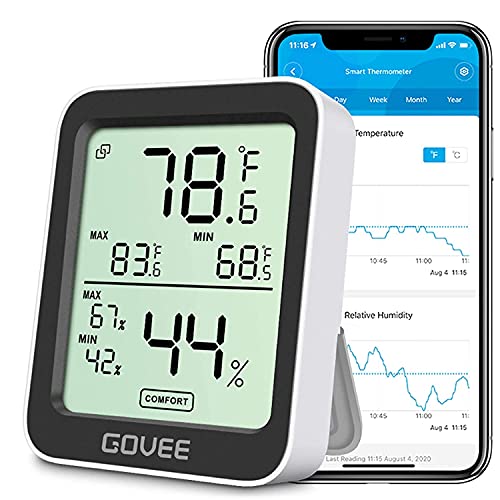
Our picks pair a replacement for an ordinary basement and one for a cold space with the cheap thermometer that tells you which one you need. See picks ↓

A frosted coil is either a cold room or a dying machine, and a thermometer tells you which before you spend anything. You pull the bucket or look behind the grille and the coil is white with frost, or wrapped in a solid block of ice. It happens on LG 70-pints, Frigidaires, hOmeLabs and Honeywell-branded units alike, and some of those machines are dying. But plenty of frost isn't a fault at all: it's what a dehumidifier does in a cool room, and most units clear it themselves.
One problem is fixed with a thermometer and the other with a receipt. The checks below run cheapest first, all done from outside the cabinet with the unit switched off and unplugged for anything you handle. None of them involve the refrigerant. If your unit runs without ice but makes no water, our dehumidifier not collecting water guide covers that instead. If the space turns out to be too cold, the unit we would buy for it is the AlorAir Sentinel HD55S.
Is it frost the machine is already handling?
A dehumidifier makes water by chilling a coil below the dew point of the room air. When that coil runs below freezing, the water lands as frost instead of drips. Each of the units below has a way of dealing with that, and where the manual describes it, it looks like a fault if you don't know what you're seeing: the compressor goes quiet, the fan keeps blowing, and no water comes out for a while.
Unit | What normal defrost looks like, per the manual |
|---|---|
Frigidaire FHDD5034Y1 | When frost builds on the evaporator coils, the compressor cycles off and the fan runs until the frost is gone, with "dF" on the display. Frost on the coils behind the filter right after start-up is normal and usually clears within 60 minutes. |
Midea Cube | The troubleshooting table calls frost on the coils normal, because the unit has an auto defrost feature. |
Santa Fe Compact70 | A defrost thermostat stops dehumidifying when excessive frost forms and runs the fan until conditions are back to normal. |
AprilAire E070 | Frosting from cool, dry incoming air, normally in spring or fall, is a normal part of operation, and DEFROSTING shows on the display. |
AlorAir Sentinel HD55S | An indicator light glows red while the unit is in auto defrost, clearing ice from the evaporator coil. |
So if you see frost on a unit that has only just started, or the display tells you it's defrosting, leave it alone and check again in an hour. On-and-off icing is the gray zone: one older unit in a 60-70°F basement builds frost that goes away when it's switched off, then has a stretch with barely any. That kind of intermittent icing can be the first sign of the slow decline we cover further down. What isn't normal is ice that keeps growing until it covers the coil, or a unit that spends most of its time defrosting and makes little water.
Check the room temperature, not the thermostat upstairs
Every unit we cover has a published floor. Here's where the makers set it:
Unit | Rated range | Below the floor |
|---|---|---|
Frigidaire FHDD5034Y1 | 41°F to 89°F, per the manual | |
Midea Cube | 41°F to 95°F | The manual says to keep it where the temperature won't fall below 41°F, because the coils can frost over at lower temperatures and performance may drop. |
hOmeLabs 50-pint models | 41°F to 90°F | |
Santa Fe Compact70 | 49°F to 95°F, most effective from 56°F | The manual says that at 55°F or below, it will produce little to no water. |
AprilAire E070 | 50°F minimum inlet air, 40°F minimum dew point | E8 shows on the display when inlet conditions prevent operation, and the unit restarts by itself once they're back in range. |
AlorAir Sentinel HD55S | 33.8°F to 104°F | Below 33.8°F the display reads LO and the unit waits until the room is back in range. |
Now the arithmetic the box skips. The DOE rates portable dehumidifiers at 65°F and 60% relative humidity. ENERGY STAR's buying guidance says that if a space typically falls below 65°F, you may want to consider a product specified for lower temperatures. It says frost can form on the coils when the air drops below 65°F, which can make the compressor cycle on and off without removing moisture, and that if it happens you should switch the unit off and let it defrost before turning it back on. That's a broader caution than the makers' own limits: the Cube and the Frigidaire both list 41°F as the bottom of their range, and both manuals describe automatic defrost. So a 58°F basement is 17°F above their floor and inside what they're built for, but it's also 7°F below the 65°F rating point, where ENERGY STAR says frost can form. Expect some defrost time there, and less water a day than the rating, because there's less water in cooler air to begin with; ENERGY STAR gives that as the reason ratings fell when the test moved to 65°F.
Measure before you blame the machine. Set a thermometer right next to the intake for a full day, including the coldest part of the night, because a basement or crawl space can sit well below the reading upstairs. If the space is near or under your unit's floor, the frost is a placement problem. A pricier unit isn't automatically rated colder: Santa Fe and AprilAire set their floors at 49°F and 50°F, higher than the Cube's, and one crawl space unit sits in its low-temperature lockout, around 50°F, for most of the winter. Our basement humidity level guide covers what reading to aim for once the temperature is sorted out.
Clean the filter and give it room to breathe
Less air across the coil means a colder coil and frost sooner. AprilAire's manual names restricted airflow as one of the two causes of frosting and tells you to look for blocked ductwork or a dirty filter when the air isn't cool and dry. AlorAir's troubleshooting table lists a clogged filter and a blocked inlet or outlet under low airflow. Go by your manual's interval: every two weeks for the Frigidaire and Midea, at least every 30 days for hOmeLabs, every three to six months for the Santa Fe filters, and every six months for the AprilAire filter and drain.
Switch the unit off and unplug it first; the Frigidaire, Midea, hOmeLabs and AlorAir manuals all say to before cleaning or maintenance. Then check clearance. Frigidaire asks for 12 inches around the FHDD5034Y1, so a unit shoved against a wall or boxed in by storage can be starved even with a clean filter.
Stop at the filter on a portable. You'll see advice to take the back off and hose the coils or spray them with cleaner. The Frigidaire and hOmeLabs manuals say no. Frigidaire's says the evaporator has sharp parts and users shouldn't clean it themselves, and that the unit has no user-serviceable parts. hOmeLabs' says never to take the dehumidifier apart or repair it yourself. It doesn't reliably help anyway: one owner deep-cleaned the coils of an older unit and still had frost, and another took the back off a three-year-old Frigidaire and found the grille cleaner than they expected. AlorAir's HD55S manual is the one that lists coil care: its maintenance section says to clean the coils once a year with an approved coil cleaner, a self-rinsing foaming type, with the unit unplugged, and its safety notes say Sentinel units should only be maintained and repaired by a qualified technician. That's yearly upkeep on that one model, not a fix for ice, and it doesn't carry over to other brands. On every other unit we cover, leave the cabinet closed.
Thaw it slowly, and only once
If the coil is iced solid, switch the unit off, unplug it, and let the ice melt on its own at room temperature, with something under it to catch the water. That's what ENERGY STAR describes: switch it off and let it defrost before turning it back on. Don't help it along. hOmeLabs' manual warns against any unapproved product or process to speed up defrosting, and AprilAire's says not to use any means to accelerate defrosting other than those the manufacturer recommends. Never chip or pry at the ice either: the coil is part of the sealed refrigerant system, and AprilAire's manual warns not to pierce it.
Once it's fully thawed and dry, run it in a room you know is above its floor, with a clean filter, and watch it for the first hour. Let it warm up, then time how long it runs before ice starts to form. Frigidaire's manual says start-up frost usually clears within 60 minutes. If ice is still building after that in a warm room, skip to the sealed-system section below.
Is the fan moving air while the compressor runs?
Frost forms when the coil gets colder than the air can keep it. If the fan stops while the compressor keeps going, no room air is moving across the coil, so it can freeze quickly. Put your hand at the outlet: with the compressor on, you should feel a strong stream of air warmer than the room.
A compressor that runs with the fan off is a real fault, and it doesn't always announce itself. On one hOmeLabs 4,500 sq ft pump model, the power switch turned off the fan but not the compressor; only unplugging stopped it. A 2016 LG that had been getting louder iced over, and pressing the power button stopped the fan while the rest of the unit kept running until the plug was pulled. That LG stopped completely when switched off in bucket mode, and nothing iced over; the trouble showed up only with the continuous drain hose connected. If yours does this, unplug it and stop using it. A compressor you can't switch off is a fault for the warranty or a servicer.
Don't misread a normal shutdown, though. AlorAir's manual says the HD55S fan keeps running for one minute after you switch it off, and asks you to stop it with the power button rather than by pulling the cord. We've seen few outright fan failures. With good airflow a failing fan is unlikely, though possible if the bearings are going, and a coil that has been freezing for a while strains the compressor, which is the likelier source of a new noise.
Ice in a warm room with a clean filter: the sealed system
This is the common case: a coil that ices in a room at about 68°F, about 70°F or 60-70°F, with a clean filter. Rule out one thing first. The LG above stopped icing when it ran in bucket mode instead of on the drain hose, so try both before you write a unit off. Otherwise the pattern points inside. Units ice in their third summer, or after a season, and one owner has seen it across hOmeLabs, Midea and Frigidaire units. An hOmeLabs froze up and its compressor failed after about three months of use, and a replacement Honeywell-branded unit kept icing up until it quit. With airflow ruled out, the usual suspects are in the refrigerant circuit: low refrigerant, a slow leak or a restriction.
A failed defrost control is the other possibility. There's usually a thermostat on the coil that shuts the compressor off when it freezes, and it can fail. One Santa Fe Compact70 had a defrost sensor fail in 2015, which Santa Fe replaced under warranty. Either way, the fix is inside the cabinet.
That's where we stop. Dehumidifiers are factory-sealed small appliances under EPA's refrigerant rules, and EPA lists adding or removing refrigerant as technician work that requires Section 608 certification. AprilAire's manual says its sealed refrigeration system is not field serviceable and that troubleshooting and repairs belong to a qualified HVAC service technician. Santa Fe's says only qualified HVAC or electrical contractors may service its units. Check your receipt date and go to the warranty. Most portables carry one year; AlorAir covers refrigeration parts through year six on orders placed on or after May 14, 2026, and Santa Fe covers components for six years. Our not-collecting-water guide lists each maker's terms and claim process.
Out of warranty, the stopgap you'll see suggested is running a dying unit on a timer, an hour on and an hour off, so the ice never builds, at the cost of compressor life from the short-cycling; the gentler version is switching it off once every week or two to let the ice melt. Treat either as a way to get a few more weeks while you shop, not a fix. One Frigidaire owner tried it, turning the unit off periodically and running it on low. The unit that used to hold their basement at 55% couldn't get it below 64%.
Ice in the drain line is a different problem
Sometimes the ice is outside the machine. A drain line that runs through an unheated crawl space or out an exterior wall can freeze, and a frozen line backs water up into the unit. hOmeLabs' manual says not to use the pump on its pump model when the outdoor temperature is at or below 32°F, because the water will freeze. A built-in pump that pushes water outside in small bursts can leave water standing in the line to freeze, which is exactly the worry for one owner of an AlorAir HDi90 crawl space unit.
Route it to an interior drain. If the line has to go outside, slope it so it can't hold water, and in a cold climate find an indoor drain or a condensate pump that discharges inside. Our dehumidifier with pump guide covers the pump setups.
When the space is too cold, buy for the temperature
If your thermometer says the space regularly drops toward 41°F, a new portable with the same floor will frost the same way. Buy the AlorAir Sentinel HD55S instead. It's rated down to 33.8°F with an auto defrost built for that range. Size it from ENERGY STAR's figure of 36.33 pints a day at 65°F, not the 55 on the box. Our AlorAir HD55 review covers its warranty terms and its gravity-only drain, and the crawl space dehumidifier guide compares it with the Santa Fe and AprilAire units for sealed crawl spaces that stay warmer.
For a basement that stays comfortably above 41°F, and ideally in the 60s, the Midea Cube 50 is the replacement we'd buy. ENERGY STAR certifies it at 49.67 pints a day on the 65°F test, and its auto defrost handles the routine frost of a cool night. The Frigidaire FHDD5034Y1 certifies 49.71 and shows dF when it's defrosting; buy it when it's priced at or below the Cube. Either way, put a thermometer and hygrometer beside the new unit for the first week.
The picks
Products we recommend for this guide.

Midea Cube 50 Pint Dehumidifier
Our replacement for a basement that stays well above 41°F, the floor Midea sets for the Cube. ENERGY STAR certifies 49.67 pints/day at 65°F, and its auto defrost handles routine frost. Not the unit for a space that drops into the 30s.
Read our full review: we scored it 7.0/10

Frigidaire 50 Pint Dehumidifier with Wi-Fi (FHDD5034Y1)
Same 41°F floor and class as the Cube (49.71 pints/day at 65°F), and its display shows dF while it defrosts, so you can tell normal frost from a fault at a glance. Buy it when it is priced at or below the Cube.
Read our full review: we scored it 6.4/10

AlorAir Sentinel HD55S Dehumidifier
For a basement or crawl space that drops below 41°F: rated to run down to 33.8°F, with an auto defrost light. ENERGY STAR lists 36.33 pints/day at 65°F, not the 55 on the box. Gravity drain only; buy from AlorAir or an authorized dealer.
Read our full review: we scored it 7.0/10
What owners say
Real owner reports from the threads and editorial sources we drew on for this guide.
“I have a 2016 LG 70 pint dehumidifier in my basement. The coils are icing over. The air filter is clean, and the fan that blows air out of the top of the unit seems to be working well based on how much air is coming out. The basement temp is about 70 degrees.”
“This new unit is now forming a block of ice whenever I run it, on the coil near the air intake. The unit has plenty of air flow (clean filter), and the air is not too cold (about 68F in the basement). I have verified the drain path is not clogged.”
“Now as I monitor it throughout the day there are occasions where I see frost build up only for it to go away when I turn it off and now it’s back to a period of no to barely any build up.”
“I have been turning it off periodically, and running it on the low setting, but it doesn’t seem to work so effectively anymore. It used to maintain my basement at 55 humidity level, but I can’t get it down below 64 humidity.”
“The unit uses its internal condensate pump to push water through small vinyl tubing out through the exterior. Because the pump cycles intermittently in small bursts rather than running continuous flow, I'm concerned standing water inside the line will freeze and create an ice plug during winter freezes.”

