What Humidity Should a Basement Be?
By Ingrid Tamsett · Updated October 2026
Independent editorial guide. We never accept payment for coverage, though we may earn a commission if you purchase through our links.
Quick Take
Keep a basement below 60% relative humidity, and aim for 45-50% through the humid months. EPA's mold guidance says to keep it below 60% if possible, ideally between 30% and 50%, and ENERGY STAR calls 30-50% the optimum for a building, warning that anything higher may promote mold growth. We'd set the dehumidifier to 50% and drop it to 45% only if a musty smell hangs on.
Two caveats. Read the number on a separate hygrometer, because the dehumidifier's own sensor sits in the air right at the machine and some read far off. And in winter, ENERGY STAR says homes in colder climates should sit at 30-40% during the heating season to prevent window condensation; if your basement already reads there, the dehumidifier can idle until spring. If water comes in when it rains, fix the gutters and grading before you buy any machine.
Our picks are the dehumidifier we would put in a typical damp basement, one for a basement that gets cold, and the hygrometer and pump that make 50% easy to hold. See picks ↓

Set it to 50% and give it a drain. For a typical damp basement that stays above 41°F, the dehumidifier we'd buy is the Midea Cube 50 Pint, set to 50% and drained by hose. The target itself isn't controversial: EPA, ENERGY STAR and DOE's crawlspace guide all land on 30-50%, and EPA's mold guide puts the ceiling at 60%. The hard part is holding it through a humid August without the machine running itself ragged, and telling a humid basement from a leaking one.
Untreated basements run anywhere from the mid-40s to above 80%. One renter started a dehumidifier in a basement that read 80% and smelled of mildew; a month later it had come down to 58% and wouldn't budge. Two units running after a heavy rain couldn't get another basement under 50%. Both are fixable, and the reasons they stalled are most of what follows.
Below 60%, ideally 45-50%: what the sources say
EPA's guide to mold and moisture is the clearest: if possible, keep indoor humidity below 60 percent, ideally between 30 and 50 percent. EPA's indoor air guide gives the same 30-50% range, ENERGY STAR calls 30-50% the optimum for a building and says anything above it may promote mold growth, and DOE's Building America guide to closed crawlspaces uses 30-50% too. EPA and ENERGY STAR both tie the range to mold. EPA's asthma page lists dust mites as a trigger, but its humidity advice sits in the mold section, so we won't put a humidity number on dust mites.
Owners spread out inside that range. Most who give a number hold their basements at about 45-50%. Some run at 40% or lower, down to 30%, and some live with 53-60% and say they're fine with it, one with no sign of mold at 55-60%. We'd aim for 45-50%: it sits inside EPA's ideal band, and 40% is often hard to reach in a basement.
We'd set 50%. It sits in the middle of every official range, and it leaves room under the 60% ceiling for a muggy week and for the error in whatever is measuring it. A hygrometer accurate to plus or minus 3 points that reads 57% could be looking at 60%, which is why we don't treat 55-60% as a target even though it's under the line. Going lower costs runtime. Units asked for less run nearly nonstop or stall a few points above the setting, and one owner who held 40% has gone through three or four consumer dehumidifiers, which they think burned out from running around the clock.
Summer and winter are different problems
Summer is when basements climb, and the humidity keeps rising as the season goes on; getting under 50% in late summer can be a fight. A dehumidifier earns its keep from late spring through early fall, and that's when you should expect it to run the most.
Winter flips the risk. ENERGY STAR says that in colder climates during the heating season, humidity should be 30-40% to prevent window condensation. EPA adds that condensation on windows, walls or pipes can be a sign of high humidity, and that you should dry the surface and reduce the moisture source. Some owners swing the target with the season, 45-50% in summer and 30% in winter, which can take a humidifier. Others run the basement dehumidifier year-round and get a little heat out of it in winter.
Leave the setpoint at 50% all year. When the basement reads under that in winter, the dehumidifier cycles off on its own and costs you nothing. If you see condensation on basement windows, walls or cold water pipes in winter, start with two of the fixes on EPA's list: lower the humidity and insulate the cold surface. And watch the temperature. ENERGY STAR suggests considering a unit specified for lower temperatures if the space typically falls below 65°F, noting that frost can form on the coils. That's a broader caution than the makers' own limits: the Midea Cube and the Frigidaire 50-pint both list 41°F as the bottom of their operating range, and both manuals describe automatic defrost, so a 55°F basement is inside what they're built for. Expect less water a day than the 65°F rating, though; ENERGY STAR's explanation of the 2019 test change is that cooler air has less water to remove.
Why a cool basement reads damp
Relative humidity is relative to temperature. ENERGY STAR defines it as the water vapor in the air compared with the most the air can hold at that temperature. Cooler air holds less, so the same amount of water reads as a higher percentage in a cool room than a warm one. Warm, humid summer air that leaks into a cool basement picks up relative humidity as it cools, without a drop of water being added.
The coldest surfaces take it further. The air touching a below-grade wall, a slab or a cold water pipe is cooler than the room, and if it cools to its dew point, the temperature at which it holds all the water vapor it can, water starts to condense on the surface. That's the sweating wall or dripping pipe. EPA's list of ways to prevent condensation starts with reducing the humidity and also includes covering cold surfaces such as cold water pipes with insulation, more air movement and warmer air.
- Placement skews the reading: a hygrometer hung on a cold exterior wall tends to read higher than one in the middle of the room.
- Heat helps the number, not the water: warming the basement lowers the relative humidity you read without removing any water. Raise the thermostat and run the dehumidifier together: the warmth helps the reading and the dehumidifier is what takes the water out.
- The unit dries its own corner first: a dehumidifier warms the space around it slightly, which ENERGY STAR says is normal, so the air right at the unit tends to be warmer and drier than the far corners.
Measure it with a separate hygrometer
EPA says relative humidity can be measured with a small, inexpensive humidity meter from a hardware store. Every ENERGY STAR dehumidifier has a built-in humidistat that cycles the unit to hold your setting, but that sensor reads the air at the machine, and it can be wrong in either direction.
Some read low. Nine Midea Cube owners describe a humidity display stuck near 30% or about 20 points low, and those who checked with another sensor saw 40-60%; our Midea Cube review covers it. A unit that thinks the room is drier than it is stops early. Placement matters too. One Midea owner (model unstated) blames some sensor complaints on air intakes pushed too close to a wall, and theirs matches their other hygrometers with the intake turned away from it. Other units over-dry their own corner. One owner who runs more than one unit keeps a fan pointed at them because otherwise the unit doesn't register the dried air and the room ends up hot and very dry. Of the three dehumidifier makers in our picks, only AlorAir publishes a figure: its Sentinel HD55S manual says the displayed humidity is approximate, within plus or minus 5%. The Midea Cube and Frigidaire FHDD5034Y1 manuals give no accuracy figure that we could find.
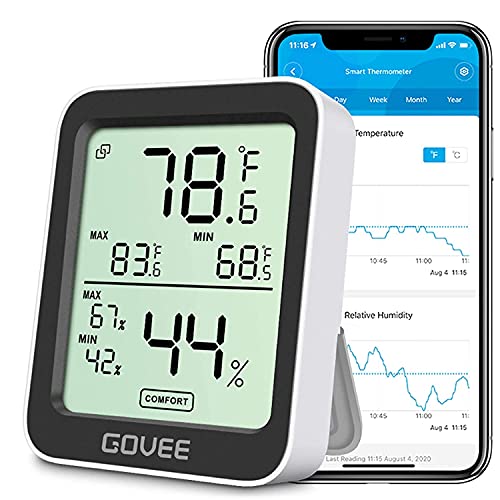
A separate hygrometer settles it. Govee lists the H5075 at plus or minus 3% relative humidity and 0.54°F on its Amazon listing, and says it keeps 20 days of graphs, which is what you want for a basement: a trend, not one reading. Check it when the HVAC is off, too. One owner first measured 47% throughout their basement, then realized the HVAC had been running; with it off on hot summer days, they measured 58%. ENERGY STAR's advice, for a unit without a humidity readout, is to hang a hygrometer near the dehumidifier. We'd start there for the first week to check the unit's display, then move it to the far side of the basement at about chest height, away from exterior walls, and watch it across a few humid days.
Size the dehumidifier to how wet the basement is, not its square footage
ENERGY STAR's sizing chart starts from the condition of the space without a dehumidifier and gives a minimum capacity in pints per day:
Condition without a dehumidifier | Under 2,000 sq ft | 2,000 sq ft and up |
|---|---|---|
Slightly to moderately damp, 50-75%, musty at times | 20-30 pints | 30 or more |
Very damp, 75-90%, damp spots on walls and floors | 25-40 pints | 40 or more |
Wet, 90-100%, walls or floor sweat or seepage is present | 30-50 pints | 50 or more |
The chart doesn't say which test its pints assume, and that matters. DOE changed the dehumidifier test in June 2019: portables are now rated at 65°F instead of 80°F, and ENERGY STAR says the same machine will likely report a smaller capacity on the new test. Its rough conversion maps an old 50 to about 30 pints and an old 70 to 40-45. We read the chart against current 65°F ratings, which is the cautious way to read it. If you're replacing a unit, ENERGY STAR also says you can judge by how much water you empty each day.
On those terms, a current-test 50 covers almost any basement under 2,000 square feet. ENERGY STAR certifies the Midea Cube 50 at 49.67 pints a day and the Frigidaire FHDD5034Y1 at 49.71, the top of the chart's wet row for a smaller space and over the 40-pint minimum for a large, very damp one. A large basement that is wet, with sweating walls or seepage, is past what one 50-pint unit should be asked to do, and it usually has a water problem first. Plenty of owners in that spot run two or more dehumidifiers.
Ignore the square footage on the box. The renter whose basement stalled at 58% had figured a dehumidifier sold for 3,000 square feet would handle a 1,000-square-foot basement. The Cube's listing claims 4,500 square feet. Size by the condition and the pints at 65°F.
Temperature is the other limit. The Cube and the Frigidaire are rated down to 41°F. For a basement that dips below that in winter, the AlorAir Sentinel HD55S is rated to run from 33.8°F with auto defrost; size it from ENERGY STAR's 36.33 pints a day at 65°F, not the 55 on the box. Our basement dehumidifier guide compares the rest of the field on the same footing.
Give the water somewhere to go
Run a hose so the unit never shuts off. A dehumidifier only holds 50% while it runs, and a full bucket stops it. Frigidaire's manual says the unit shuts down with the BUCKET FULL light on, and ENERGY STAR says there's typically an automatic shutoff when the bucket is full. The FHDD5034Y1's 2.7-gallon bucket is 21.6 pints, about 10 hours at its rated 49.71 pints a day. One owner emptied theirs two or three times a day in their first house before switching to a drain tube so it could run constantly.
If there's a floor drain, sump or laundry standpipe lower than the unit's drain port, use a gravity hose. ENERGY STAR says to set the dehumidifier near enough to the drain to avoid a long, unwieldy hose, to plug it into a properly grounded outlet, and to keep drain hoses away from electrical cords and connections. With no drain below the unit, the water has to be pumped, either by a dehumidifier with a built-in pump or a separate condensate pump; our dehumidifier with pump guide and condensate pump guide cover both. The Little Giant VCMA-15ULS we pair with a pumpless unit moves 25 gallons an hour at 10 feet of lift, wants a circuit of its own, and has an overflow switch that breaks a low-voltage control circuit, so with a plug-in dehumidifier plan on connecting it to an alarm (sold separately). If there's no spare circuit near the drain, that's a job for a licensed electrician.
Move the air while you're at it. A fan helps the dehumidifier, and a basement split into rooms traps damp air where the unit can't reach it. ENERGY STAR's advice is to close the doors and windows to the space being dried; inside it, we'd leave interior doors open so a storage room or bedroom isn't cut off from the unit.
When the humidity is a water problem
If you see puddles or wet spots after rain, no setpoint will fix it. EPA's moisture advice includes cleaning and repairing gutters and making sure the ground slopes away from the foundation so water doesn't collect there. ENERGY STAR says better drainage around the foundation may lower basement humidity, and lists extending downspouts away from the foundation, keeping gutters clear and making the soil slope away.
Wet spots on a slab in the same place every time it rains, near where a gutter pipe empties, call for the gutters, downspouts and grading first, then a second look at the humidity. Puddles throughout after several inches of rain in an hour aren't concrete sweat either. Fixing the outside works: one owner dug out and sealed the foundation and now holds 55% with no mold on the walls, and another regraded, added a sump basin and put a membrane on the walls.
A dry basement can still need a dehumidifier. One owner with a 2017 house, an exterior waterproofing wrap, buried downspouts 10 feet out and proper grading still sees the 50s and 60s every summer without one. Much of a basement's moisture is water vapor migrating slowly through the slab and walls below ground, and rim joists in older unfinished basements let in a lot of outside air and moisture too; in a 2017 house they're a less likely source. Deal with liquid water first, then let the dehumidifier handle the vapor, and treat air sealing as a worthwhile extra rather than a substitute.
If the house has central air, ENERGY STAR suggests considering an A/C vent in the humid space, and one owner who added a supply and a return to their basement from existing ductwork calls it a major improvement; that's a job for an HVAC contractor. ENERGY STAR also says whole-home dehumidifiers can be expensive but carry significant benefits for relatively well sealed homes with central air that see readings above 55% consistently throughout the house. One owner had one installed while finishing their basement and says it holds 45-50% year-round and drains into the condensate line.
Crawl spaces: same target, harder conditions
DOE's Building America guide to closing crawlspaces uses the same 30-50% and says a permanent dehumidifier might be necessary to hold it in places without air conditioning. A Santa Fe holds one owner's 1,500-square-foot crawl space at 50% without running all day. Closing vents without a plan can backfire, though: one owner built two living rooms in a lower level that used to be vented to the outside, the renovation closed the vents in the remaining crawl space, and the new rooms now read 80%, so they're weighing reopening the vents. Crawl spaces can run colder than basements, and a portable's 41°F floor can rule one out for winter in a cold climate; our crawl space dehumidifier guide covers sealing first and the units rated for cold air.
The picks
Products we recommend for this guide.

Midea Cube 50 Pint Dehumidifier
Our pick for holding a damp basement at 50%: ENERGY STAR certifies 49.67 pints/day on the 65°F DOE test, the top of its sizing chart’s wet row under 2,000 sq ft. No pump; run its hose to a drain, and check its display against a hygrometer.
Read our full review: we scored it 7.0/10

Frigidaire 50 Pint Dehumidifier with Wi-Fi (FHDD5034Y1)
The Cube’s equal on paper at 49.71 pints/day on the 65°F test, with a 2.7-gallon bucket. It ships in Auto, which picks its own humidity target, so switch to Dry and set 50%. Buy it when it’s priced at or below the Cube.
Read our full review: we scored it 6.4/10

AlorAir Sentinel HD55S Dehumidifier
For a basement that drops below the 41°F floor of the portables in winter: rated to run from 33.8°F with auto defrost. Size it from ENERGY STAR’s 36.33 pints/day at 65°F, not the 55 on the box. Gravity drain only.
Read our full review: we scored it 7.0/10

Little Giant VCMA-15ULS Condensate Pump
Lets a pumpless Cube or Frigidaire run nonstop with no drain below it: 25 GPH at 10 ft of lift. It wants its own circuit, and its overflow switch breaks a control circuit a plug-in dehumidifier lacks, so add an alarm.
Read our full review: we scored it 7.3/10
What owners say
Real owner reports from the threads and editorial sources we drew on for this guide.
“The basement would smell musty. The humidity gets to around 60/70% RH. A 50 pint dehumidifier keeps it under control and I keep the RH at 40/50% RH. It keeps the musty smell and the bugs away as well.”
“When I first started running the humidity level was 80%!!! I have been running it for about a month now, extracting about a gallon of water every 24h and getting the humidity down to 60% in the first two weeks. After that it hasn’t gone any lower than 58%.”
“My basement varies between 55 and 60, and I see no signs of mold. If I set my dehumidifier for 50, it would run all day.”
“Unfortunately at the time of initial testing, I didn’t realize the HVAC was on, which reduced the relative humidity eventually down to 44%. Without it running on these deep summer days, I measured it at 58%.”
“Pretty sure the people complaining about the sensor have the air intake side pushed too close to the wall. I have mine reversed with the air intake away from the wall and it matches my other hygrometer sensors perfectly.”
“Same here but also have a fan pointed at the units. Otherwise the unit does not recognize the dehumidified air and makes the room like the Sahara desert…insanely dry but hot. The fans help direct some of the air back to the unit so it knows it reads the humidity better.”
“I keep mine at 45-50 during summer months and aim for 30% in winter and I have to run a humidifer to do that”
“I had to run down 2-3 times a day in my first house to keep emptying it. Otherwise it stops working because it's full. Now I go one with a drain tube so it can run constantly. Wow, what a difference and I don't have to worry about it any more.”
“I have 2 GE Smart dehumidifiers (I think about 35 pint capacity) that I bought a few years ago and they both have hoses draining to a sump pump and an unused basement bathroom shower stall in the finished half. They keep the whole basement right around 50% and that has worked out very well. They also do not run continuously.”
“Running both dehumidifiers got the basement down to 50-55%, but I cannot get it below 50, for whatever reason. Never had an issue before running one, and now running two can’t get it below 50.”
“Mine is at 55 for basment and crawl space, 1100sqft total. Before install had mold on walls and in crawl space. Haven't seen any mold or sweating walls in past few months. Check gutters and perimeter around house, I dug out outside foundation to seal it and then put 4 ft concrete on the sides.”
“The dehumidifier sits next to the furnace and automatically keeps the basement around 45-50% humidity year-round, even when the AC isn’t running. It drains directly into the condensate line, so there’s nothing to empty.”
