GE Profile ClearView Review: Buy the Inverter Sizes, Test for Vibration
By Teo Varnadoe · Updated October 2026
Independent editorial review. We never accept payment for coverage, though we may earn a commission if you purchase through our links.

Spec sheet
| Inverter sizes (GE) | 10,300 BTU PHNT10CC (up to 450 sq ft); 12,200 BTU PHNT12CC (up to 550 sq ft) |
| Fixed-speed sizes | 6,100 BTU AHTT06BC and 8,300 BTU AHTT08BC: rotary, no inverter (GE); not in ENERGY STAR's listing |
| CEER | Inverter sizes 14.7 (ENERGY STAR; EnergyGuide (10,300); GE page says 14.6); 6,100: 11.5; 8,300: 11.4 |
| Noise (GE dBA, high / low / quiet mode) | 10,300: 54 / 51 / 40; 12,200: 56 / 53 / 40 |
| Window fit (GE) | 20-40 in wide, 13 in minimum opening height; straddles the sill |
| Net weight (GE) | 80 lb (10,300 and 12,200); 70.55 lb (6,100 and 8,300) |
| Electrical (manual + GE pages) | 115/120 V grounded outlet, 15 A time-delay fuse or breaker; rated 9.8 A (10,300), 12.7 A (12,200) |
| Operating range (manual) | Cooling at 70-109°F outdoors; cool-only, not for use below 32°F |
| Warranty (GE) | 1 year replace, repair or refund; no labor warranty; return-period claims go through the retailer |
| Owner-reported issue | Wall vibration or compressor drone: 6 owner reports (self-selected sample) |
Verdict
Owner reports on the GE Profile ClearView come from r/hvacadvice, and most come from troubleshooting posts, so they lean negative. The clear pattern is vibration: six owners in a single discussion of it say their unit does it, four in detail and two only that they have the same problem, and one says it settled after the first hour of running. That discussion is built around the complaint, so it's self-selected. Two owners describe it as quiet indoors, one of them with no outside sill, who found the kit had everything needed. Failures (a fixed-speed 8,300 BTU unit that was returned to the store, a used 12,200 that barely cooled, icing, a high-pitched noise) are each a single report.
Read full take ↓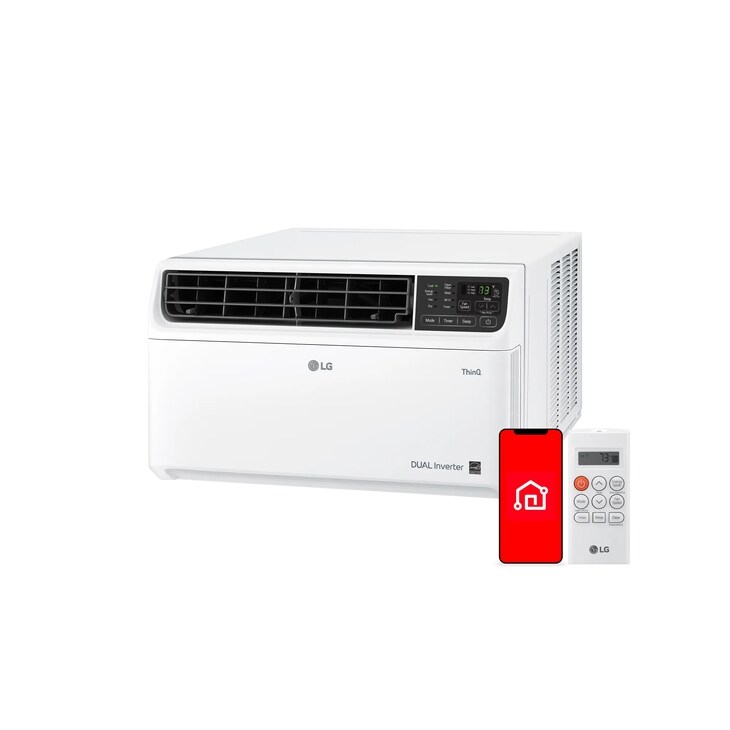


The GE Profile ClearView 10,300 BTU Inverter Window Air Conditioner is a good buy for a large bedroom, a primary suite or a living room, especially if your window is too short or too wide for a Midea U. It's a saddle-style window unit: it straddles the sill, with the compressor half outside and the other half inside, so more of the glass stays clear than with a box unit. ENERGY STAR lists the two inverter sizes, the 10,300 BTU PHNT10CC and the 12,200 BTU PHNT12CC, at CEER 14.7, and GE lists 40 dBA in quiet mode. It fits a wider range of windows than the Midea U: 20 to 40 inches wide with a 13-inch minimum opening.
Skip the fixed-speed 6,100 and 8,300, and read the model number before you buy, because the ClearView name covers two different machines. The 6,100 BTU AHTT06BC and the 8,300 BTU AHTT08BC look the same from the curb, but GE lists a rotary compressor with no inverter in both, rates them at CEER 11.5 and 11.4, and they aren't ENERGY STAR certified. That's awkward for bedroom shoppers, since the smallest inverter ClearView is rated by GE for rooms up to 450 square feet.
Go in knowing two things. The complaint we see most is a low, wall-shaking vibration when the compressor runs, and GE's warranty is one year with no labor coverage, so use the return window to test it hard.
A note on the link: when we checked in October 2026, Amazon's 10,300 listing had no featured offer. One third-party seller offered it new, and the rest of the offers were used scratch-and-dent units, so pick an offer whose condition says New. The 12,200 BTU inverter, which Amazon sold as a bundle with a GE Profile air purifier, had no sellers at all, so we don't link it.
Where the ClearView earns its price
- Closed sash: the saddle design puts the closed window sash between the room and the compressor, and a couple of owners describe it as quiet inside the house.
- Inverter efficiency: the 10,300 and 12,200 BTU sizes are inverter units, ENERGY STAR certified at CEER 14.7.
- Quiet mode: GE lists 40 dBA in quiet mode on both inverter sizes.
- Window range: wider than the Midea U, LG 10,000 or Windmill: 20 to 40 inches wide, 13-inch minimum opening height.
- Power: a standard 115V plug; the 10,300 is rated at 9.8 amps.
Where it falls short
- Same name, different machine: the 6,100 and 8,300 BTU ClearViews are fixed-speed, CEER 11.5 and 11.4, not ENERGY STAR.
- Vibration: a low drone that shakes the wall is the ClearView's known complaint, and foam pads don't always cure it. The reports come from people who have the problem, so we can't tell you how common it is.
- Weight: 80 pounds for the inverter sizes, 70.55 for the small ones.
- Warranty: one year of replace, repair or refund, with no labor coverage.
- Cooling only: and GE's manual says not to run it below 32°F outdoors.
Which rooms and windows it fits
The 10,300 belongs in a room of roughly 350 square feet or more, and the ClearView lineup has no good answer for a small bedroom. ENERGY STAR's sizing chart calls for 6,000 BTU in a room of 150 up to 250 square feet, and GE rates its smallest ClearView, the 6,100, for up to 250, but that size is the fixed-speed one. ENERGY STAR warns that an oversized unit will cool the room before it has a chance to remove the humidity, which leaves it feeling damp and clammy. An inverter softens that by slowing down, but we wouldn't put a 10,300 BTU unit in a 150 square-foot room to get one.
ENERGY STAR's chart puts 9,000 BTU at 350 up to 400 square feet and 10,000 at 400 up to 450, and it adds 10 percent for a very sunny room. That covers a big bedroom, a top-floor or west-facing room that bakes in the afternoon, or a living room. The 12,200 is for open rooms up to about 550 square feet, which is where ENERGY STAR's chart tops out its 12,000 BTU row. Compare current prices before you assume the smaller unit is the cheaper one, and check that the offer you pick is sold new: in October 2026 most Amazon offers on the 10,300 were used scratch-and-dent units.
Window fit is the ClearView's strongest card. GE lists a 20 to 40-inch opening width and a 13-inch minimum opening height for all four sizes. The Midea U needs 22 to 36 inches wide and 13.75 inches tall. If your window is 21 inches wide, 38 inches wide, or opens to 13 1/2 inches, the ClearView is the saddle unit that fits. One owner with plastic-framed windows flush to the siding and no outside sill found they didn't need one: the unit came with everything to seal the gaps.
Pick something else if:
- Your bedroom is under about 250 square feet: a 6,000 BTU LG Dual Inverter or an 8,000 BTU Midea U gives you an inverter at the right size; the 6,100 ClearView doesn't.
- You need spring and fall heat: no ClearView has a heat mode.
- Nobody can help you lift it: eighty pounds through a window is a two-person job.
- You sleep lightly in an older house: with uninsulated walls. Read the vibration section below first.
Inverter or fixed-speed: the four sizes
The ClearView sells under nearly identical titles at every size, so the model number is how you tell which compressor you're getting. Figures are GE's except CEER, which is ENERGY STAR's listing for the inverter sizes. Noise is high fan / low fan / quiet mode.
Model | Cooling | Compressor | CEER | ENERGY STAR | Room (GE) | Weight | Noise (GE) | Rated amps |
|---|---|---|---|---|---|---|---|---|
PHNT10CC (ENERGY STAR model PHNT10CCH1) | 10,300 BTU | Inverter | 14.7 | Yes | Up to 450 sq ft | 80 lb | 54 / 51 / 40 dBA | 9.8 A |
PHNT12CC (ENERGY STAR model PHNT12CCH1) | 12,200 BTU | Inverter | 14.7 | Yes | Up to 550 sq ft | 80 lb | 56 / 53 / 40 dBA | 12.7 A |
AHTT08BC | 8,300 BTU | Fixed-speed rotary | 11.4 | No | Up to 350 sq ft | 70.55 lb | No figure | No figure |
AHTT06BC | 6,100 BTU | Fixed-speed rotary | 11.5 | No | Up to 250 sq ft | 70.55 lb | 52/63 dBA high fan, 41 quiet mode | No figure |
GE's own titles help a little: the 10,300 and 12,200 product names include "ENERGY STAR" and "Inverter," and the 6,100 and 8,300 names don't. Amazon titles are less consistent. Some ClearView listings also come bundled with a GE Profile air purifier, which is a different purchase from the AC alone. Check the model in the listing details and on the box before you install, while the return window is still open.
GE's spec field for the 10,300 and 12,200 says "Variable Speed" and lists inverter technology; ENERGY STAR records a variable-speed compressor for both. For the 6,100 and 8,300, the same GE field just says "Yes" for a rotary compressor, with no inverter listed, and ENERGY STAR doesn't list the AHTT06BC or AHTT08BC at all. All four use R32 refrigerant, and you never handle it: these are sealed plug-in appliances.
Efficiency, noise and power
CEER (combined energy efficiency ratio) is the room AC rating; higher means more cooling per watt. GE's product pages list CEER 14.6 for both inverter sizes, while ENERGY STAR's listing and the EnergyGuide label for the PHNT10CCH1 both say 14.7. We print 14.7 because the label and the independent listing agree, and the 0.1 gap doesn't change any buying decision. The fixed-speed sizes are another matter. Energy use scales with 1 divided by CEER, so the 10,300 inverter uses about 22% less electricity than the 8,300 fixed-speed ClearView for the same cooling (11.4 ÷ 14.7 = 0.78).
Do one more division. GE lists the cooling wattage at 900 watts for the 10,300 and 710 for the 8,300. That works out to about 11.4 BTU per watt for the inverter and 11.7 for the fixed-speed unit at GE's listed cooling watts. So the inverter doesn't win at full blast on a heat-wave afternoon. It wins in the hours when the room needs less than its full output and it can slow down instead of switching off and on.
The small fixed-speed units get two noise numbers on GE's pages, such as 52/63 dBA on high fan for the 6,100. GE doesn't say what the second figure measures, and we couldn't find anything GE published that explains it, so we won't guess. We don't measure sound ourselves, and GE doesn't state a test distance, so treat these as GE's figures for comparing ClearView sizes, not as a match for another brand's sheet.
Every ClearView is a 115-volt unit. GE's manual for the inverter models says they need "a 115/120-volt AC, 60-Hz grounded outlet protected with a 15-amp time-delay fuse or circuit breaker." The manual also says the air conditioner "should always be plugged into its own individual electrical outlet," to avoid overloading house wiring. We'd put the 12,200 on a circuit with nothing else on it, and have an electrician check the circuit if you don't know what shares that outlet.
The inverter models' manual lists cooling operation at 70 to 109°F outdoors and 70 to 90°F indoors. It also calls the unit cool-only and says it "must not be used when the outdoor temperature is below freezing (32°F)." There's no heat mode on any size.
What the install involves
No refrigerant work and no wiring; it's a plug-in appliance. The work is in the lifting and the fitting. At 80 pounds for the inverter sizes, getting the outside half over the sill and onto the window is a two-person job, and on a second floor it's a careful one. One shopper looked at a ClearView in a store, decided it was too large and heavy, and bought a regular box unit instead. Even the 6,100 is 70.55 pounds, heavier than LG's 63-pound 6,000 BTU box unit.
Measure before you order: the width of the opening and the opening height with the sash raised. GE's limits are 20 to 40 inches wide and at least 13 inches tall. The sill-less install above is encouraging, but it's one report, so if your window is unusual, read the installation section of the manual for your model before you buy.
Level it and seal it carefully. Vibration is the biggest risk with this unit, and an owner of two 8,000 BTU ClearViews puts the buzzing others describe down to a unit that isn't level or isn't supported by foam where the sill is uneven. That's an owner's explanation, not GE's, but it costs nothing to get the unit level before you blame the compressor.
Plan for the screen and the water. One owner was left without a window screen after the install, with only the window, the foam and the weatherstripping from the kit between them and the bugs. Outside, the same 8,000 BTU owner describes the fan flicking condensate onto the outdoor coil, which helps efficiency but makes a slapping noise outdoors that they say eases once the house dries out. If the unit sits over a deck or next to a neighbor's bedroom window, that matters.
Vibration, failures and the warranty
Test it at night, in your room, inside the return window. The owner record on the ClearView is thin and comes mostly from troubleshooting posts, so it skews negative. There was no CPSC recall on the ClearView when we checked in October 2026.
Vibration is the pattern, with a caveat. Six owners in a single discussion of the problem say their unit does it, and that discussion collects the people who have it, not a sample of all owners. Two of them name the 12,000 BTU class, which in GE's current lineup is the inverter PHNT12CC, though neither gave a model number, so an inverter compressor doesn't rule the problem out. Foam pads didn't fix it for one owner after five days. Another decided to return theirs after a couple of hours, then found it calmed down after about an hour of running, with the vibration about 90% gone by the next day; it came back once after a week switched off and calmed again within about 20 minutes. In a 105-year-old house, uninsulated walls may be what carries it. Against that, a couple of owners describe the unit as quiet inside the house. We can't tell you which install you'll get.
Hardware failures are single reports, not a pattern, and none covers more than a season or two, so there is no longevity record yet:
- A failed 8,300: one of two AHTT08BC units bought together ran fine; the other threw a P1 code plus a code its owner describes as water not moving properly, kept shutting off after about 15 minutes even after the retailer serviced it, and went back to the store.
- A used 12,200: a PHNT12CCH1 bought used, under a year old, was barely cooling with no error code.
- Icing: ice inside the unit, along with weak, uneven airflow.
- Noise: a sporadic, sometimes very loud high-pitched noise about a month in.
- No issues: the owner of two 8,000 BTU units reports zero issues; their one annoyance is that it defaults to Eco mode between uses.
The warranty is short, and the claim process changes partway through. GE's manual for the inverter models gives one year from the date of purchase: "Replacement, repair, or refund of the original retail price for any product which fails due to a defect in materials or workmanship." GE decides which, and a replacement unit is covered only for the rest of the original year. GE's product pages list the labor warranty as "No Warranty" and the parts service as "Return to vendor." The manual also sets out a separate claim process for your retailer's allowable return period, when the claim goes through the store, and a GE process for the rest of the year. In practice, the retailer's return window is the cheapest time to find a vibration or a bad unit, so run it hard in the first weeks.
How it compares
CEER is ENERGY STAR's listing; the rest is each maker's figures. Noise test distances aren't stated by either brand, so read dBA as a rough comparison.
Unit | Style | CEER | Window width / min opening | Weight | Low noise | Warranty |
|---|---|---|---|---|---|---|
GE ClearView 10,300 (PHNT10CC) | Saddle, inverter | 14.7 | 20-40 in / 13 in | 80 lb | 51 dBA low, 40 quiet mode | 1 yr replace, repair or refund; no labor |
Midea U 8,000 (MAW08V1UWT) | Saddle, inverter | 15 | 22-36 in / 13.75 in | No figure | No figure | No figure |
LG 6,000 (LW6023IVSM) | Box, inverter | 15.5 (Most Efficient) | No figure | 63 lb | No figure | 1 yr parts and labor |
LG 10,000 (LW1022FVSM) | Box, inverter | 15 | 22-36 in / 13 in | 62 lb | 50 dBA low, 44 sleep | 1 yr parts and labor |
Windmill 10,000 WhisperTech | Box, inverter | 15 | 23-37 in / 14 in | 63 lb (8.7 A) | No figure | No figure |
Windmill 12,000 WhisperTech | Box | 13.5, not ENERGY STAR | No figure | No figure | No figure | No figure |
- Midea U: the other saddle-style inverter unit, and the one we'd pick first for a typical bedroom. It's a bit more efficient than the ClearView, and it's an inverter at a bedroom-sized capacity, which the ClearView can't offer. Earlier U models were recalled in June 2025 over mold from pooled water, so check the model suffix; the V1UWT now on Amazon isn't on that list. Choose the ClearView when your window falls outside the U's range or you need 10,000-class capacity in a saddle unit.
- LG Dual Inverter: a box unit, whose chassis runs straight through the window opening with no closed sash between the room and the compressor. For a small bedroom the LG 6,000 uses about 26% less electricity than the 6,100 ClearView at CEER 11.5 for the same cooling (11.5 ÷ 15.5 = 0.74). Amazon had no offers on that LG when we checked in October 2026, so our pick links LG's own store. At 10,000 BTU the LG is lighter, and LG's year of parts and labor beats GE's year with no labor. LG's 8,500 and 12,000 BTU sizes carry power figures LG's own documents don't resolve, so we don't compare amps there.
- Windmill: a direct-to-consumer box unit. The 10,000 BTU WhisperTech is lighter and a touch more efficient than the 10,300 ClearView, but like any box unit it has no closed sash between the room and the compressor. At 12,000 BTU the ClearView is the more efficient of the two.
- Heat: none of these four heats. If you want spring and fall heat from the window, look at a reverse-cycle window unit; for a room you'll heat and cool for years in a house you own, a ductless mini-split is the long-term answer.
Who should buy the ClearView
Buy the 10,300 BTU inverter ClearView for a room of roughly 350 to 450 square feet when you want a closed sash between you and the compressor and your window is too narrow, too wide or a little too short for a Midea U. Buy the 12,200 for a big open room, and give it a circuit of its own; Amazon had no sellers for it when we checked, so look for it from a GE dealer. Skip the 6,100 and 8,300: they're fixed-speed units that cost energy every summer, and an LG 6,000 BTU Dual Inverter or an 8,000 BTU Midea U does the small-bedroom job better. Whatever size you get, have two people for the install, level it carefully, and run it overnight in the first week so you find out about any vibration while the store will still take it back.
Score breakdown
The inverter 10,300 and 12,200 BTU sizes are ENERGY STAR certified at CEER 14.7, GE lists 40 dBA in quiet mode, and the saddle design puts a closed sash between the room and the compressor. It trails the Midea U, LG and Windmill inverter units slightly on CEER, has no heat mode, and the smallest inverter size is rated for 450 sq ft, so small bedrooms get the fixed-speed CEER 11.4-11.5 models.
There was no CPSC recall when we checked, but wall-shaking vibration is a known complaint, including on the 12,000 BTU class, and the reports come from people who have the problem, so we can't size it. Single owners report a failed 8,300 BTU unit that was returned to the store, a used 12,200 that barely cooled, icing, and a loud high-pitched noise. GE's warranty is one year of replace, repair or refund with no labor coverage.
When we checked in October 2026, Amazon's 10,300 BTU inverter listing had no featured offer; the one new unit, from a third-party seller, cost more than the Windmill 10,000 BTU inverter and about what LG's 10,000 BTU Dual Inverter did, and the 12,200 had no sellers at all. The one-year, no-labor warranty is thin for an 80-pound unit you'll have to haul back to the store, and the 6,100 and 8,300 are poor value next to inverter units at the same size.
GE Profile ClearView on Amazon.
The Evidence Behind Our Verdict
Owner reports on the GE Profile ClearView come from r/hvacadvice, and most come from troubleshooting posts, so they lean negative. The clear pattern is vibration: six owners in a single discussion of it say their unit does it, four in detail and two only that they have the same problem, and one says it settled after the first hour of running. That discussion is built around the complaint, so it's self-selected.
Two owners describe it as quiet indoors, one of them with no outside sill, who found the kit had everything needed. Failures (a fixed-speed 8,300 BTU unit that was returned to the store, a used 12,200 that barely cooled, icing, a high-pitched noise) are each a single report.
Our rating above is our own editorial call. What follows is the field evidence we weighed to reach it: first-hand reports from owners on Reddit and independent HVAC and DIY forums, which we lean on more than manufacturer-influenced published reviews because unsponsored owners tend to be the more candid signal.
What Reddit Is Saying
“Yup, it turns out you do not need an outdoor window sill to make this work. The unit came with all of the stuff to seal the spaces around the unit. It works like a charm and is super quiet inside the house”
“I bought 2x 8000 BTU units. Zero issues. The only annoyance is that it defaults to Eco mode between uses. Looks fantastic compared to other units in the window. I've seen some common complaints for these. One is that they make a buzzing / vibration noise id attribute that to not leveling the unit properly or using foam on the underside if uneven. The other is the fan outside blows water on the condenser/radiator for cooling / energy efficiency, which produces an annoying sound.”
“You know what? It actually calmed down after about an hour of running. I left it in son’s window overnight - he turned it on the next day while I was at work, and by the time I was home the vibration had dampened 90%. It made the diesel generator vibration one more time after my son had it off for a week, but again calmed within 20 mins or so.”
“I have a GE Profile Clearview AC, it’s working great but I’m getting scared because there is no window net anymore to block off bugs.”
“I installed a new window AC (12000) and what I’m noticing is that when the compressor engages my entire wall vibrates. A lot. I don’t know if that’s common to this design, a factor of the size (like would the 6000 version be less) or what, but the smaller LG I used to have didn’t do this to my wall.”
“Yea this unit is maddening. I see other threads complaining about rattling but the low frequency tones of the compressor are just so annoying”
“Mine is doing this, it's been five days and a hundred different foam pad arrangements and I am over it.”
“I have the same supremely annoying issue with my walls vibrating whenever the compressor comes on. I've seen videos online where people rave about how quiet the unit is; which leaves me scratching my head, wondering why I can't get this low thudding noise to go away. Part of me thinks the issue lies with installation in a newer house vs. an old one. My house is 105 years old, which means there's no insulation in the walls.”
“I bought 2 of the ge units 3 weeks ago (AHTT08BC from BestBuy). I’m in MA and it’s been pretty hot and humid. One unit is great, the other is giving big issues. There is a flashing light that gives a P1 code and another code related to water not moving properly. We do all the troubleshooting then it will work for a bit then essentially turn off.”
“I picked up a GE Clearview (PHNT12CCH1) AC that I picked up recently from Marketplace. The unit is less than a year old, but cools in a very limited capacity (69F outlet temp, vs 72F ambient).”
“I just installed this unit about a month ago. The noise is sporadic but can be VERY loud at times. Sometimes it happens when first turning it on, sometimes after it’s been on for a while.”
Frequently asked questions
Is the GE Profile ClearView worth it?
When we checked in October 2026, Amazon's 10,300 BTU inverter listing had no featured offer; the one new unit, from a third-party seller, cost more than the Windmill 10,000 BTU inverter and about what LG's 10,000 BTU Dual Inverter did, and the 12,200 had no sellers at all. The one-year, no-labor warranty is thin for an 80-pound unit you'll have to haul back to the store, and the 6,100 and 8,300 are poor value next to inverter units at the same size.
How reliable is the GE Profile ClearView?
There was no CPSC recall when we checked, but wall-shaking vibration is a known complaint, including on the 12,000 BTU class, and the reports come from people who have the problem, so we can't size it. Single owners report a failed 8,300 BTU unit that was returned to the store, a used 12,200 that barely cooled, icing, and a loud high-pitched noise. GE's warranty is one year of replace, repair or refund with no labor coverage.
How well does the GE Profile ClearView perform?
7, GE lists 40 dBA in quiet mode, and the saddle design puts a closed sash between the room and the compressor. 5 models.
What do real owners say about the GE Profile ClearView?
Owner reports on the GE Profile ClearView come from r/hvacadvice, and most come from troubleshooting posts, so they lean negative. The clear pattern is vibration: six owners in a single discussion of it say their unit does it, four in detail and two only that they have the same problem, and one says it settled after the first hour of running. That discussion is built around the complaint, so it's self-selected.
Options Worth Checking Out

Midea 8,000 BTU U-Shaped Window AC (MAW08V1UWT)
The saddle-style inverter for a typical bedroom, a size the ClearView only sells as fixed-speed. ENERGY STAR CEER 15, not recalled (check the V1UWT suffix), fits 22-36 in windows. No featured offer when we checked, only a third-party seller.
Read our full review: we scored it 7.5/10


