Midea U Window Air Conditioner Review: The Quiet Pick, Check the Suffix
By Teo Varnadoe · Updated October 2026
Independent editorial review. We never accept payment for coverage, though we may earn a commission if you purchase through our links.

Spec sheet
| Sizes (DOE BTU) | 6,000 / 8,000 / 10,000 / 12,000; 8,000 rated for up to 350 sq ft |
| Efficiency (ENERGY STAR, MAW08V1UWT) | CEER 15; not Most Efficient (U2QWT 8k/10k: CEER 16, Most Efficient) |
| Power | 115V plug; 8.78 A (8k) / 12.17 A (12k), original V1QWT retailer spec |
| Window fit (listing) | Single- or double-hung, 22-36 in wide, 13.75 in minimum height |
| Wall thickness (U1QWT manual) | 3-10.5 in, inside of window to outside wall |
| Noise (Midea figures) | "As low as 32 dBA" (listing); 42 dB low / 47 dB high in retailer spec (original 8k) |
| Heat mode | None on any U model |
| CPSC recall #25320 (June 2025) | 8k-12k V1QWT, AV1QWT, W1QWT and U1QWT; V1UWT and 6k MAW06V1QWT not listed |
| Warranty | Listing: 1 yr limited; V1QWT/U1QWT manuals add 5 yr sealed system, 3 yr compressor |
| Owner-reported gotcha | Built-in sensor misreads room temp; remote Comfort Sense fixes it |
Verdict
Owner reports on the Midea U from owner forums lean positive: many describe it as quiet, one who replaced traditional window units and one who came from a portable both rave about the change, and owners who've run both sizes say the 12,000 BTU runs a louder fan than the 8,000. The split is an inverter whine: 12 or more owners of earlier U models describe a high-pitched tone, two more hear it mainly at startup, and four or more hear none. Of the owners who ran a U and an LG Dual Inverter side by side, six found the whine worse on the Midea and two on the LG. The recurring frustrations are a fiddly bracket install on older windows and a built-in thermostat that misreads the room until the remote is set up as the sensor. Hardware failures show up only as isolated reports.
Read full take ↓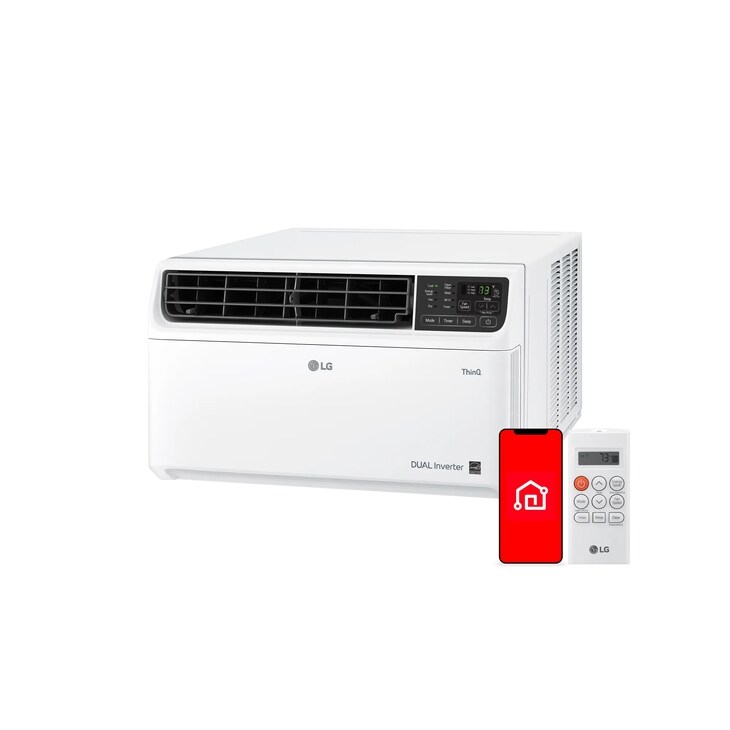


The Midea 8,000 BTU U-Shaped Window Air Conditioner is the window unit we'd put in a bedroom first, as long as your window fits it and the model number isn't on the recall list. The U-shaped chassis straddles the sash, so the compressor sits outside the glass and the window closes down into the notch between the two halves. Pair that with an inverter compressor that slows down instead of slamming on and off, and you get a window AC quiet enough that one owner holds phone calls right next to it. The listing we link is the MAW08V1UWT, a model ENERGY STAR certified in October 2025 at a CEER of 15. When we checked in October 2026, that listing had no featured offer, only a third-party seller; the 6,000 and 10,000 BTU listings of the same generation were sold by Amazon.
Read two warnings before you click buy. Midea has sold the U under at least six model suffixes with near-identical names, and the earlier 8,000 to 12,000 BTU models were recalled in June 2025 over mold from water that pools inside the unit. Some Amazon listings still show recalled model numbers, so the suffix on the listing and on the label is what tells you which one you're getting. And the U is picky about windows: the listing and Midea's manuals call for an opening 22 to 36 inches wide and at least 13.75 inches tall, and owners with old sills, short sashes or louvered windows spend real time making it fit.
If you need heat, it isn't the right unit at all, because no U-shaped Midea we could find on Midea's US store has a heat mode.
What we like
- Quiet where it counts: the compressor lives outside the window, and many owners call it very quiet.
- Efficient for a plug-in unit: CEER 15 on the MAW08V1UWT we link. The 8,000 and 10,000 BTU U2QWT revision rates CEER 16 with ENERGY STAR Most Efficient status.
- Inverter throttling: it holds a temperature instead of cycling the whole compressor on and off every few minutes.
- Plug-in power: a standard 115V plug; Midea rated the original 8,000 BTU model at 8.78 amps.
- In the box: an outside support bracket and foam pieces for sealing the gaps.
What we'd change
- The recall: CPSC recall #25320 covers the 8,000-12,000 BTU V1QWT, AV1QWT, W1QWT and U1QWT models, and some Amazon listings still show those model numbers. You have to check the suffix.
- Window fit: strict. The sash height has to clear the unit, and the bracket has to be perfectly level or the window won't open and close.
- Thermostat: the built-in temperature sensor reads the air right at the unit, so it misjudges the room until you set up the remote as the thermostat.
- No heat: no U-shaped model on Midea's US store heats.
- The 12,000 is louder: it runs a louder fan than the 8,000, which matters if it sits next to your bed.
- Inverter whine: a high-pitched tone that 12 or more owners of earlier U models describe, while others hear nothing of the kind.
Which rooms and windows it fits
The U is built for one job: cooling a bedroom, home office or small living room through a sash window without the drone of a conventional box unit. Midea rates the 8,000 BTU model for up to 350 square feet and the 6,000 BTU model for up to 250. ENERGY STAR's sizing chart puts a room of 150 up to 250 square feet at 6,000 BTU and adds 10 percent for a very sunny room, so for a typical bedroom the 6,000 BTU U is the by-the-chart size. We'd step up to the 8,000 for a west-facing or top-floor bedroom near the top of that range, where an inverter can still turn itself down on mild nights; ENERGY STAR warns that an oversized unit cools before it removes humidity.
Don't size up to the 12,000 just because it's on sale. Owners who've run both sizes say the 12,000's fan is a lot louder, never throttles down as low as the 8,000, and seems to default to a slightly higher fan speed, which you can turn down in the app. One who ended up with a 12,000 next to their bed found its cycling hard to sleep through, though they kept it. The published numbers point the same way: a retailer spec table for the original V1QWT models puts the 8,000 BTU at 47 dB on high and the 12,000 at 52 dB, with both at 42 dB on low. The 12,000 earns its place in a 500-square-foot open room, not in a bedroom.
Pick something else if:
- Your window is a slider or casement: or anything other than a single- or double-hung sash. The listing names those two window types only.
- Your sash opening is under 13.75 inches tall: the U needs that clearance to slide in.
- You want spring and fall heat: look at a window unit with a reverse-cycle heat mode instead.
- Your outlet is shared: with a space heater or other big load, and you were planning on the 12,000 BTU size.
Efficiency, power and the whine
The U line comes in 6,000, 8,000, 10,000 and 12,000 BTU (DOE) sizes. ENERGY STAR certifies the MAW08V1UWT we link at 8,000 BTU and CEER 15, and it does not meet ENERGY STAR's Most Efficient criteria. Other revisions rate higher (see the suffix table below). A higher CEER means more cooling per watt; going from 15 to 16 is about a 6% cut in power for the same cooling, which is nice but not worth chasing a hard-to-find listing.
Every U size is a 115V unit with a standard plug. The V1UWT listing doesn't print amps; a retailer spec listing for the original V1QWT models gives 8.78 rated amps for the 8,000 BTU and 12.17 for the 12,000. Midea's manuals say to "Be sure the electrical service is adequate for the model you have chosen" and point you to the serial plate, on the side of the cabinet behind the grille, for your unit's figures. They also say not to use an extension cord or an adapter plug. The 8,000 is easy to place; we'd give the 12,000 a dedicated circuit if you can, and ask an electrician if you don't know what else shares that outlet.
Plan on 42 dB at low fan, and treat Midea's 32 as a best-case marketing number. Midea's listing and store pages say the U runs "as low as 32 dBA." Midea's copy on a retailer listing for the original 8,000 BTU V1QWT says "as low as 42dB," with a 47 dB high / 42 dB low table. We don't measure sound, and the two numbers can't both be the same test. Owners fill in what the numbers miss: the U is widely called very quiet, and one who replaced traditional window units calls it a big upgrade.
The catch is a high-pitched whine from the inverter compressor drive, a thin tone some people hear clearly and others can't hear at all. It's common on earlier U models: 12 or more owners describe one, a couple more hear it mainly at startup, and plenty hear nothing. Owners who had a U and an LG Dual Inverter at the same time mostly found the whine worse on the Midea, six to two; we cover that matchup in our Midea U vs LG comparison. Every whine report we've seen predates the V1UWT models now on Amazon, which ENERGY STAR certified in September and October 2025, but ENERGY STAR lists the 8,000 BTU V1UWT at the same cabinet size and weight as the original, so we wouldn't assume the whine is gone. One owner found it dropped sharply once they fitted the foam blocks the way the manual shows. Buy from a seller with an easy return and run it overnight on low fan in the first week; if the tone bothers you, send it back while you can.
Midea's V1QWT manual lists a cooling range of 64-109°F outdoors and 60-90°F indoors. There's no heat mode on any U model in the spec data we checked, and ENERGY STAR lists heating mode as No for the MAW08V1UWT. Midea's heat-capable window units, such as the 8,000 BTU MAW08HV1CWT, are sold as regular inverter window units; Midea doesn't market them as U-shaped. Its Amazon listing for that model says the heat pump function works when the outside temperature is above 41°F, so treat it as spring and fall heat.
Which U is on the listing: model suffixes and the recall
Midea has sold the U under nearly the same Amazon title through several revisions, and the model suffix is the only way to tell them apart. From the CPSC recall list and ENERGY STAR's database:
Suffix | Sizes (BTU) | ENERGY STAR certified | CEER | Recalled? |
|---|---|---|---|---|
V1QWT (the original U) | 8,000, 10,000, 12,000 | No figure | 15 | Yes |
AV1QWT (the original U) | 8,000, 12,000 | No figure | 15 | Yes |
W1QWT | 8,000, 10,000, 12,000 | No figure | No figure | Yes |
U1QWT | 8,000, 10,000, 12,000 | November 2023 | 16 / 16 / 15.2 | Yes, in those three sizes |
U2QWT | 8,000, 10,000, 12,000 | December 2024 | 16 / 16 / 15.2 (8,000 and 10,000 Most Efficient) | No |
V1UWT | 6,000, 8,000, 10,000, 12,000 | September and October 2025 | 15.1 on the 6,000, 15 on the rest | No (the MAW08V1UWT is the model we link) |
U1KWT | 7,800, 10,000, 12,000 | July 2026 | 15.1 / 16 / 16 | No |
MAW06U1QWT | 6,000 | May 2026 | 15.1 | No |
No 6,000 BTU model is on the recall list, including the 6,000 BTU MAW06V1QWT, despite its V1QWT suffix. The 2026 U1KWT re-rates the 8,000 BTU size at 7,800 BTU.
The recall is CPSC #25320, announced June 5, 2025. Midea recalled about 1.7 million U and U+ window air conditioners because pooled water inside the unit can fail to drain quickly enough, which can lead to mold growth. It covers units sold from March 2020 through May 2025, including the same hardware sold under other brand names such as Frigidaire, Danby and Insignia. The notice tells owners to contact Midea immediately for a free repair or a full or prorated refund. If you already own one with a recalled suffix, do that before you reinstall it this season.
On Amazon, check the model number in the listing details, not the title. When we looked in October 2026, the listings titled "U Shaped Window Air Conditioner" showed V1UWT model numbers, including the MAW08V1UWT on the 8,000 BTU listing we link. When we checked, that listing had no featured offer, only a third-party seller, while the Midea 6,000 BTU U-Shaped Window AC (MAW06V1UWT) and the Midea 10,000 BTU U-Shaped Window AC (MAW10V1UWT) were sold by Amazon. Pick by room size, not by which one is available: the 6,000 is the by-the-chart size for most bedrooms, and the 10,000 is for a larger room. Two older listings titled "U-Shaped Smart Inverter Window AC" still showed the recalled MAW08V1QWT and MAW10V1QWT. We can't tell from a listing whether a unit has had the recall repair, so we don't link those. Check the label on the box when it arrives, too. If it's an 8,000-12,000 BTU V1QWT, AV1QWT, W1QWT or U1QWT, contact Midea before you install it.
What the install involves
Budget an afternoon for the first one. There's no refrigerant work and no wiring; it's a plug-in appliance, but a fussier install than a box unit. The U hangs on an outside support bracket that Midea's manuals have you screw to the sill, with 1/8-inch pilot holes and 1/2-inch Type A screws on a lipped sill. The bracket has to be perfectly level or you can't open and close the window, and old windows mean trial and error with the bracket height, or sill lips too small to catch the bracket. ENERGY STAR lists the 8,000 BTU MAW08V1UWT at 53.1 pounds, 19.2 inches wide and 13.5 inches tall. Midea's manual recommends two people for the install.
Measure three things before you order:
- Opening width: 22 to 36 inches, per the listing and the manuals.
- Opening height: at least 13.75 inches.
- Wall thickness: Midea's U1QWT manual says the bracket works on walls 3 to 10.5 inches thick from the inside of the window to the outside wall.
One owner with a 30-inch-wide, 12.1-inch-tall opening squeezed a U in anyway and nearly broke the window getting it out. That opening is 1.65 inches below Midea's stated minimum, so treat a window like that as out of spec, not as proof a short window will work.
Drainage deserves more attention than the instructions give it, given what the recall was about. The outdoor half should sit slightly lower than the indoor half so condensate runs outside. One owner's deep window trough sat right under the drain hole, and on a humid day water filled the sill and ran into the house, even with the unit tilted well back. They added a hose so the water dripped farther outside, and later got rid of the unit. Check where your drain hole lands before you lower the sash.
Seal the gaps. The kit includes foam pieces, and one owner says the seal is good enough to leave the unit in year-round. Below the manual's 64°F outdoor cooling floor it does nothing for you, so in a cold climate you're choosing between pulling it out and leaving a sealed, idle unit in the window.
Warranty fine print matters here. The listing we link states a one-year limited warranty. Midea's manuals for the V1QWT and U1QWT add five years on the sealed system and three years on the compressor; we couldn't find a manual for the V1UWT, so read the one in your box. The V1QWT manual also lists, among the owner's responsibilities, "proper installation by an authorized service professional," and says failure due to improper installation isn't covered. Follow the instructions to the letter, and keep your receipt and a photo of the finished install.
Living with it: Comfort Sense, Eco mode and failures
Turn on Comfort Sense the day you install it. Day to day, the U is easy to live with, and the most common complaint is about the thermostat, not hardware: the built-in sensor reads the air right at the unit, so it can think the room is colder or warmer than it is. Comfort Sense is a remote-only feature that turns the remote into the thermostat. Midea's U1QWT manual says the remote sends its temperature reading to the unit at 3-minute intervals, and it needs a clear line to the unit because it doesn't talk over Wi-Fi. Set it up once, leave the remote on a dresser pointed at the unit, and keep using the app for everything else. Owners who switch it on say their set point finally matches the room.
Eco mode, which Midea's manuals call Energy Saver, is the other setting worth understanding. Per the manual, "The fan will continue to run for 3 minutes after the compressor shuts off," and then it cycles on for 2 minutes at 10-minute intervals until the room warms past the set point. That's why the noise rises and falls with Eco on. With Eco off, the fan keeps running. Two catches: the U1QWT manual says Energy Saver is on by default, and both manuals say that turning the unit off and back on with the power button switches it back on in Cool, Dry and Auto. For a light sleeper we'd turn Eco off after every power-up and set the fan low.
One owner with a Midea 12,000 BTU of unknown revision saw the app report 400-650 watts while holding temperature. That's an owner-reported figure. Midea's retailer spec for the original 12,000 BTU V1QWT lists 1,140 rated cooling watts, so if the two are comparable, that's roughly 35-57% of rated power, which is what inverter throttling is supposed to look like.
Hardware failures are scattered one-offs rather than a pattern: a blown capacitor on the control board after a winter in a closet, a remote that stuck on one fan speed, a rattle cured by setting a rock on top of the outside half, a high-pitched noise on a 12,000 BTU unit, and a Wi-Fi connection that dropped repeatedly until its owner turned on IPv6 in the router. The pattern that does exist is the one the CPSC acted on: water and mold in the earlier models. ENERGY STAR lists the V1UWT as on the market only since fall 2025, which isn't long enough for us to call that problem fixed, so tilt the unit correctly, run the fan to dry the coil, and look inside at the start of each season.
There's one report on Midea support: an owner with an unusual sill asked about mounting options and was told to follow the printed instructions without deviation.
How it compares
- LG Dual Inverter: the closest rival on efficiency and quiet, in a standard box chassis that runs straight through the window opening. The size LG publishes a window range for is the 10,000 BTU LW1022FVSM: 22 to 36 inches wide with a 13-inch opening height, three-quarters of an inch less than the U's 13.75. You give up the U's main advantage: with a box unit, there's no closed sash between the room and the compressor. It usually costs more, too. We cover the matchup in detail in our Midea U vs LG comparison.
- GE Profile ClearView: GE's saddle-style inverter unit, which straddles the sill and, like the U, keeps the compressor outside. GE's Amazon listings for the 10,300 and 12,200 BTU inverter models say the window can open and close freely after install, and it fits windows 20 to 40 inches wide with a 13-inch minimum opening height and at least 10 inches from the floor. If daylight through the window matters to you as much as quiet, or your window is a bit too short or too wide for the U, it's the one to cross-shop.
- Windmill: a direct-to-consumer box unit sold on design and easy install. The 8,000 BTU WhisperTech model we list uses an inverter compressor, but like any box unit its chassis runs straight through the opening, with no closed sash between the room and the compressor, and it needs a 14-inch opening height. It's a reasonable pick for a window the U won't straddle.
- Portable AC: no contest. A portable puts the whole compressor in the room with you, and one owner who switched from a portable to the U found the indoor compressor too loud to stand. If your window can take a U, take the U.
- Mini-split: quieter still and can heat, but it's a different budget and usually a professional install. For one bedroom in a rental, the U is the sensible answer; for a room you'll heat and cool for ten years in a house you own, read our mini-split vs window AC guide first.
Should you buy one?
Yes, if you have a window that fits and you want about the quietest cooling a plug-in window unit can offer. Buy the 8,000 BTU size for a bedroom and the 10,000 for a larger room, confirm the model number isn't on the recall list (V1UWT, U2QWT, U1KWT and the 6,000 BTU models are all clear), and set up Comfort Sense the day you install it. Skip it if your window is too short, isn't single- or double-hung, or you need heat; an LG Dual Inverter or a heat-capable window unit is the better fit for those rooms.
Score breakdown
Among the quietest plug-in window cooling, per owner reports and Midea's figures, because the compressor sits outside the glass and the inverter throttles down instead of cycling. The MAW08V1UWT we link rates CEER 15; the U2QWT revision reaches 16 with Most Efficient status. It loses points for having no heat mode and for a built-in sensor that misreads the room until you set up Comfort Sense.
CPSC recall #25320 covers the 8,000-12,000 BTU V1QWT, AV1QWT, W1QWT and U1QWT models over mold from pooled water. The V1UWT we link, the U2QWT, the U1KWT and the 6,000 BTU models (including the MAW06V1QWT) are not on the list. Other owner-reported failures are one-offs, not a pattern, but post-recall units haven't been in homes long enough to call the drainage problem solved.
It sells in the same range as other inverter window units and usually for less than LG's Dual Inverter, while running quieter in the room. The listing we link carries a one-year limited warranty, which is short for the price. The value depends on buying a model number that isn't on the recall list.
Midea U Window Air Conditioner on Amazon.
The Evidence Behind Our Verdict
Owner reports on the Midea U from owner forums lean positive: many describe it as quiet, one who replaced traditional window units and one who came from a portable both rave about the change, and owners who've run both sizes say the 12,000 BTU runs a louder fan than the 8,000. The split is an inverter whine: 12 or more owners of earlier U models describe a high-pitched tone, two more hear it mainly at startup, and four or more hear none. Of the owners who ran a U and an LG Dual Inverter side by side, six found the whine worse on the Midea and two on the LG.
The recurring frustrations are a fiddly bracket install on older windows and a built-in thermostat that misreads the room until the remote is set up as the sensor. Hardware failures show up only as isolated reports.
Our rating above is our own editorial call. What follows is the field evidence we weighed to reach it: first-hand reports from owners on Reddit and independent HVAC and DIY forums, which we lean on more than manufacturer-influenced published reviews because unsponsored owners tend to be the more candid signal.
What Reddit Is Saying
“They're so quiet you can carry on a phone conversation basically right next to them and people won't hear it. My previous units were so loud I couldn't use air conditioning while on a Zoom call. Installing them is a bit of an ordeal... the support bracket is a bit complicated and you have to get it perfectly level or you can't open/close your window.”
“I got the 12k last year and put in my bedroom. It was fine, hardly used any electricity due to running at a low capacity. It was kind of nice have so much extra capacity available cause I could leave it off during the day and at night crank it way down, and it took little time to bring the room to temp. Then it operated atca whisper all night.”
“What it does is turn the remote into the thermostat. The remote will report the temperature it's reading to the unit every few minutes, and I find that sensor is way more accurate than the sensor on the unit itself.”
“I have the 12k BTU u shaped unit, if it fits your window and you have a circuit that can power it, absolutely get it. It does a great job of throttling and circulation.”
“I installed it which took longer than expected since I have louvered windows. Once installed, it cooled the room in no time. This a/c is quiet on low and high speeds.”
“This thing is absolutely amazing so far. I went from a DeLonghi portable air conditioner which the whole unit sits in your room with the plastic tube venting out the window, while it works great I couldn't stand how loud it was having the compressor inside.”
“We have had an 8k BTU Midea U shaped window ac for a couple of summer now and have generally been very happy with it. It cools well and gets very very quite when it throttles itself down. We got a 12k unit at Costco last year at a good price and while it also does a great job at cooling the room, the fan is also a lot louder and it never seems to throttle itself down as low and quiet as the 8k unit.”
“In the app controls you can adjust the fan speed by percentage rather than just High/Medium/Low. With the eco setting off and the fan set to a lower speed on “Low”, the 12K unit should be a very similar noise level to the 8K unit. I have had an 8K and 12k unit and the 12k can throttle the compressor way down too, but it seems to default to a slightly higher fan speed.”
“I’m an extremely light sleeper and this is right next to my bed… the throttling on and off (eco mode or not) is annoying.”
“I'm not sure if this is a software bug or whatnot, but when my Midea 12k gets to its set temp and in Eco/Auto mode, it doesn't seem to throttle down. It stays running.”
“My bedroom window is 30 inches wide but stubby for height and it’s exactly 12.1 inches for the opening. I BARELY fit the Midea U unit in, but that got recalled. Almost busted my window taking it out.”
“I big time got rid of mine but if you’re using one, I’d either cut a hole or rip off the lip otherwise water is gonna fill in there if you’re not careful. Had one really hot and humid day and my window sill filled with water that started draining inside my house.”
“I have a U-shaped Midea window A/C that has been sitting in a dry closet for a winter. Today I tried to put it in and turn it on, it turned on but no cold air.”
Frequently asked questions
Is the Midea U Window Air Conditioner worth it?
It sells in the same range as other inverter window units and usually for less than LG's Dual Inverter, while running quieter in the room. The listing we link carries a one-year limited warranty, which is short for the price. The value depends on buying a model number that isn't on the recall list.
How reliable is the Midea U Window Air Conditioner?
CPSC recall #25320 covers the 8,000-12,000 BTU V1QWT, AV1QWT, W1QWT and U1QWT models over mold from pooled water. The V1UWT we link, the U2QWT, the U1KWT and the 6,000 BTU models (including the MAW06V1QWT) are not on the list. Other owner-reported failures are one-offs, not a pattern, but post-recall units haven't been in homes long enough to call the drainage problem solved.
How well does the Midea U Window Air Conditioner perform?
Among the quietest plug-in window cooling, per owner reports and Midea's figures, because the compressor sits outside the glass and the inverter throttles down instead of cycling. The MAW08V1UWT we link rates CEER 15; the U2QWT revision reaches 16 with Most Efficient status. It loses points for having no heat mode and for a built-in sensor that misreads the room until you set up Comfort Sense.
What do real owners say about the Midea U Window Air Conditioner?
Owner reports on the Midea U from owner forums lean positive: many describe it as quiet, one who replaced traditional window units and one who came from a portable both rave about the change, and owners who've run both sizes say the 12,000 BTU runs a louder fan than the 8,000. The split is an inverter whine: 12 or more owners of earlier U models describe a high-pitched tone, two more hear it mainly at startup, and four or more hear none. Of the owners who ran a U and an LG Dual Inverter side by side, six found the whine worse on the Midea and two on the LG.
Options Worth Checking Out

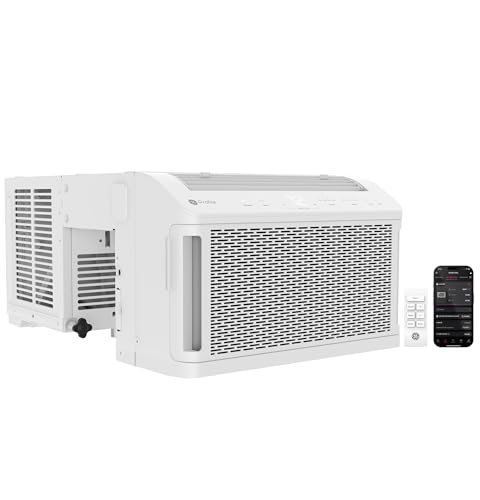
GE Profile ClearView 10,300 BTU Inverter Window AC (PHNT10CC)
GE's saddle-style inverter keeps the compressor outside and fits windows 20-40 in wide with a 13 in opening. The 10,300 BTU size, rated for up to 450 sq ft, so cross-shop it for a big bedroom or living room. Only a third-party seller had it new.
Read our full review: we scored it 6.8/10

Windmill 8,000 BTU Quiet Window Air Conditioner
Windmill's 8,000 BTU WhisperTech, an inverter box unit sold on design and a simple install, for a bedroom window the U can't straddle. A box chassis, so no closed sash sits between room and compressor, and it needs a 14 in opening height.
Read our full review: we scored it 5.7/10

Midea 8,000 BTU Smart Inverter Window AC with Heat
For the buyer who wants shoulder-season heat, which no U model offers. This Midea inverter unit heats and cools; Midea doesn't market it as U-shaped, and its listing says the heat pump works only when it's above 41°F outside.
Read our full review: we scored it 6.9/10
More Midea Reviews
See all →


How Does It Compare?
Side-by-side breakdowns featuring this product
