Midea U vs LG Dual Inverter Window AC: Your Window Decides, Then Your Ears
By Teo Varnadoe · Updated October 2026
Independent editorial review. We never accept payment for coverage, though we may earn a commission if you purchase through our links.

Verdict
Midea U (8,000 BTU)
LG Dual Inverter (8,500 BTU)
Owner reports for this matchup come mostly from long-running r/AirConditioners threads (2021-2026) where people compared the two, plus r/hvacadvice. We counted 15 owners who owned or tried both. Of the 10 who compared the sound, six found a high-pitched whine worse on the Midea, two found it worse on the LG and two heard no problem from either; one more replaced a whining Midea with an LG, and three say the LG moves more air. Nearly all of these units are older generations, and every Midea whine report predates the V1UWT now on Amazon.
Read full take ↓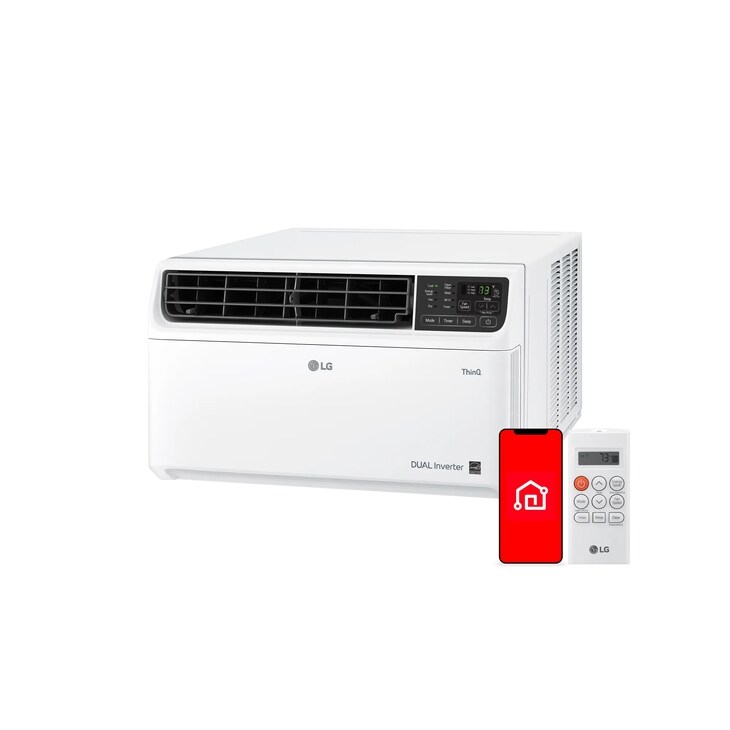


This one is a near tie that your window decides first and your ears second. For a bedroom with a single- or double-hung window 22 to 36 inches wide that opens at least 13.75 inches, we'd buy the Midea 8,000 BTU U-Shaped Window Air Conditioner over the LG 8,500 BTU Dual Inverter Window Air Conditioner, as long as the listing shows a model that isn't on the recall list and you buy somewhere returns are easy. On paper they tie. The Midea listing we link is the MAW08V1UWT and the LG is the LW8024IVSM, and ENERGY STAR certifies both at a CEER of 15. Both use an inverter compressor, both are rated for 350 square feet, both plug into a standard 115V outlet, and neither heats. The difference is the shape. The U straddles the sash, so the window closes down between your room and the compressor. The LG is a box unit with what LG calls a slide in-out chassis: it runs straight through the opening, with no closed sash between the room and the compressor.
Owners who've lived with both tell a messier story, and it centers on a high-pitched whine. Among owners of both who compared how they sound, six of ten found it worse on the Midea and two on the LG, though two of those ten still found the Midea quieter overall. Nearly all of those reports predate the Midea V1UWT now on Amazon and involve older LG generations, so neither brand's current model has much of an owner record yet.
When we checked in October 2026, the 8,000 BTU listing we link had no featured offer, only a third-party seller; the 6,000 and 10,000 BTU listings of the same V1UWT generation were sold by Amazon. If high-pitched sounds get to you, if the U won't fit, or if you'd rather skip the brand with the recent recall (we found no CPSC recall on LG window air conditioners), buy the LG, and choose its size by your window, because the 8,500 BTU LG needs a bigger opening than the U does.
How they stack up
Every row below comes from ENERGY STAR, the Amazon listing or the maker's own spec documents. Where a maker doesn't publish a figure, we say so instead of guessing.
Spec | Midea U (MAW08V1UWT, 8,000 BTU) | LG Dual Inverter (LW8024IVSM, 8,500 BTU) |
|---|---|---|
Chassis | U-shaped; straddles the sash | “Slide In-Out” per LG’s spec sheet; a box that runs through the opening |
Window fit | Single- or double-hung, 22-36 in wide, 13.75 in minimum opening height (listing) | No window range published; cabinet 23 10/16 in wide, 14 15/16 in tall, 28 12/16 in deep |
Weight | 53.1 lb (ENERGY STAR listing) | 85 lb |
Noise (maker figures; neither states test conditions) | “As low as 32 dBA” on its listing; 42 dB low / 47 dB high in a retailer spec for the original 8,000 BTU U | 58/54/46/44 dBA on high/mid/low/sleep |
Power | Listing doesn’t print amps (the original 8,000 BTU U was rated 8.78 A) | LG’s power figures conflict with its own CEER, so we don’t publish them |
Warranty | One year limited per the listing; earlier Midea U manuals added 5 years on the sealed system and 3 on the compressor | One year on parts and labor, no longer compressor term |
Amazon availability (October 2026) | No featured offer, only a third-party seller | Available, no price shown |
Recall history | Earlier Midea U models are on CPSC recall #25320 (June 2025); the MAW08V1UWT is not | No CPSC recall on LG window air conditioners that we found |
What's the same on both: CEER 15 per ENERGY STAR (neither meets ENERGY STAR’s Most Efficient criteria), a 350 sq ft room rating (Midea listing, LG spec sheet), a variable-speed (inverter) compressor per ENERGY STAR, 115V plug-in power, and no heat mode.
Noise: a closed window against a whine
The U's design advantage is physical. With the sash lowered into the notch, glass and window frame sit between you and the compressor. ENERGY STAR credits U-shaped and saddle-style units with "greater noise reduction" for that reason. A box unit like the LG has to keep compressor noise out of the room with its own cabinet insulation, and the LG does that well: one owner who bought one of each could hear the LG's compressor whine only from outside, while the Midea's reached them indoors.
That whine is the biggest knock on the U. It's a high-frequency tone that some people hear and others don't. Plenty of Midea U owners describe one, a couple hear it mainly at startup, and others hear nothing of the kind; a handful of LG owners describe a high-pitched sound indoors too. Head to head it goes against the Midea: six of the ten owners of both who compared the sound found it worse on the Midea and two on the LG, and one more replaced a whining Midea with an LG. Two owners of both, one who heard the whine and one who didn't, still call the Midea quieter overall. One owner who kept both finds the LG's tone easier to live with because it doesn't vary, and the LG quieter in sleep mode. Every Midea whine report on record was posted before ENERGY STAR certified the V1UWT in September-October 2025. ENERGY STAR lists the V1UWT at the same 13.5 x 19.2 x 22 inch, 53.1-pound cabinet as the original V1QWT, so it appears to share the earlier cabinet, and we wouldn't assume the whine is fixed.
Two things help on the U. The whine can drop sharply once the white foam blocks and the gray sealing foam are fitted the way the manual's install section shows; one owner's did. And Midea's Eco mode, which the manuals call Energy Saver, cycles the fan: per the manual, the fan runs for 3 minutes after the compressor stops, then comes on for 2 minutes at 10-minute intervals. That on-off pattern is easy to mistake for a fault at 2 a.m. Midea's U1QWT manual says Energy Saver is on by default, and both manuals we read say switching the unit off and on with the power button turns it back on in Cool, Dry and Auto. A light sleeper should check it after every power-up.
The published numbers point the U's way, with caveats. The retailer spec for the original 8,000 BTU U lists 47 dB on high; LG lists 58 dBA on high for the 8,500. Neither brand states a test distance, and the Midea figure is for a recalled earlier model, so treat that 11-point gap as a rough direction only. At the bottom of the range they're close: 42 dB on low for that original U, 46 dBA on low and 44 in sleep mode for the LG. One owner of both says the Midea stays in its quiet low range longer with the compressor running, while the LG ramps down and off faster at the set point.
Whichever you choose for a bedroom, buy from a seller with an easy return, and spend the first night with the fan on low in a quiet room. If you hear a whine and it bothers you, return it while you can.
Window fit and the install
Size-matched, the U is the one that fits more windows. Its listing calls for a single- or double-hung window 22 to 36 inches wide that opens at least 13.75 inches. LG doesn't publish a window range for the 8,500, but its cabinet is 23 10/16 inches wide and 14 15/16 inches tall, so your opening has to clear both, and it's the same cabinet as LG's 12,000 BTU unit, which LG lists for windows 27 to 39 inches wide with a 16-inch opening. Until LG publishes a range for the 8,500, we'd measure as though it needs the 12,000's numbers. If you want an LG for a shorter or narrower window, look at the 6,000 BTU LW6023IVSM, whose spec sheet gives only its 19 4/7 by 12 1/3-inch cabinet but whose LG Amazon listing fits it to double-hung windows 22 to 36 inches wide with a 13-inch opening, or the 10,000 BTU LW1022FVSM (22 to 36 inches wide, 13-inch opening, 62 pounds).
The LG 8,500 weighs 85 pounds and is 28 12/16 inches deep, so lifting it over a sill is a two-person job; ENERGY STAR lists the 8,000 BTU Midea at 53.1 pounds. LG's spec sheet calls the 8,500's chassis slide in-out. LG installs can be a chore. An older 14,000 BTU unit had to come out of its casing to fit the curtain hooks, and then some screws were impossible to refit without reaching the outside of the unit. An 8,000 BTU LG bought to replace a recalled Midea was very heavy, with confusing instructions. And the side curtains that ship with the unit get called terrible.
The U has its own fiddly parts. It hangs on an outside support bracket that Midea's manuals have you screw to the sill with 1/8-inch pilot holes and 1/2-inch Type A screws on a lipped sill. Get the bracket perfectly level, or, as one owner warns, you can't open and close the window. Midea's U1QWT manual says the bracket works on walls 3 to 10.5 inches thick, measured from the inside of the window to the outside wall. Some installs run long, two hours in one case, while other owners find it fairly simple and are glad the bracket comes in the box. One owner in New York City drills into the window as well, because of kids at home and people on the sidewalk below.
Can you open the window with a U installed? ENERGY STAR lists "the ability to freely open and close the window" among the U-shaped design's benefits, and one owner bought two partly for that. For others it doesn't work in practice: a screen that doesn't fit in the U channel, or sealing the gaps against bugs and drafts that locks the window in place, especially with a storm window. Count it as a perk only if your screen setup allows it.
Neither unit involves refrigerant or wiring. One more LG note: the manual for an older LG Dual Inverter reportedly tells you to install the unit out of direct sunlight, yet one LG has sat in full sun in a third-floor kitchen window for over two years with zero issues. We couldn't retrieve LG's manuals for the current models, so check the one in your box.
Cooling, airflow and the thermostat
With both at CEER 15, they use the same electricity for the same amount of cooling. The LG's extra 500 BTU is about 6% more capacity (8,500 ÷ 8,000 = 1.06), and at the same CEER that means roughly 6% more power when both run flat out, with no efficiency penalty. The 8,000 BTU U2QWT revision of the Midea rates CEER 16, about 6% less power than either for the same cooling (15 ÷ 16 = 0.94); it isn't on the recall list, but it isn't the listing we link either.
Airflow is where owners of both notice a difference, and it favors the LG. One calls it a beast at cooling large rooms quickly, a 12,000 BTU LG seems to blow harder than the 12,000 BTU U it replaced, and an 8,000 BTU Midea was noticeably weaker than a 9,500 BTU LG (a bigger unit, as its owner points out). Not everyone sees it: one owner found the two cooled the same, and an energy monitor on a 12,000 BTU U and a 14,000 BTU LG showed both drawing the same power. If your room is an open space where air has to travel, that's a point for the LG. In a closed bedroom it matters less than the noise.
Both brands have thermostat quirks. The Midea U's built-in sensor reads the air right at the unit, which is why we tell U owners to set up Comfort Sense: Midea's U1QWT manual says the remote measures the temperature where it sits and sends it to the unit at 3-minute intervals. LG's 2017-2022 Dual Inverter models carry a wrong-temperature-reading complaint, covered in our LG review, with errors of 5 to 8°F where owners gave a figure, mostly in Energy Saver mode. LG offers no remote-sensor fix we could document. Whichever you buy, check its reading against a cheap room thermometer in the first week.
Reliability, the recall and the warranty
The recall is the Midea U's history and the main reason its model number matters. CPSC recall #25320, announced June 5, 2025, covers about 1.7 million U and U+ window air conditioners because pooled water inside the unit can fail to drain quickly enough, which can lead to mold growth. It covers the 8,000-12,000 BTU V1QWT, AV1QWT, W1QWT and U1QWT models. The MAW08V1UWT we link is not on the list, and neither are the U2QWT, U1KWT or the 6,000 BTU models, including the 6,000 BTU MAW06V1QWT. Check the model number on the listing and again on the box label. The notice tells owners of recalled units to contact Midea for a free repair or a full or prorated refund.
Mold isn't only a Midea topic. One owner of an LG and a U has seen mold on every brand, never lets the vent shut, and lets the fan run to dry the wheel. A post-recall U owner keeps Eco mode off for the same reason, so the fan keeps running. That's an owner habit, not a manual instruction, but it lines up with how Midea's manual describes Energy Saver shutting the fan down between cycles.
Failures lean against the Midea. Four older Midea units died within two seasons, one named as a U and the rest unnamed by owners comparing the U with the LG: one at exactly 15 months, one after two seasons left in the window over winter, one after a couple of months, and one of an owner's three that didn't last a year. The owner of the 15-month U opened it up, found heavy rust in the outdoor half and a control box that didn't look well sealed, and judged the LG's internals much better built. On the LG side, one arrived dead on arrival, one LG inverter unit lasted four years, and our LG review covers a 14,000 BTU unit that iced up at six years old. One household has run a 14,000 BTU LG for over five years with no complaints.
Warranties are short on both. Midea's listing for the MAW08V1UWT states a one-year limited warranty, valid for authorized purchases only; Midea's manuals for the V1QWT and U1QWT added five years on the sealed system and three on the compressor, but we couldn't find a manual for the V1UWT, so read the one in your box. LG gives one year on parts and labor with no longer compressor term, applies it only to units bought through an LG authorized dealer or distributor, doesn't cover damage or missing items on display, open-box, discounted or refurbished units, and includes a binding arbitration clause with an opt-out. One Midea owner who calls support horrible says running the unit on an extension cord "voided" their warranty; Midea's manuals say not to use an extension cord or an adapter plug, so plan the outlet before you buy.
Electrical requirements, from the makers: both are 115V units. Midea's manuals tell you to check the serial plate, on the side of the cabinet behind the grille, to confirm your electrical service suits the model. LG's figures for the 8,500 conflict with each other, so read the nameplate and the manual in the box, and ask an electrician if you're unsure about the outlet.
Pick the size before the brand
Both 8,000-class units are sized for a big room. ENERGY STAR's sizing chart, which assumes an 8-foot ceiling, calls for 6,000 BTU in a 150-250 square-foot room, 7,000 in 250-300, 8,000 in 300-350 and 9,000 in 350-400. It adds 10% for a very sunny room, takes off 10% for a heavily shaded one, adds 600 BTU for each regular occupant beyond two, and adds 4,000 BTU in a kitchen.
- A 12 x 14-foot bedroom: 168 square feet, a 6,000 BTU room. Both brands make one. LG’s LW6023IVSM is CEER 15.5 with Most Efficient status; Midea’s 6,000 BTU U (MAW06V1UWT) is CEER 15.1, which works out to about 3% more electricity for the same cooling (15.5 ÷ 15.1 = 1.03).
- A very sunny 280-square-foot room: about 7,700 BTU (7,000 plus 10%), which puts it in 8,000-class territory and makes this head-to-head the right one.
- A 400-450 square-foot living room: a 10,000 BTU room. Midea sells a 10,000 BTU U (MAW10V1UWT, CEER 15, not on the recall list) and LG the LW1022FVSM.
ENERGY STAR's reason for sizing carefully: an oversized unit "will cool the room before it has a chance to remove the humidity," leaving it damp and clammy. You'll hear that with a variable-speed compressor it's okay to size up. We disagree. An inverter narrows the penalty, but it still has a minimum speed, and one Midea owner found a conventional 8,000 BTU unit did a slightly better job of dehumidifying their space than their 12,000 BTU U. Buy the size the chart gives you.
Which one we’d buy
The Midea U, by a nose, for most bedrooms. It's the one that keeps the compressor behind a closed window, it fits narrower and shorter openings than the size-matched LG's cabinet allows, it cost less than the LG at the 6,000 and 10,000 BTU sizes when we priced them in October 2026 (LG hides the 8,500's price on Amazon), and it ties the LG on efficiency. Buy the MAW08V1UWT we link (or the 6,000 BTU MAW06V1UWT for a smaller room), confirm the model suffix, set up Comfort Sense, and keep the box until you've slept a few nights with it. When we checked, the 8,000 BTU listing had no featured offer, only a third-party seller; if it still does, don't size up to fill the gap. Check back, or drop to the 6,000 BTU for a room under 250 square feet; the Midea 10,000 BTU U-Shaped Window AC (MAW10V1UWT) is the same generation for a 400-450 square-foot room.
Buy the LG Dual Inverter instead if:
- High-pitched sounds bother you: owners of both who compared the sound found the whine worse on the Midea three times as often as on the LG.
- Your window opens less than 13.75 inches: match the LG size to the window. LG’s product page lists the 10,000 BTU for openings 22-36 inches wide and 13 inches tall, and LG’s Amazon listing gives the 6,000 the same range (its spec sheet gives only the cabinet size).
- You want the most airflow: for an open room, owners of both say the LG pushes air harder.
- You’d rather skip a recalled brand: we found no CPSC recall on LG window air conditioners, against recalls on earlier Midea U models. You’ll need to handle an 85-pound unit at the 8,500 size, against 53.1 pounds for the 8,000 BTU Midea.
If you need heat in spring or fall, skip both. Neither line has a heat mode; a reverse-cycle window unit such as Midea's heat-capable inverter models covers shoulder seasons, and a ductless mini-split is the long-term answer for a room you'll heat and cool for years in a house you own.
Scores at a Glance
Midea U (8,000 BTU)
Our pick
LG Dual Inverter (8,500 BTU)
Filled circle = category winner. Scores are our editorial assessments on a 1 to 10 scale.
Reliability & Durability
Earlier Midea U models are on CPSC recall #25320 over mold from pooled water; the MAW08V1UWT isn't on the list, but four older Midea units died within two seasons in owner reports comparing the two (one named as a U). We found no CPSC recall on LG window air conditioners, though one owner's LG was dead on arrival and older LG models carry a wrong-temperature-reading complaint. Both warranties are one year, and neither current model has a long owner record yet.
Performance & Results
On paper it's a tie: both are ENERGY STAR CEER 15 inverter units rated for 350 square feet, and neither heats. The U keeps the compressor behind a closed sash, which is why it still edges ahead, but we score it 0.2 below our Midea U review because owners of both who compared the sound found the Midea's high-pitched whine worse three times as often as the LG's, and one replaced a whining Midea with an LG. Owners of both also say the LG moves more air.
Value
When we priced them in October 2026 (on Amazon, and on LG's own store for the 6,000 LG, which Amazon had no offers on), the Midea U cost less than the LG Dual Inverter at the 6,000 and 10,000 BTU sizes; LG hides the 8,500's price on Amazon, and the 8,000 BTU Midea listing had no featured offer, only a third-party seller, so we couldn't price the size-matched pair and we keep the gap narrow. The size-matched LG also asks you to handle an 85-pound unit and a bigger window, and its one-year warranty has no longer compressor term. The 8,000 BTU Midea listing states one year too, so neither wins on coverage.
The Evidence Behind Our Verdict
Owner reports for this matchup come mostly from long-running r/AirConditioners threads (2021-2026) where people compared the two, plus r/hvacadvice. We counted 15 owners who owned or tried both. Of the 10 who compared the sound, six found a high-pitched whine worse on the Midea, two found it worse on the LG and two heard no problem from either; one more replaced a whining Midea with an LG, and three say the LG moves more air.
Nearly all of these units are older generations, and every Midea whine report predates the V1UWT now on Amazon.
Our rating above is our own editorial call. What follows is the field evidence we weighed to reach it: first-hand reports from owners on Reddit and independent HVAC and DIY forums, which we lean on more than manufacturer-influenced published reviews because unsponsored owners tend to be the more candid signal.
Midea U (8,000 BTU) owners
“It's in its second season of use and holding up like a trooper so far. No weird rattles or sounds like I had heard some other people talking about. It literally sounds about like my tower fan when it runs. Today, it was 101.3° in Iowa where I live and this 10,000 BTU unit ran all day along in my living room front window with the 5,000 BTU unit I have in my bedroom and between those two they kept my apartment at 70°, the whole time.”
“I have the 12k btu Midea and there's no high pitched whine like others have said. It's very quiet and the variable compressor makes a noticeable difference in how it cools. It replaced a Friedrich that was much louder.”
“I did some more due diligence reading the manual and watching the how-two videos — and found the noise very significantly went away when I used the white foam (and gray window sealing foam).”
“I tried two Midea units and they both had the same high-pitch whine. I honestly didn't give it much of a chance (a few hours) but I know myself well enough to know that I would have never got used to that. It was absolutely excruciating for me, just an absolutely awful frequency of sound, and very audible even though I did my best to seal around the unit. It's such a shame because it was whisper quiet otherwise.”
“My Midea totally failed after two seasons. Don't leave it in the window over winter. It will nuke it I guess.”
“DO NOT buy Midea. Support is horrible. I “voided my warranty” by using an extension cord on their stupidly short cord. Have 3 of them. 1 lasted less than a year.”
LG Dual Inverter (8,500 BTU) owners
“Mines is an LG 8000 BTU LW8022IVSM - it's a dual inverter type. Just to back up your old post I got off a Google search because I was wondering if I should get one, do it. They're pricey but it is worth it. They're quieter - if you set the fan on these things to low it is near impossible to hear them.”
“This “Dual Inverter” 9,500 BTU LG unit draws roughly .45-6A where my Honeywell 10,000 BTU portable drew 10A consistently and hardly dropped the room a couple degrees.”
“However: The Side Curtains that come with the unit are terrible. I'm actually stunned that they'd ship such poor quality side curtains with such a great AC. This thing rocks except for the side curtains.”
“I previously had an LG Inverter Window AC that had a similar high pitched noise but that one would only make the noise on cool when the compressor would ramp up or down and the noise would also ramp up and down.”
Compared both
“We've had a 14k btu LG downstairs for 5+ years. No complaints. This is our second year with the 8k B=btu Midea U in our master bedroom. No complaints. The LG is pretty quiet (where we no longer have to crank up the TV volume all Summer) The Midea is quieter because of the U shape, but that could also be the size too.”
“Just bought one of each. Big fan of the LG so far. The Midea emits a high-pitched whine from the compressor that is maddening.”
“I've tried both. The high pitched inverter whine on the midea is much more noticable than with the LG. For that reason alone, if it's for a bedroom there's no comparison, LG is superior.”
“In my experience they both cooled the same. However, the Midea’s have just been recalled due to a mold issue. (I would’ve guessed the recall was due to the high-pitched piercing whine that all my units produced that made them unbearable to use, but it wasn’t.) I’ve had a good experience with the LG after a year. No whine. Such a relief!”
“I highly value the noise characteristics since I sleep about 0.5-3ft away from it, slightly above head level (bed is right under window). When I had both units, I took measurements and journaled the characteristics over various operating settings and wrote it into a comparison/review posted on my personal site. But while doing all that, the constant whine was just a little too pronounced on the LG for me to even consider the decibel measurements or any other aspect, so after a bunch of measurement numbers and descriptions the review ends abruptly with the Midea as the winner for me lol.”
“Yes, just want to add someone who bought 2 of each (Mideas/LG, 4 total), the LG has a constant much higher pitched whine than the Mideas. I have sensitive hearing, so imagine it is outside of the frequency range for many people.”
“I ended up keeping both, as it wasn't apparent there was anything better on the market last year when I was looking. As I mentioned, I find the sound of the LG easier to handle because it doesn't vary as much. And on sleep mode it's quieter than the Midea. But I have the Midea in my office and it's not bad. I have learned to ignore the high pitch sound.”
“I find that the Midea has better low speed control. They both will run down to a whisper, but the Midea will stay in this lower regime longer with the compressor engaged, whereas the LG seemingly ramps down and off quicker when it hits set point. For this reason, and the condensing unit being isolated outside, the Midea is quieter overall.”
“I got rid of my 12K kitchen one, a whine was driving me nuts and I sent a sound file to Midea, actually I wanted to keep it but they said their techs listened to it and it was defective, so I got a refund and put in a 12K smart LG with dual inverter. I think it blows harder than the Midea. The Midea U shaped I don't think blows enough air out due to the design.”
“LG dual internals are much better. You'll notice immediately the difference in weight. That ought to give you a fairly good idea on build quality.”
Frequently asked questions
Should I buy the Midea U (8,000 BTU) or the LG Dual Inverter (8,500 BTU)?
When we checked in October 2026, the 8,000 BTU listing we link had no featured offer, only a third-party seller; the 6,000 and 10,000 BTU listings of the same V1UWT generation were sold by Amazon. If high-pitched sounds get to you, if the U won't fit, or if you'd rather skip the brand with the recent recall (we found no CPSC recall on LG window air conditioners), buy the LG, and choose its size by your window, because the 8,500 BTU LG needs a bigger opening than the U does.
How do the Midea U (8,000 BTU) and LG Dual Inverter (8,500 BTU) compare on construction?
Earlier Midea U models are on CPSC recall #25320 over mold from pooled water; the MAW08V1UWT isn't on the list, but four older Midea units died within two seasons in owner reports comparing the two (one named as a U). We found no CPSC recall on LG window air conditioners, though one owner's LG was dead on arrival and older LG models carry a wrong-temperature-reading complaint. Both warranties are one year, and neither current model has a long owner record yet.
What do real owners say about the Midea U (8,000 BTU) and the LG Dual Inverter (8,500 BTU)?
Owner reports for this matchup come mostly from long-running r/AirConditioners threads (2021-2026) where people compared the two, plus r/hvacadvice. We counted 15 owners who owned or tried both. Of the 10 who compared the sound, six found a high-pitched whine worse on the Midea, two found it worse on the LG and two heard no problem from either; one more replaced a whining Midea with an LG, and three say the LG moves more air.
Top Picks


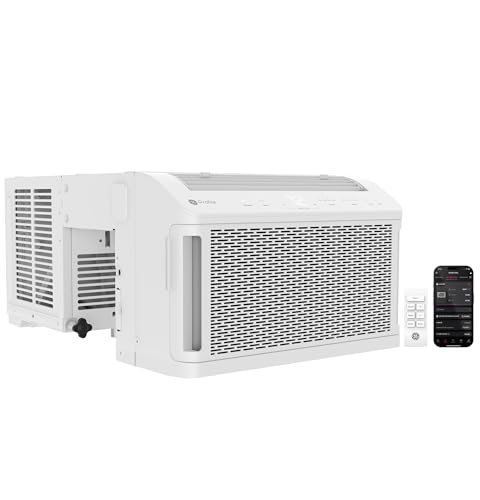
GE Profile ClearView 10,300 BTU Inverter Window AC (PHNT10CC)
A saddle-style inverter for windows outside the U’s range: GE lists 20-40 in wide with a 13 in opening. The 10,300 BTU size, CEER 14.7, up to 450 sq ft, 80 lb, no labor warranty. Only a third-party seller offered it new when we checked.
Read our full review: we scored it 6.8/10
Full Individual Reviews
Deep-dive on each, individually
