Mr. Heater Big Buddy vs Portable Buddy: Which Size for Your Shelter
By Margo Pettibone · Updated October 2026
Independent editorial review. We never accept payment for coverage, though we may earn a commission if you purchase through our links.

Verdict
Mr. Heater Big Buddy (MH18B)
Mr. Heater Portable Buddy (MH9BX)
Most owner reports come from ice anglers on r/IceFishing, with more from campers, van dwellers and people heating through power outages. Owners of the Portable Buddy mostly say it's enough for a two- or three-person shelter. Big Buddy owners like the extra heat in bigger or colder setups, and one moved down because it ran too hot. One owner started with the Portable Buddy and moved up after shivering through a cold, windy trip. Across the Buddy line, owners keep coming back to a Mr. Heater hose and fuel filter on bulk tanks, cylinders that falter in deep cold, and a CO alarm.
Read full take ↓


For one to three people in an ice shack, a tent or a truck cap, buy the Portable Buddy. It costs a lot less than the Big Buddy, needs half the vent opening, and on 9,000 BTU/hr it keeps a two- or three-person shack warm, usually on low. Get the Big Buddy when the shelter is bigger, the days are colder and windier, or you want to run a 20 lb tank outside on a regulated quick-disconnect hose.
They're the same heater at two sizes. Both are radiant propane heaters with a low-oxygen shutoff and a tip-over switch, both carry the same indoor statement in their US manuals, and both are certified to the same camp-heater standard. The Portable Buddy runs 4,000 or 9,000 BTU/hr on one 1 lb cylinder. The Big Buddy adds an 18,000 BTU/hr HI setting and a second cylinder port, and its MED setting is the Portable Buddy's HI. In a bedroom during a power outage the Big Buddy is capped at MED, so there it's no hotter than the small one.
Neither is a garage heater by its manual, and whichever you buy, put a battery CO alarm in the space with it.
Which one to buy
- Portable Buddy: one to three people in a two- or three-person ice shelter (insulated or not), a small tent, a truck cap or a van, or emergency heat in one room on 1 lb cylinders. Its 9 sq in vent requirement is the easier one to meet.
- Big Buddy: a four-person hub, a wall tent or a cabin, long days well below zero with wind, or when you want the medium step and a regulated quick-disconnect hose. Plan on 18 sq in of venting at the ceiling and at floor level, and two 1 lb cylinders for HI.
- Neither: heating a closed garage or shop for hours, or a room you sleep in. Neither manual's indoor list includes a garage, and both say never to run the heater while you sleep.
Side by side
From each heater's US manual (Big Buddy F274805, Portable Buddy manual 32178 REV F) unless noted.
Spec | Big Buddy (MH18B) | Portable Buddy (MH9BX) |
|---|---|---|
Heat input | 4,000 / 9,000 / 18,000 BTU/hr (LO / MED / HI) | 4,000 / 9,000 BTU/hr (LO / HI) |
Heating area (maker claim) | Up to 450 sq ft | Up to 225 sq ft |
Fuel | One or two 1 lb cylinders, or one or two remote tanks up to 20 lb kept outdoors. HI needs two 1 lb cylinders. | One 1 lb cylinder, or a remote tank up to 20 lb kept outdoors |
Run time | 1.5-6 h on one 1 lb cylinder, 3-12 h on two, 24-108 h on a 20 lb tank | 3-6 h on a 1 lb cylinder, 48-110 h on a 20 lb tank |
Indoor venting | 18 sq in (e.g. 4.25 x 4.25 in) at the ceiling and at floor level | 9 sq in minimum (e.g. 3 x 3 in) at the ceiling and at floor level |
Emergency home use | Bathroom LO only; bedroom LO or MED | Bathroom LO only; bedroom HI or LO |
Quick-disconnect hoses | F271802 and F271803 on an 11 in W.C. regulated supply | Not listed |
Minimum ambient temp | Not stated | 0°F |
Weight (product pages, unit not stated) | 17.1 | 10.6 |
What's the same on both: clearances to combustibles of 30 in above, 24 in in front, 6 in at the sides and 0 in behind; a low-oxygen shutoff (Mr. Heater calls it ODS) and a tip-over switch; a possible shutoff above 7,000 ft, which both product pages also list as the maximum elevation; run times that can drop sharply below 20°F, where both manuals recommend a 20 lb tank; Mr. Heater hoses F273701, F273702 or F272702 with fuel filter F273699, or the filter-free F273704 Buddy series hose; and ANSI Z21.103-2017 certification. Both work out to 40 BTU/hr per square foot of their claimed area at full input, and the bedroom cap is 10,000 BTU/hr on either.
How much heat your shelter needs
Since the Big Buddy's MED and the Portable Buddy's HI are the same 9,000 BTU/hr, the question is whether you'll want 18,000 often enough to haul the bigger heater and a second cylinder. For a two- or three-person shack, mostly you won't. The Portable Buddy handles those shelters, insulated or not, and plenty of owners run it on low most of the time. It takes something like night fishing at -20 in heavy wind to push one past its limit.
The Big Buddy earns its size in bigger or colder setups. A shelter a bit bigger than a two-person Quickfish, like a Clam Bigfoot, on a cold windy day is where the Portable Buddy starts to feel small, and Big Buddy owners in that spot mostly end up running it on MED with HI in reserve. Go the other way and it's too much heater: in a small portable shelter the Big Buddy runs hot, and some owners have traded down for that reason.
Our rule of thumb is a Portable Buddy for a two- or three-person shelter and a Big Buddy for a four-person hub or anything with a lot of wall area in serious cold. Insulation, wind and snow banked around the skirt matter as much as the heater, and on either one the top setting can run too hot in a small shack.
Where each is allowed indoors
The two US manuals use the same wording. Each heater is "safe for indoor use in small recreational enclosures having means for providing combustion air and ventilation, such as enclosed porches, cabins, fishing huts, trailers, tent trailers, tents, truck caps and vans," and may be used for emergency indoor heating on a disposable 1 lb cylinder. A recreational enclosure needs a window or roof vent. The Portable Buddy manual adds that it may also be used outdoors, and both are certified as camp heaters for indoor and outdoor use. Mr. Heater's product pages also list hunting blinds and ice fishing shanties. A fishing hut is on the manual list and a blind isn't, so we'd only treat a closed blind as a recreational enclosure if it has a window or roof vent and the required openings; otherwise run the heater outside it.
- Ice shanty, tent, truck cap, van: both are covered, with the vent opening at the ceiling and at floor level while it runs: 9 sq in for the Portable Buddy, 18 sq in for the Big Buddy. One cracked door at one height doesn't meet that.
- Emergency heat at home: 1 lb cylinders only, never a refillable tank indoors, LO only in a bathroom. In a bedroom the Big Buddy is limited to LO or MED and the Portable Buddy may run HI or LO. Neither may run while you sleep, and neither is for use in a dwelling home in California, per both manuals.
- Garage or workshop: not on either manual's indoor list, even though Mr. Heater's product pages name garages and workshops among their uses. Both manuals also say that with the cylinder attached, the heater and cylinder must be stored outdoors and not in a building or garage, and that gasoline and other flammable vapors and liquids must not be stored or used in the vicinity. The CPSC says never to use portable fuel-burning camping equipment inside a home, garage, vehicle or tent unless it is designed and instructed for that enclosed space. Use either one as an outdoor spot heater in the driveway, and see our garage heater guide for a closed garage.
- Massachusetts and Canada: Mr. Heater's pages for both heaters list Massachusetts and Canada sale restrictions, and the Massachusetts and Canada version of the Big Buddy ships with a manual that says For Outdoor Use Only. Read the manual that came in your box.
Plenty of people run a Buddy in the garage anyway, and some bring a 20 lb tank inside during an outage. Both manuals say never to bring a refillable cylinder indoors, and we'd follow them.
When the low-oxygen system trips, both manuals say not to relight until you've let in fresh air, and to have the heater serviced if it keeps shutting off. A shutoff means the space is short on air. Don't just reset it.
Buy a CO alarm with either one
Neither manual asks for one, but neither heater can tell you carbon monoxide is building. The safety system on both watches oxygen: it cuts the gas when oxygen runs low and does nothing about CO. Some owners assume the low-oxygen shutoff doubles as a CO detector. It doesn't. The CPSC says an alarm is no substitute for using the heater properly, so you still follow the venting rules. One minivan owner's alarm went off the one time they forgot to crack the windows.
Get a battery CO alarm listed to UL 2034 (check the package) and take it wherever the heater goes. The First Alert SMCO100 in our picks is the same battery smoke and CO combo we recommend in the garage heater guide. Keep it out of the spot directly above the heater, where the CPSC advises against mounting one. The CPSC also notes that CO risk goes up at high altitude, which matters for both heaters.
Fuel: cylinders, tanks, hoses and the filter
At 9,000 BTU/hr the two burn propane at the same rate; only the Big Buddy can double it. Twelve hours on the Portable Buddy takes two to four 1 lb cylinders at its manual's 3-6 hours each. The Big Buddy on HI burns two at a time, and at the manual's 3-12 hours per pair, a 12-hour day on HI is about eight cylinders. A 20 lb tank outside the shelter changes the math for either: 48-110 hours on the Portable Buddy and 24-108 on the Big Buddy. For emergency heat in a home, both manuals stick to 1 lb cylinders.
The tank stays outdoors and connects through a Mr. Heater hose. Both manuals name F273701, F273702 and F272702 with fuel filter F273699, replaced every year, or the F273704 Buddy series hose, which needs no filter. Mr. Heater "strongly recommends using disposable fuel filter F273699 to trap any oil substances when connected to a remote cylinder that can make heater inoperable." The Big Buddy can also take Mr. Heater's F271802 or F271803 quick-disconnect hoses on a supply regulated to 11 in W.C. The Portable Buddy manual doesn't list them and its regulator is fixed, so don't reduce tank pressure to it.
Use the filter. Running without one, or on a generic hose, is behind most of the oily-line, clogged-heater and won't-idle-below-full-blast complaints you'll see about the Buddy line. Some people go years without a filter and have no trouble, and a few have had more trouble with one in the line than without, which is why we'd check an old filter first; both manuals call for a new one every year. One Big Buddy owner's pilot stopped dropping out on a tank once they switched to Mr. Heater's own quick-connect hose. The Portable Buddy manual's warranty and Mr. Heater's warranty policy page both say hand-made or third-party accessories void it, and both manuals call them extremely dangerous.
Cold is the other fuel problem. Cylinders and tanks frost over, quit before they're empty, or can't keep the heater going; one owner's 1 lb run time on low fell from 5-6 hours to about two and a half in a cold winter, though they also suspected a leak. That's what both manuals warn about below 20°F, and their fix is a 20 lb tank outside on the proper hose. Expect to hold the pilot longer after hooking up a hose, since both manuals say purging air from the supply hose takes longer with a longer hose.
Shutoffs, pilots and altitude
Both heaters have touchy pilots, and the usual fix is more fresh air. If yours keeps shutting off, open the vent wider before you blame the heater; one owner ran a pipe under the tent wall to feed it and the shutoffs stopped. Wind is the other culprit. A light breeze can push the pilot flame off the thermocouple, and the Portable Buddy manual itself mentions nuisance shutoffs outdoors in some wind. Both manuals' troubleshooting tables list a blocked pilot and too little fresh air as the first things to check.
We can't call either one more reliable. They share most of their parts and their weak points, and the stories cut both ways: a Portable Buddy that ran ten years without trouble next to a brand-new Big Buddy that shut off after four hours on two trips (its replacement was fine), and a regular Buddy that never stayed lit next to a new Big Buddy that threw flame out the front.
Altitude is the one rule both manuals state the same way: above 7,000 ft the heater may burn less brightly and may shut off, and if it does, let in fresh air, wait 5 minutes and relight, knowing it may not relight. Owner experience up high is mixed, with some Buddys running fine around 9,000 ft and above 10,000 ft and others quitting. If you camp high, bring a backup plan for heat.
Where the Buddy FLEX fits
The Buddy FLEX (MH11BFLEX) sits between them at 8,000-11,000 BTU/hr per its manual, with the same indoor statement and California notice. We'd pass on it for most people. Its low setting starts at 8,000, twice the Buddy's LO, so it can't turn down for a small insulated shack. Its manual asks for 11 sq in of venting at the ceiling and at floor level and says not to use it in a bathroom or bedroom at all, which rules it out for the bedroom emergency case both Buddys allow. It needs 24 in of side clearance against 6 in on the other two, and runs 1.5-3.5 hours on a 1 lb cylinder. The product page lists electronic ignition and up to 275 sq ft. Owners who have one either like it on low with the doors cracked or find it even more finicky than the rest of the Buddy line.
Warranty, price and our pick
Mr. Heater's documents disagree on the warranty. The current Portable Buddy manual says 3 years from date of purchase and the product pages for both heaters list a 3 year limited warranty, but Mr. Heater's warranty policy page still says 1 year for everything except unit heaters, and the Big Buddy manual we read gives no term. Register the heater, keep the receipt, and plan on the shorter term until Mr. Heater's pages agree. Third-party accessories or cooking on the heater void it, per the Portable Buddy manual and the policy page.
The Portable Buddy costs a good deal less (check current prices on Amazon) and weighs less, and for one to three people in a fishing hut, tent or truck cap, or one room in an outage, it's the one we'd buy. Spend more on the Big Buddy when the shelter is big, the cold is serious, or you want the medium step and the quick-disconnect hose. Either way, budget for the CO alarm, and for a tank setup, a Mr. Heater hose (plus the filter, unless it's the F273704).
Scores at a Glance
Mr. Heater Big Buddy (MH18B)
Mr. Heater Portable Buddy (MH9BX)
Filled circle = category winner. Scores are our editorial assessments on a 1 to 10 scale.
Reliability & Durability
Both use the same low-oxygen pilot system and tip switch, and owners of both report the same pilot fussiness, cold-cylinder trouble and hose sensitivity. Neither has the better reliability record, so we score them the same. Run either on a Mr. Heater hose with the filter the manual names.
Performance & Results
The Big Buddy's 18,000 BTU/hr HI and its medium step give it range the Portable Buddy can't match in a big hub or a wall tent. The Portable Buddy tops out at 9,000, the same as the Big Buddy's MED, and that's enough for a two- or three-person shack, often on low. Neither has a thermostat or a built-in fan.
Value
The Portable Buddy costs a good deal less, sips one 1 lb cylinder at a time, and needs half the vent opening. The Big Buddy costs more and burns two cylinders on HI, but pays off for bigger shelters and long tank-fed weekends. Check current prices on Amazon.
The Evidence Behind Our Verdict
Most owner reports come from ice anglers on r/IceFishing, with more from campers, van dwellers and people heating through power outages. Owners of the Portable Buddy mostly say it's enough for a two- or three-person shelter. Big Buddy owners like the extra heat in bigger or colder setups, and one moved down because it ran too hot.
One owner started with the Portable Buddy and moved up after shivering through a cold, windy trip. Across the Buddy line, owners keep coming back to a Mr. Heater hose and fuel filter on bulk tanks, cylinders that falter in deep cold, and a CO alarm.
Our rating above is our own editorial call. What follows is the field evidence we weighed to reach it: first-hand reports from owners on Reddit and independent HVAC and DIY forums, which we lean on more than manufacturer-influenced published reviews because unsponsored owners tend to be the more candid signal.
Mr. Heater Big Buddy (MH18B) owners
“I currently have the big buddy heater. I love it and have 0 complaints...just looking for something a little more portable for the lake superior ice trips.”
“I've got a 2 man frabill guardian uninsulated and a big buddy. Bought the big buddy to also use in garage and elsewhere, very handy to have the extra heat. On a 6 degree F day with a little wind I found myself running the heater on medium and was pretty comfortable with jacket/bibs on.”
“I use a Big Buddy with an 11lb tank. Like you said, it takes a little while to purge the air out of the line, but then I haven't had any issues.”
“I bought the hose made for this by Mr. Heater and have never had issues after this.”
“Big Buddy is hot. I got that first (thinking the longer run time and heat capacity would give more flexibility) but I moved down to the little buddy, and bringing a backup 1lb tank, just in case.”
“It’s fairly newer, only been used 1 season. I’m able to get a good blue flame on the pilot light and hold it down for about 30 seconds but once I lift up on the pilot to turn it to the heat settings the pilot light turns off.”
Mr. Heater Portable Buddy (MH9BX) owners
“I see far more complaints about the big buddy being too hot and propane hungry than I do about the portable buddy being too cold. I have a 2 man uninsulated cheapo ice house and the only time I pushed my portable buddy past its limits was night fishing on leech lake in -20 conditions with heavy wind.”
“Portable buddy in a non-insulated 3 person works fine for me. Usually works fine on low up to around -15C then high is necessary.”
“When I run my portable Mr. Buddy in my old two man shappell shanty its on low. If ran on high it gets too hot in no time.”
“I have a portable buddy heater and it works great. Even on low I can sit with my jacket off (still have a long sleeve shirt though) and be comfortable. My Frabill is insulated so that might make a difference.”
Compared both
“And I started with a regular portable buddy. One trip in cold windy weather I stood over top of the portable buddy heater shivering trying to stay warm. Bought a big buddy after that and never looked back. Yes, the big buddy stays on medium heat most of the time, but there are times you need to have that high end. Buy one cry once.”
Frequently asked questions
Should I buy the Mr. Heater Big Buddy (MH18B) or the Mr. Heater Portable Buddy (MH9BX)?
Neither is a garage heater by its manual, and whichever you buy, put a battery CO alarm in the space with it.
How do the Mr. Heater Big Buddy (MH18B) and Mr. Heater Portable Buddy (MH9BX) compare on construction?
Both use the same low-oxygen pilot system and tip switch, and owners of both report the same pilot fussiness, cold-cylinder trouble and hose sensitivity. Neither has the better reliability record, so we score them the same. Run either on a Mr.
What do real owners say about the Mr. Heater Big Buddy (MH18B) and the Mr. Heater Portable Buddy (MH9BX)?
Most owner reports come from ice anglers on r/IceFishing, with more from campers, van dwellers and people heating through power outages. Owners of the Portable Buddy mostly say it's enough for a two- or three-person shelter. Big Buddy owners like the extra heat in bigger or colder setups, and one moved down because it ran too hot.
Top Picks
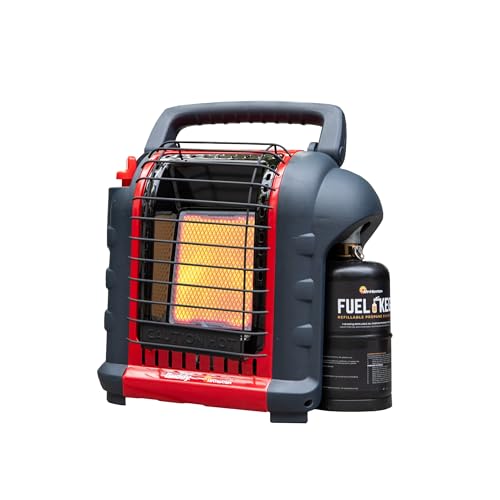
Mr. Heater Portable Buddy (MH9BX)
Our pick for one to three people in a fishing hut, tent or truck cap: 4,000 or 9,000 BTU/hr on one 1 lb cylinder, and half the Big Buddy's vent opening (9 sq in at ceiling and floor). It keeps a 2-3 person shack warm, often on low.
Read our full review: we scored it 7.0/10

You Might Also Need
Accessories worth grabbing alongside your purchase


Full Individual Reviews
Deep-dive on each, individually