Cadet Com-Pak Wall Heater Review: A Sensible 240V Room Heater
By Margo Pettibone · Updated October 2026
Independent editorial review. We never accept payment for coverage, though we may earn a commission if you purchase through our links.
 ← Grille 9 in W x 12 in H →
Spec sheet
| Output (Cadet) | 2,000 W / 6,825 BTU/h at 240 V; 1,500 W / 5,120 BTU/h at 208 V |
| Current (Cadet) | 8.3 A at 240 V, 7.2 A at 208 V; hardwired |
| Thermostat (Cadet) | Built-in knob, 40-85°F |
| Rough-in (Cadet) | 8 in W x 10-1/8 in H x 4 in D; 9 x 12 in grille |
| Clearances (Cadet) | 3 ft clear in front; 12 in off the floor recommended |
| Placement (guide) | Not above a tub or sink or in a shower area; no ceiling mount with built-in thermostat |
| Maintenance (guide) | Clean at least every 6 months |
| Owner-reported failure | Noisy or buzzing fan; a failed element; a thermostat stuck on |
| Warranty | 2 years in Cadet's guide; the Amazon listing says 1 year |
Verdict
Owner reports come from r/AskElectricians, r/HomeImprovement, r/DIY, r/hvacadvice and r/homeowners, plus Garage Journal. We card only posts that name the Com-Pak or answer a thread about one; generic "Cadet heater" posts and Com-Pak Twin owners are left as context. The threads skew toward troubleshooting, so failure reports are over-represented: fan noise, a failed element, a stuck thermostat and a unit that wouldn't reset. Long-time owners who clean them describe decades of service.
Read full take ↓


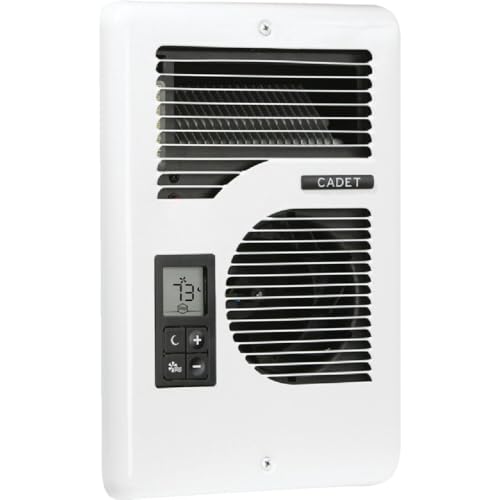
For a bedroom, bathroom or small office that needs its own heat, the Cadet Com-Pak CSC202TW 2,000 W in-wall heater is the plain, sensible buy, and it's the one we'd put in. It recesses into a standard stud wall, comes complete with the wall can, grille and a built-in thermostat, and makes 6,825 BTU/h on a 240 V circuit. Owners who clean theirs twice a year describe them lasting decades.
Know what you're buying, though. It's resistance heat, which turns every watt into heat and is among the most expensive ways to heat a room. The fan is audible, and a light sleeper may hear it click on. And the circuit behind it is the expensive part: Cadet's guide expects the work to follow the National Electrical Code, and if you're not comfortable with that, a licensed electrician runs the 240 V circuit. This review is about choosing the heater, not wiring it.
Reasons to buy it
- Complete in one box: heater, galvanized wall can, grille and a 40-85°F built-in thermostat, so there is nothing else to buy for the heater itself.
- Compact: an 8 x 10⁻¹/8 x 4 in rough-in opening between studs and a 9 x 12 in grille. It fits rooms where the 8 ft of baseboard it takes to make 2,000 W won't.
- Fast heat: a fan pushes about 40-55 CFM across the element, so the room warms quicker than with convection baseboard.
- Two layers of overheat protection: a manual-reset high-temperature limit and a one-time thermal fuse on the element board.
- A two-year warranty in the owner's guide: longer than the one-year terms on most of the electric garage heaters we review.
Reasons to pass
- The fan: it whirs while heating and clicks as it starts and stops. Fine in a bathroom, a real complaint in a bedroom.
- Running cost: resistance heat costs about 2 kWh for every full-power hour at 240 V.
- Cleaning is not optional: Cadet says to clean it at least every 6 months, and dust inside is the first thing its troubleshooting table blames for a burning smell.
- Basic controls: a knob thermostat on the grille; no timer, no setback and no app.
Is 2,000 W enough for your room?
For a typical bedroom, bathroom or home office, yes. 2,000 W is 6,825 BTU/h at 240 V, Cadet's own figure and what watts times 3.412 gives. The Amazon listing says it warms up to 200 sq ft, which matches the old 10 watts per square foot rule. Treat that as a rule of thumb, not a heat-loss calculation; ENERGY STAR warns that rules of thumb tend to mis-size equipment, and a room with big windows or an outside corner can need more.
Watch the voltage. On a 208 V supply, which some apartment and commercial buildings have, the same heater makes only 1,500 W and 5,120 BTU/h, a quarter less.
Model (240/208 V, with thermostat) | Watts | BTU/h | Amps at 240 V |
|---|---|---|---|
Com-Pak CSC102TW | 1,000 / 750 | 3,415 / 2,560 | 4.2 |
Com-Pak CSC152TW | 1,500 / 1,125 | 5,120 / 3,840 | 6.3 |
Com-Pak CSC202TW (this review) | 2,000 / 1,500 | 6,825 / 5,120 | 8.3 |
Com-Pak Twin CSTC302TW | 3,000 / 2,250 | 10,240 / 7,680 | 12.5 |
Com-Pak Twin CSTC402TW | 4,000 / 3,000 | 13,650 / 10,240 | 16.7 |
From Cadet's product sheets. If your room needs more than 2,000 W, step up to the Twin, which puts two heaters behind one grille. Twin owners report heating a detached 20 x 28 ft garage in upstate New York and a roughly 550 sq ft well-insulated basement room in Chicago, so it covers living rooms and open areas the single Com-Pak can't.
The 240 V circuit, and what it means for your budget
At 8.3 A, a CSC202TW is a modest load, but it is hardwired and needs a 240 V circuit with a double-pole breaker. If one is already there from an old heater, a replacement can be simple. If not, the circuit run is usually the biggest line item, so get the electrician's quote before you buy. We give no wiring steps; the guide's own rule is that work must follow the NEC and local codes, and to call a licensed electrician if you aren't comfortable with it.
Two rules in Cadet's guide shape what you can buy:
- Match the voltage: connecting a heater to a voltage higher than its label destroys the heater and could start a fire, and a 120 V Com-Pak on a 240 V circuit is exactly that mistake. One tenant's landlord installed 120 V units on a 240 V line and they burned out. Check the label of the old heater before you order.
- The 80% rule: the guide limits the load on one breaker to 80% of its rating or the thermostat's rating, whichever is lower. On a 20 A circuit that is 16 A, so the 4,000 W Twin's 16.7 A doesn't fit where a 2,000 W Com-Pak lived, which is a new circuit and your electrician's call.
Placement matters for performance and safety. Cadet recommends mounting it 12 in off the floor for cleaner running and a longer life, on an inside wall, with 3 ft clear in front. It can't go above a tub or sink, in a shower area, behind a door, under a towel bar, or where gasoline, paint or flammable vapors are stored. Ceiling mounting is allowed only for Com-Pak units up to 1,500 W, and Cadet doesn't recommend it for models with a built-in thermostat, so the CSC202TW is a wall heater.
Thermostat, noise and running cost
The built-in knob is a simple line-voltage thermostat with a 40-85°F range. Cadet's instructions are to turn it all the way up, then back until it clicks off at a comfortable temperature, so expect to set it by feel. If you want a schedule or app control, a smart line-voltage thermostat can switch the heater with its own knob turned to max, which is how some owners run theirs; that is wiring work for an electrician. The Energy Plus model below builds a digital thermostat with setback into the heater instead.
Noise is the trade for fast heat. In a bathroom or office you won't care. In a bedroom, the fan clicking on and off is the common complaint, and baseboard heat is the quiet alternative: slower, steadier, and silent apart from a tick as the metal warms.
Running cost is simple arithmetic. At full power the CSC202TW uses 2 kWh an hour, which is 30 cents an hour at an example rate of 15 cents per kWh. The thermostat cycles it, so a room that holds its heat costs much less. A small outbuilding can surprise you: one Com-Pak Twin owner's insulated backyard gym, held at 50°F, cost over $200 to heat in December. If you heat the room daily all winter, a ductless heat pump makes the same heat for far less: at ENERGY STAR's cold-climate floor of COP 1.75 at 5°F, 6,825 BTU/h takes about 1,140 W instead of 2,000 W, 43% less on the coldest night and more on mild ones.
Durability and the Cadet recall question
Kept clean, a Com-Pak lasts a long time. The design is simple (an element, a fan motor and a knob), and the best record comes from owners who pull the grille twice a year and vacuum it, which is exactly what Cadet's guide asks for. The guide also says to run a new heater on high for 30 minutes, since some smoking is normal as the element burns off manufacturing residue.
When they fail, it's usually the fan, the element or the thermostat: a buzzing motor in a brand-new house, an element that quit, a thermostat that heats even in the off position, a unit that won't come back after its reset. Cadet's guide is blunt about the safety cutoff: if it trips more than once a day, replace the heater, and if a heater malfunctions, have it inspected before you use it again. Cadet sells the heater assembly separately from the wall can, so a replacement can go into the can already in the wall.
You'll read that Cadet wall heaters were recalled. They were: in 2000 the CPSC announced a recall of more than 1.9 million Cadet and Encore in-wall heaters, models FW, FX, LX, TK, ZA, Z, RA, RK, RLX, RX, RW and ZC. The Com-Pak, model CS, is not on that list. If you're replacing an old heater, check its model label behind the grille, and if it's one of those, replace it.
The warranty question has two answers. Cadet's owner's guide gives a limited two-year warranty on the CS and CST heaters, while the Amazon listing says one year. We go by the guide; keep your receipt, and register it with Cadet. Note that the warranty excludes damage from improper installation, incorrect voltage and skipped maintenance.
Com-Pak, Twin, Energy Plus or a mini-split?
Com-Pak CSC202TW | Com-Pak Twin CSTC402TW | Energy Plus CEC163TW | |
|---|---|---|---|
Heat at 240 V | 2,000 W (6,825 BTU/h) | 4,000 W (13,650 BTU/h) | 1,600 W (5,460 BTU/h), modulates down to 200 W |
Thermostat | Knob, 40-85°F | Knob, 40-85°F | Digital, 40-86°F, Night/Away setback |
Mounting | Wall, element up or to the left | Wall, horizontal only | Wall, vertical; fits existing Com-Pak cans |
Warranty (Cadet documents) | 2 years | 2 years | 5 years |
The Twin is the answer for a bigger room on its own circuit. The Energy Plus costs much more than the Com-Pak, makes a little less heat, and in return gives you a digital thermostat, a variable-speed fan Cadet bills as ultra-quiet, and a five-year warranty. It fits an existing vertically mounted Com-Pak wall can, which makes it the upgrade we'd pick for a bedroom. Cadet claims up to 30% less energy than a standard wall heater, but that comes from holding temperature more tightly, not from making heat more efficiently, so treat it as a best case.
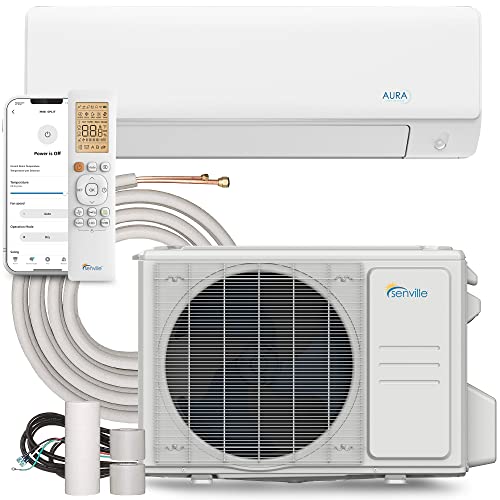
If the room is lived in every day, look past all three. A ductless heat pump like the Senville Aura 12,000 BTU unit, which NEEP rates at 11,500 to 12,000 BTU/h at 5°F depending on the version, makes nearly twice a Com-Pak's heat on a 5°F night for a fraction of the electricity, and cools in summer. It costs many times more to buy and install, so it pays off only where the heat runs most of the winter.
Should you buy it?
Yes, for a bathroom, a small bedroom, a home office or a finished space up to about 200 sq ft that needs reliable heat on its own thermostat, especially if a 240 V circuit or an old Com-Pak can is already there. It's inexpensive, compact and easy to service, and a clean Com-Pak is a long-lived one.
Pick the Energy Plus for a bedroom where you want a digital thermostat and a variable-speed fan, the Twin for a living room, and a heat pump if this room is where you spend the winter. And whatever you buy, budget for the electrician first.
Score breakdown
2,000 W at 240 V is 6,825 BTU/h, enough for a bedroom, bathroom or office up to about 200 sq ft, and the fan warms the room faster than baseboard. On 208 V it drops to 1,500 W. The fan is audible and clicks on and off, and the knob thermostat has no schedule or setback.
A simple element, fan and knob that owners keep running for decades when they clean it twice a year, as Cadet's guide asks. Fan noise, failed elements and a thermostat that stuck on are the reported failures. The Com-Pak is not on the 2000 CPSC recall list, and Cadet's guide gives a two-year warranty.
The complete unit with wall can, grille and thermostat costs little, and a replacement drops into an existing can. Resistance heat is expensive to run, and a new 240 V circuit from an electrician can cost more than the heater. Check the current price on Amazon.
Cadet Com-Pak Wall Heater on Amazon.
The Evidence Behind Our Verdict
Owner reports come from r/AskElectricians, r/HomeImprovement, r/DIY, r/hvacadvice and r/homeowners, plus Garage Journal. We card only posts that name the Com-Pak or answer a thread about one; generic "Cadet heater" posts and Com-Pak Twin owners are left as context. The threads skew toward troubleshooting, so failure reports are over-represented: fan noise, a failed element, a stuck thermostat and a unit that wouldn't reset.
Long-time owners who clean them describe decades of service.
Our rating above is our own editorial call. What follows is the field evidence we weighed to reach it: first-hand reports from owners on Reddit and independent HVAC and DIY forums, which we lean on more than manufacturer-influenced published reviews because unsponsored owners tend to be the more candid signal.
What Reddit Is Saying
“Had these cadets in my old house that I lived in for 27 years. Twice a year I would pull the fronts off and vacuum and wipe everything down. Never had a failure. They served their purpose.”
“I lived in an apartment building with 129 units, each containing these heaters. The building still hasn't burned down.”
“The baseboard heat is slow, steady, and quiet. You don't hear when it's own (maybe a tiny click as the metal heats). It's a gentle heat with no high/low spikes. The in-wall fan based also work well. They can heat an appropriately sized room fairly quick. They are louder because of the fan, but do heat nicely.”
“I have a Cadet Com Pak heater and am constrolling it with a Mysa Thermostat”
“I have a Cadet Com-Pak heater with detached manual thermometer. I hate hearing the fans click on while sleeping.”
“Seems like it's the fan that's making the noise; almost like it's poorly lubricated or isn't sitting right in its housing. It's not so horrible that it's messing with the functionality of the heater but it's definitely more buzzing than I'd like to hear out of an electric heater.”
“I currently have a Cadet Compak 240v, 2000 watt heater in my wall. It has broken down (I think probably the heating element is broken?) I would like to replace it with a bigger/stronger unit that is 240v, 4000 watts”
“It appears to be the Com-pak electric fan heaters. There is a thermostat built in with the knob on the heater itself. There is only one heater that will turn on automatically even if it is in the off position.”
“I have an in-wall space heater that isn't working. This looks like the exact same one. Can I just switch out for another 240V unit without replacing the metal box in the wall?”
Frequently asked questions
Is the Cadet Com-Pak Wall Heater worth it?
The complete unit with wall can, grille and thermostat costs little, and a replacement drops into an existing can. Resistance heat is expensive to run, and a new 240 V circuit from an electrician can cost more than the heater. Check the current price on Amazon.
How reliable is the Cadet Com-Pak Wall Heater?
A simple element, fan and knob that owners keep running for decades when they clean it twice a year, as Cadet's guide asks. Fan noise, failed elements and a thermostat that stuck on are the reported failures. The Com-Pak is not on the 2000 CPSC recall list, and Cadet's guide gives a two-year warranty.
How well does the Cadet Com-Pak Wall Heater perform?
2,000 W at 240 V is 6,825 BTU/h, enough for a bedroom, bathroom or office up to about 200 sq ft, and the fan warms the room faster than baseboard. On 208 V it drops to 1,500 W. The fan is audible and clicks on and off, and the knob thermostat has no schedule or setback.
What do real owners say about the Cadet Com-Pak Wall Heater?
Owner reports come from r/AskElectricians, r/HomeImprovement, r/DIY, r/hvacadvice and r/homeowners, plus Garage Journal. We card only posts that name the Com-Pak or answer a thread about one; generic "Cadet heater" posts and Com-Pak Twin owners are left as context. The threads skew toward troubleshooting, so failure reports are over-represented: fan noise, a failed element, a stuck thermostat and a unit that wouldn't reset.
Options Worth Checking Out

Senville Aura 12,000 BTU Ductless Mini-Split Heat Pump
One of our top-rated mini-splits, for rooms heated daily: 11,500 to 12,000 BTU/h at 5°F per NEEP, depending on version, plus summer cooling. It costs many times a wall heater and needs a real install, but uses far less power.
Read our full review: we scored it 7.5/10


