Mr. Heater Big Buddy Review: Great Portable Heat, Strict Indoor Rules
By Margo Pettibone · Updated October 2026
Independent editorial review. We never accept payment for coverage, though we may earn a commission if you purchase through our links.

Spec sheet
| Heat input | 4,000 / 9,000 / 18,000 BTU/hr (LO / MED / HI) |
| HI setting on cylinders | Needs two 1 lb cylinders |
| Fuel | 1 lb cylinders, or remote tank up to 20 lb kept outdoors |
| Indoor rating | US F274805: recreational + emergency indoor; MA/Canada F274806: outdoor use only |
| Indoor ventilation (US manual) | 18 sq in at the ceiling and at floor level |
| Safety shutoffs | Low-oxygen (ODS) shutoff + tip-over switch |
| Altitude | May shut off above 7,000 ft |
| Run time (manual) | 2 x 1 lb: 3-12 h; one 20 lb: 24-108 h |
| Hose filter | F273699 on hoses (not needed with F273704); replace yearly |
| Warranty | 3 yr on product page, 1 yr on warranty policy page; third-party attachments void it |
Verdict
Most owner reports come from r/camping, from people using the Big Buddy in tents, blinds, ice shelters and during power outages. They like the heat and the option of running a 20 lb tank, and they consistently recommend a fuel filter and a CO alarm. The complaints are the missing fan on current units, condensation, and fussy pilots or burner tiles.
Read full take ↓


We like the Mr. Heater Big Buddy a lot for camp, ice shacks, tents and power outages, and we'd be slower to call it a garage heater. It's the propane heater people buy when the Portable Buddy feels too small: 18,000 BTU/hr on HI, two 1 lb cylinder ports, a hose port for a 20 lb tank, and a low-oxygen shutoff plus a tip-over switch. Its manual's indoor statement is why the garage gets a no from us.
The US manual says the Big Buddy is safe for indoor use in small recreational enclosures (it lists porches, cabins, fishing huts, trailers, tents, truck caps and vans) and for emergency indoor heating on a disposable 1 lb cylinder. A garage or workshop isn't on that list, even though Mr. Heater's product page names garages and workshops as uses, and the indoor statement is the part the certification covers. The manual also carries a notice that it's not for use in a dwelling home in California. The Massachusetts and Canada version of the same MH18B ships with a different manual that says For Outdoor Use Only. Before you think about BTUs, find out which heater you're holding and where you plan to run it.
Owners love the heat output and the fuel flexibility. What they complain about: the current model has no fan, a bulk tank needs the right hose and filter, and the pilot can get finicky.
Buy it, or skip it
Buy it if you want a lot of radiant heat that runs without electricity and you can follow its ventilation rules. Skip it if you want a set-and-forget heater for a closed shop.
- Three heat settings: 4,000 / 9,000 / 18,000 BTU/hr, so one heater covers a chilly morning and a cold night.
- Flexible fuel: one or two 1 lb cylinders, or a remote tank up to 20 lb kept outdoors for camp, blind and shelter use. For emergency heat in a home, the manual allows 1 lb cylinders only.
- Built-in shutoffs: a low-oxygen shutoff (ODS) and a tip-over switch.
- Thirsty on HI: HI needs two 1 lb cylinders, and on cylinders it burns fuel fast.
- No thermostat, no fan: the current no-fan model sends a lot of its heat straight up.
- Strict indoor rules: 18 sq in of venting at the ceiling and at floor level, room-by-room limits, and a tank that must stay outside.
- Outdoor-only in some places: the Massachusetts/Canada version is labeled outdoor use only.
Where it fits, and where to buy something else
It fits an ice-fishing shelter, a canvas wall tent, a truck cap, a camper or trailer, a cabin, an enclosed porch, and a house during a power outage (outside California) on 1 lb cylinders while you are awake and watching it. Those are the spaces the US manual names, and they're where most owners run theirs. Mr. Heater's product page also lists hunting blinds, but the manual doesn't, so we'd treat a closed blind as a small recreational enclosure only if it has a window or roof vent and the 18 sq in openings, and otherwise run the heater outside it.
For a closed garage or shop you heat several hours at a time, buy something else. The Big Buddy's indoor statement covers recreational enclosures and emergency home heating, not a workshop, and the CPSC says never to use portable fuel-burning camping equipment inside a home, garage, vehicle or tent unless it is designed and instructed for that enclosed space. A hardwired 240V garage heater usually gives you a thermostat, no combustion byproducts and no tank swaps; our garage heater guide covers those. If your garage use is standing in the driveway with the door up while you work on a car, the Big Buddy works fine as an outdoor spot heater.
Don't use it as overnight sleeping heat either. The manual says not to leave it unattended while it's running, and the CPSC says never to operate unvented fuel-burning appliances in any room where people are sleeping. The US manual itself says, in capitals, never to operate it while sleeping. Owners who sleep beside one are going against all three. Run it to warm the space, then turn it off before you sleep.
Specs and fuel math
From the US manual unless noted.
Spec | Big Buddy (MH18B) |
|---|---|
Input | 4,000 / 9,000 / 18,000 BTU/hr on LO / MED / HI. The regulator is fixed at 11 in W.C., so there is nothing to adjust. |
Fuel | One or two 1 lb disposable cylinders, or one or two remote refillable cylinders up to 20 lb through Mr. Heater hoses. Two 1 lb bottles are needed to run HI. |
Run time | One 1 lb cylinder 1.5-6 hours; two 1 lb cylinders 3-12 hours; one 20 lb tank 24-108 hours; two 20 lb tanks 48-216 hours |
Clearances to combustibles | 30 in above, 24 in in front, 6 in at the sides, 0 in behind |
Safety systems | Low-oxygen shutoff (ODS on the product page) and tip-over switch |
Altitude | May shut off above 7,000 ft; the product page lists 7,000 ft as the maximum elevation |
Ignition and controls | Piezo ignition, no thermostat |
Certification | ANSI Z21.103-2017, unvented portable gas camp heaters for indoor and outdoor use |
Heating area (maker claim) | Up to 450 sq ft |
The manual's run times are rough ranges, and they don't quite agree with each other. The two-cylinder figure bottoms out at 3 hours, about 1.5 hours per pound, while the 20 lb figure bottoms out at 24 hours, about 1.2 hours per pound. Either way, a 12-hour outage at full heat means roughly eight to ten 1 lb cylinders, or two cylinders at the 12-hour top of the manual's range on low. That's the number to plan around, because for emergency heat in a home the manual allows 1 lb cylinders only. A 20 lb tank on a hose belongs to the camp, blind and shelter side of the ledger, where it saves a lot of cylinder swaps.
The 450 sq ft claim works out to 40 BTU/hr per square foot at full input. That's generous for a tent or a tight cabin. In a drafty room, or any space where you've opened the vents the manual requires, treat it as an upper bound. Expect it to feel strong in front and uneven across a room, which is how a radiant heater with no fan behaves.
Indoor use: which manual you have decides the answer
Mr. Heater sells the MH18B under two part numbers with two different manuals. F274805 is the US version (every state except Massachusetts), and its cover reads portable propane heater for recreational and emergency indoor use. F274806 is the Massachusetts and Canada version, and its manual says For Outdoor Use Only and warns never to use it in an enclosed space such as a camper, tent, car or home. The model number is the same on both, so it won't tell you which you have. Check the part number and read the manual that came in the box. If it says outdoor use only, that's your answer, whatever an online listing claims.
For the US version, indoor use comes with these conditions from the manual:
- Venting: a vent area of 18 sq in (for example a 4.25 x 4.25 in opening) at the ceiling and at floor level while it runs.
- Recreational enclosures: only if the enclosure has a window or roof vent.
- Emergencies: emergency indoor heating only on a disposable 1 lb cylinder. The manual defines emergency as the permanent heat being out, heat being needed to prevent damage, and the heater never left unattended.
- California: not for use in a dwelling home in California, per the US manual.
- Room limits: in emergency home use, LO only in a bathroom (5,000 BTU/hr maximum) and LO or MED in a bedroom (10,000 BTU/hr maximum).
- Other appliances: no other fuel-burning appliances running inside at the same time.
- Tanks: a refillable tank never comes indoors. A remote cylinder up to 20 lb is allowed only when it sits outdoors.
Mind the two openings. The usual owner advice is to crack a window, but one open window sits at one height, and the manual asks for venting at the ceiling and at floor level. Follow the manual.
Run a battery CO alarm every time it's on indoors. The Big Buddy's sensor reacts to low oxygen; it doesn't measure carbon monoxide, and the CPSC says a CO alarm is no substitute for proper use of the appliance. Buy one listed to UL 2034 (check the package), and keep it out of the spot directly above the heater, where the CPSC advises against placing one. Owner readings are all over the place: a CO monitor in a tent that never registered anything, a borrowed confined-space meter in an ice-fishing tent that read 18.8% oxygen and 14 ppm CO with the heater running, and a truck camper where a four-gas monitor alarmed for both CO and low oxygen. Anecdotes, not measurements, but they're why the alarm isn't optional.
What running it on a big tank involves
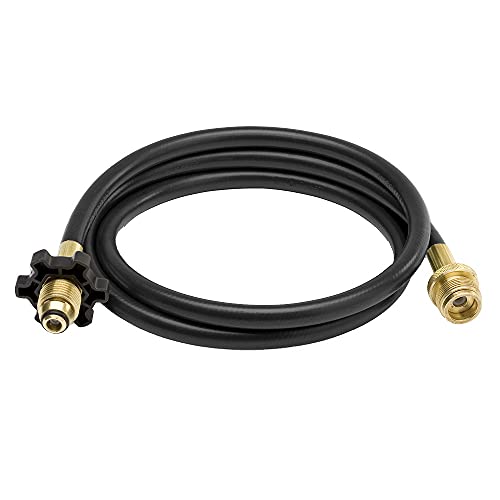
This is for camp, blind and shelter use; in a home emergency the manual sticks to 1 lb cylinders. The manual lists Mr. Heater hoses F273701, F273702 and F272702, each used with fuel filter F273699, plus hose F273704 (Buddy series), which doesn't need the filter, and F271802 or F271803 hoses on a regulated supply. It says the filter must be replaced every year. The hose and regulator are sold separately. Get the filter: without it the heater can gum up, which is the advice owners hand every new buyer, and the manual requires it on the F273701, F273702 and F272702 hoses.
Buy Mr. Heater's own hose rather than a generic one. The warranty policy says third-party attachments void the product warranty, and Amazon is full of hose-and-filter kits from other brands. Before you buy any hose, confirm the listing names one of the part numbers above.
Expect to hold the pilot knob a long time after a tank change while air purges from the line; the manual's own hose instructions say purging the supply hose may take longer. It's a nuisance, not a defect, and better to know before the first cold night. If yours won't stay lit, Mr. Heater's support line and the manual are the right next stop.
Reliability and living with it
The missing fan surprises people most. Older Big Buddy units had a battery fan; the current model sold on Mr. Heater's site is the no-fan version. Owners with newer units confirm it's gone, and one buyer opened the box expecting a fan. Without a fan, heat rises fast, which is fine in a blind and a letdown in a room with a loft. Don't add a heat-powered stove fan or any other third-party attachment. The manual calls third-party accessories extremely dangerous, and they void the warranty.
Plan for moisture. Unvented combustion adds water vapor (the EPA says so plainly), and owners describe condensation on tent walls and van windows. Dry out a camper after a long weekend.
When a Big Buddy fails, it's usually lighting or a burner: a pilot orifice that clogs, a burner tile that won't glow, and slow starts after a tank swap. A fuel filter on a hose setup is the fix owners mention most. We haven't seen a pattern of heaters dying outright, and Mr. Heater's recall page lists no current Buddy recall.
Mr. Heater's documents disagree on the warranty. The Big Buddy's product page lists a 3 year limited warranty, but Mr. Heater's warranty policy page says 1 year from date of purchase for all its products except unit heaters, and the Big Buddy manual we read gives no term. Use with third-party attachments voids it, per the policy page. Plan around the shorter term until Mr. Heater's pages agree, register the purchase date and keep the receipt.
How it compares
Big Buddy (MH18B) | Portable Buddy (MH9BX) | |
|---|---|---|
Heat input | 4,000 / 9,000 / 18,000 BTU/hr | 4,000 / 9,000 BTU/hr |
Heating area (maker claim) | Up to 450 sq ft | Up to 225 sq ft |
Vent area | 18 sq in | 9 sq in minimum (2017 manual) |
The two share the 7,000 ft altitude caveat, the ODS and the tip-over switch. For one person in a blind or a small tent, the Portable Buddy is cheaper, lighter and asks for half the vent opening. The Big Buddy earns its place when you need the HI setting or two people's worth of heat, and one Big Buddy owner says they wish they'd bought the smaller one.
The Buddy FLEX sits between the two at 11,000 BTU on the Amazon listing. We'd look at it if you want more than the Portable Buddy without the Big Buddy's bulk, and read its own manual for ventilation limits.
A vent-free wall heater with a thermostat (Heatstar and Mr. Heater both sell 18,000 BTU models) fixes the two biggest Big Buddy complaints: it holds a set temperature and adds a blower. Those are installed heaters rather than portable ones, with their own manuals covering fuel supply, room size and ventilation; read those before you buy. For a cabin you visit all winter, that's the better tool. For a heater that moves from the truck to the blind to the kitchen during an outage, the Big Buddy is the one.
Who should buy one
Buy the Big Buddy if you hunt, ice fish, or winter camp in a canvas tent (where a 20 lb tank outside on a Mr. Heater hose makes sense), or want a no-electricity backup for outages on 1 lb cylinders, and you'll run it awake, vented the way the manual says, with a CO alarm nearby. In those roles it's the portable propane heater we'd buy.
Don't buy it to heat a closed garage shop for hours, to sleep beside, or if you live in Massachusetts or Canada and want indoor heat, since your version's manual says outdoor use only. California owners shouldn't plan on it for heating a dwelling home either. For a regular one-person setup, the Portable Buddy saves money and needs half the vent area.
Score breakdown
Plenty of heat for most people: up to 18,000 BTU/hr of radiant heat with three settings covers a blind, a shelter, a canvas tent or a room during an outage. It has no thermostat, and the current model has no fan, so heat goes where the heater points and then rises. HI needs two 1 lb cylinders or a tank on a hose.
The low-oxygen shutoff and tip-over switch do their jobs, and we haven't seen a pattern of outright failures. The trouble is pilot and burner fussiness, usually from air in the line, debris such as a spiderweb in the pilot orifice, or unfiltered fuel on a hose. Mr. Heater lists 3 years on the product page but 1 year on its warranty policy page, so plan on the shorter term; third-party attachments void it.
It costs more than the Portable Buddy, but you get double the top heat and a second cylinder port. For camp and shelter use, a 20 lb tank saves a lot of cylinder swaps, though you have to add Mr. Heater's hose (and the filter, unless it's the F273704) to the budget. Check the current price on Amazon.
Mr. Heater Big Buddy on Amazon.
The Evidence Behind Our Verdict
Most owner reports come from r/camping, from people using the Big Buddy in tents, blinds, ice shelters and during power outages. They like the heat and the option of running a 20 lb tank, and they consistently recommend a fuel filter and a CO alarm. The complaints are the missing fan on current units, condensation, and fussy pilots or burner tiles.
Our rating above is our own editorial call. What follows is the field evidence we weighed to reach it: first-hand reports from owners on Reddit and independent HVAC and DIY forums, which we lean on more than manufacturer-influenced published reviews because unsponsored owners tend to be the more candid signal.
What Reddit Is Saying
“The older units do have a fan built in. Newer units do not. If I remember correctly, there was some reason that the cost of the fan was going to increase significantly, so they removed it to keep the cost down. My older unit does have a fan, my buddy's newer one does not.”
“I've used a big buddy in a tent, with a CO monitor and it never registered any. Same with an ice fishing popup hut.”
“If you're running it on a 20lb tank, the tank should be outside of the tent from my understanding of the directions. I have a Big Buddy as well. Kinda wish I'd gotten the smaller version, but it keeps us warm.”
“I’m sure it will give us some heat with out the fan but it would be much better if I could get it to circulate throughout my kitchen and living area. I have a loft so all the heat will just escape up there without one.”
“I also had the pilot light metering oriface clog, it's in a thin sheet of clear plastic, and apparently will sometimes get blocked by a spiderweb strand.”
“The issue I’m having is that the second heat tile will glow orange, but not the first. When I light the heater, a decently large flame will go up the first tile. But the tile will never glow. Then, when I turn the heater to high, the second tile glows just fine.”
Frequently asked questions
Is the Mr. Heater Big Buddy worth it?
It costs more than the Portable Buddy, but you get double the top heat and a second cylinder port. For camp and shelter use, a 20 lb tank saves a lot of cylinder swaps, though you have to add Mr. Heater's hose (and the filter, unless it's the F273704) to the budget.
How reliable is the Mr. Heater Big Buddy?
The low-oxygen shutoff and tip-over switch do their jobs, and we haven't seen a pattern of outright failures. The trouble is pilot and burner fussiness, usually from air in the line, debris such as a spiderweb in the pilot orifice, or unfiltered fuel on a hose. Mr.
How well does the Mr. Heater Big Buddy perform?
Plenty of heat for most people: up to 18,000 BTU/hr of radiant heat with three settings covers a blind, a shelter, a canvas tent or a room during an outage. It has no thermostat, and the current model has no fan, so heat goes where the heater points and then rises. HI needs two 1 lb cylinders or a tank on a hose.
What do real owners say about the Mr. Heater Big Buddy?
Most owner reports come from r/camping, from people using the Big Buddy in tents, blinds, ice shelters and during power outages. They like the heat and the option of running a 20 lb tank, and they consistently recommend a fuel filter and a CO alarm. The complaints are the missing fan on current units, condensation, and fussy pilots or burner tiles.
Options Worth Checking Out
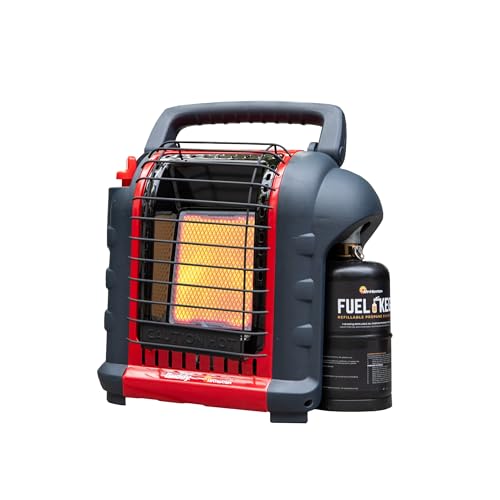
Mr. Heater Portable Buddy (MH9BX)
The smaller sibling at 4,000/9,000 BTU/hr with the same low-oxygen shutoff and tip-over switch. Its manual asks for half the vent area (9 sq in). The better buy for one person in a blind or a small tent.
Read our full review: we scored it 7.0/10


You Might Also Need
Accessories worth grabbing alongside your purchase

More Mr. Heater Reviews
See all →
How Does It Compare?
Side-by-side breakdowns featuring this product
