What Humidity Should a Crawl Space Be?
By Ingrid Tamsett · Updated October 2026
Independent editorial guide. We never accept payment for coverage, though we may earn a commission if you purchase through our links.
Quick Take
Keep a crawl space below 60% relative humidity and set the dehumidifier to about 50%. EPA's mold guidance says to keep indoor humidity below 60%, ideally 30-50%, and DOE's Building America guide to closing crawl spaces aims for 30-50%. The same DOE guide says the wood down there must stay below 17% moisture content, and that anything above 17% should be investigated.
A dehumidifier can only hold that number in a crawl space that's been closed up. If water comes in when it rains, the dirt is bare or the vents are open, fix those first; the DOE guide cites research showing that vented crawl spaces in mixed and hot-humid climates tend to get wetter, not drier. If you're starting from 80% or higher, we'd step the setpoint down over a few weeks, because the guide warns that rapid drying can cause cosmetic damage to wood finishes in the rooms above.
Our picks are the dehumidifiers we'd put in a sealed crawl space, warm or cold, plus the hygrometer that tells you whether the far corner is under 60%. See picks ↓

Getting a crawl space to 50% is a building job first and a dehumidifier job second. A crawl space is a box of cool air sitting on damp ground, often with holes to the outside, and no machine fixes that by itself. Once it's sealed, for a crawl space that stays above about 55°F all winter, the dehumidifier we'd buy is the Santa Fe Compact70; for one that runs colder, the AlorAir Sentinel HD55S.
Crawl space readings run anywhere from 35% to 90%. One in central North Carolina, with the vents open and the vapor barrier missing in places, read 90% after a few days of heavy rain. At the low end, a four-year-old AprilAire E070 holds one owner's sealed crawl space at 35%, about ten points below the house above it. The target is the easy part, because EPA and DOE agree on it.
Below 60%, with about 50% as the setpoint
EPA's guide to mold and moisture says to keep indoor humidity below 60 percent if possible, ideally between 30 and 50 percent. ENERGY STAR says 30-50% is generally considered the optimum for a building and that anything above it may promote mold growth. DOE's Building America guide to closing and conditioning ventilated crawl spaces works to the same 30-50%: it says a permanent dehumidifier might be necessary to hold that range in areas without air conditioning, and that a crawl space saturated with moisture needs temporary dehumidifiers to bring it to 30-50% before the sealing work goes on.
Humidity is the stand-in; the wood is what you're protecting. The DOE guide says the moisture content of the wood in a crawl space must remain below 17%, and that anything higher is of concern and should be investigated. It also says that once moisture is high, it condenses on the cooler surfaces of the framing and floor deck, and calls those surfaces easy to observe, so look there first. Here's how real crawl spaces measure up against that 17%:
Crawl space | Wood reading |
|---|---|
Reading 85-90% humidity | Joists at about 18% |
Washington crawl space, inspected | 20%, with some wood rot (inspector's reading) |
Encapsulated in 2017 | Sills at 13-15%, which the owner calls good |
Joists in the direct path of a dehumidifier's dry air | 9.8-10.3%, with cracks at knots; the owner wondered whether the wood had dried too far |
With a dehumidifier running, crawl spaces mostly land between 35% and 60%. Some hold 50% or lower. Others sit around 55-60%, and one set at 60% while the joists dry reads about 64% on a separate sensor. A newly encapsulated 1,300 sq ft crawl space set at 63% holds 60-65% through the summer.
We'd set 50%. It's inside every official range, and it leaves room under 60% for a humid week and for sensor error: AlorAir says the humidity its Sentinel HD55S displays is approximate, within plus or minus 5%, so a display reading 55% could be sitting in 60% air. Going much lower buys little in a cool space. Santa Fe's manual describes its Drier setting as about 35-45% and advises against it in a room under 65°F, because the unit will run a long time to little effect; its Normal setting, 45-55%, is the one Santa Fe recommends for most uses.
Why open vents can make a crawl space wetter
Foundation vents were meant to dry a crawl space with cross-ventilation. The DOE guide says research has shown the opposite in mixed and hot-humid climates: vented crawl spaces there tend to increase the moisture level instead of keeping the space drier, and that moisture condenses on the colder wood of the floor framing, promoting fungal growth and wood damage.
Relative humidity explains why. ENERGY STAR defines it as the water vapor in the air compared with the most the air can hold at that temperature, and cooler air holds less. Take a summer afternoon: outdoor air at 85°F and 50% relative humidity has a dew point of about 64°F. Let it into a crawl space at 70°F and it reads about 82%. At 65°F it reads about 98%, and any surface colder than about 64°F, such as a supply duct, a foundation wall or a cold water pipe, collects condensation. No water was added; the air only cooled. Cool ductwork in a crawl space is often the first thing to sweat.
That's why open vents and an open supply duct in a Southern crawl space are the first two suspects for high humidity, and why the North Carolina crawl space with open vents hit 90% after heavy rain. Winter has its own version. One commenter points out that closing the vents for winter on an otherwise unsealed crawl space raises the humidity until it condenses on the cold block wall and grows mold, and in some areas most people now seal the crawl space completely.
Closing the vents alone isn't the fix. The DOE guide says turning a vented crawl space into a sealed, dry one takes more than sealing the vent openings, and that sealing them without handling the other details could make the moisture worse. One owner's lower level may be a case of it: two rooms were built into a formerly vented under-house space, the remaining crawl space vents were closed during the work, and the space now reads 80% against 50-60% upstairs. Closing the vents wasn't the only change there, so it proves nothing on its own.
There's a safety reason to do it in order, too. The DOE guide says sealing the vents could create a deadly situation if naturally ventilated combustion equipment sits in the crawl space. If a gas furnace or water heater down there draws combustion air from the foundation vents, the guide says equipment upgrades or changes to the makeup air will be necessary, and its stop-work checklist sends that to a qualified mechanical contractor before the job goes on. It also says to verify that a carbon monoxide detector is installed and working in the crawl space. Where radon is a risk or local code requires soil-gas control, it says closed crawl spaces must be tested and monitored.
The vapor barrier comes before the dehumidifier
The DOE guide calls a comprehensive vapor barrier on the crawl space floor one of the most important details, and says an improperly installed one lets ground moisture in and raises the relative humidity. Its spec: cover the whole floor with at least 10-mil poly, or a cross-laminated, puncture-resistant 6-mil; lap the sheet joints at least 12 inches and tape them; and seal the barrier to the foundation walls 4 inches below the top with mesh tape and mastic. It adds that gaps or open seams let ground moisture through, and that a missing or unsealed sump lid raises the humidity too.
Codes come into it. The guide quotes the 2009 International Residential Code's unvented crawl space section, which said vents weren't required where exposed earth is covered with a continuous vapor retarder, with joints lapped 6 inches and sealed or taped and the edges run at least 6 inches up the stem wall and sealed to it. The guide cites the same code section again for the conditioned-air rate covered below, so don't read the barrier as the whole requirement. Your jurisdiction may have adopted a later edition with different terms, and the guide itself says its designs may or may not meet local codes, so check your local code with your building department before you seal vents.
Cover the dirt. Put a dehumidifier on bare ground and the ground keeps feeding it. Owners who've laid a barrier describe drier crawl spaces afterward: thick plastic with overlapped seams, laid about 20 years ago in a very wet climate, ended their moisture issues, and a crawl space with the dirt graded flat and covered, the penetrations sealed and a dehumidifier added now matches the living space on moisture and temperature. The 2017 encapsulation above, reading 13-15% in the sills, is now testing whether it holds on its own after its dehumidifier died. It isn't a huge job, either: three people laid a thousand square feet of barrier in about two hours.
Lay and seal the barrier, close the vents where it's safe to, and then watch a hygrometer for two weeks before you buy a dehumidifier. If the crawl space stays under 60% on its own, you may not need one yet. The DOE guide still says a crawl space must always have a drying mechanism, though, and names a small supply of conditioned air from the house, with a return path, as one of the most effective; where there's no air conditioning, it says a permanent dehumidifier might be necessary.
If water comes in, fix that first
No setpoint keeps up with liquid water. The DOE guide says any standing water must be eliminated and its source found and repaired, and that standing water typically means a leaking pipe or groundwater coming in. It makes controlling bulk water outside the house the first step of the whole job: ideally, ground sloping 5% away from the foundation (6 inches over the first 10 feet), and roof runoff carried at least 10 feet away or into an underground drain. EPA's moisture advice says the same about gutters and grading, and adds that wet or damp materials dried within 24-48 hours after a leak or spill will, in most cases, not grow mold.
The water version is easy to recognize. Water collects in the low corner of a sloped crawl space, kept in check by a sump pump. The downhill end floods in torrential rain; one took about a foot of water during Hurricane Helene. Contractors don't agree on the fix, either. A Washington owner whose wood read 20% with some rot, and evidence of past leaks, got two quotes that disagreed completely: one would add a sump pump and French drain, open the foundation vents and lay a loose 6-mil barrier; the other would seal the vents, insulate the walls, lay a sealed 20-mil barrier and add an AprilAire E070.
Look outside first: gutters, downspouts, grading and French drains, and on a hillside, water from uphill damming against the foundation at one end of the house. One owner credits that work plus a new patio and sidewalk pour that steered water away from the foundation. The DOE guide also calls a water leak alarm at the low spot or near the drain a good practice, and we'd add one; a crawl space is the place a leak goes unnoticed longest.
Bring it down slowly
The DOE guide says that, depending on conditions, it might be best to close a crawl space slowly, because rapid and excessive drying can cause cosmetic damage to wood-based finish products in the living area. It also says swollen and cupped hardwood may flatten as it dries, and that wood floors, trim and caulk joints can shrink. It gives no drying rate.
Even contractors disagree here. One owner who started at 85-90%, joists at about 18%, found the contractors they called split roughly in half on whether fast drying could hurt their floors, so they set their unit to 60% and planned to hold it there for a couple of weeks before stepping to 55%. Another dropped from 60% to 40% in four to five days, then pulled back. The joists with cracks at knots read near 10% where the dry air blew directly and 12-14% elsewhere. Nobody can say the drying caused damage, and those cracks may have other causes, but the caution matches the DOE guide.
It isn't a published schedule, but here's how we'd do it: if the crawl space starts above about 70%, set 60% for the first two weeks, then 55%, then 50%, and point the discharge so it isn't blowing straight onto one joist. Check the wood with a moisture meter as you go. Slow doesn't mean leaving it wet; the DOE guide's 17% limit is the number to get under, and if surface mold is already growing on the framing, the guide says a certified mold remediation expert should inspect it before the work goes on.
Choosing a dehumidifier for a crawl space
If the house has ducted central air, ask an HVAC contractor about the DOE guide's conditioned-air approach before you buy anything. It calls for supply air of at least 1 cfm for every 50 square feet of crawl space floor, or 50 cfm, whichever is greater, with a return path to the house. A 1,500 sq ft crawl space works out to 30 cfm, so the 50 cfm minimum applies. The guide says this met the 2009 IRC and that local codes might differ.
Otherwise, choose by three things you can measure first. The first is how cold the space gets, which decides the brand:
Unit | Cold limit | What it means |
|---|---|---|
Santa Fe Compact70 | Rated to operate from 49°F to 95°F | The manual says it works most effectively from 56°F up and removes little to no water at 55°F or below. |
AlorAir Sentinel HD55S | Rated down to 33.8°F, with auto defrost | The HD55P, with a built-in pump, lists 33-105°F. |
AprilAire E070 | Dehumidifies from 50°F inlet air, 40°F dew point minimum | In 55°F air that dew point is about 57% relative humidity, so in a 55°F crawl space its rated dehumidifying range stops short of a 50% target (in 60°F air, the same dew point is about 48%). |
Those limits bite. One owner's crawl space unit shuts off on a low-temperature lockout at about 50°F for most of the winter, while an owner with an AlorAir in a crawl space reading about 81% wants theirs running all winter. Log the temperature for a few weeks of winter before you buy. If it stays above about 55°F, the Compact70 fits; if it drops below that, we'd buy the AlorAir.
The second is capacity, compared at the DOE's 65°F test rather than the box number. Santa Fe publishes 43.7 pints a day at 65°F for the Compact70; ENERGY STAR lists the HD55S at 36.33. AlorAir gives the HD55P only at the old 80°F condition (55 pints) and at saturation. A crawl space below 65°F will likely see less than either figure. Size by the 65°F number and the makers' coverage claims (Santa Fe: the Compact70 up to 2,600 sq ft tightly sealed; AlorAir: the HD55S up to 1,300 sq ft), not by buying bigger to be safe.
The third is where the water goes. The DOE guide says a crawl space dehumidifier might need to be tied into a sealed drain point. The HD55S is gravity only and wants at least 1 inch of fall per 10 feet of hose. The Compact70 drains by gravity through a trap, and Santa Fe sells a pump kit rated to lift up to 12 feet. The HD55P has a built-in pump, set to gravity by default, with no published lift height that we could find. If a line has to leave the house, keep it above freezing all the way out. Our crawl space dehumidifier guide covers drains, pumps and warranties in detail. Two warranty points matter here: AlorAir's warranty applies only to units bought from AlorAir or an authorized dealer, and after the first six months a unit sent back for inspection ships at your cost; Santa Fe's written warranty covers defects for five years and excludes labor.
Measure it at the far end, and measure the wood
Read the humidity on a separate hygrometer, not only on the dehumidifier. A dehumidifier's sensor reads the air right around the unit, which makes its number run a touch lower than a standalone sensor. ENERGY STAR suggests hanging a hygrometer near a dehumidifier that has no humidity display, and the DOE guide suggests an optional humidistat so you can track the crawl space and catch unusual moisture loads.
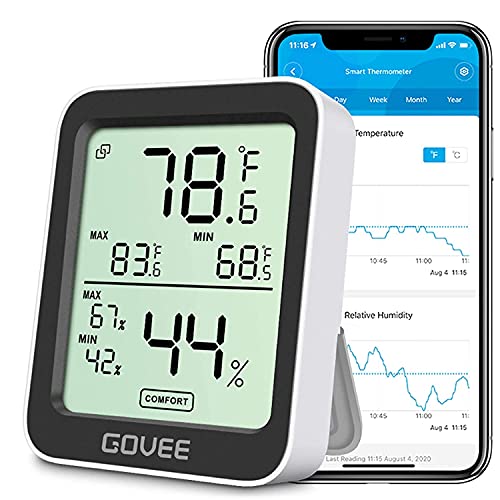
No standard says where to hang it, so here's what we'd do. Put one hygrometer at the far end of the crawl space from the dehumidifier, hung from a joist so it reads the air around the framing, and leave it there; that's the reading that has to stay under 60%. For the first week, a second one beside the unit will show you how far its display is off. A hygrometer that logs temperature too earns its keep in winter, when it tells you whether the space drops below a unit's cold limit. Govee lists the H5075 at plus or minus 3% relative humidity and 0.54°F on its Amazon listing, with 20 days of graphs in the app and two years of exportable data.
Old sensors drift. One owner chasing a 70% reading in one room bought a new meter and found that room matched the rest of the house; the old meter was about 20 years old, and their thermostat's humidity reading turned out to be 5 points off. It's also hard to tell an undersized unit from a sensor in the wrong spot. If two readings disagree by more than a few points, trust neither until you've put them side by side.
Then check the wood. A hygrometer tells you about the air; a pin-type wood moisture meter tells you about the joists and sills, which is what the DOE guide's 17% limit is about, and owners take these readings themselves. If the hygrometer climbs after every hard rain while the dehumidifier runs, treat it as a water problem, not a dehumidifier problem.
The picks
Products we recommend for this guide.

Santa Fe Compact70 Dehumidifier (part 4044110)
For a sealed crawl space that stays above about 55°F: 43.7 pints/day at the DOE 65°F test, and its Normal setting (45-55%) brackets a 50% target. Five-year defect warranty. No pump in the box, so plan the drain first.
Read our full review: we scored it 7.0/10

AlorAir Sentinel HD55S (ENERGY STAR, gravity drain)
For a crawl space that drops below about 55°F in winter: rated to run from 33.8°F with auto defrost, and ENERGY STAR lists 36.33 pints/day at 65°F. Gravity drain only. Buy from AlorAir or an authorized dealer for the warranty.
Read our full review: we scored it 7.0/10

What owners say
Real owner reports from the threads and editorial sources we drew on for this guide.
“There’s a vapor barrier but it’s missing in some places. We’ve had heavy rain the last few days and I noticed the relative humidity in the crawlspace was 90% yesterday and today following the rain. I checked it out and there was a little dampness in a few places. The vents are all open as I’ve heard it’s best to let the space breathe this time of year.”
“The problem is that humidity in the space has climbed to 80% vs the 50-60% upstairs. During the construction they closed all the venting in the remaining crawl space and there is a crawl space door directly into the living space.”
“We bought our house 20 odd years ago and there was no vapor barrier and the joists had way too much moisture in them (I’m in a very wet climate). Laid down thick plastic sheeting, overlapped all the seams, etc. No more moisture issues.”
“First make sure all water drains away from the house. I had someone grade the dirt flat and lay down a layer of roofing material. They only went up the walls about 4” and did not need to seal this off. The termite inspector needs to see the walls to make sure there are not paths up to your wood. They sealed off all penetrations and installed a dehumidifier. The moisture level and temp is now about the same as the living space.”
“I did mine myself! Bought a few rolls of vapor barrier on Amazon, laid it down in my crawl space, and just taped it together where the seams met. A thousand square feet took three of us about 2 hours to get done”
“An inspector found 20% wood moisture and some wood rot. Given that this summer was very dry in PNW, high moisture is concerning me. There is an evidence of past leaks, but currently dry (no standing water).”
“My crawl space humidity was pretty high to start with, 85-90% and joist were at about 18% moisture so I want to go slow. Thankfully I did not have active mold or rot, so I think have time to slowly correct the issue.”
“However the hardwood floors looked "wavy" in a couple rooms including the living room. It didn't register until we looked in the area under the house. The humidity was like a blanket was thrown over me. The space was huge and with no barrier over the ground area.”
“I think the meter I had before was old and not accurate anymore it was like 20 years old lol Also, I placed the new meter next to my thermostat (centrally located in the house) and the humidity on the thermostat is off by +5% so I've adjusted my thermostat for the offset in the app...”

