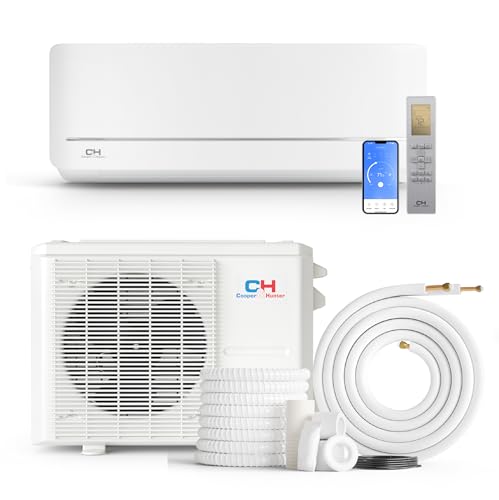
Gree Livo R32 Mini-Split Review: Good Hardware, Contractor-Only Warranty
By Wendell Asaro · Updated October 2026
Independent editorial review. We never accept payment for coverage, though we may earn a commission if you purchase through our links.
 ← 42-7/16 in wide (30K indoor unit) →
Spec sheet
| Rated heat @ 47°F | 30K: 30,000 Btu/h · 18K: 17,000 · 24K: 22,400 (NEEP/AHRI) |
| Heat @ 5°F (share of rated) | 30K: 23,000 (77%) · 18K: 12,100 (71%) · 24K: 15,700 (70%) Btu/h |
| Lowest heating temp + max there | -13°F, all sizes; 30K max 16,900 Btu/h at COP 1.30 (NEEP) |
| SEER2 / HSPF2 | 30K: 22.0 / 9.0 · other sizes 19.0-20.5 / 8.5-8.8 |
| Voltage + circuit | 30K: 230V, 27 A MCA / 30 A max overcurrent · 9K/12K also in 115V (20 A) |
| Line set | 30K: flared 1/4 x 5/8 in, 25 ft pre-charge, 131 ft max, 82 ft rise |
| Install type | Flared connections; no quick-connect version in Gree documents |
| Warranty | 5-yr parts / 7-yr compressor only with a state certified or licensed HVAC contractor install; no labor |
| Owner-reported issues | Louver drift, unmutable beep, D3 code not in manual (single reports, Gen 3 / Gen 4) |
Verdict
Owner reports come from r/hvacadvice and r/heatpumps threads about Gree Livo and Sapphire units; installers' views are summarized in the text, not quoted as owner cards. Livo owners mostly name Gen 3 or Gen 4 units, which we treat as older R-410A units rather than the current R-32 line, and their reports are nuisances and documentation gaps rather than failures. Sapphire owners, a separate and pricier line, are consistently positive, though only one confirms an R-32 unit. Brand-level comments split, with parts and support the recurring knock.
Read full take ↓


We like the Livo's hardware for the money, and we'd only buy one with a licensed HVAC contractor already lined up. Gree's warranty statement "applies only to systems that are properly installed by a state certified or licensed HVAC contractor." Hang it yourself and you own a mini-split with no manufacturer warranty. Gree's own-brand single-zone wall mounts come in a value line and a premium line, and the Gree Livo R32 30,000 BTU mini-split belongs to the value one: 9,000 to 36,000 BTU heat pumps on R-32 refrigerant, each rated to keep heating down to -13°F, with 115V versions at 9K and 12K. We link the 30K because it's the Livo size whose Amazon listing reports a clean Livo R32 model number.
On cold-weather heat the Livo lands in the middle. On the AHRI-certified figures in the NEEP cold-climate heat pump list, every size keeps 70% to 77% of its rated heat at 5°F. The 30K makes 23,000 Btu/h at 5°F against 30,000 at 47°F, or 77%, and NEEP lists a maximum of 16,900 Btu/h at -13°F. The 18K, the size most people shop, goes from 17,000 Btu/h at 47°F to 12,100 at 5°F, or 71%; Gree's own submittal prints a higher 19,100 at 47°F. That's a little less 5°F heat than the Della Serena 18K or the Pioneer Diamante Pro 18K publish, though the Livo keeps running 18 degrees colder than the Della and 9 degrees colder than the Pioneer. Gree's premium Sapphire R32 sits a tier above all of them: its 24K lists 24,000 Btu/h at 5°F, more than the Livo 30K, and heats to -22°F.
Think of it as a solid contractor-installed heat pump for a big open zone (the 30K) or a bedroom, office or addition (the smaller sizes) in a climate with single-digit winter nights, priced below the dealer brands. If you're doing the install yourself, the Della or the Pioneer gives you warranty coverage Gree won't. If your coldest nights run well below zero and this is the main heat, pay for the Sapphire.
Telling the Livo generations apart
Gree has sold several units under the Livo name, and they don't share a spec sheet. The current line is what Gree's documents call Livo R32. Full-set model numbers start with LIV, then the size, HP and the voltage, and end in R32AO for the outdoor unit and R32AH for the indoor head. The 30K, for example, is LIV30HP230V1R32AO with LIV30HP230V1R32AH. The 9K and 12K come in 115V and 230V versions; the 18K through 36K are 230V only.
The older units are separate products. The LIVO+ (model numbers starting LIVS) runs on R-410A; Gree's submittal for the LIVO+ 18K lists 16 SEER under the old test, a -4°F minimum heating temperature and Wi-Fi as an optional kit. A Livo Gen 3, with model numbers starting LIVV, also turns up at retailers. Gree's own Livo GEN4 page lists 4LIV model numbers on R-410A refrigerant, with heating rated from -13°F to 75°F, so the -13°F floor isn't unique to the R-32 line. Gen 3 came before Gen 4, and we treat Gen 3 and Gen 4 owner reports as evidence about the older R-410A Livos, not as proof about the R-32 unit.
On Amazon the naming is a mess, which is why we link the 30K and not the 18K. The 18K listing titled "Gree R32 LIVO+" reports model LIVS18HP230V1B, the R-410A LIVO+, despite "R32" in its title; we don't link it. A 9K listing titled "16 SEER LIVO+" has the same identity problem. The 30K listing we link reports model LIV30HP230V1R32AH/AO, but its bullet points copy LIVO+ text, including "16-SEER," where Gree and NEEP rate the Livo R32 30K at 22.0 SEER2. Go by the model number, not the bullets. The Sapphire listings are no cleaner: the 24K is titled "21.5 SEER" and an 18K "24.5 SEER," while Gree's documents list 27.0 and 27.5 SEER2 for the R32 versions. Before you order any size, ask the seller to confirm both model numbers end in R32AO and R32AH. If they don't, the numbers in this review don't describe what you're buying.
Generation matters on install day too. One homeowner's handyman arrived with a Gen 3 Livo condenser and a Gen 4 indoor unit and claimed the pair would rate higher than either half; Gree's compatibility chart, the owner found, showed the two wouldn't work together. Gree's ratings come from an AHRI certificate for one specific indoor and outdoor pair (214802443 for the 30K), so insist on the matched pair. Under EPA's current rule, an R-410A split system can still be installed if its components were made or imported before January 1, 2025, so old LIVO+ stock isn't illegal to sell. For a new install we'd still buy the R-32 unit, because it's the one these numbers describe.
Strengths and gripes
What we like:
- A cold floor of -13°F: heating is rated down to -13°F on every size, colder than the 5°F floor of the Della Serena and the -4°F floor of the current Pioneer Diamante Pro, and NEEP lists a real maximum there: 16,900 Btu/h on the 30K.
- Retention: the 30K keeps 77% of its rated heat at 5°F (23,000 of 30,000 Btu/h), and the 9K and 12K 230V keep 76%.
- 115V option: at 9K and 12K, for a room where running a 230V circuit is a hard job.
- Certification and leak sensors: every Livo R32 size we found in ENERGY STAR's dataset is certified with the cold-climate flag, and each indoor head has a factory-installed refrigerant leak sensor.
What we'd change:
- Warranty: covers only installs by a state certified or licensed HVAC contractor, claims go through the contractor, and labor and refrigerant are never covered.
- Flare install: flared line connections with a 25 ft pre-charge. None of Gree's documents we reviewed shows a quick-connect version.
- Middle sizes: the 18K and 24K keep 71% and 70% of their certified heat rating at 5°F, a point or less over ENERGY STAR's 70% cold-climate line, and HSPF2 is 8.5 on most sizes, the minimum that badge allows on a ductless unit.
- Listings: Amazon listings mix old and new names. Even the 30K we link has bullet points copied from the old LIVO+, so you have to check model numbers before you buy.
- Small gripes: a louver that won't hold its angle, a beep you can't turn off, a code the manual doesn't list.
Which homes and climates it fits
Put a Livo on a zone you want heated and cooled on its own schedule. The 30K we link is sized for a big open living area, a large addition or a small house's main floor; the 9K and 12K suit a bedroom or office, with each head on its own outdoor unit. It fits best where winter nights reach the single digits but rarely sit far below zero. Every size keeps 70% to 77% of its rated heat at 5°F, and NEEP's -13°F maximums run between 47% and 62% of the 47°F rating.
Size it by the 5°F column. Say a heat-loss calculation puts a zone at 20,000 Btu/h on a 5°F night. That's an illustration; your number comes from a Manual J or a careful heat-loss estimate. The Livo 24K's 15,700 Btu/h at 5°F covers about 79% of that. The 30K's 23,000 covers it with 3,000 Btu/h to spare. The Sapphire 24K, listed at 24,000 Btu/h at 5°F, covers it one size smaller. If your nights reach -13°F, the 30K's maximum there is 16,900 Btu/h, below the 20,000 the zone needed at 5°F, and the zone needs more when it's colder; the Sapphire 24K still lists 17,000 Btu/h at -22°F. The same pattern holds lower in the range: in the cold, a Sapphire 12K (12,200 Btu/h at 5°F) makes about as much heat as a Livo 18K (12,100).
For scale, a 1,500 W plug-in heater makes about 5,100 Btu/h (one watt of resistance heat is 3.412 Btu/h). At 5°F the Livo 30K is worth about four and a half of those heaters, and at its NEEP-rated COP of 1.80 it uses about 56% of the electricity per Btu. At -13°F, running flat out at a COP of 1.30, it still uses about 77% of what resistance heat would. Don't jump a size "to be safe," though. An oversized unit short-cycles in mild weather and dehumidifies poorly in summer; one Livo owner who'd oversized their units by a good amount later had humidity problems in cooling mode.
Pick something else when:
- You're installing it yourself: a DIY install falls outside Gree's warranty. Della's web warranty policy says that for a registered product with a non-professional install, Della will, at its discretion, provide replacement parts free of charge, and Pioneer's warranty policy doesn't require a licensed installer.
- Your design temperature is below about 0°F and this is the main heat: the Livo keeps 70% to 77% of its rated heat at 5°F and less than two-thirds of it at -13°F. The Sapphire, rated to -22°F with 5°F output at or near its 47°F rating, is the Gree built for that house.
- You want Gree's longest warranty: the 10-year parts and compressor term requires that the unit be purchased and installed by a GREE Select Dealer, which an Amazon purchase isn't.
Heat by size, from the certified ratings
These figures come from the NEEP cold-climate heat pump list, which carries the AHRI-certified ratings for each matched pair. The 47°F, 17°F and 5°F figures are NEEP's rated capacities; the -13°F figure is NEEP's maximum, because no rated point is listed there. The 47°F figure is the nameplate rating, and the colder figures are what the unit makes when it's cold. Percentages are 5°F rated output divided by the 47°F rating. Capacities are Btu/h. Circuit figures come from Gree's submittals: minimum circuit ampacity (MCA) and maximum overcurrent protection (MOCP).
Size / voltage | 47°F | 17°F | 5°F (% of 47°F) | COP at 5°F | Max at -13°F (COP) | SEER2 | HSPF2 | MCA / MOCP |
|---|---|---|---|---|---|---|---|---|
9K 115V | 10,000 | 10,000 | 7,600 (76%) | 1.86 | 5,700 (1.52) | 20.5 | 8.8 | 19 A / 20 A |
9K 230V | 10,000 | 9,600 | 7,600 (76%) | 1.94 | 5,500 (1.43) | 20.5 | 8.8 | 10 A / 15 A |
12K 115V | 12,000 | 9,700 | 8,500 (71%) | 1.75 | 6,500 (1.42) | 19.0 | 8.5 | 19 A / 20 A |
12K 230V | 12,000 | 9,700 | 9,100 (76%) | 1.80 | 6,500 (1.42) | 19.0 | 8.5 | 12 A / 15 A |
18K 230V | 17,000 | 15,300 | 12,100 (71%) | 1.85 | 10,200 (1.51) | 20.0 | 8.5 | 13 A / 15 A |
24K 230V | 22,400 | 19,200 | 15,700 (70%) | 1.75 | 10,500 (1.33) | 19.0 | 8.5 | 15 A / 20 A |
30K 230V | 30,000 | 24,000 | 23,000 (77%) | 1.80 | 16,900 (1.30) | 22.0 | 9.0 | 27 A / 30 A |
36K 230V | 34,000 | 27,400 | 24,600 (72%) | 1.80 | 21,000 (1.54) | 21.0 | 8.5 | 24 A / 35 A |
Gree's submittal sheets disagree with the certified figures in a few places. They list higher 47°F ratings for the 18K (19,100 Btu/h) and the 24K (24,000), a lower 17°F figure for both 9K models (8,100), and a COP of 1.75 at 5°F for the 12K 230V and the 18K. We go by the certified numbers. The heating range is -13°F to 75°F outdoors on every size, and cooling runs 0-118°F on the 9K through 24K.
ENERGY STAR's cold-climate badge asks for at least 70% of 47°F capacity at 5°F, a COP of at least 1.75 at 5°F, and HSPF2 of at least 8.5 on a ductless split. On the certified figures the 18K (71%) and 24K (70%) clear the capacity bar by a point or less; divide the same 5°F output by Gree's higher submittal ratings and you'd get 63% and 65%. COP at 5°F runs 1.80 to 1.94 on most sizes, and only the 24K and the 12K 115V sit exactly on the 1.75 minimum. HSPF2 sits on the 8.5 minimum on five of the eight models. The Livo qualifies, without much room to spare in the middle sizes. NEEP shows the 12K 115V without ENERGY STAR or cold-climate certification, and we couldn't find it in ENERGY STAR's dataset, so check the certification yourself if a rebate depends on it.
Inside the brand, the Sapphire R32 is the comparison that matters. NEEP lists its 5°F rated output at 11,500 Btu/h on the 9K, 12,200 on the 12K, 18,000 on the 18K and 24,000 on the 24K, at or near each size's 47°F rating, with maximums at -22°F of 7,400, 8,500, 10,800 and 17,000. It's rated 27.0-30.0 SEER2 and 10.0-11.2 HSPF2, from a double-cylinder compressor where the Livo uses a single-cylinder one. Gree's Sapphire submittals print a 17°F column below their own 5°F figures (15,500 at 17°F on the 18K), but the certified 17°F ratings on NEEP's list are higher: 12,000, 13,000, 19,500 and 23,000 for the four sizes. Go by the certified numbers. The Sapphire comes in 230V only, 9K through 24K, and every size allows 131 ft of line.
Indoor sound is rated 24-41 dB(A) on the 9K 230V, 27-47 on the 12K, 34-53 on the 18K and 36-52 on the 30K, with outdoor units at 51, 52, 57 and 62 dB(A). The 9K and 12K indoor heads are 32-7/8 in wide, the 18K is 37-1/8 in, and the 24K through 36K are 42-7/16 in. These are Gree's figures, not our measurements.
What the install involves
The Livo R32 isn't a homeowner quick-connect kit. Gree's submittals list flared line-set connections, with a 1/4 in liquid line and a gas line of 3/8 in on the 9K and 12K, 1/2 in on the 18K and 24K, and 5/8 in on the 30K and 36K. The outdoor unit holds a factory charge for a 25 ft pre-charge length. The minimum run is 10 ft. The maximum is 66 ft with 40 ft of rise on the 9K and 12K, 82 ft with 33 ft on the 18K, and 131 ft with 82 ft on the 24K through 36K. Plan the run around that 25 ft figure, because anything that calls for added refrigerant is a certified technician's job: EPA says only Section 608 certified technicians can buy refrigerant for stationary air-conditioning equipment.
Gree's Sapphire R32 manual lists a vacuum pump, a pressure meter and a torque wrench among its installation tools. We couldn't find the same tools list in the text of the Livo R32 outdoor manual, but the connections are the same flared type, and we'd plan on the same evacuation. Most installers also confirm the vacuum with a digital micron gauge; that's trade practice, not a line in Gree's manuals. Both manuals put the labor question in one sentence: "Installation or maintenance must be performed by qualified professionals."
The legal side points the same way. EPA's Section 608 guidance says "Any person servicing, installing or disposing of stationary appliances (except the disposal of small appliances) must be a section 608 certified technician," and EPA's definition of a technician names owners as well as installers and lists attaching hoses and gauges among the activities that count. Add Gree's warranty clause and the Livo is a contractor's install in every sense.
Electrical comes next. The 115V 9K and 12K list a 19 A minimum circuit ampacity and a 20 A maximum overcurrent device, which leaves no room on a 20 A circuit for anything else. The 230V sizes run from a 15 A maximum on the 9K, 12K and 18K up to 30 A on the 30K and 35 A on the 36K. A new circuit usually means a licensed electrician and a permit, and in an older house it's often the line item that decides between 115V and 230V.
R-32 is classed A2L, mildly flammable, in EPA's SNAP table, and every Livo R32 indoor head has a factory-installed A2L leak detection sensor. Plan a drain path for the indoor unit's condensate, and remember the outdoor unit sheds water when it defrosts in heating mode. The ribbed drain hose that comes in the Sapphire box is poor, by one owner's account; a better hose is a cheap upgrade worth making on either line.
If you're paying a contractor, get their labor warranty in writing, because Gree's covers no labor. Don't settle for one year: a homeowner was offered a 1-year labor warranty on a Gree quote, while a Gree owner said 3 years was standard and got 5.
The warranty, in Gree's words
This decides whether an Amazon Livo makes sense for you. Gree calls its program the Licensed Contractor Warranty Program, and the name is accurate.
- Who installs: "This Limited Warranty Statement applies only to systems that are properly installed by a state certified or licensed HVAC contractor, under applicable local and state law in accordance with all applicable building codes and permits, GREE installation and operation instructions and good trade practices."
- Standard term: "The warranty period is Five (5) Years on all Parts and Seven (7) Years on the Compressor when installed in a residential application." Gree's warranty page says the same in one line: "Standard dealers receive 5/7 years parts & compressor warranty." Gree branded controls get 1 year. The web page says registration "is not a requirement for the Standard Warranty; however, it is highly recommended."
- Extended term: 10 years on parts and the compressor, but only under the Select Dealer warranty: "Unit must be purchased and installed by a certified GREE Select Dealer." The PDF statement gives 90 days to register; Gree's warranty web page and the FAQ in its claims guide both say 60. Register within 60 to satisfy all three.
- Not covered: "Labor or other costs incurred for diagnosing, repairing, removing, installing, shipping, servicing, or handling of either defective parts, or replacement parts, or new units," and "Any cost to replace, refill or dispose of refrigerant, including the cost of refrigerant." Corrosion damage within one mile of a seacoast is excluded too.
- Claims: "Warranty claims are contractor-only and cannot be submitted by a homeowner." For units bought online, Gree's claims guide says "The claim form is only used for systems purchased online, or through Home Depot or Lowes," and the warranty page tells owners to "contact your installing contractor."
- Start date and scope: "All warranty periods begin on the date of original installation. If the date cannot be verified, the warranty period begins one hundred twenty (120) days from date of manufacture." The program brochure limits it to the contiguous United States and Hawaii.
Put together: a Livo bought on Amazon and installed by its owner has no Gree warranty. Bought on Amazon and installed by a licensed contractor, it gets 5 years on parts and 7 on the compressor, with the contractor filing any claim through Gree's online form, and you pay labor and refrigerant on every repair. One more inconsistency to know about: the registration form on the same web page says non-Select systems registered there "will receive a 5-year warranty," while the statement, the dealer-tier line and the Sapphire brochure say 5 years on parts and 7 on the compressor. Keep a copy of the statement with your install invoice.
That puts Gree alongside Cooper & Hunter, whose warranty applies only to units installed by a licensed HVAC technician, and behind Della and Pioneer for a self-installer. Della's web policy says it will, at its discretion, provide free replacement parts for a registered DIY install, and Pioneer's policy doesn't require a licensed installer, though it excludes damage from a faulty installation.
Reliability and living with it
The Livo's problems are annoyances, not failures, as far as anyone can tell. Owner evidence on the Livo by name is thin: seven owners, most of them on a Gen 3 or Gen 4 unit, which we treat as the older R-410A Livos, and almost none of it can be pinned to the R-32 line. None reported a refrigerant leak or a compressor failure, but seven people is not a long-term record. On the good side, Gen 4 heads in a very leaky house performed well through a polar vortex in the small rooms they heated, while the downstairs units held about 46 degrees so nothing froze.
The gripes: louvers that drift back to their lowest angle whenever a unit cycles (on five Gen 3 units, and on an unnamed Gree model in a workshop); a Gen 4 head that beeps on every remote press with no way to mute it, though on another Gree turning off the display light silences it; and a D3 code in heat mode on a Gen 4, with the heat still working, the code missing from the error list and no answer from Gree at last report. The one hardware failure is on the old R-410A LIVO+: a cracked cross-flow fan in a 9K 115V head, which its owner was replacing themselves.
Gree's documentation is the weak spot we'd plan around. The beep, the D3 code, and remote symbols on a Gen 3 that the manual doesn't define all sent owners to the manual or the error-code list first, and they came up empty. Download the manual for your exact model number before the install, and keep the installer's number handy.
Sapphire owners are happier. One has heated and cooled a whole house in the north edge of Zone 5A with a Sapphire for three-plus years and says heating costs fell below what a 96.1% gas furnace cost them; a unit that old is almost certainly the earlier R-410A version. An R-410A 12K Sapphire ran nearly nonstop for four years with zero issues, though its owner rates their Midea higher. A new R-32 9K in southern Vermont is quiet with good heat and Wi-Fi that connected in minutes, before its first Vermont winter; that's the only confirmed R-32 owner report so far. One owner of two was planning five more units, and installers who've put in many of them speak well of the line, one reporting very few problems with the units they sell in Quebec. This is evidence about the Sapphire and about Gree's build quality, not about the Livo's cold-weather output.
Brand-wide, the record splits along a familiar line. A 12K Gree that has run around the clock since 2021 is a champ to its owner, and an owner of both Gree and Mitsubishi systems calls Gree fine but credits Mitsubishi with better tech support, parts availability and fit. Installers disagree: one sees Midea and Gree units fail within five years from coil leaks, inverter boards and compressors, and another was asked by Gree tech support why they were fixing a unit still under warranty instead of replacing it. Parts and support are the recurring complaint. The hardware record is decent; support is the risk, which is one more reason to buy a Livo through a contractor who'll own the claim.
How it compares
Capacities in Btu/h from NEEP.
Unit | Heat at 5°F | Coldest published point | SEER2 / HSPF2 | Install and warranty |
|---|---|---|---|---|
Gree Livo R32 18K / 30K | 12,100 / 23,000 | 16,900 max at -13°F (30K) | 20.0 / 8.5; 22.0 / 9.0 | Flared; licensed contractor required for the warranty |
Gree Sapphire R32 18K / 24K | 18,000 / 24,000 | 17,000 max at -22°F (24K) | 27.0 / 10.0 (24K) | Same warranty and contractor rule; 230V only |
Della Serena 18K | 13,500 (75%), ENERGY STAR cold-climate certified | Nothing below 5°F | 22 / 9.5 | Flared; registered DIY installs get free replacement parts at Della's discretion |
Pioneer Diamante Pro 18K | 12,500 | Heating ends at -4°F | 21.0 / - | Nitrogen-assisted evacuation to 500 microns with a 4-hour hold; no licensed installer required; not ENERGY STAR |
Cooper & Hunter MIA 18K | 11,500 | Heating stops at 5°F | No figure | Licensed-technician installs only, registered within 60 days |
- Sapphire: in a cold climate it's the better Gree by a wide margin, from a smaller unit.
- Della Serena: for a self-installer whose load fits an 18K and whose winters stay above 5°F, we'd take the Della.
- Pioneer Diamante Pro: a better warranty position for DIY, with a warmer heating floor.
- Cooper & Hunter MIA: if a contractor is installing either one, the Livo is the better cold-weather unit.
Livo, Sapphire, Della or Pioneer: who should buy which
Buy the Livo if a licensed contractor is doing the install, you're heating and cooling one zone, and your winter nights reach single digits without living below zero. The 30K we link is the size for a big open zone, with 77% of its rated heat left at 5°F; for a single room, the 9K and 12K 230V keep about 76%, and the 115V versions are a real option for a room far from the panel. Confirm the R32AO and R32AH model numbers before you pay.
Buy the Sapphire if this is the main heat in a cold climate. NEEP lists 5°F output at or near its 47°F rating, heating to -22°F and the best efficiency in either line, and a Sapphire 24K makes a little more 5°F heat than a Livo 30K. The contractor requirement is the same, so the only question is budget.
Buy the Della Serena or the Pioneer Diamante Pro if you're installing it yourself, or paying a tech only for the evacuation and startup, and an 18K covers your load. Either one gives a self-installer warranty coverage Gree's statement rules out. Pick the Della for 5°F output and efficiency where winters stay above 5°F, and the Pioneer for the warranty with the fewest strings and a heating range to -4°F.
Score breakdown
On NEEP's certified figures every size keeps 70% to 77% of its rated heat at 5°F, the 30K holds 77%, and every size heats to -13°F, colder than the Della or Pioneer. The 18K and 24K clear ENERGY STAR's 70% cold-climate line by a point or less, and HSPF2 of 8.5 on most sizes sits on that badge's minimum. Gree's Sapphire outperforms it on every cold-weather number.
Livo owners report nuisances (louver drift, an unmutable beep, a code missing from the manual) rather than leaks or compressor failures, but the sample is seven owners, mostly on older R-410A Gen 3 and Gen 4 units. Sapphire and brand-level owner reports lean positive, while installers split and parts and support draw repeated criticism. The warranty requires a licensed contractor install, routes claims through that contractor, and never covers labor or refrigerant.
Owners' contractor quotes put Gree systems thousands of dollars below Mitsubishi for the same layout, which is where a contractor-installed Livo earns its place. On Amazon the size we can link is the 30K, which costs more than a Della Serena or Pioneer Diamante Pro 18K; if your load fits an 18K, both publish more 5°F heat than the Livo 18K and give a self-installer warranty coverage Gree doesn't. Add the contractor Gree's warranty requires and the gap widens.
Gree Livo R32 Mini-Split on Amazon.
The Evidence Behind Our Verdict
Owner reports come from r/hvacadvice and r/heatpumps threads about Gree Livo and Sapphire units; installers' views are summarized in the text, not quoted as owner cards. Livo owners mostly name Gen 3 or Gen 4 units, which we treat as older R-410A units rather than the current R-32 line, and their reports are nuisances and documentation gaps rather than failures. Sapphire owners, a separate and pricier line, are consistently positive, though only one confirms an R-32 unit.
Brand-level comments split, with parts and support the recurring knock.
Our rating above is our own editorial call. What follows is the field evidence we weighed to reach it: first-hand reports from owners on Reddit and independent HVAC and DIY forums, which we lean on more than manufacturer-influenced published reviews because unsponsored owners tend to be the more candid signal.
What Reddit Is Saying
“it actually did perform pretty well (i don’t have attic insulation and based on blower door test i had 6000 CFM of air movement or whatever so very leaky house). I only used it in my small rooms tho and kept the other units on my first floor to like 46 degree heating so nothing freezes.”
“I have a 9k r32. It's actually the same system as the 12k ( you can see when you look at the parts manual). It's in S. VT and so far I like the unit, though it hasn't made it though a VT winter yet... Wi-Fi out of the box instead of the BS Kumo Cloud Mitsubishi garbage. I was connected to the app in minutes. It's quiet and puts out good heat. I haven't run the AC or dry function. Make sure you buy better drain hose for the install. The ribbed stuff included in the box is garbage. No surprises with the install.”
“We have a GREE Sapphire that has been heating and cooling our house for the past 3+ years. We love it. It is efficient enough that our heating costs, in our cold climate (north edge of Zone 5A) are significantly less than when we were heating with a 96.1% efficiency natural gas furnace. Its cooling efficiency is even more remarkable.”
“I've had a r410a 12k Sapphire unit in basically nonstop operation for 4 years with zero issues. It's a good unit but my 12k Midea is way better.”
“Yesterday, he brought the equipment to be installed on Monday but I noticed that the condenser is a Gree livo gen 3 while the indoor unit is a gen 4. He is also saying that these two paired together result in a higher SEER rating of 20 (when they are individually rated at 16 and 17.5). The compatibility chart from Gree indicates that these components will not work together.”
“That sounds like the same % differential our contractor quoted and we went with Gree. The 1 year labor warranty sounds lousy; standard was 3 years and we got 5 years.”
“I'm trying to set the louver position so it won't blow air on me while I sleep. I set the position and for a little while air louver will stay at the position I select. But when the unit cycles between stand by and actively heating it will start blowing air at the lowest angle again. This happens whether I set the angle from the remote or the app. This happens with all of my units.”
“I have a Gree Livo Gen 4 mini split and every time you push a button on the remote the wall unit makes a high pitched beeping noise. This can be very annoying at night if you adjust the temperature and don't want to wake your spouse. I don't see anywhere in the manual how to disable the beep.”
“Anyone know how to make this code go away? It started the other day while in heat mode. The heat still works, but trying to get this code to go away. Sent an inquiry to Gree but have not heard back. There isn't anything in the error codes.”
“Much better tech support for future repairs. Much better parts availability and dealer support. Better build quality on the Mitsubishi...not necessarily a deal breaker, things just seem to fit better and run more quietly on the Mitsu.”
Frequently asked questions
Is the Gree Livo R32 Mini-Split worth it?
Owners' contractor quotes put Gree systems thousands of dollars below Mitsubishi for the same layout, which is where a contractor-installed Livo earns its place. On Amazon the size we can link is the 30K, which costs more than a Della Serena or Pioneer Diamante Pro 18K; if your load fits an 18K, both publish more 5°F heat than the Livo 18K and give a self-installer warranty coverage Gree doesn't. Add the contractor Gree's warranty requires and the gap widens.
How reliable is the Gree Livo R32 Mini-Split?
Livo owners report nuisances (louver drift, an unmutable beep, a code missing from the manual) rather than leaks or compressor failures, but the sample is seven owners, mostly on older R-410A Gen 3 and Gen 4 units. Sapphire and brand-level owner reports lean positive, while installers split and parts and support draw repeated criticism. The warranty requires a licensed contractor install, routes claims through that contractor, and never covers labor or refrigerant.
How well does the Gree Livo R32 Mini-Split perform?
On NEEP's certified figures every size keeps 70% to 77% of its rated heat at 5°F, the 30K holds 77%, and every size heats to -13°F, colder than the Della or Pioneer. 5 on most sizes sits on that badge's minimum. Gree's Sapphire outperforms it on every cold-weather number.
What do real owners say about the Gree Livo R32 Mini-Split?
Owner reports come from r/hvacadvice and r/heatpumps threads about Gree Livo and Sapphire units; installers' views are summarized in the text, not quoted as owner cards. Livo owners mostly name Gen 3 or Gen 4 units, which we treat as older R-410A units rather than the current R-32 line, and their reports are nuisances and documentation gaps rather than failures. Sapphire owners, a separate and pricier line, are consistently positive, though only one confirms an R-32 unit.
Options Worth Checking Out

Gree Sapphire R32 24,000 BTU Mini-Split (230V)
Gree's premium tier, one size down from the Livo 30K: 24,000 Btu/h at 5°F, 17,000 max at -22°F and 27.0 SEER2 per NEEP. The title's 21.5 SEER doesn't match Gree's papers; confirm SAP24HP230V1R32AH/AO.
Read our full review: we scored it 7.5/10

DELLA Serena 22 SEER2 18,000 BTU Mini-Split (230V)
For a self-installer whose load fits an 18K: 13,500 Btu/h at 5°F and 22 SEER2, and Della's web policy gives registered DIY installs free replacement parts at its discretion. Its data stops at 5°F; the Livo heats to -13°F.
Read our full review: we scored it 7.3/10

You Might Also Need
Accessories worth grabbing alongside your purchase