Amana J-Series PTAC Review: Strong Specs, but We'd Buy the Distinctions
By Teo Varnadoe · Updated October 2026
Independent editorial review. We never accept payment for coverage, though we may earn a commission if you purchase through our links.
 ← Fits Amana's standard 42 in wide wall sleeve →
Spec sheet
| Cooling (PTH123J, 230/208V) | 12,000 / 11,600 BTU/h at EER 11.5 / 11.5 |
| Heat pump output (PTH123J) | 11,000 / 10,800 BTU/h at a rated COP of 3.3 |
| Heat pump cutoff (Amana J/K) | Compressor off near a 27°F outdoor coil; heat pump as low as 24°F outdoors |
| Strip heat (3.5 kW) | 11,900 / 9,800 BTU/h at 230/208V |
| Electrical (3.5 kW) | 230/208V; 19.5 A MCA, 20 A max; NEMA 6-20P plug, 6-20R receptacle |
| Controls | No control pad on the unit; wired wall or Amana wireless thermostat required |
| Wall sleeve | 42 in W x 16-1/16 in H, 14-1/8 in internal depth |
| Sound | No dB published; STC 29 (Quiet chassis STC 31) |
| Warranty | 5-yr limited from installation; yrs 2-5 functional parts are parts-only; labor via authorized Amana PTAC servicer |
| Owner-reported failures | Heat mode blowing unheated air (2 reports); dead controls, failed outdoor fan (older Amana units) |
Verdict
Owner discussion of Amana PTACs on r/hvacadvice is problem-led and mostly about older units: a 2016 chassis, G-series models and several with no model given. It mixes homeowners, one apartment tenant and a K-series owner using one in an outbuilding office. Five distinct posters described a fault and a sixth reported the same no-heat issue; two of the five described heat mode blowing unheated air. There are no reports on the current J series or the Distinctions line. Treat these as brand-level failure modes, not a failure rate. Posts from a PTAC retailer's account were left out.
Read full take ↓


For most garages and shops we'd buy the cheaper Distinctions by Amana PTAC and keep the difference, even though the Amana PTH123J35AXXX 12,000 BTU PTAC heat pump we're reviewing is the better-specified unit. Amana's packaged terminal units are the boxes you've seen under hotel windows: one chassis that slides into a 42-inch wall sleeve, cools in summer and heats in winter with a small heat pump backed by an electric strip heater. The J is Amana's current R-32 heat pump. Two other Amana-badged options sit next to it on Amazon. Distinctions by Amana is a separate, cheaper PTAC line from Daikin Comfort Technologies; its brochure says it's stocked and sold from the same warehouse as Amana's PTACs and that the Amana name is used under license from Maytag. The Amana K-Series is the R-410A model that Amana's service manual calls a 2023 redesign.
For a garage, a backyard office, an addition or an ADU (accessory dwelling unit), a PTAC solves one problem well: you get heat and cooling without anyone touching refrigerant. The unit is sealed at the factory, and EPA's definition of a "small appliance" names packaged terminal air heat pumps right alongside window units. The job is a wall opening, a sleeve, an outdoor grille and a 230/208V receptacle. There's no line set to run, no vacuum pump to rent and no outdoor unit to set on a pad.
The J is the best-specified of the three: EER 11.5 against the Distinctions' 10.5, more published strip heat, and a service manual that spells out when the heat pump quits. It also costs a lot more, and it has no control pad on the unit, so you'll buy a wall thermostat too. Whichever you pick, a PTAC gives up efficiency, quiet and cold-weather heat. On the Amana units the heat pump locks out when the outdoor coil gets down to about 27°F, and a 3.5 kW resistance coil takes over at about 3.3 times the cost per BTU of the heat pump's rated, mild-weather efficiency. If you'll live in the space through a real winter, a mini-split is the better buy, and the numbers below show why.
What the J does well
- No refrigerant work: the chassis ships sealed, slides into its sleeve and plugs into a receptacle.
- One standard hole: Amana's catalog puts its sleeves at the industry-standard 42 in wide by 16-1/16 in high, with a 14-1/8 in internal depth.
- Efficiency: the best published figures of the three 12k heat pumps here: EER 11.5 and a heat pump COP of 3.3 at 230V.
- R-32 refrigerant: GWP 675 in EPA's table, so the R-410A sales deadline that hangs over the K doesn't touch it.
- Backup heat: strip heat of 11,900 BTU/h at 230V that takes over on its own when the heat pump locks out or falls behind.
- Warranty: five years limited, with the sealed system covered for parts and labor through year five and the clock starting at installation.
Where it falls short
- Price: it costs well more than the Distinctions 12k, and the gap buys about one point of EER.
- No control pad: Amana's service manual says it's run from a wired wall thermostat or Amana's wireless thermostat, so budget for one.
- Early lockout: Amana's service manual shuts the compressor off when the outdoor coil reaches about 27°F.
- Strip heat cost: below that you're heating with resistance at about 3.3 times the cost per BTU of the heat pump's rated COP.
- Circuit: its listings describe a 230/208V, 20 A unit, so most garages and additions will need a new circuit; confirm on the unit's nameplate or spec sheet.
- Noise: no decibel figure is published, and the one noise report we have, from a tenant, calls their Amana extremely loud.
- Years two to five: fan motors, boards and capacitors are parts-only coverage. You pay the labor.
Which spaces and climates it fits
A PTAC earns its place where a mini-split is awkward: no good spot for an outdoor unit, no easy route for a line set, or an existing 42-inch sleeve already in the wall. It's also the simplest heat-and-cool box for a space you use part of the day, like a shop or a home office out back, in a climate where winter nights mostly stay above the mid-20s.
Great fit:
- Replacing an old Amana PTAC: where the wall opening, sleeve, receptacle and maybe a wall thermostat are already there.
- A part-time garage, workshop or backyard office: cooled in summer and kept comfortable in a mild winter.
- A closed-up cabin or addition you want kept above freezing: Amana's freeze protection brings on the fan and strip heater when the room gets cold, and the Distinctions offers a similar low-temperature mode.
Pick something else if:
- You want buttons on the unit and no thermostat to buy: the Distinctions 12k has a 7-button control design, per its brochure, and a wall thermostat is optional.
- You'll live in the space through a cold winter: the Pioneer Diamante Pro 12k 230V mini-split keeps its compressor heating to -4°F, and NEEP lists it at 9,000 BTU/h at 5°F.
- Quiet matters: for a bedroom or an office where you take calls. Pioneer publishes 28 to 45 dB(A) indoors for its 12k; neither Amana line publishes any dB figure.
- You only have 115V to work with: the MrCool DIY 5th Gen 12k runs on 115V, installs with pre-charged quick-connect lines, and MrCool designs it for homeowner installation.
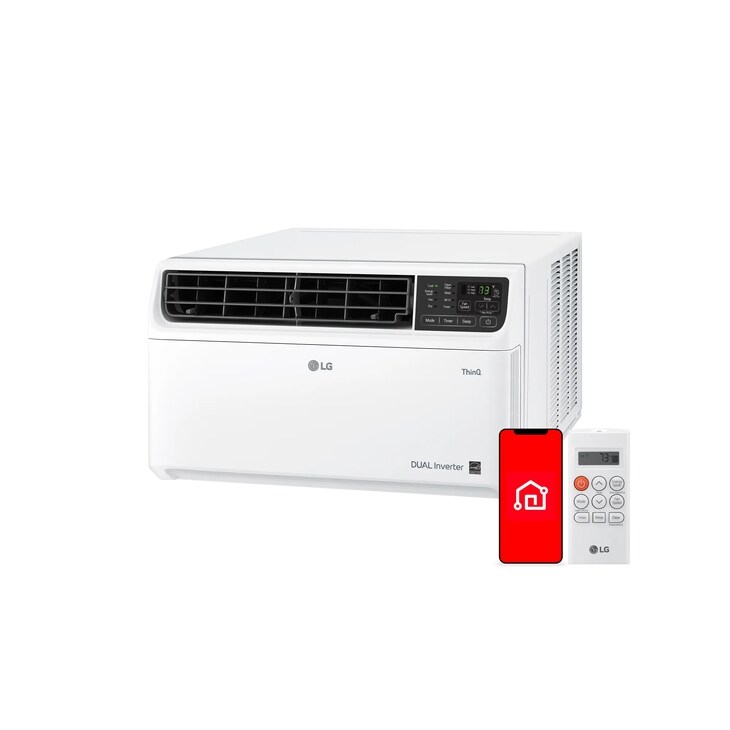
- You have an existing 26-inch through-the-wall AC sleeve: a PTAC needs the 42-inch opening. LG's through-the-wall units fit the smaller sleeves, but the four LG models we reviewed are cool-only.
The specs that matter
Here's how the three 12,000 BTU heat pumps, and the other sizes in the J and Distinctions lines, compare on the manufacturers' own tables, with the 230V figure first and 208V second. Heat pump COP is a mild-weather rating.
Model | Refrigerant | Cooling (BTU/h) | EER | Heat pump (BTU/h) | COP | Strip heat, 3.5 kW (BTU/h) |
|---|---|---|---|---|---|---|
Amana J PTH123J35AXXX | R-32 | 12,000 / 11,600 | 11.5 | 11,000 / 10,800 | 3.3 | 11,900 / 9,800 |
Distinctions DHP123J35BA | R-32 | 12,000 / 11,800 | 10.5 | 10,800 / 10,500 | 3.2 | 10,900 / 8,900 |
Amana K PTH123K35AXXX | R-410A | 11,600 / 11,400 | 11.0 / 11.1 | 10,600 / 10,500 | 3.2 | 11,900 / 9,800 |
Amana J 9k PTH093J35AXXX (230V) | R-32 | 9,000 | 12.4 | 8,200 | No figure | No figure |
Amana J 15k PTH153J35AXXX (230V) | R-32 | 14,600 | 10.4 | 14,300 | No figure | No figure |
Distinctions 9k DHP093J35BA (230V) | R-32 | 9,300 | 11.4 | 8,100 | No figure | No figure |
Distinctions 15k DHP153J35BA (230V) | R-32 | 14,700 | 10.6 | 13,500 | No figure | No figure |
A few things in those tables deserve a second look. The "12,000 BTU" Amana K is rated 11,600 BTU/h at 230V. Distinctions prints its column header as 208 / 230 but lists the pairs in 230/208 order (higher capacity and watts, lower compressor amps first), so we read the first number as the 230V rating. Amana's J table carries a boilerplate note that R-410A is used in all systems; the service manual's model key defines J as R-32 and the Amazon title says R32, so we go with those. And every listing we cover here has the 3.5 kW heater (the 35 in the model number), so a 15k gives you more cooling and more heat pump output, but once it's running on strip heat, it heats no better than the 12k.
The strip heat numbers don't line up between the brands either. Amana lists 11,900 BTU/h for 3,500 W at 230V, which matches the arithmetic (3,500 W times 3.412 BTU per watt-hour is about 11,940). Distinctions lists 10,900 BTU/h for the same 3,500 W, about 3.1 BTU per watt, which looks like a different rating basis. We can't confirm that, so we quote each brand's figure as published.
Check your voltage before you size the room. If the circuit delivers 208V rather than 230V, the heater drops from 3,500 W to 2,860 W on the Amana units and 2,897 W on the Distinctions, and heat output falls to 9,800 and 8,900 BTU/h. That's an 18% cut on the Amana, and it hits on the coldest nights, when strip heat is all you have.
Reading the model number
- Capacity code: 093, 123 and 153 are the 9k, 12k and 15k classes in both brands' tables.
- Series letter: Amana's service manual defines J as R-32 and K as the R-410A redesign of 2023. The Distinctions J models are R-32.
- Heater code: the two digits after the series letter are the heater size, so 35 means 3.5 kW. Amana's catalog tells buyers to specify the two-digit heater kW to complete the model number.
- Prefix: Amana listings whose model starts PTH are heat pumps. Amana's service manual calls PTC a standard cooler, and its catalog lists PTC models as cooling with electric heat. Distinctions heat pumps start with DHP.
- Listing titles: the J heat pump's own Amazon title calls it an "A/C" and never says heat pump, and Amazon also carries a "12,000 BTU Distinctions by Amana PTAC A/C" and an "AMANA K-Series 12,000 BTU PTAC A/C" that aren't heat pumps. Check the model prefix before you order.
- Heater size sets the circuit: the 3.5 kW Amana J and Distinctions heat pump listings are titled 20 A; the 5 kW Distinctions versions are titled 30 A.
Cold weather: where the heat pump stops
Amana's service manual for its J and K units is specific. The heat pump runs until the outdoor coil reaches about 27°F, then the outdoor coil thermistor shuts the compressor off and the unit goes to electric heat only. It stays locked out until the coil reads above 33°F. Amana says heat pump operation can go as low as 24°F outdoors, depending on humidity and the balance point. Separately, if the room falls 4°F below the set point, the heat pump shuts off and strip heat comes on. The two never run together.
Distinctions publishes less, and Amana's cutoff shouldn't be read across to it. Its install manual lists heating operation from 23°F to 76°F outdoors and notes that performance may be reduced outside that range. Its brochure says the unit switches to electric resistance heat automatically if the compressor fails or the heating load exceeds the unit's capacity. It doesn't publish a switchover temperature.
Now the arithmetic. On the Amana J at 230V, Amana's table rates the heat pump at 11,000 BTU/h for 980 W, a COP of 3.3. Below the cutoff, the strip heater makes 11,900 BTU/h for 3,500 W. Resistance heat turns each watt into one watt of heat, a COP of 1. Compared with the heat pump at its rated COP (a mild-weather rating), strip heat costs about 3.2-3.3 times as much per BTU across these three units. Near the cutoff the gap is smaller, because heat pump efficiency drops as it gets colder. A night of steady strip heat at 3.5 kW for 10 hours is 35 kWh. Multiply by your rate.
Compare the Pioneer Diamante Pro 12k 230V mini-split at 5°F: NEEP lists 9,000 BTU/h at 5°F, and Pioneer's submittal gives a COP2 of 1.8. That's 2,900 BTU/h less raw heat than the Amana's strip heater on a 230V circuit (1,900 BTU/h less than the Distinctions' published 10,900), but it uses about 56% of the electricity per BTU compared with strip heat (1 divided by 1.8). For a garage you warm a few hours on winter weekends, the PTAC's simpler install wins. For an ADU you heat every night from December to March, the mini-split wins.
Both lines can guard an empty space against freezing. Amana's manual turns on the fan and strip heat when the room drops below 40°F, plus or minus 5°F, and runs them until it reaches 43°F. The Distinctions manual offers an optional DIP-switch setting that brings on strip heat below a 32°F room temperature and warms the room to 40°F.
Noise
For a bedroom or office, the missing noise figure is a reason to look at a mini-split. Neither brand publishes an operating sound level in decibels. Amana gives an STC (sound transmission class) rating of 29 for its standard chassis and 31 for an optional Quiet chassis, which isn't offered on DigiAir models. STC is a sound transmission rating, not a decibel figure for the unit running, so it won't tell you how loud the fan and compressor are in the room. Distinctions publishes no sound rating at all. The one noise report we have came from a tenant in a studio apartment who called their Amana extremely loud.
What the install involves
A PTAC install has more in common with framing a window than with a mini-split install. Plan for:
- The wall opening and sleeve: Amana states its sleeves use industry-standard dimensions of 42 in wide by 16-1/16 in high, with the industry-standard 14-1/8 in internal depth for its WS900E sleeve. Cutting that opening in an exterior wall is a carpentry job; ask your building department whether it needs a permit.
- The grille: Amana's J listing says new installations need a sleeve and a rear grille and that neither is included; the K listing is titled "A/C Unit Only." Plan on buying both unless you're reusing ones already in the wall.
- An existing sleeve: if you already have a 42-inch PTAC sleeve, it's the right size class for Amana's standard. For the Distinctions, the only sleeve statement we could verify is its Amazon listing's "Fits standard 42" PTAC sleeve"; the install manual's sleeve pages are images we couldn't verify, so confirm fit with the seller before you reuse an old one.
- Weight: the Amana J and K 12k units are both 108 lb; the Distinctions units weigh 99.2 lb (9k), 110.2 lb (12k) and 113.5 lb (15k). It's a two-person lift into the sleeve.
- Refrigerant: none of your concern. The chassis ships sealed. Distinctions' manual says only trained personnel should service the unit, and only licensed personnel where a jurisdiction requires a license.
Electrical: what the manual requires
For a 230/208V Amana unit with the 3.5 kW heater, J or K, Amana's catalog lists a minimum circuit ampacity of 19.5 A, a 20 A maximum overcurrent device and a NEMA 6-20P plug, which goes into a NEMA 6-20R 250V receptacle. Every Amana unit under 250V ships with an LCDI (Leak Current Detector Interrupter) power cord that meets UL 484. Supply voltage on the 230/208V models has to stay between 197 and 253 volts.
Distinctions says only that an LCDI power cord is included. Its listings say 20 A for the 3.5 kW units, but the plug type isn't in any Distinctions text we could verify, so read the cord tag and the nameplate when the unit arrives. Either way, hand the circuit and receptacle to a licensed electrician and have them match the nameplate. We don't give wiring steps. Price that circuit before you compare a PTAC with anything else.
Controls and thermostats
Budget for a thermostat with either Amana. The J listing says the series "eliminates the user-operated control pad," and Amana's service manual says the unit is controlled by a wired wall thermostat or Amana's wireless thermostat. The K listing is blunter: it "does require a wired or wireless wall thermostat for operation." The same manual says to use a manufacturer-approved thermostat, because one that hasn't been approved may not work correctly, and Amana's catalog lists its Eden wireless thermostat as sold separately. The Distinctions is simpler here: its brochure describes a 7-button control design, and its install manual lists the wall thermostat terminal as optional.
Confirm which thermostat the exact model supports before you count on a schedule. One owner had a Nest connected to their older Amana units, but a K-series owner running a PTAC in an outbuilding office wanted a programmable wireless thermostat, found Amana's simple one couldn't be programmed, and heard that wireless options are limited.
Where to buy it
Compare landed cost, not list price. Online PTAC dealers can price well below other sellers, though one buyer replacing an Amana wasn't sure those sites were legitimate and got local quotes instead. Another, replacing a PTH153G35AXXX, ordered from one after a retailer they'd used before came in almost $200 higher once shipping and sales tax hit at checkout. Check the Amazon listing's current offers and delivery terms before you assume it's the cheapest route.
Reliability and living with it
There's no owner record on the J series or the Distinctions line in either direction, so what follows is brand-level and older: a 2016 unit, two G-series units, a G-series being replaced, a K-series with no complaint, and several where nobody gave a model number. Read it as the failure modes this kind of unit has, not a failure rate for the one you'd buy.
Heat mode blowing unheated air is the fault that comes up most, from a few posters, and one of them ended up running a space heater after a tech told them the unit may have died. Two older PTC093G25AXXXGA units stopped powering on three to four months apart, with the plug lit but the control panel dead, and their owner started weighing a four-zone mini-split instead. A 2016 unit stopped cooling when its outdoor fan quit. And a tenant in a studio apartment described a unit that surged, rattled and ran nearly all day without holding 70 to 75°F.
An FP code with cold air in a room below 40°F isn't the heat pump doing what heat pumps do in the cold, whatever you may read. On J and K units, Amana's service manual says freeze protection switches on the fan and the strip heater below 40°F, give or take 5°F, and runs them until the room reaches 43°F. If yours is one of those, an FP code with cold air isn't normal, and it's a service call, not something to wait out. (The owner who saw it didn't give a model.)
Check the sleeve seams after the installers leave. One homeowner had technicians put in four Amana PTACs and then found holes along the sleeve seams and a gap at one side; the suggested fix was a 1/4-inch hex screw that should have been tightened, not spray foam. The chassis-in-sleeve design cuts both ways: the chassis is held in by a few screws, which is why a rattle can come from a loose fastener and why a failed chassis can come out without touching the wall.
The warranty, and who can claim it
Amana's owner-occupied warranty, dated April 2022 and linked from its current PTAC page, lists its R-32 series units. In year one it covers the entire unit, including labor and new refrigerant if required. In years two through five it covers the sealed system (evaporator coil, condenser coil, compressor, reversing valves and connecting tubing) with labor and refrigerant, but for functional parts such as fan motors, blower wheels, thermistors, the circuit board, heaters, the power cord and capacitors, it only provides the part. Labor credit requires an authorized Amana brand PTAC servicer. Coverage begins on the installation date, which suits a unit bought now and installed later; if the purchase date can't be verified, it counts from three months after manufacture.
Distinctions' owner-occupied residence warranty covers models starting DHP and DCP and follows the same structure, with labor credit only through an authorized PTAC servicer. Its clock starts on the date of purchase, and it excludes damage from faulty installation or application. Distinctions has separate warranties for commercial and non-owner-occupied installs, so if the ADU is a rental, ask the seller for the terms that apply, in writing, before you buy.
Amana's 2022 warranty starts at installation, but it doesn't name the K; it lists the R-410A E, F, G and H series and the R-32 series. Amana's catalog promises the K a five-year limited warranty, so get the K's written terms from the seller before you pay for one.
Line the failures up against those warranties. A dead fan motor, capacitor or control board in year three is a free part and a paid service visit.
The R-410A question
EPA's rule restricts manufacturing or importing self-contained residential and light commercial air conditioning and heat pump products that use a refrigerant with a GWP of 700 or more, effective January 1, 2025, and bars their sale three years after that, which works out to January 1, 2028. R-410A is 2,090 in EPA's table; R-32 is 675. Amana's service manual dates the K redesign to 2023, so a new K sold today was built in 2023 or 2024, and Amana's PTAC product page now lists only J models. Existing R-410A equipment can still be repaired under the rule. If you buy a K, keep the receipt and get the install date on record, since Amana's fallback start date runs from the manufacture date. The J and the Distinctions are both R-32, so none of this applies to them.
How it compares
- Amana J vs Distinctions 12k: the J rates a better EER (11.5 vs 10.5), a little more heat pump output (11,000 vs 10,800 BTU/h) and more published strip heat (11,900 vs 10,900 BTU/h), documents its cold-weather lockout, and starts its warranty at installation. The Distinctions costs a lot less, has controls on the unit, and is R-32 too. One point of EER is about 9% less electricity for the same cooling; in a part-time garage or shop we doubt that pays back the difference. We'd buy the Distinctions.
- Amana J vs Amana K: same Amana controls and thermostat requirement, but the K is R-410A, rates 11,600 BTU/h and EER 11.0 at 230V, and isn't named in Amana's warranty PDF. It costs less than the J and more than the Distinctions, which leaves it without a clear buyer.
- LG through-the-wall: a different hole. LG's sleeve is 25-7/8 in wide against the PTAC's 42 in, the four LG models we reviewed are cool-only, three run on 115V, and the warranty is one year. Good for cooling a bedroom through an existing 26-inch sleeve, wrong for heat.
- Pioneer Diamante Pro 12k 230V mini-split: costs less than the Amana J and about the same as the Distinctions 12k. NEEP lists 9,000 BTU/h at 5°F; it heats to -4°F, rates 20.0 SEER2 and publishes 28-45 dB(A) indoors. Its manual requires a vacuum with a manifold gauge, which EPA treats as certified-technician work, so budget for a pro. Pioneer's warranty doesn't require a licensed installer but excludes faulty installation, and the five-year term needs registration.
- MrCool DIY 5th Gen 12k 115V mini-split: costs more than any of these PTACs. Pre-charged quick-connect lines built for homeowner installs, 8,400 BTU/h at 5°F, and heat published to -13°F. The answer if you have only 115V and want to do the work yourself.
Should you buy one?
Buy the Amana J if you want the most efficient 12k PTAC heat pump of the three, you're replacing an Amana PTAC and already have a compatible wall thermostat, or you value Amana's published cold-weather controls and a warranty that starts at installation. For most people putting a PTAC in a garage, shop or mild-climate addition, the Distinctions by Amana 12k is our pick: it's R-32, it has controls on the unit, and it costs a lot less for about one point of EER. Pick a 15k only if the room needs the cooling; once it's running on strip heat, it heats no better than the 12k.
Skip the K unless a seller shows you its written warranty and the price undercuts the Distinctions. For an ADU or addition someone lives in all winter, skip the PTAC and put the money toward a 230V mini-split like the Pioneer Diamante Pro. NEEP lists it at 9,000 BTU/h at 5°F, its compressor heats to -4°F, and it's quieter on paper. It also won't hand the coldest nights to a 3.5 kW resistance coil the way the Amana does once its outdoor coil reaches about 27°F (Distinctions doesn't publish its switchover point at all).
Score breakdown
Cooling is on spec for the size, at 12,000 BTU/h and EER 11.5 on the PTH123J35AXXX, the best of the three 12k heat pumps we compared. Heating is the weak spot: the heat pump locks out near a 27°F outdoor coil, and below that the 3.5 kW strip heater costs about 3.3 times as much per BTU as the heat pump at its rated COP, a mild-weather rating. No decibel figure is published.
Owner reports are problem-led and come from older Amana units: heat mode blowing unheated air, two units dying months apart, a failed outdoor fan. There is nothing on the J series itself either way. The sealed system has five years of parts and labor, but fans, boards and capacitors are parts-only after year one.
The J costs well more than the Distinctions 12k and more than a 230V Pioneer mini-split, before you add a sleeve, a grille, a wall thermostat and a 230V circuit. The extra buys about one point of EER and stronger published strip heat. It earns its price for someone replacing an Amana PTAC with a compatible thermostat already on the wall.
Amana J-Series PTAC on Amazon.
The Evidence Behind Our Verdict
Owner discussion of Amana PTACs on r/hvacadvice is problem-led and mostly about older units: a 2016 chassis, G-series models and several with no model given. It mixes homeowners, one apartment tenant and a K-series owner using one in an outbuilding office. Five distinct posters described a fault and a sixth reported the same no-heat issue; two of the five described heat mode blowing unheated air.
There are no reports on the current J series or the Distinctions line. Treat these as brand-level failure modes, not a failure rate. Posts from a PTAC retailer's account were left out.
Our rating above is our own editorial call. What follows is the field evidence we weighed to reach it: first-hand reports from owners on Reddit and independent HVAC and DIY forums, which we lean on more than manufacturer-influenced published reviews because unsponsored owners tend to be the more candid signal.
What Reddit Is Saying
“I see that Amana makes a pretty simple thermostat but it can't be programmed which I would prefer. What I'm looking for is something I can program by day/time so it's not running in the evenings when I'm not out in the office in my exterior building.”
“Nope, nothing. Got a space heater in the mean time. I had an HVAC guy come by for my house's heater and ask him about the PTAC. He said it could have just gone out.”
““fp” error code and heat not working on this unit, just blows cold air. Outside and inside temp is below 40f currently Manual and online says unit disables and displays “fp” error code if temp <43. But isn’t the point of a heating function to heat a cold room ?”
“The plug lights up, but no lights on the control panel, no response to buttons, and no power goes through to the connected Nest thermostat. The built-in breaker on the plug is not tripped.”
“My 2016 PTAC quit cooling but the exhaust coils are hot but the fan isnt blowing the hot air out.”
“There’s a rattling coming from inside and I’ve noticed that the apartment does not get cool. The ac has to run almost the entire day and it can barely keep up at 70 or even 75 when I leave to go do things during the day.”
“There's holes in the seams that appear to just lead to the outside? Did my HVAC techs install the PTAC correctly or is this an issue with Amana's sleeves?”
Frequently asked questions
Is the Amana J-Series PTAC worth it?
The J costs well more than the Distinctions 12k and more than a 230V Pioneer mini-split, before you add a sleeve, a grille, a wall thermostat and a 230V circuit. The extra buys about one point of EER and stronger published strip heat. It earns its price for someone replacing an Amana PTAC with a compatible thermostat already on the wall.
How reliable is the Amana J-Series PTAC?
Owner reports are problem-led and come from older Amana units: heat mode blowing unheated air, two units dying months apart, a failed outdoor fan. There is nothing on the J series itself either way. The sealed system has five years of parts and labor, but fans, boards and capacitors are parts-only after year one.
How well does the Amana J-Series PTAC perform?
5 on the PTH123J35AXXX, the best of the three 12k heat pumps we compared. 3 times as much per BTU as the heat pump at its rated COP, a mild-weather rating. No decibel figure is published.
What do real owners say about the Amana J-Series PTAC?
Owner discussion of Amana PTACs on r/hvacadvice is problem-led and mostly about older units: a 2016 chassis, G-series models and several with no model given. It mixes homeowners, one apartment tenant and a K-series owner using one in an outbuilding office. Five distinct posters described a fault and a sixth reported the same no-heat issue; two of the five described heat mode blowing unheated air.