Best Heat Pump Water Heater: Picks by Room, Noise and Circuit
By Margo Pettibone · Updated October 2026
Independent editorial guide. We never accept payment for coverage, though we may earn a commission if you purchase through our links.
Quick Take
For a basement, a garage or a big utility room, buy the Rheem ProTerra 50 (XE50T10HS45U1). ENERGY STAR rates it at 3.88 UEF with a 67-gallon first-hour rating, which works out to about a quarter of the electricity a plain electric tank uses for the same hot water, and it ships with a leak sensor and automatic shutoff valve. It scores 6.3 in our review, the higher of the two tanks we've scored.
The room can change the answer. Next to a bedroom, buy the GE Profile GeoSpring: 4.50 UEF, the best 50-gallon figure on ENERGY STAR's list, and the quieter machine by owners' accounts. In a closet too small for the Rheem's 700 cubic feet, the A. O. Smith Voltex AL needs only 450, but its compressor record is the worst of the tanks we've reviewed. To buy on Amazon, the Rinnai REHP50 has the biggest first-hour rating of the tanks sold there.
Our basement and garage pick, the tank for near bedrooms, the tight-closet option, two Amazon-sold tanks and the condensate pump most installs need are below. See picks ↓

The heat pump water heater we'd buy first is the Rheem ProTerra, for a tank that can live in a basement, an attached garage that stays above freezing, or a utility room of at least 700 cubic feet. It runs on the same 30 A, 240V circuit many electric tanks already use, and when something fails, Rheem's support usually ships the part. Expect to hear it, and expect to swap a control board or sensor at some point; after the first year, the labor is yours.
Where the tank goes decides the rest:
- Basement, garage or large utility room: the Rheem ProTerra 50.
- Next to a bedroom or living space: the GE Profile GeoSpring 50. ENERGY STAR lists it at 41 dB, and owners describe it as the quieter machine. It isn't sold on Amazon.
- A closet or tight utility room: the A. O. Smith Voltex AL, which needs 450 cubic feet enclosed, 84 with a louvered door, and no minimum when ducted. Buy it only from an installer who'll handle a warranty swap.
- You want to buy on Amazon: the Rinnai REHP50: 3.75 UEF and a 73-gallon first-hour rating on a 240V, 30 A circuit.
- Only a 120V outlet where the tank goes: a plug-in model is a slower heater with a smaller first-hour rating. Read the 120V section before you buy one.
- A garage that gets cold: every tank here stops running its heat pump somewhere between 35 and 37.4°F and heats with its elements below that, so a garage near freezing turns it into a plain electric tank for those months.
Our scores, ranked
We've scored two of these tanks in full reviews (Performance 40%, Reliability 35%, Value 25%). The rest we cover on their ENERGY STAR ratings and listings in those reviews' comparisons, so they carry no score yet.
Tank | Our score | Key spec (ENERGY STAR) | Best for | Where we cover it |
|---|---|---|---|---|
Rheem ProTerra 50 (XE50T10HS45U1) | 6.3 | 3.88 UEF, 67-gal first hour; 700 cu ft room unducted | Basements, garages, big utility rooms | |
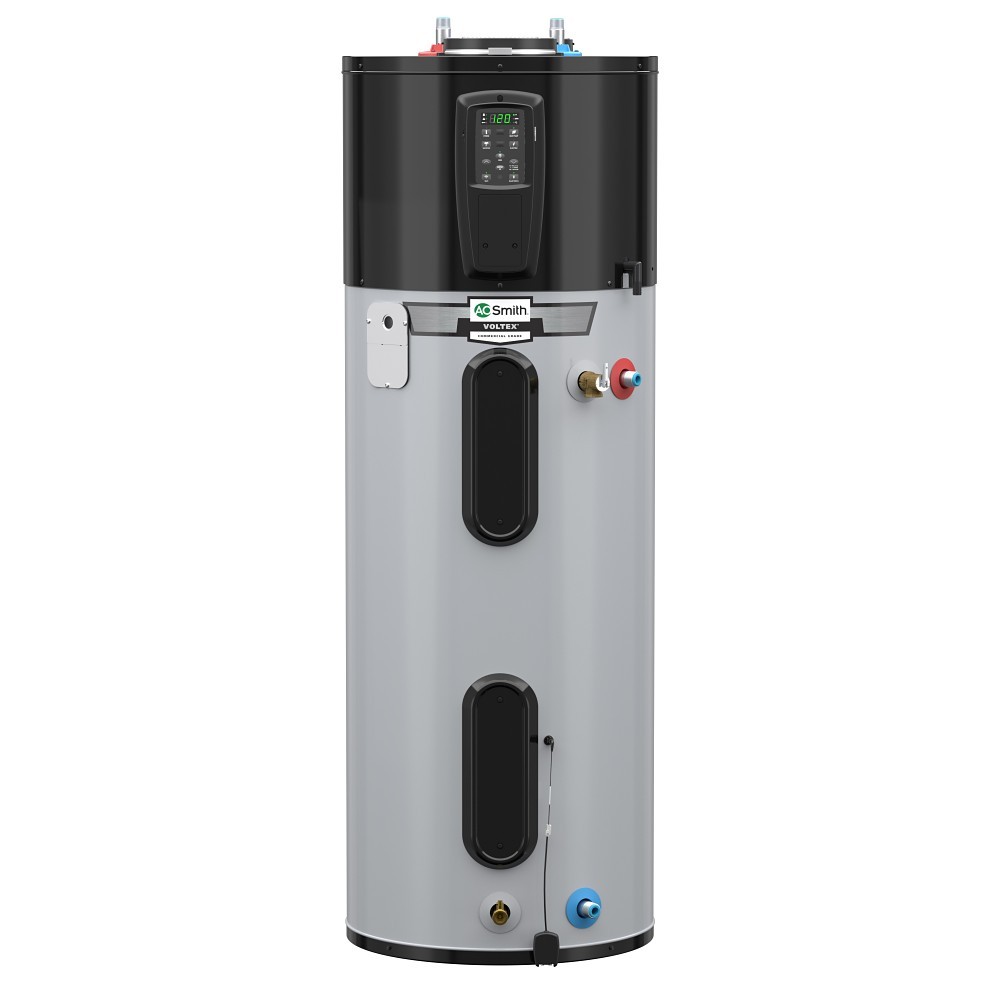
A. O. Smith Voltex AL (HPTS-50) | 5.6 | 3.80 UEF, 65-gal first hour; 450 cu ft enclosed | Closets and tight utility rooms | |
GE Profile GeoSpring 50 (PH50S10BNY) | No figure | 4.50 UEF, 75-gal first hour; 41 dB | A tank near bedrooms | |
Rinnai REHP50 | No figure | 3.75 UEF, 73-gal first hour; 49 dB | Buying on Amazon | |
ACiQ 50 gal (ACIQ-50G-HP-WH) | No figure | 3.75 UEF, 69-gal first hour; 49 dB | An Amazon tank with a long listed warranty | |
Senville SENWH-HP50US | No figure | 3.75 UEF, 69-gal first hour | An Amazon tank sold by its maker |
The GE posts the best efficiency and first-hour numbers, but ENERGY STAR tests it on a heavier daily draw than the others, so its estimated yearly kWh can't be lined up against theirs. Compare UEF and first-hour rating instead. A plain electric tank can't top 1.0 UEF, so at 3.75 to 4.50 every tank in this table needs only about a quarter of the electricity for the same hot water on the DOE test.
The room decides more than the brand
A heat pump water heater pulls its heat out of the surrounding air, so the room has to be big enough, warm enough and far enough from where people sleep. Rheem wants at least 700 cubic feet unducted, about a 7 x 10 ft room with a 10 ft ceiling; it will run down to 450 at reduced efficiency, and a smaller room needs a louvered door or ducting. A. O. Smith built the Voltex AL for tighter spots: 450 cubic feet enclosed, 84 with a fully louvered door, no minimum when ducted, and zero clearance at the sides and back.
Tank | Room it needs | Heat pump works down to | Noise rating |
|---|---|---|---|
Rheem ProTerra 50 | 700 cu ft unducted; 450 at reduced efficiency | 37°F | None published; one owner measured about 60 dB at 2 ft |
A. O. Smith Voltex AL (HPTS-50) | 450 cu ft enclosed; 84 with louvers; none when ducted | 37°F | 45 dBA (A. O. Smith claim) |
GE Profile GeoSpring 50 | No figure | 35°F | 41 dB (ENERGY STAR) |
Rinnai REHP50 | No figure | 37.4°F | 49 dB (ENERGY STAR) |
ACiQ 50 gal | No figure | 37.4°F | 49 dB (ENERGY STAR); listing claims 49.5 dB(A) |
Senville SENWH-HP50US | No figure | 37.4°F | No figure |
Below its cutoff, each tank heats with its resistance elements like a standard electric tank. In summer the trade runs the other way: the tank blows cool, dried air into the room, which helps in a hot garage or a damp basement and is less welcome in a basement you're trying to keep warm.
Noise near bedrooms
Plan on hearing any of these in a room that shares a wall or an open door with it. The Rheem is the loud one. Rheem publishes no sound rating, owners describe a compressor drone and whine you can hear through a door, and one owner measured about 60 dB two feet from the tank. For a tank next to a bedroom we'd buy the GE, which ENERGY STAR lists at 41 dB and owners describe as the quieter machine.
The Voltex AL is the other quiet option. A. O. Smith claims 45 dBA, and owners who live with one describe a light hum they don't hear outside the room. We'd still put the GE there first, because the Voltex's compressor record is the worst of any tank we've reviewed.
240V tank or 120V plug-in
Buy the 240V version if the panel can take the circuit. The ProTerra, the Voltex AL and the Rinnai all want a 30 A, 240V circuit, and if you're replacing an electric tank, have an electrician confirm the existing one qualifies. A 120V plug-in shares an ordinary circuit, which is the reason to buy one, but it heats with far less power. ENERGY STAR lists Rheem's ProTerra plug-in (XE50T10HM00U0) at 1.0 kW of electric input against 4.5 kW for the 240V tank, with a 3.00 UEF and a 55-gallon first-hour rating to the 240V tank's 67. A. O. Smith's 120V Voltex (HPTV-50) is listed at 3.00 UEF and a 52-gallon first hour.
If you do go 120V, size up, because the tank has to lean on what it has stored. One owner of a 120V A. O. Smith bought an 80-gallon tank for a family of four and hasn't run out. Judge a plug-in on its own ratings, not on reviews of the 240V version with the same name.
Reliability and who pays for the repair
Neither tank we've scored has a clean record. The ProTerra's failures cluster around control boards, temperature sensors, units dead on arrival and leaks in the heat pump section; Rheem usually ships the part and leaves the labor to you after year one. The Voltex AL's pattern is worse: compressors that stop moving heat or leak refrigerant in the first two years, sometimes on the replacement as well, and A. O. Smith replaces the whole tank rather than repair the sealed system. Owners put the labor for each swap at $500 to more than $1,000.
The GE, Rinnai, Senville and ACiQ don't have enough owner history yet to judge either way. Budget for the labor of a swap whatever you buy, because no tank on this list pays for labor after year one.
Tank | Warranty (maker or listing) |
|---|---|
Rheem ProTerra 50 | 10 yr tank and parts; 1 yr labor in a single-family home |
A. O. Smith Voltex AL | 10 yr tank, 10 yr parts; onsite labor in the first year only |
Rinnai REHP50 | Listing promises 10 yr tank and parts, 1 yr labor |
ACiQ 50 gal | Listing claims 12 yr tank and parts with online registration |
Senville SENWH-HP50US | Listing gives 7 yr parts, 10 yr compressor |
GE Profile GeoSpring 50 | No figure |
Keep the installer's invoice whichever tank you buy. Rheem starts coverage on the documented installation date, and A. O. Smith asks for proof of purchase and the installation date before it will process a claim.
Plan for the condensate
Every heat pump water heater makes condensate, and the install needs a drain or a pump for it. Rheem's manual calls for a condensate pump rated for at least 2 gallons a day where there's no drain, and says it can't empty into the water heater's own pan. The Little Giant VCMA-15 handles a water heater's condensate easily, and our condensate pump guide covers the alternatives. The rest of the job is for a licensed plumber and an electrician, and many towns require a permit to replace a water heater.
Which one we'd buy
- Basement, garage or big utility room: the Rheem ProTerra 50.
- Next to a bedroom: the GE Profile GeoSpring 50.
- A tight closet: the A. O. Smith Voltex AL, from an installer who'll handle warranty swaps at a fixed price.
- Buying on Amazon: the Rinnai REHP50, or the ACiQ if its listed 12-year warranty matters more to you than owner history.
- Only 120V available: a plug-in sized up, after an electrician rules out a 240V circuit.
And add a condensate pump if there's no floor drain within reach of the tank.
The picks
Products we recommend for this guide.



Little Giant VCMA-15ULS Condensate Pump
For a tank with no floor drain nearby: Rheem's manual calls for a condensate pump rated for at least 2 gallons a day. This is the pump we reviewed, and its overflow switch can drive a separate high-water alarm if it ever fails.
Read our full review: we scored it 7.3/10
What owners say
Real owner reports from the threads and editorial sources we drew on for this guide.
“I have the new GE geospring with the inverter compressor. The compressor is dead quiet. The o my noise I have is the fan noise. Mine is in a mech room next to my home theater. We spend a lot of time down there. With the door closed(cheap) it’s not audible through uninsulated walls.”
“I went with the Geospring and have been happy with it. I just did the 240v version since I already had the wiring for it.”
“Get the 240V. Do not get the 120V. The compressor is a “drone”. Mine exhausts into a laundry room where I can close the door so I don’t hear it. That room gets quite cold in the winter. If you can’t do this expect to hear a sound like a window AC or large refrigerator running. I have the 80g Rheem Proterra. It’s fine.”
“Fwiw, I have been told that many plumbers no longer install rheems because they keep having control board issues. Their warranty service was pretty good but I don't think I would choose the Rheem again.”
“We installed a Rheem HPWH in 2021 and have not had any issues with it. Got an alarm on it a month ago, went thru troubleshooting steps and called Rheem, which FedEx’ed a part overnight. Installed it ourselves. Was super impressed with their tech support and customer service.”
“Mine is in my attached garage. I can hear it through the non-vented wall inside my house. It is not loud at all through an unvented wall. I would recommend that you do not put this near your living space if it will need a vent to your living space. You will find the noise through the vent to be disturbing. A basement or garage are the best places for these.”
“What I can tell you is my outside water heater shed shares a wall with our bedroom (bed is maybe 8 feet away from water heater) and I can't hear a thing.”
“I don't have an AO Smith anymore. I replaced it 3 times because of the reasons you mentioned. They only lasted about a year each time. I have a Rinnai now.”
“I recently had one installed also, it is the 120v unit and I have a family of 4 which technically a 60 gallon would work with a gas, or full electric. However in reality there is only so much heat can be produced with 120v lol 😂😂 so for this reason I over sized my unit and got the 80 gallon. Big unit! But we never run out of water and the unit doesn’t constantly run to reheat the water.”
“I recently installed the rinnai rehp50 in my basement laundry room. It's whisper quiet and very cheap to run. I installed a mixing valve and keep the tank temp at 128, it struggled to get above that so 128 is where it's staying at. Wife takes long showers 15-20mins and doesn't complain about losing hot water.”
“Installed Rinnai REHP 80 in my garage in the Bay Area in November. Our winter nights, for 2-3 months, frequently get into high 30's and always into the 40's with daytimes in low 60's. For us so far, with mostly winter experience, it has needed the resistive daily at different time slots to keep up in winter. Summer we are waiting to see. Pros: quiet and great programming flexibity, Cons: no app at all and no visibility to what it is doing unless you stand in front of it; and probably an underpowered heat pump at 80 gallons, ~60F ambient, and 50's incoming.”
