Rheem ProTerra Review: Big Savings, Bumpy Service Record
By Margo Pettibone · Updated October 2026
Independent editorial review. We never accept payment for coverage, though we may earn a commission if you purchase through our links.
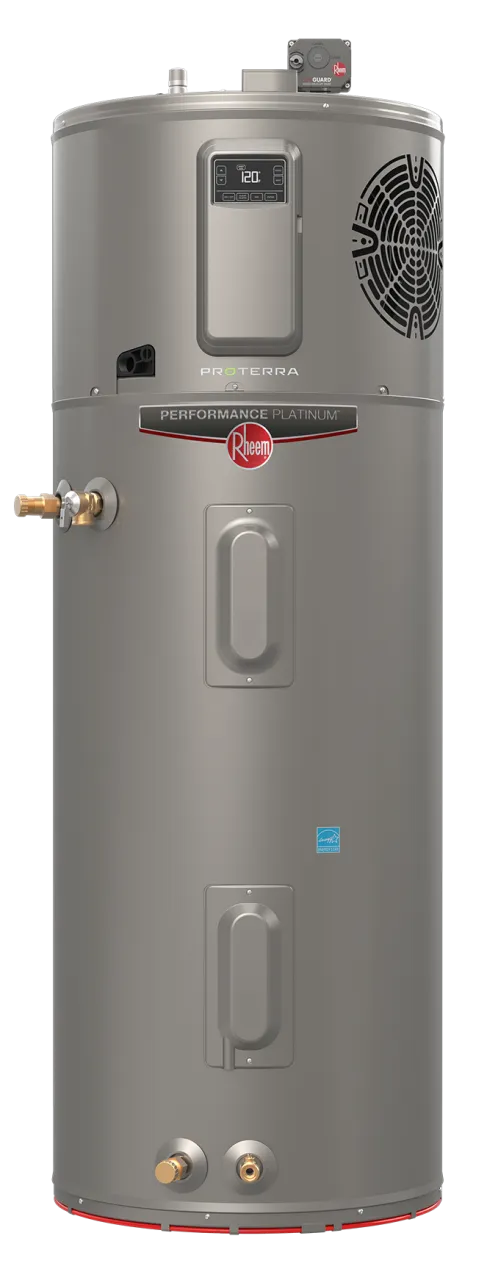 ← 50 gal: 62 in tall, 22-1/4 in diameter (Rheem) →
Spec sheet
| UEF (ENERGY STAR) | 3.88 (50 gal); 3.83 (40); 4.05 (65); 4.07 (80) |
| First-hour rating | 67 gal (50); 60 (40); 75 (65); 87 (80) |
| Rated storage (DOE) | 45 gal in the 50; 36 / 59 / 72 in the 40 / 65 / 80 |
| Estimated energy use | 846 kWh/yr on the 50 (ENERGY STAR), about 2.3 kWh a day |
| Electrical | 208-240V, 30 A breaker; 4.5 kW elements; 21 A max |
| Heat pump operating range | 37-145°F surrounding air; elements below that |
| Room size | 700 cu ft unducted, or louvers or a duct kit |
| Compressor output | 4,200 Btu/h, about 7 gal/h from 50°F to 120°F (our math) |
| Owner-reported noise | About 60 dB at 2 ft with the compressor running |
| Warranty | 10 yr tank and parts; 1 yr labor (single-family home) |
Verdict
Owner reports come from r/heatpumps and r/HomeImprovement. Most owners name a ProTerra or confirm the same tank; a few describe a Rheem heat pump water heater without naming the line. Seven are positive: measured use of 2 to 5 kWh a day, a replacement that became one of an owner's best purchases, savings in a cold-climate crawl space, settings that doubled usable hot water, and one owner who finds it quieter than their furnace. Two are mixed (a measured 60 dB at 2 ft, and a tank with one sensor failure in three years). Six are negative: a burned controller wire on the current model, two long support runarounds, a leaking tank and its leaking replacement, recurring error codes with labor on the owner, and a Rheem heard throughout an open house.
Read full take ↓


The Rheem ProTerra hybrid water heater is the heat pump water heater we'd put in a basement, garage or big utility room if you want the efficiency without paying for the best-rated tank on the market. ENERGY STAR rates the 50-gallon at 3.88 UEF, roughly four times the hot water per kilowatt-hour a plain electric tank manages, and estimates about 2.3 kWh a day on its test. It runs on a 30 A, 240V circuit like the one many electric tanks use, and it comes with a leak sensor and an automatic shutoff valve in the box.
Go in knowing its two weak points. It's loud for something that lives indoors, and its service record is spotty: control boards, temperature sensors and units that arrive dead come up again and again. Rheem's warranty covers the parts for 10 years, but after the first year the labor to fit them is yours. If the tank can sit somewhere you won't hear it, and you're comfortable swapping a board when support ships one, the savings are real. If it has to sit next to a bedroom, look at the GE Profile.
One buying note. Amazon's ProTerra 50 listing showed no featured offer when we checked, with a single third-party seller behind All Buying Options, so we link Rheem's own page instead. We earn nothing on it. The Amazon picks below are the comparable tanks you can buy there.
What it gets right
- Efficiency: 3.88 UEF on the 50, 4.05 on the 65 and 4.07 on the 80, near the top of ENERGY STAR's list for tanks this size.
- Easy to plumb: water connections on both the top and the side, and a 240V, 30 A circuit.
- Leak protection: a leak-sensing cable and an automatic shutoff valve that limited a leak to no more than 20 ounces in Rheem's testing.
- Free cooling: it blows cool, dried air into the room it sits in, which helps in a hot garage or a damp basement.
What gets in the way
- Noise: Rheem's spec sheet and manual give no sound rating, and owners describe a compressor drone and whine you can hear through a door.
- Slow heat pump: a 4,200 Btu/h compressor recovers slowly on its own, so the default mode leans on the elements or lets the tank run low.
- Electronics: control boards and thermistors (the tank and coil temperature sensors) are the usual failures.
- The app: Rheem's EcoNet app misreports energy use and doesn't hold schedules reliably, by most owners' accounts.
Which ProTerra is this?
Rheem sells the same hybrid design under several names, and the 120V version is a different machine. Check the model number before you compare reviews or prices.
Model | What it is | UEF / first-hour rating (50 gal) |
|---|---|---|
XE50T10HS45U1 (reviewed) | Performance Platinum ProTerra with LeakGuard, top and side connections, 240V/30 A | 3.88 / 67 gal |
PROPH50 T2 RH400 | Professional Prestige ProTerra, the version plumbing distributors sell | 3.88 / 67 gal |
XE50T10HM00U0 | ProTerra plug-in, 120V, shares a circuit | 3.00 / 55 gal |
The 120V plug-in is the one to keep separate. ENERGY STAR lists it at 1.0 kW of electric input against 4.5 kW for the 240V tank, so its first-hour rating drops to 55 gallons, and owner reviews of it don't describe the 240V tank. Ruud and Richmond list ratings identical to the 240V ProTerra for their own versions.
The numbers that matter
Ratings below are ENERGY STAR's for each size, plus Rheem's spec sheet for the hardware.
Size | UEF | First-hour rating | Rated storage | Est. kWh/yr | Height x diameter |
|---|---|---|---|---|---|
40 gal (XE40T10HS45U1) | 3.83 | 60 gal | 36 gal | 859 | 63 x 20-1/4 in |
50 gal (XE50T10HS45U1) | 3.88 | 67 gal | 45 gal | 846 | 62 x 22-1/4 in |
65 gal (XE65T10HS45U1) | 4.05 | 75 gal | 59 gal | 1,184 | 65 x 24-1/4 in |
80 gal (XE80T10HS45U1) | 4.07 | 87 gal | 72 gal | 1,213 | 75 x 24-1/4 in |
A few things in that table need explaining. The "50-gallon" tank holds 45 gallons by the DOE's measure. The estimated kWh per year rises on the 65 and 80 because ENERGY STAR tests them with a heavier daily draw, not because they're less efficient. On the 50, 846 kWh a year works out to about 2.3 kWh a day.
The UEF is where the savings come from. A plain electric tank heats with resistance elements, and its UEF can't exceed 1.0. At 3.88, the ProTerra delivers the same hot water on the DOE test for about a quarter of the electricity or less.
Why it runs out of hot water
Rheem lists the compressor at 4,200 Btu/h. Heating a gallon of water by 1°F takes 8.34 Btu, so raising incoming 50°F water to 120°F takes 584 Btu per gallon, and the compressor alone recovers about 7 gallons an hour. Two back-to-back showers drain the tank much faster than that. The ProTerra covers the gap in two ways: its 4.5 kW elements, or a hotter tank.
We'd use the second. Set the tank to 130-140°F, add the thermostatic mixing valve Rheem's manual recommends so the taps get 120°F, and run it in Heat Pump mode. Each gallon of hotter water stretches further once it's mixed, and the elements stay off. The factory default, Energy Saver, lets the tank fall further before it reheats, which saves energy on paper and leaves some households with a cold second shower. Switch to High Demand for the day you fill a big tub.
Where it can go
The heat pump works with surrounding air between 37°F and 145°F; below 37°F it falls back to the elements and heats like a standard electric tank. Unducted, Rheem wants at least 700 cubic feet of room, about a 7 x 10 ft room with a 10 ft ceiling. A smaller room needs a louvered door or ducting, and Rheem says it will run in as little as 450 cubic feet at reduced efficiency. A conditioned basement, an attached garage that stays above freezing, or a large utility room all work. A closet off a bedroom is the wrong place.
What the install requires
Rheem's manual assumes a qualified electrician runs the circuit and a licensed plumber handles the water side, and many towns require a permit for a water heater replacement. Here's what the job has to provide:
- Circuit: a separate 208-240V branch circuit with a 30 A breaker and a disconnect, per the manual and spec sheet. If you're replacing an electric tank, have the electrician confirm the existing circuit qualifies.
- Space: about 62 in of tank height on the 50, plus clearance above for the air filter and the top connections; the 50 weighs 185 lb.
- Condensate: a 3/4 in drain line to a floor drain, or a condensate pump rated for at least 2 gallons a day. It can't drain into the water heater's own pan.
- Mixing valve: an ASSE 1017 thermostatic mixing valve is recommended, and required if you enroll the heater in a utility demand-response program.
- Air: 700 cubic feet of room or a duct kit; Rheem sells 5- to 8-in duct and termination kits.
If there's no drain nearby, a small pump such as the Little Giant VCMA-15 handles a heat pump water heater's condensate easily.
Reliability and support
This is where the ProTerra loses points. Plenty of owners have run one for years without trouble, and the energy savings are real; owners who measure their usage with a separate meter report 2 to 5 kWh a day for households of two to four. But the failure reports cluster around the same parts. Control boards fail, sometimes within months, and one owner of the current 45U1 model found a burned wire at the controller connector not long after install. Thermistors throw error codes. Some units arrive dead or leak from the heat pump section on day one, and later leaks into the drain pan turn up too.
Rheem's support usually responds by shipping the part, and many owners say it does so quickly and walks them through the swap. When the fix doesn't take, the process gets long: owners describe repeated part shipments, escalations through several tiers of support, and in one case an offer of prorated store credit instead of a replacement. Expect to do the diagnosis on the phone yourself, and to pay for the labor after year one.
Noise is the other recurring complaint. One owner measured about 60 dB two feet from the tank with the compressor running. Opinions split from there: some owners find it quieter than their gas furnace, others hear it through a whole open-plan house. Plan for it to be audible in any room that shares a wall or an open door with it.
The warranty
Rheem's residential heat pump water heater warranty gives the original owner 10 years on the tank and parts and 1 year of labor in a single-family home; in any other kind of building the whole warranty drops to 1 year. Coverage starts on the documented installation date, or 90 days after the manufacture date if you can't document it, so keep the installer's invoice. It excludes damage from installs that don't meet code or "good plumbing and electrical trade practices," from sizing the heater wrong, from running it with the anode removed or the tank empty, and any labor after the first year.
The newest copy of that certificate we could find is dated 2017; Rheem's current product page still describes a 10-year limited tank and parts warranty. Register the heater with Rheem after installation.
How it compares
Fifty-gallon heat pump water heaters, ENERGY STAR figures. The kWh column only compares tanks tested at the same draw pattern.
Tank | UEF | First-hour rating | Draw pattern | Heat pump works down to | On Amazon |
|---|---|---|---|---|---|
3.88 | 67 gal | Medium | 37°F | Third-party offer only | |
GE Profile GeoSpring 50 (PH50S10BNY01) | 4.50 | 75 gal | High | 35°F | No |
Rinnai REHP50 | 3.75 | 73 gal | Medium | 37.4°F | Yes |
Senville SENWH-HP50US | 3.75 | 69 gal | Medium | 37.4°F | Yes |
ACiQ 50 gal (ACIQ-50G-HP-WH) | 3.75 | 69 gal | Medium | 37.4°F | Yes |
- GE Profile GeoSpring: the most efficient 50-gallon tank on ENERGY STAR's list at 4.50 UEF, with a bigger first-hour rating, and owners describe it as the quieter machine. It's the one we'd buy for a tank near living space; it isn't sold on Amazon.
- Rinnai REHP50: slightly less efficient than the ProTerra but with a 73-gallon first-hour rating, the best of the Amazon-sold tanks, and a listing that promises 10 years on tank and parts and 1 year of labor. It has much less owner history.
- Senville and ACiQ: identical ENERGY STAR ratings, which suggests the same underlying tank. ACiQ's listing claims 49.5 dB(A) and a 12-year tank and parts warranty with online registration; Senville's lists 7 years on parts and 10 on the compressor. Neither has a meaningful owner record yet.
Is the ProTerra worth buying?
Yes, if it can live in a garage, basement or large utility room away from bedrooms, you're replacing an electric tank on a 30 A circuit, and you'll set it up the way it works best: hot tank, mixing valve, Heat Pump mode. Keep the install paperwork, register it, and expect to swap a board or a sensor at some point.
If the tank has to sit near living space, or you'd rather not spend a weekend on hold with tech support, look at the GE Profile. And if you only have a 120V outlet where the tank goes, the ProTerra plug-in is a different heater with a 55-gallon first hour; judge it on its own ratings.
Score breakdown
ENERGY STAR rates the 50-gallon at 3.88 UEF with a 67-gallon first-hour rating, second tier behind the GE Profile's 4.50, and the heat pump runs on 37-145°F air. The 4,200 Btu/h compressor recovers slowly on its own, Rheem publishes no noise rating, and one owner measured about 60 dB at 2 ft.
Owner reports cluster around failed control boards, thermistors, units dead on arrival and leaks in the heat pump section, and a controller wiring failure has turned up on the current 45U1 model. Rheem ships parts and sometimes whole units, but the warranty pays labor only in the first year, and hard cases drag on through several support tiers.
Measured household use of 2-5 kWh a day makes it far cheaper to run than a plain electric tank, and the 10-year tank and parts term is solid. On Amazon it showed only a third-party offer, and the Rinnai and Senville tanks sold there cost about the same or less. Check the current price with Rheem's retailers.
The Evidence Behind Our Verdict
Owner reports come from r/heatpumps and r/HomeImprovement. Most owners name a ProTerra or confirm the same tank; a few describe a Rheem heat pump water heater without naming the line. Seven are positive: measured use of 2 to 5 kWh a day, a replacement that became one of an owner's best purchases, savings in a cold-climate crawl space, settings that doubled usable hot water, and one owner who finds it quieter than their furnace.
Two are mixed (a measured 60 dB at 2 ft, and a tank with one sensor failure in three years). Six are negative: a burned controller wire on the current model, two long support runarounds, a leaking tank and its leaking replacement, recurring error codes with labor on the owner, and a Rheem heard throughout an open house.
Our rating above is our own editorial call. What follows is the field evidence we weighed to reach it: first-hand reports from owners on Reddit and independent HVAC and DIY forums, which we lean on more than manufacturer-influenced published reviews because unsponsored owners tend to be the more candid signal.
What Reddit Is Saying
“My Rheem ProTerra 40 also had to have its control board replaced due to a minor issue (it was reporting inaccurate power consumption, but heating the water fine). It wasn't a problem though to do this; their tech support was efficient and they offered to send a tech to do it for free, but they also said it would be easy to DIY which was true. I'm basically a happy customer despite that hiccup.”
“Only difference is I stopped using stupid energy saver mode and just use heat pump mode set to 120* 24/7. I tried scheduling temperature and mode changes throughout the day to eek out some extra energy savings but anything I tried just made things worse. Leaving it set to 120* and heat pump mode has worked great for the two of us.”
“Are you using the rheem app to measure consumption? If so, know that it overstates energy usage by about 25%. I have a proterra 65 set to 135deg f in HP only mode. Family of 4 (two teenagers who like long showers) and my usage is (measured by my emporia vue II not by the rheem app) averaging 2kWh a day.”
“My brand new Rheem HPWH is much quieter than my high efficiency gas furnace. The noise is not an issue at all. I would encourage you to download a decibel app on your phone and measure the noise from your furnace for comparison.”
“Yes, with the replacement heat pump water heater and mixing valve fix, everything's been working great. It's probably been one of the best purchases we've made from a cost to benefit standpoint.”
“Mine has been incredible up here in Canada... In my heated crawlspace/basement. Crawlspace has a little more then the recommended cubic footage recommend by Rheem. Added bonus = Helping dehumidify my humid crawlspace along with saving me roughly $22-$32 a month compared to my old electric tank.”
“If you want the electric element to come on when it's at ~1/3, use High Demand, otherwise just set it to Heat Pump. Also, setting ours to 140 and installing a thermostatic mixing valve essentially doubled our hot water capacity while preventing burns at the faucet.”
“I have a new (purchased in 2023) Rheem ProTerra 50 gallon heater, freshly installed and heating up the tank for the first time. I figured this is the best time to take a noise level reading. With the compressor running I'm measuring about 60dB standing 2ft away.”
“Our Rheem 80 gal is in the garage next to the family room wall and its whine is not terrible but it is noticeable. It’s had one failure in 3 years due to bad thermistors, a common Rheem problem.”
“I have the *45U1 version of this model. Been installed since 23 December 25. Loud pop and soot around the base of controller this weekend. Initiated a claim. Removed the controller during call with Rheem and at least one wire was blown off at the base of a connector.”
“They just want a code and that code equates to a part they send you, i have done that 6 times since January. I have escalated it to the upper tiers of Rheem trying to get help, or a replacement, but they just want me to install parts or order a new one and me pay for it upfront(This exact model isn't available on their site any longer).”
“An open floor plan with a Rheem on the main level is an absolute no-go for me. I've got mine in the laundry room in the basement, and if that door is open it bounces up the (open) stairwell and can be heard throughout my whole house. I actually really like these machines but the Rheem is not a quiet unit.”
“Rheem tier two support finally stating this unit needs a full replacement. This is after a same level tech was adamant the problem was with the app.”
“It's about 3 years old, errors started 6 months ago. 10 year warranty, but I have to do all the labor.”
“I got a Rheem Proterra heat pump water heater two and a half years ago. The wifi couldn't be set up (even though the car charger next to it set up quickly and easily). And then after two years, it started leaking water into the pan. Eventually, Rheem replaced the unit. The wifi still didn't work on the new unit, and then after a week the unit started giving alarms.”
Frequently asked questions
Is the Rheem ProTerra worth it?
Measured household use of 2-5 kWh a day makes it far cheaper to run than a plain electric tank, and the 10-year tank and parts term is solid. On Amazon it showed only a third-party offer, and the Rinnai and Senville tanks sold there cost about the same or less. Check the current price with Rheem's retailers.
How reliable is the Rheem ProTerra?
Owner reports cluster around failed control boards, thermistors, units dead on arrival and leaks in the heat pump section, and a controller wiring failure has turned up on the current 45U1 model. Rheem ships parts and sometimes whole units, but the warranty pays labor only in the first year, and hard cases drag on through several support tiers.
How well does the Rheem ProTerra perform?
50, and the heat pump runs on 37-145°F air. The 4,200 Btu/h compressor recovers slowly on its own, Rheem publishes no noise rating, and one owner measured about 60 dB at 2 ft.
What do real owners say about the Rheem ProTerra?
Owner reports come from r/heatpumps and r/HomeImprovement. Most owners name a ProTerra or confirm the same tank; a few describe a Rheem heat pump water heater without naming the line. Seven are positive: measured use of 2 to 5 kWh a day, a replacement that became one of an owner's best purchases, savings in a cold-climate crawl space, settings that doubled usable hot water, and one owner who finds it quieter than their furnace.
Options Worth Checking Out


You Might Also Need
Accessories worth grabbing alongside your purchase

Little Giant VCMA-15ULS Condensate Pump
Rheem's manual requires a condensate pump rated for at least 2 gallons a day if there's no floor drain nearby. This is the one we reviewed; its overflow switch can drive a separate high-water alarm if the pump ever fails.
Read our full review: we scored it 7.3/10

