Best Vacuum Pump and Micron Gauge for a Mini-Split Install
By Cal Dunwoody · Updated October 2026
Independent editorial guide. We never accept payment for coverage, though we may earn a commission if you purchase through our links.
Quick Take
For a first flare install on an R-454B or R-32 mini-split, buy a vacuum pump that's listed as A2L-rated or sparkless, a digital micron gauge, and an A2L manifold set. Our default is the VIVOHOME 5 CFM two-stage A2L pump with a CPS VG200 micron gauge. If you buy only one good tool, make it the gauge: every flare manual we checked names a 500-micron reading, and the pump can't tell you whether you hit it.
Della's CloudAir MX manual says an A2L system needs an A2L-rated vacuum pump, or the vacuuming has to happen outdoors, so an old R-410A pump from the garage isn't automatically fine. And if you'd buy these tools for one install and never use them again, compare that against a quick-connect unit like the MrCool DIY 5th Gen, which skips the pump entirely.
Our pump, gauge and manifold picks for a one-time flare installer, plus the cheaper kit and the pro-grade pump, are below. See picks ↓

You need these tools only if your mini-split has flare fittings. A quick-connect system like the MrCool DIY 5th Gen ships its line set sealed and charged, and MRCOOL says setup needs no vacuuming. A flare unit from Pioneer, Senville, Della or Cooper & Hunter ships with empty lines, and its manual has them evacuated before the refrigerant goes in. If you're not sure which kind you're buying, start with our guide on whether you need a vacuum pump for a mini-split. It walks through what each manufacturer requires, what a hired startup costs, and when the quick-connect premium pays for itself. This guide picks up where that one ends: you've chosen a flare unit and now you need to buy the gear.
The pump matters less than the gauge and the hoses. HVAC techs agree on that more than you'd expect, and owners who struggle with an evacuation more often have a hose, gauge or procedure problem than a pump that can't pull a vacuum.
Who should buy these tools at all
Three kinds of buyer end up here. You hold an EPA Section 608 card, or you're getting one, and you'll do the evacuation yourself. You've hired a tech for the startup but want your own gauge to check the work. Or you're weighing whether owning the kit beats paying for a quick-connect unit. The third reader should start with the math, because it isn't obvious.
When we ran the numbers in our vacuum-pump guide, a flare unit plus a full tool kit still came in under the MrCool at the prices we checked. So the case for the MrCool DIY 5th Gen isn't purely price. It's that you skip the step the flare unit's warranty depends on, and you never own a pump you'll use once. If you'd buy these tools for a single install, have no 608 card and no tech lined up, the cheapest route that ends in a working, warrantied system may be no tools at all.
On the legal side, our wording matches our other install guides. EPA's Q&A says "Any person servicing, installing or disposing of stationary appliances (except the disposal of small appliances) must be a section 608 certified technician," and EPA's technician definition includes attaching and detaching hoses and gauges to measure pressure. A flare evacuation does exactly that. Owning the tools is one question; who may connect them to a refrigerant circuit is another, and if you don't hold the card, we'd hand that step to a certified tech. Only Section 608 certified technicians can buy refrigerant for stationary systems, so a leak puts you back in a tech's hands either way.
What the manuals say you need
From the manuals of the flare units we cover. We list these so you know what to buy and what to ask an installer for, not as steps to follow; each manual's own procedure governs the install.
- Pioneer Diamante Pro: the manual's suggested tools include a manifold gauge, flaring tool, vacuum pump, refrigerant scale, micron gauge, leak detector and torque wrench. Its evacuation calls for "a vacuum pump and manifold gauge," ends at 500 microns, and holds for at least 4 hours, and the manual says qualified, well-trained personnel must complete it.
- Senville Leto and Cooper & Hunter MIA: a vacuum pump and manifold gauge, run "for at least 15 minutes, or until the vacuum measured using micron gauge to 500 microns."
- Della Serena CloudAir (MX): the tool list reads "Micron Gauge / AC manifold Gauge," the micron-gauge evacuation the manual marks as recommended runs until the gauge reads 500 or lower (a manifold-gauge method is the alternative), and the manual requires an A2L-rated pump for A2L systems or an outdoor evacuation (more on that below). It also says only a qualified HVAC technician should alter the pipe length, which is when you'd need a flaring tool.
- Mitsubishi MSZ-FX, sold through contractors: a flare tool, gauge manifold and vacuum pump "for R410A/R454B," and "A micron gauge must be used at all times."
Where a manual lets you end the evacuation on a timer or a manifold-gauge reading instead of a micron reading (Senville, Cooper & Hunter, Della), we'd still want the micron reading. Fifteen minutes on a pump tells you the pump ran. It doesn't tell you the lines are dry and tight.
R-454B and R-32 change which pump you buy
EPA classes both R-454B and R-32 as A2L refrigerants, and every current flare unit we cover uses one of them. Della's CloudAir MX manual is the plainest about what that means for the pump: "When evacuating mini-split system with A2L rated refrigerant, an A2L rated vacuum pump must be used. If an A2L rated pump is not available, vacuuming must be done outdoor only. Failure to follow this instruction may result in fire or explosion hazard." That line is in Della's newer CloudAir MX manual; we didn't find it in the earlier Serena manual. Mitsubishi's tool list asks for a vacuum pump "for R410A/R454B" without saying more, and we didn't find an A2L pump requirement in the Pioneer, Senville or Cooper & Hunter manuals. Pioneer's, Senville's and Cooper & Hunter's do say, in their sections on opening a charged A2L circuit for repairs, to keep the vacuum pump's outlet away from ignition sources with ventilation available, and Pioneer's wants leak detectors that are "non- sparking, adequately sealed, or intrinsically safe."
Our recommendation goes a step past most manuals: buy a pump that's listed as A2L-rated or sparkless, whatever brand of mini-split you own. When we checked, the A2L versions cost little more than the same maker's non-A2L pumps, and buying one removes the question. An older pump may not be usable around these refrigerants because its motor can spark, which lines up with why Della wrote its rule.
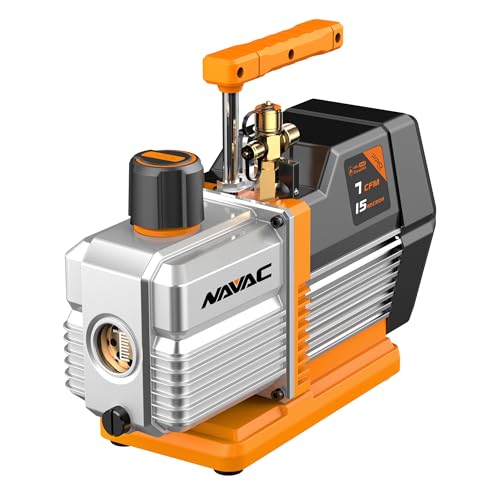
Read listings word for word. VIVOHOME describes our top pick as "sparkless, suitable for A2L new refrigerants such as R32, R1234yf, R454B," and its budget kit as having "an ignition-proof ON/OFF switch and a sparkless motor." NAVAC calls the NP7DP2 "A2L (R32, R454B) compatible." By contrast, the Elitech 5 CFM single-stage pump we looked at makes no A2L claim in its listing, so we left it out. If a listing says nothing about A2L, assume it isn't rated.
Single-stage, two-stage and CFM: what the specs say
None of the five mini-split manuals we searched names a pump size, a stage count or an ultimate vacuum. They name a target (500 microns) and leave the pump to you. So everything below comes from the tool makers, and we'd treat their numbers as claims.
Pump | Stages | Flow | Motor | Claimed ultimate vacuum |
|---|---|---|---|---|
VIVOHOME VH1397US (our top pick) | Two-stage | 5 CFM | 1/2 HP | "As low as 0.2 Pa (15 Micron)." Those two units don't match: 0.2 Pa is about 1.5 microns, and 15 microns is about 2 Pa. We'd read it as a 15-micron claim. |
VIVOHOME VH1752 kit (budget) | Single-stage | 3.5 CFM | 1/4 HP | "An ultimate vacuum of 2 Pa," which works out to about 15 microns |
NAVAC NP7DP2 (premium) | Dual-stage | 7 CFM | No figure | 15 microns, per NAVAC's own product page |
On paper, then, the stage count doesn't separate them; all three claim a floor far below the 500 microns the manuals ask for. CPS's micron gauge manual offers a useful sanity check: "Many published specifications state that pumps rated between 2 & 8 CFM should experience an ultimate vacuum between 15 and 50 microns." What separates them on paper is flow and motor size. That matters most when a manual like Pioneer's calls for three separate evacuations with nitrogen breaks between them.
For a single-zone mini-split's short line set, 5 CFM is plenty, and hose size matters more than the last few CFM. Techs who give a number disagree: a good, large pump of 8-12+ CFM with fresh oil pulls a leak-free system down quickly on an equipment swap-out, while a 2 CFM pro-brand pump like a NAVAC with large hoses will pull down faster than standard 1/4 in charging hoses allow. Small pumps work: of two owners on 3 CFM pumps, one traced their trouble to a step they missed and the other suspected their cheap equipment was partly to blame, and a budget Vevor pump did the job for three home mini-splits for one DIYer.
The micron gauge is the tool to spend on
If you skimp anywhere, don't make it here. An owner who couldn't spare "an additional 200 dollars" for a micron gauge and asked for workarounds was told, overwhelmingly, to get one; even some of the people who offered workarounds said it's better to have the gauge. Owners of self-installed systems put the micron gauge first or near the top of the tools to get, and we agree. The pump makes the vacuum; only the gauge tells you whether you reached 500 microns and whether it holds once the pump is isolated, which is the number the manuals ask for and the photo you want for your warranty file.
What the specs say about our pick: CPS states the VG200's accuracy as "+/- 10% of Reading," temperature-compensated from 32 to 122°F. At 500 microns that's plus or minus 50, so a reading of 480 could mean anything from about 430 to 530. The manual says the sensor is cleaned with denatured alcohol, which matters more than it sounds: the DIYer with the Vevor pump, whose pump seemed stuck at 2,500 microns, found the actual fault was a dirty micron gauge, likely oil on the sensor, and after cleaning it with alcohol the gauge showed the pump reaching 300. The manual also describes a vacuum pump check, which CPS says tests a pump's performance before it's used to evacuate a system.
The gauge has its doubters. One contractor tried a CPS micron gauge years ago (model not stated) and never felt confident in the readout; their own kit lists a much pricier pro gauge. Someone who owns three brands of micron gauge says the cheapest cost $160. Elitech vacuum gauges have their users too, and one calls theirs great. We'd still start with the VG200 because its maker publishes the accuracy, the compensated temperature range and the cleaning procedure.
Hoses, core tools and the other places a vacuum leaks
The most common failure isn't the pump. When an owner's dad and a friend installed two units, the original vacuum pump hoses were lousy and they couldn't pull a vacuum until they upgraded them. Hoses and fittings get the blame again and again when someone can't reach a deep vacuum, from "cheap Amazon fittings and hoses" to the fact that gauge hoses aren't vacuum rated. We'd budget for it: the charging hoses that come with a manifold set are built for pressure, and they're one more set of seals between your gauge and the system.
So, at the level of what to buy: a valve core removal tool, ideally one with a side port for the micron gauge, and a vacuum-rated hose. Our manifold pick includes a valve core remover and four 5 ft hoses rated 800 psi working, 4000 psi burst, which are pressure ratings. The budget kit's three hoses are described as reinforced rubber with leak-proof seals. Neither listing calls its hoses vacuum hoses. The DIYer whose $671.07 tool tally appears below listed refrigerant ball valves and a valve core removal tool alongside the pump and probe.
Mitsubishi's manual is blunt that "System manifold gauges must not be used to measure vacuum." Buy the manifold for the pressure side of the job and the micron gauge for the vacuum.
Rent, borrow or buy: what the kit costs
Renting is real, with limits. One owner who installed a flare unit said they rented a vacuum pump and manifold gauge from the auto parts store (store not named) on terms of return within 48 hours and no cost, and added that you'll probably need an R-410A adapter. AutoZone loans out vacuum pumps too, according to one owner (we haven't checked any store's loaner terms), and the flare alternative gets described, by someone who'd pick a quick-connect unit next time, as borrowing a pump from AutoZone and hoping it reaches 500 microns. The owner who rented didn't mention a micron gauge. If you borrow, check what the pump is rated for before using it on an R-454B or R-32 system, and bring your own gauge. One Della owner who ordered Della's rental kit said the oil it came with didn't reach the minimum fill line and the gauge showed no numbers while vacuuming.
What owners say a kit costs, as they reported it (owner-reported, not our prices): one DIYer tallied $671.07 for vacuum and test gear, including a sparkless two-stage pump, an R-454B manifold, a nitrogen regulator and tank and a digital vacuum probe, plus about $25 to fill the nitrogen tank. At the low end, one owner installed theirs for less than $200 in tools, and another spent close to $200 on a micron gauge, pump, hoses, a core-removal tool and tees. Others put the tools at around $800. The $671.07 tally included a nitrogen regulator and tank; neither total near $200 mentioned nitrogen gear.
Buy if you'll use the gear more than once, or if your manual calls for a long hold (Pioneer's is 4 hours), because a loaner on a 48-hour clock and a nitrogen test plus evacuation don't mix well. Rent the pump and buy the gauge if it's a single install and you hold the card. And if you have neither the card nor a tech, compare the whole kit against the Pioneer Diamante Pro plus a hired startup, or against a quick-connect unit, before you order anything; our MrCool vs Pioneer comparison runs those numbers.
The picks
Products we recommend for this guide.




What owners say
Real owner reports from the threads and editorial sources we drew on for this guide.
“You definitely need the proper tools: micron gauge, vac pump, high quality pump hoses, a core-removal tool, t junctions. The job is very straightforward with the right tools, and impossible without. We ended up spending close to $200 on tools. The only tricky bit is that our original vacuum pump hoses were lousy, and we couldn’t pull a vacuum. Upgraded the hoses and it was easy.”
“Tips: Get decent tools, in particular the micron vacuum guage, vacuum pump, vacuum fittings, and most especially the flare tool. Your flare joints are the weakest link. The difference between a flare with a cheap tool and a good quality tool is night and day (I learned that the hard way).”
“I suspect that the issue I have is partly caused by poor (cheap) equipment, which is all I can manage until I invest in better equipment in future.”
“Yes, it was a Vevor. It did the job for 3 home mini-splits, or 4 if you count the 12V one I put in my van. As with all HVAC vacuum pumps, buy some Robinair vacuum pump oil and change it once in a while.”
“Lowest I’ve been was 35 microns after being pulled from a job and leaving the vacuum pump on for a week before returning. NAVAC makes a hell of a pump she still works great.”
“I rented a vacuum pump and manifold gauge from the auto parts store. Return within 48 hours and there is no cost. You’ll probably need an R410a adapter, but that is cheap.”
“I ordered the rental kit from Della which so far hasn’t been very helpful. They gave me a bottle of oil that didn’t even make it to the minimum fill line.”

