Best Window Heat Pump: What Heats Below 41°F and What Doesn't
By Teo Varnadoe · Updated October 2026
Independent editorial guide. We never accept payment for coverage, though we may earn a commission if you purchase through our links.
Quick Take
For most people who want a window unit that heats with a heat pump, buy the Midea 8,000 BTU inverter window AC with heat (MAW08HV1CWT). ENERGY STAR lists it in DOE's "with reverse cycle" room AC class, which means it heats by running its refrigeration loop backward. It plugs into a standard 115V outlet and cools a room of up to 350 square feet. Treat its heat as spring and fall heat: Midea rates it for supplemental heat between 40°F and 110°F outside, and it locks out near 41°F.
If you need heat on a 10°F night, no cheap window unit we can verify that's still sold new does that. The window heat pumps rated for real cold, like Midea's 9,000 BTU Packaged Window Heat Pump (MAH09H1AGR), which Midea rates at full output at 5°F, mostly sell through HVAC distributors, weigh 130 to 140 pounds and cost several times as much. In a house you own, a ductless mini-split is the better buy for winter heat.
Our picks cover the Midea for shoulder-season heat, a Keystone that publishes its heating output, Midea's cold-climate saddle unit from distributors, and a 115V mini-split for owners who can drill a wall. See picks ↓

Buy a window heat pump for spring and fall, not for January. Our default pick, the Midea 8,000 BTU Smart Inverter Window AC with Heat, heats with a heat pump, and so does the Keystone we list beside it; the catch with both is the outdoor temperature floor. "A window unit that heats" can mean two very different machines. One runs its refrigeration loop backward and moves heat in from outside, which is what a heat pump does. The other glows a resistance coil like a toaster. Box titles call both of them "with heat" or "supplemental heat", and the price tags overlap.
The cheap window heat pumps stop heating around 40°F outside. That's fine for a cool October evening and useless in January. The units that keep going below freezing are big saddle-style machines aimed at apartment buildings (Midea says its unit was developed for multi-family buildings), and they're hard for one household to buy. Somewhere in between sat GE's 8,000 and 11,000 BTU window heat pumps, which GE rated to keep heating down to a 5°F shutoff. GE has reportedly discontinued them, and the only Amazon offer for the 8,000 BTU model was used when we checked.
Heat pump or heat strip: read the spec sheet, not the title
Amazon titles don't tell you which kind of heat you're buying. Frigidaire's 8,000 BTU window unit is titled "with Supplemental Heat", and its own spec sheet lists the heat as "Electrical Heat": 3,500 BTU at 1,390 watts. The Keystone we recommend carries the same "with Supplemental Heat" in its Amazon title, and it's a heat pump. Three checks sort them out:
- ENERGY STAR product class. ENERGY STAR's room air conditioner listing names a DOE product class for every certified unit. A heat pump shows up in a "With reverse cycle" class. The Midea MAW08HV1CWT, the Keystone KSTAW08INV-HC, Midea's saddle unit and Gradient's saddle unit (listed as model CCHP11) all carry it.
- A heating capacity close to the cooling capacity. Keystone lists 7,000 BTU of heat on an 8,000 BTU unit and calls it a heat pump. Frigidaire's 3,500 BTU on an 8,000 BTU unit is labeled "Electrical Heat", which is resistance heat.
- An outdoor temperature limit for heat mode. A resistance coil doesn't care what it's doing outside. A heat pump does, so its manual or listing will give you a floor (41°F for Keystone, 40°F for Midea's store page).
If a listing gives you none of the three, assume it's a coil until the maker says otherwise. ROVSUN's 8,000 BTU inverter window unit is a listing we couldn't settle: it claims 8,400 BTU of heat and a 5°F floor, but neither ROVSUN's own site nor the Amazon copy says heat pump, and there's no ENERGY STAR reverse-cycle record for it that we could locate. One owner who bought one to sit beside their GE says the bolts, vents and lines are the same and the visible parts match up, though they hadn't run it yet. That may be true, and it's still not a spec sheet, so we left it out of our picks.
The 41°F wall on the cheap window heat pumps
Buy the Midea or the Keystone with the 41°F limit as part of the plan. Every affordable window heat pump we could verify that's still sold new stops heating around 40°F outside. Midea's store page rates the MAW08HV1CWT for "supplemental heat for spring and fall between 40°F - 110°F", and its Amazon listing says the heat pump works when it's above 41°F. Keystone's page says its heat mode is meant for outdoor temperatures between 41 and 75 degrees and is "NOT meant as primary heat source". The Keystone manual adds that below 41°F the unit stops and shows LO, and it can restart heating once it's above 43°F.
Owners confirm it. Six owners of Midea's heat-capable window units describe the lockout near 41°F, several of them on the 8,000 BTU MAW08HV1CWT. Most say it shuts off and cycles until it warms up; one, with a 12,000 BTU Midea, says theirs keeps heating to about 30°F if it's already running when the temperature drops. Don't count on the rumored firmware update that unlocks lower temperatures: owners who checked their apps found none.
So who are they for? Someone in a mild climate, or anyone who wants to stop running the furnace for a single room in spring and fall, when the room needs a little heat on 45°F mornings and the central system would otherwise heat the whole house to get it. They aren't a winter plan anywhere it freezes, and we wouldn't buy one hoping it becomes one.
Shoulder-season unit | Heat | Published heating | Heat mode range | Weight (ENERGY STAR) | Window |
|---|---|---|---|---|---|
Midea MAW08HV1CWT | Heat pump (reverse cycle) | None published | 40-110°F (store page); above 41°F (listing) | 56 lb | Double-hung, 24-38.5 in wide, 14.5 in clear opening |
Keystone KSTAW08INV-HC | Heat pump (reverse cycle) | 7,000 BTU; no heating wattage | 41-75°F; restarts above 43°F | 56 lb | 24-38.5 in wide, 14.5 in tall |
Frigidaire 8,000 BTU "with Supplemental Heat" | Resistance ("Electrical Heat") | 3,500 BTU at 1,390 W | No figure | No figure | No figure |
The cold-climate window units, and why you can't just add one to your cart
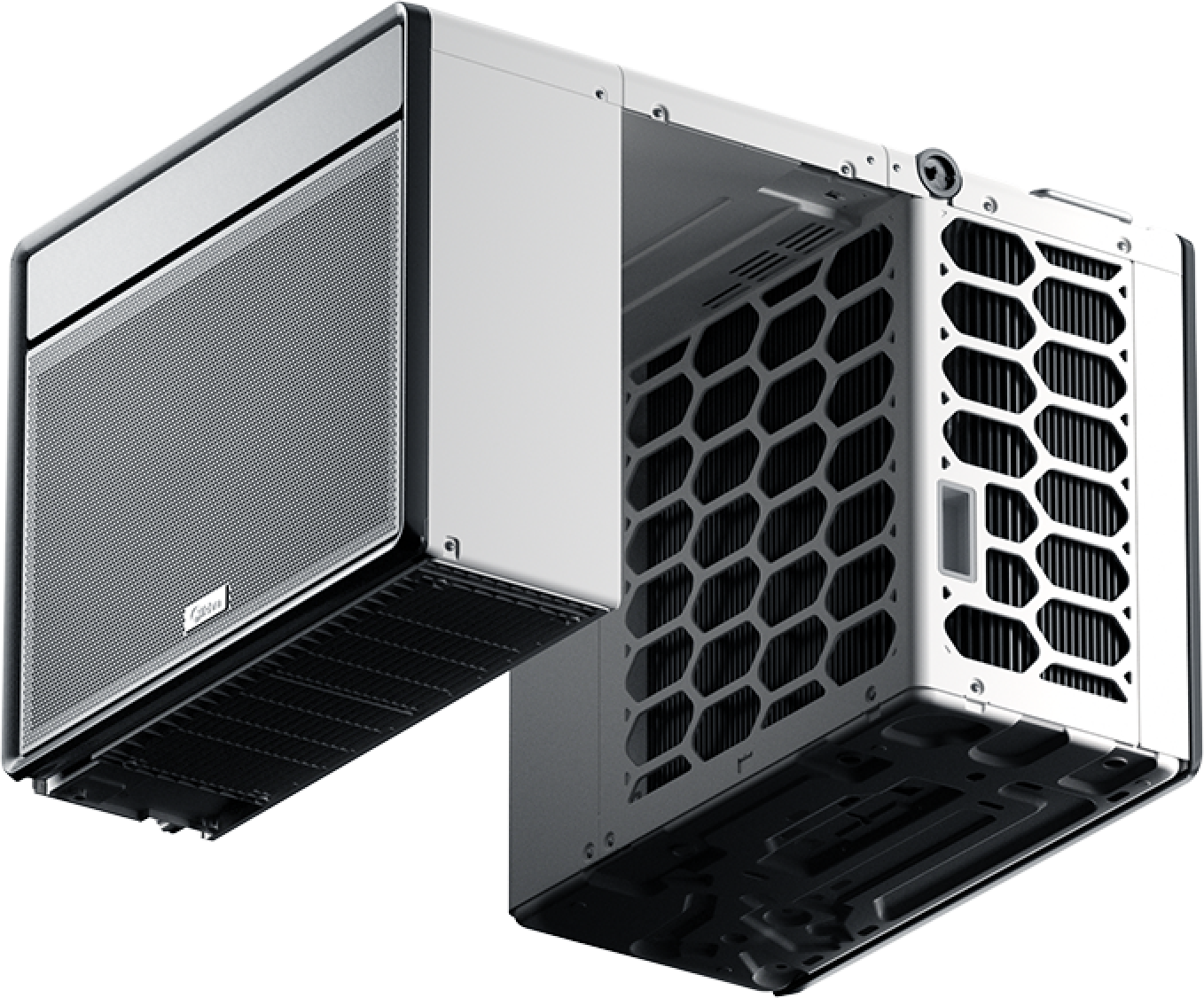
Two window heat pumps we could verify are built for winter and publish their heat output at low temperatures. Midea's Packaged Window Heat Pump (MAH09H1AGR) and Gradient's All-Weather 120V both straddle the sill like a saddle and plug into a 120V outlet. Capacities in BTU/h, each maker's figures; CEER is ENERGY STAR's listing.
Unit | 47°F | 17°F | 5°F | -13°F | CEER | Weight |
|---|---|---|---|---|---|---|
Midea MAH09H1AGR | 9,000 (COP 4.0) | 9,000 (COP 2.42) | 9,000 (COP 2.0) | 5,050 (COP 1.41) | 17.6 (ENERGY STAR and Midea's current page; 2024 spec sheet says 16) | 130 lb (ENERGY STAR record: 129) |
Gradient All-Weather 120V | 9,000 | 9,000 | 7,200 (COP 2.06) | 7,026 | 16.8 | 140 lb |
-13°F is the coldest point in Midea's spec sheet table; Midea's HVAC page separately claims continuous operation at -22°F. The spec sheet says "No auxiliary resistance electric heater", so every BTU comes from the heat pump.
Those are mini-split numbers in a window box, and buying one is the problem. Midea's page for the unit says "Please contact our authorized distributors for pricing" and describes it as developed for multi-family buildings. Gradient's shop page has no cart, only a prompt to contact sales. Tosot (a Gree brand) also lists a 9,900 BTU "Ultra-Heat" window heat pump it says works down to -15°F, but its page marks it coming soon and publishes no output at low temperatures, so we left it out. Owners and shoppers report prices several times what a cheap window heat pump costs, from distributors they had to track down. The one report from a household running them is strong: two units kept a Connecticut house at 66-69°F on its first nights in the single digits.
We list the Midea as our premium pick because it's the cold-climate window unit a homeowner can buy through Midea's distributor network, and its published limited warranty is long: 2 years full, 5 years on functional and sealed-system parts, 12 years on the compressor. We earn nothing on it.
What it costs to run, from the published efficiency
A resistance heater turns every watt into a watt of heat; DOE's Better Buildings Industrial Electrification Technologies Booklet puts it as "Electric resistance and IR heating are 100% efficient." A heat pump's COP tells you how many watts of heat it delivers per watt it draws. Working from Midea's published figures for its packaged window unit:
- At 5°F: it makes 9,000 BTU/h at COP 2.0. That's 9,000 ÷ 3.412 = 2,638 W of heat for about 1,319 W of electricity, half what a resistance heater would draw for the same heat.
- At 47°F: COP 4.0 cuts the draw to about 659 W for the same 9,000 BTU/h, a quarter of resistance heat.
- A 1,500 W space heater: makes 1,500 × 3.412 = 5,118 BTU/h, a bit over half of the Midea's 5°F output.
- Gradient at 5°F: about 1,024 W for 7,200 BTU/h (7,200 ÷ 3.412 ÷ 2.06).
We can't do the same math for the cheap units. Midea publishes no heating capacity or heating efficiency for the MAW08HV1CWT, and Keystone publishes a 7,000 BTU heating capacity but no heating wattage. Both are heat pumps, so in the hours they run we'd expect them to use less electricity than a space heater for the same heat, but neither maker publishes a number that says how much less. Below 41°F they make nothing, and your furnace or a resistance heater picks up the load at full price.
One owner of GE's window heat pump saw the difference in their own room: their old 1,500 W space heater couldn't keep up, and the heat pump held it at about 350 W. That's one room, but it's the physics working the way the COP says it should.
Noise, weight and getting it into the window
The Midea MAW08HV1CWT and the Keystone are conventional box units of about 56 pounds each, with the window ranges in the table above. One owner fit the Midea into a horizontal slider by building a frame from scrap 2x4 and plywood. Neither is U-shaped, so the sash closes on top of the box rather than between you and the compressor.
The saddle units are a different lift. Midea ships its unit with a pivoting outdoor section and a lift-assisted mounting bracket, and an owner who installed two says the job needs a second person to get it onto the sill.
Seal around the unit; owners stress it, and we think it matters more in heating than cooling because the temperature difference across a leaky window is bigger in January than in July. Expect more noise in cold weather, and if you hear a terrible racket, check for ice in the drain tray. Published noise figures don't help much here: Midea lists 51/43/29 dB(A) indoors for its packaged unit at high, low and silent, Gradient lists 47/44/38 dB(A), Keystone lists 54/50/43 with no unit or test distance, and Midea gives no figure for the MAW08HV1CWT that we could locate.
Renters, condos and the mini-split question
A window heat pump's best argument is that it needs no permission. If you rent, live in a condo that won't allow a wall penetration, or own a house where a historic commission has a say, a plug-in unit you can remove when you move is often the only heat pump you're allowed. That's where the Midea and the Keystone earn their place. Our mini-split vs window AC guide goes deeper on that trade.
If you own the house and want winter heat, we'd put the money into a ductless mini-split instead. The MrCool DIY 5th Gen 12,000 BTU 115V makes 8,400 BTU/h at 5°F on its NEEP listing and keeps heating down to -13°F. No cheap window unit we can verify publishes a 5°F figure at all, and the MrCool's is 600 BTU/h short of Midea's saddle unit, without a window full of machine. It's a wall-mounted install with a pre-charged line set, and MrCool lists a 20 A maximum breaker for the 12K outdoor unit, so check your panel before you order. Our best 115V mini-split guide compares it with the other plug-voltage options.
Which one we'd buy
- A rental or mild climate, spring and fall heat: the Midea MAW08HV1CWT. It's the cheapest heat pump window unit we could verify on Amazon, and owners are happy with it inside the 41°F limit, though one who knew about the limit still calls the lockout "a bit disappointing".
- Same job, and you want a published heating number: the Keystone KSTAW08INV-HC, with its 7,000 BTU heat pump rating and a 1-year parts-and-labor warranty. There are no owner reports on it yet, so it's a spec-sheet pick.
- Real winter heat through a window: Midea's Packaged Window Heat Pump from a distributor, if you can find one at a price you can stomach.
- You own the place and can drill a wall: a mini-split. It puts the compressor outdoors, leaves your window alone, and heats far below 41°F.
For a bedroom where cooling matters more than heat, our quiet window AC guide and Midea U review cover Midea's U-shaped units, none of which has a heat mode on Midea's US store.
The picks
Products we recommend for this guide.

Midea 8,000 BTU Smart Inverter Window AC with Heat (MAW08HV1CWT)
A true heat pump in a standard 115V window box, ENERGY STAR certified at CEER 14.5. Midea rates the heat for spring and fall between 40°F and 110°F, and owners report it stops near 41°F, so it's shoulder-season heat for one room.
Read our full review: we scored it 6.9/10


MrCool DIY 5th Gen 12,000 BTU 115V Mini-Split
If you own the house, this is the better winter heater: 8,400 BTU/h at 5°F on its NEEP listing and heat down to -13°F, on 115V. It's a wall install with a pre-charged line set, not a plug-in, but it frees your window and puts the compressor outside.
Read our full review: we scored it 6.9/10
What owners say
Real owner reports from the threads and editorial sources we drew on for this guide.
“Heating also works well, as long as outside temperature is above 41F. In heat mode, there is a bass hum as the heat pump kicks in, and then it settles down into a quiet purr. I've had it for about two years now, gone through a hot summer and a cold winter. Very happy with it.”
“Well I've made it to cold.. it's been working well up until now where the controller locks it out under 41 degress outside. I knew to expect it but its a bit disappointing.”
“Thanks for answering, the Midea unit stops when the outside temp dips below 41. It supposedly does not have a defrost cycle, however it definitely does something when it dips below 41 to heat itself up a bit and turn back on. However, it only stays on for a few minutes, then dips below 41 and shuts off again.”
“However, for whatever reason if you have it running in heat mode while it’s above 41 and the outside temp drops below the threshold it will continue heating down to about 30F as long as you don’t turn it off. If it’s super cold out and you turn the unit on it will display an error message.”
“First nights in single digits and house was consistently 66 to 69 degrees set in 68 auto. 1 fan in hallway circulating air. Very happy with these with the size of my house 14k for 2 mini splits installed would have been overkill. They did get a little louder last night when temp was low only negative.”
“Impressed honestly, my old 1500W space heater could never keep up with the thermal loss of the room and this thing is maintaining a comfortable temperature at only 350W”
“I have the GE heat pump window AC, the 11000 Btu one and it is working well down to 5 F. The only drawback is that it is noisy and makes all sorts of airplane and hissing sounds.”
“Just make sure you have a solid plan for insulating around the unit. Mine seems to leak some heat out of the house but I suppose a window in itself would lose heat anyway. Without the insulation and air sealing it'd be fighting itself trying to heat or cool the room.”

