Best 115V Mini-Split: 12K Picks for a Standard 120V Circuit
By Wendell Asaro · Updated October 2026
Independent editorial guide. We never accept payment for coverage, though we may earn a commission if you purchase through our links.
Quick Take
Buy the MrCool DIY 5th Gen 12K (115V) if you need heat and cooling on an ordinary 120V supply and want to install it yourself. Its 25 ft line set comes pre-charged with quick-connect fittings, NEEP lists it at 8,400 BTU/h of heat at 5°F, and its warranty allows owner installs with 5 years on parts and 7 on the compressor. If your winters go well below zero, the Klimaire DIY 12K (115V) lists a 6,680 BTU/h maximum at -13°F against the MrCool's 3,800; get its DIY warranty terms in writing first.
Two limits come with the voltage. 115V tops out at 12,000 BTU in every line we checked, and the 12Ks we pick make 8,400-9,200 BTU/h at 5°F (some 115V 12Ks list only 6,600), enough for one room or a small addition but not a drafty garage on a cold night. And these units aren't plug-ins: the spec tables for our picks call for a 15-18 A minimum circuit ampacity where it's listed and a 20-25 A breaker, so check with an electrician whether the circuit you have can carry one before you buy.
Our 115V default, the stronger quick-connect for sub-zero winters, the cheapest 12K if you'll hire the startup, and a 9K for a small bedroom are below. See picks ↓

A 115V mini-split is a workaround, and a good one, as long as you buy it for one room. Most mini-splits want 230V. That's a two-pole breaker, and in plenty of homes it's a slot the panel doesn't have, or a wire run through finished walls that an electrician prices like a small renovation. The 115V version is what you buy for an addition with no ductwork, a home office over the garage, a backyard ADU (accessory dwelling unit) fed from a small subpanel, or a cabin running on a 120V generator.
The trade is size and cold-weather output. Our default is the same unit our best DIY mini-split guide picks, the MrCool DIY 5th Gen 12K, because at this voltage the quick-connect line set and an owner-install warranty matter more than a few hundred BTU. The other three picks below each win one specific situation: deep cold, the lowest price if you'll pay for a flare startup, and a small bedroom.
Who a 115V mini-split is for
Buy 115V when getting 230V to the spot is the hard part. That usually means one of four situations: no free breaker space for a two-pole breaker, an existing 120V circuit already run to the right wall, a long run through finished space, or a power source that only makes 120V, like a portable generator, an RV hookup or a small solar setup. A trailer in Alberta limited to 15 A is one version of it. A Canadian condo whose only circuit to the old unit is 120V, with the panel at the far end of the condo behind finished walls, is another.
If you're running a new circuit from the panel anyway and there's room for a two-pole breaker, buy 230V. Installers and owners say it constantly, and our reason is choice: every 115V line we checked stops at 12,000 BTU, while the 230V versions go to 18K, 24K and beyond. If your room ever needs more, or the unit dies in ten years, you'll have far more to pick from on a 230V circuit.
Ask one more question before you settle on 115V. You'll hear, including from a self-described electrician, that a dedicated 120V circuit can often be repurposed to 240V. Sometimes it can't: one owner's own electrician said a new 240V run in their house would be tricky. Whether it works in your house depends on what else is on the circuit and what your local code allows, which makes it a question for a licensed electrician, not a weekend project.
12K is the ceiling: what it makes on a cold night
Every 115V unit here is sold as a 12,000 BTU unit or smaller, and that nominal size is a cooling rating; heating ratings are taken at 47°F. Winter is decided by the heat at 5°F and below. The figures come from NEEP's cold-climate heat pump list (rated and maximum are the same number at 5°F for the three NEEP-listed units), and from ENERGY STAR's records for the Della, which isn't NEEP-listed:
Unit (115V) | Heat at 17°F (BTU/h) | Heat at 5°F (BTU/h) | Coldest published point |
|---|---|---|---|
MrCool DIY 5th Gen 12K | 8,500 | 8,400 | 3,800 maximum at -13°F; heats down to -13°F |
Klimaire DIY 12K | 10,000 | 8,900 | 6,680 maximum at -13°F |
Della Serena 12K | 9,500 per ENERGY STAR | 9,200 per ENERGY STAR | Della publishes nothing below 5°F, and its heating range ends there |
Pioneer Diamante Pro 9K | 8,000 rated | 7,300 | 6,200 maximum at -4°F, where its heating range ends |
Here's an illustration, not a load calculation for your room. Say a Manual J or a careful heat-loss estimate puts a 400 sq ft addition at 10,000 BTU/h on a 5°F night. The Della 12K comes up 800 BTU/h short, the Klimaire 1,100, the MrCool 1,600 and the Pioneer 9K 2,700. One watt of resistance heat makes 3.412 BTU/h, so the MrCool's gap is about 470 W of backup heat and the Pioneer 9K's about 790 W. If you already have a baseboard heater in the room, keep it for those few hours a year. If your load at 5°F is well past 9,000 BTU/h, no 115V unit will cover it, and that's the point to price a 230V circuit.
Below zero, the order changes. The Della and Pioneer stop publishing figures at 5°F and -4°F, the MrCool falls to 3,800 at -13°F, and the Klimaire still lists 6,680. If your winters regularly go below zero, that column should pick your brand, and our cold-climate mini-split guide covers the bigger 230V units that go further.
Don't oversize a small room just because 12K is the biggest you can get. Owners split on it: one regrets a 9K in a room where a 6K would have done, while another runs a 12K on low in a small bedroom without complaint. Minimum output settles it. NEEP lists the MrCool 12K's minimum as 2,600 BTU/h at 17°F and 1,900 at 5°F, against 4,000 and 3,400 for the Pioneer 9K, so in cold weather the bigger MrCool can turn down further.
The circuit you will need
A 115V mini-split runs on the same voltage as a wall outlet, which is why people assume it plugs into one. The manufacturers' spec tables say otherwise:
Unit (115V) | Minimum circuit ampacity | Maximum breaker or fuse | Notes |
|---|---|---|---|
MrCool DIY 5th Gen 12K | 18 A | 20 A breaker | The 9K is the same |
Klimaire DIY 12K | 16 A | 25 A fuse | Klimaire's manual says electrical connections must be made by a qualified or licensed electrician where required |
Della Serena 12K | 15 A | 25 A breaker | No figure |
Pioneer Diamante Pro 9K | No figure | 25 A single-pole breaker | No figure |
Cooper & Hunter MIA 12K (not a pick) | 19 A | 20 A fuse | No figure |
Senville Leto 12K (not a pick) | 19 A | 20 A fuse | No figure |
None of the 115V mini-splits in this guide asks for less than a 20 A circuit, and installers report the same. One shopper went through about a dozen 6K and 9K units hoping for one that fit a 15 A trailer circuit and found maximum ratings of 20, 25 or 30 A on every one.
The running draw is lower than those numbers. ENERGY STAR lists the Della 12K at 9,200 BTU/h with a COP of 2.10 at 5°F. That's about 2,700 W of heat for about 1,280 W in, roughly 11 A at 115V. A 1,500 W plug-in heater on the same power makes about 5,100 BTU/h. One owner of an older 120V Pioneer at a cabin says theirs has never gone above 1,000 W. The breaker and ampacity figures describe what the circuit has to be built for, whatever the meter shows on a mild day, and they're what your electrician will size the wire and breaker to.
Plenty of owners run a 115V unit off a receptacle or an existing circuit, and one says it tripped a couple of times until they got careful about what else runs on that circuit. Whether your existing circuit can carry an 18 A minimum circuit ampacity alongside everything else on it, and whether your area requires a disconnect at the outdoor unit, is a licensed electrician's call, and your town may want a permit. Get that quote before you order.
Check the model number before you install
Most of these lines sell a 115V and a 230V version of the same size, in the same box art, with model numbers a character apart, and wrong-voltage boxes do ship. One owner's invoice showed the 230V model while the box said 115V; they wired it to a 240V line without checking and burned it out. Another bought a unit advertised as 115V that showed up as 230V. Before you mount anything, match the model number on the box and the nameplate to the voltage you ordered:
Line | 115V model code | 230V model code |
|---|---|---|
MrCool DIY 5th Gen | -115D25 (only the 9K and 12K come in 115V) | -230D25 |
Klimaire DIY 5th Gen | H1 (KIWQ12H1-45T) | H2 (208-230V) |
Della Serena | 1VR (12K1VR) | 2VR (208-230V) |
Pioneer Diamante Pro | ALSI20RL | GLSI20RL |
Pioneer has a second trap. Its older Diamante Pro Series, model numbers ending FI19RL, runs on R-410A and is in final sellout; the current SI20RL units in our picks run on R-454B. Make sure the listing you buy is the one whose specs you read.
Quick-connect or flare: the install and the warranty
At 115V the install question is the same as at any voltage. The MrCool and Klimaire ship 25 ft line sets pre-charged with quick-connect fittings and need no vacuum pump; both manuals say those fittings are for one-time connection, so plan the route before you make them. MrCool's install manual allows a 75 ft maximum run. The Della and Pioneer are flare units with shorter included lines (16.4 ft and 16 ft) that need the lines evacuated before the refrigerant is released; Pioneer's manual calls for a nitrogen-assisted evacuation to 500 microns with a 4-hour hold by qualified personnel. One owner of a 120V Tosot found it cheaper to buy a vacuum pump, gauges and a torque wrench than to pay for a pre-charged kit, which is the trade to price for yourself.
The MrCool and Klimaire manuals also set mounting rules for their R-454B refrigerant, so check them before you pick a wall: the indoor unit at least 6.0 ft above the floor, a room at least 7.3 ft tall, and a minimum room area from the manual's table. A low-ceilinged addition or basement room can fail that test. The Pioneer also runs on R-454B and the Della on R-32, so read their manuals for any installation-height or room-size limits too.
Then read the warranty for what an owner install does to it:
- MrCool DIY 5th Gen: owner installs allowed, 5 years parts and 7 compressor, no registration, line sets covered. MrCool says a licensed contractor "may be necessary" when required by law or for diagnostics it directs.
- Klimaire DIY 5th Gen: the current DIY warranty allows owner installs on DIY-designated models (5 years parts and 7 compressor if registered within 45 days), but its claim procedure asks for an installation invoice from a licensed HVAC technician, and it excludes refrigerant line sets. Get Klimaire's answer for your model in writing.
- Della Serena: lifetime parts if you register within 100 days, and Della's web policy gives a registered non-professional install free replacement parts at Della's discretion. The Amazon listing says the system mandates professional installation, which is one more reason to hire the startup.
- Pioneer Diamante Pro: no licensed-installer requirement, 5 years parts and compressor if registered (1 year if not), but faulty installation and refrigerant loss are excluded, and a claim starts with an installer or qualified contractor diagnosing the failure.
No warranty here pays labor. On the refrigerant side, EPA's Section 608 Q&A says "Any person servicing, installing or disposing of stationary appliances (except the disposal of small appliances) must be a section 608 certified technician." EPA hasn't published a plain statement on whether connecting a factory-charged quick-connect line set counts as installing in that sense. A flare unit's evacuation means attaching hoses and gauges to the refrigerant circuit, one of the activities EPA's technician definition names, so if you don't hold the card, hire that step out.
Long-term evidence at this voltage is thin and split, too thin to rank brands on. One owner has two Senville 10K 120V units still running after about ten years, and two Pioneer 12K 120V units have performed well since 2018 for another. On the other side, a professionally installed Pioneer from an older line that wasn't named developed a slow leak, froze up four or more times and lost its fan within four years. None of those is the current Diamante Pro.
Does 115V cost more to run?
You'll read that a 115V unit burns more electricity than the 230V version, and you'll read that the idea is a myth. The published ratings land in between: where there's a gap it's small, and some pairs show none.
Same-size pair | SEER2 (115V / 230V) | HSPF2 (115V / 230V) | EER2 (115V / 230V) |
|---|---|---|---|
Della Serena 12K | 22 / 22 | 9.5 / 9.5 | 12.0 / 11.3 |
Pioneer Diamante Pro 12K | 20.0 / 20.0 | 9.5 / 9.5 | 10.5 / 11.2 |
Klimaire DIY 12K | 23.0 / 24.0 | 10.0 / 10.0 | 13.0 / 13.0 per the spec sheet |
Pioneer Diamante Pro 9K (our pick) | 19.0 / 20.0 | 9.5 / 10.0 | 11.7 / 12.0 |
The Della's 115V model also posts slightly more heat at 5°F than its 230V twin (9,200 vs 9,100 BTU/h). On the ratings, a one-point SEER2 gap at this level is about 4-5% more electricity for the same seasonal cooling (24.0 / 23.0 and 20.0 / 19.0). A 115V unit draws about twice the current of a 230V unit for the same power. That changes the wire and breaker your electrician specifies; the meter counts watts.
Where the choice of unit can show up on your bill is rebates. One owner got a utility cold-climate rebate on a 115V 12K, and the thresholds their utility listed match ENERGY STAR's cold-climate criteria: a COP of at least 1.75 at 5°F and at least 70% of the 47°F capacity there. The MrCool 12K, Klimaire 12K and Pioneer 9K are ENERGY STAR Cold Climate per NEEP; the Della 12K is flagged cold-climate in ENERGY STAR's records but isn't on NEEP's list; the Pioneer 12K 115V isn't ENERGY STAR at all. Check your utility's program rules and the unit's AHRI number before you buy.
Generators, solar and off-grid power
A backup generator that only makes 120V, or a trailer on a 15 A supply, puts you in 115V territory by default. Size the generator from the maximum input power on your unit's submittal sheet and the generator maker's guidance, not from an owner's meter. There's no verifiable measured startup figure for the units in our picks; the one owner number we have, for an older 120V Pioneer at a cabin, is 700-800 W at first start and about 200 W once it settled.
For solar, one owner runs a 12K unit built to take solar panels directly or 120V AC, or both at once. That's a different product class from the grid-tied units here, and we haven't reviewed one. If you'll run a standard 115V mini-split from an inverter or battery system, the same circuit figures above apply to what that system has to supply.
Which 115V mini-split we would buy
- One room or a small addition, you install it, winters near 5°F: the MrCool DIY 5th Gen 12K. Quick-connect lines, an owner-install warranty with no registration, and 8,400 BTU/h at 5°F.
- Winters that go below zero: the Klimaire DIY 12K, with a 6,680 BTU/h maximum at -13°F to the MrCool's 3,800. Get Klimaire's DIY warranty terms in writing.
- Lowest price, winters that bottom out near 5°F, and a certified tech for the startup: the Della Serena 12K, with 9,200 BTU/h at 5°F per ENERGY STAR for far less than the quick-connect units. Our Della review covers its warranty line by line.
- A bedroom or office of a few hundred square feet: the Pioneer Diamante Pro 9K (115V), ENERGY STAR Cold Climate with 7,300 BTU/h at 5°F. It's a flare unit, and heating ends at -4°F.
- A garage: read our garage mini-split guide first. In our example there, a 115V 12K comes close to holding 50°F on a 5°F night and falls well short of 65°F.
Whichever you pick, get the electrician's answer on the circuit first, then match the model number on the box to the voltage you ordered before anything goes on the wall.
The picks
Products we recommend for this guide.

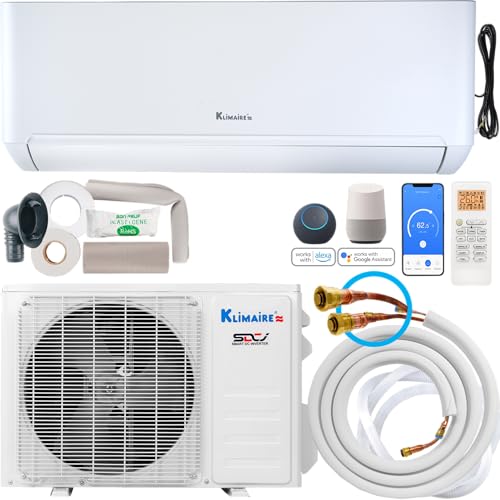
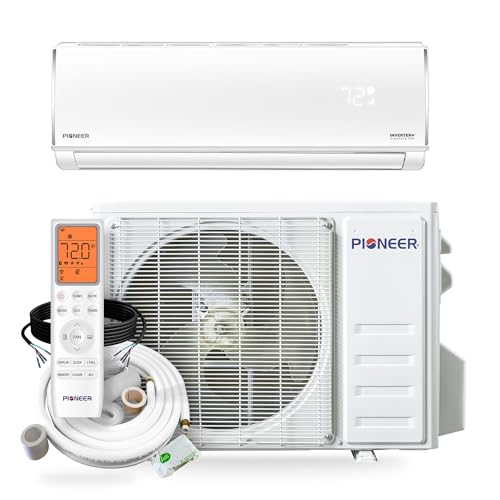
MRCOOL DIY 5th Gen 12,000 BTU 115V Mini-Split
Our 115V default: a 25 ft pre-charged quick-connect line set, 8,400 BTU/h at 5°F per NEEP, and an 18 A MCA / 20 A max breaker. The warranty allows owner installs, 5 years parts and 7 compressor, no registration.
Read our full review: we scored it 6.9/10

What owners say
Real owner reports from the threads and editorial sources we drew on for this guide.
“Part number on outside of box is so very similar on both models, I didn't bother to double check anything.”
“Be cautioned that it advertises 115v but mine came as 230v so you may need to make accommodations.”
“I have a Confortotal I installed myself with a 110V. Plugs into wall... tripped it a couple times, I'm just careful now with other thing on the circuit so hasn't tripped in about a year now.”
“I have an older 120 volt pioneer I use at my cabin. I've never seen it go above 1000 watts. It's rated at like 1100 on the max input on the submittal sheet. It usually runs at like 700-800 at maximum capacity on first start up but then modulates down to like 200 watts.”
“I installed a 120 v 12k Tosot in my wife's studio last year. It works fine in temperate No. California, but I don't know how it would do with an Alberta winter. Company support was stellar, and installation was trouble-free. It was less expensive to buy the vacuum pump/gauge set (and an open-end torque wrench) than to go the precharged Mr. Cool route.”
“I installed two of these units under the Senville brand 10 years ago. And one 220 unit. They were being sold direct to consumer on the internet. They had containers of them. They were about 400 bucks then. The exact unit… 10K BTU 120 V. Still going strong.”
“I have a Pioneer currently, I've spent more on fixing/keeping it running than I did on buying it (4 years old, only ran great the first year). Has a slow leak somewhere. Has frozen up at least 4 times. Last year the fan died.”
“I did specifically apply for the "Cold-Climate" Air Source Heat Pump Rebate, so figured I'd pass it on that the 12k (115v) SeerXtreme does Pass the Xcel Energy Cold-Climate Rebate.”
“The unit was $1400, but it is 100% solar or 100% 120vAC or any combo of the two. It's so nice to look at the app and see it cruising on solar on a hot afternoon.”
