Mini-Split vs Window AC: Cost, Heat, Noise and When Each One Wins
By Wendell Asaro · Updated October 2026
Independent editorial guide. We never accept payment for coverage, though we may earn a commission if you purchase through our links.
Quick Take
Buy a mini-split if you own the place, the room needs heat as well as cooling, and you'll live with it for years. Our pick is the MrCool DIY 5th Gen 12K (115V): its 25 ft line set comes pre-charged with quick-connect fittings, NEEP lists its rated heat output at 5°F as 8,400 BTU/h, and its warranty allows owner installs. You keep your window, and the compressor sits outside at the far end of the line set.
Buy an inverter window unit if you rent, only need summer cooling in one room, or can't put a hole through an exterior wall and run a new circuit. A U-shaped Midea U plugs into a standard 115V outlet, costs a fraction of a mini-split kit, and leaves with you when you move. A window heat pump sits in between, but Midea rates the one we link for supplemental heat only between 40°F and 110°F outside.
Our picks cover both answers: the quick-connect mini-split we'd install, a cheaper flare unit for a bedroom, a U-shaped window unit, an LG for sashes the U won't fit, and a window heat pump for spring and fall. See picks ↓

If you own the house and the room needs heat as well as cooling, we'd put in a ductless mini-split before any window unit. It gives you the window back, moves the compressor outdoors, and keeps heating far below the 40°F floor Midea gives the window heat pump we link. For a do-it-yourself install, the MrCool DIY 5th Gen 12K is the one we'd buy, for the same reasons it tops our best DIY mini-split guide: pre-charged quick-connect lines and a warranty that allows owner installs.
A window unit wins more often than mini-split fans admit, though. It plugs into an outlet, needs no hole in the wall, and costs a small share of what a mini-split costs once the electrician and any installer are paid. Some owners run inverter window units by choice: an HVAC tech of 15 years trusts name-brand inverter window units over cheap off-brand mini-splits, and a homeowner who priced a five-head mini-split system couldn't justify the gap.
Owners who made the switch mostly don't look back. They describe quieter rooms, better summer comfort or lower cooling bills, though one calls their mini-split silent and says that's about all they gained. The complaints are real too: some owners are bothered by noise from their indoor heads, and a refrigerant leak has sent more than one mini-split owner back to window units.
Which one fits your situation
- You own the home, the room needs heat, and you can add a circuit: a mini-split. This is the case it was built for.
- You rent, or the lease forbids alterations: an inverter window unit, ideally U-shaped. It comes out of the window when you leave, and nothing goes through the wall.
- The room is already heated and you only want summer cooling: a window unit. Window unit if you have heat already, mini-split if you don't: we'd follow that, with the noise and window caveats below.
- A rental that wants some spring and fall heat: a window heat pump, with its 40°F heating floor in mind.
- A building, park or condo rule that bans one type: the rule decides. Rules cut both ways, as the section on renters and HOAs shows. If neither a window unit nor a wall hole is allowed, read our window AC vs portable AC guide or our LG through-the-wall review for a sleeve that already exists.
Upfront cost: the unit, the install and the circuit
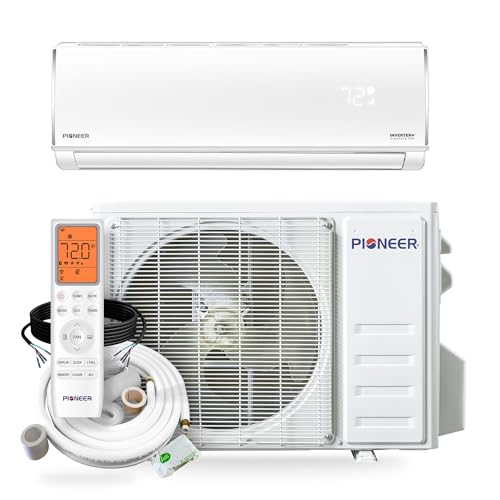
On Amazon, the MrCool 12K kit costs several times what Midea's 10,000 BTU U-shaped window unit costs. The Pioneer 9K mini-split sits between them, and the window units we link are all in the same range as each other. Prices move, so check the current number on each listing, but the gap between the two types is wide and stable.
Then add the install. Here's what owners say they paid, in their own words and years; treat these as owner-reported figures, not quotes for your house:
Job (owner-reported) | Cost |
|---|---|
MrCool DIY installed by the owner in 2020, an earlier generation than the 5th Gen we pick | About $1,800 total, including $500 to have the disconnect box wired; installer quotes for the same equipment were $4,500-6,000 |
Four-head Fujitsu system replacing window units | About $8,500 total, and worth it to the owner |
Five-head Fujitsu system, quoted | $19,000, against about $2,500 for five good inverter window units by the owner's estimate |
The circuit is the cost people forget. The MrCool 12K (115V) lists an 18 A minimum circuit ampacity and a 20 A maximum breaker, and the Pioneer 9K (115V) calls for a 25 A single-pole breaker, so plan on a dedicated circuit for either one, and ask a licensed electrician whether your area also requires a disconnect at the outdoor unit and a permit. A window unit plugs into a standard 115V receptacle: LG rates its 10,000 BTU Dual Inverter at 11 A with a 115V, 15 A plug. That isn't a free pass. Midea's manuals say not to use an extension cord or adapter plug, and one owner who put a window unit on a 15 A office circuit tripped the breaker as soon as the compressor kicked on with their computer equipment running. A window unit sharing a busy circuit can need electrical work too.
The gap narrows as the space grows. For an insulated 900 sq ft garage, a window unit big enough to cool it gets into the same price range as a budget mini-split, though hiring out the mini-split install can get expensive. For one bedroom, the gap doesn't narrow much.
Efficiency: CEER and SEER2 measure different things
Window units and mini-splits are rated on different yardsticks, and the numbers can't be held side by side. CEER, the combined energy efficiency ratio, is how DOE's room air conditioner test procedure (appendix F) states a window unit's efficiency, in Btu of cooling per watt-hour. SEER2, the rating on a mini-split, comes from a separate DOE test procedure for central air conditioners and heat pumps (appendix M1), mandatory since January 1, 2023; the federal minimum for a split heat pump is 14.3 SEER2. We haven't found a DOE, ENERGY STAR or AHRI conversion between CEER and SEER2, so a 23.5 SEER2 mini-split and a CEER 15 window unit can't be ranked from their labels, and any percentage someone derives from those two numbers is a guess. Here are the ratings for our picks:
Unit | Type | Rating |
|---|---|---|
Midea U 10,000 BTU (MAW10V1UWT) | Window, ENERGY STAR | CEER 15 |
LG Dual Inverter 10,000 BTU | Window, ENERGY STAR | CEER 15 |
Midea 8,000 BTU with heat (MAW08HV1CWT) | Window heat pump, ENERGY STAR | CEER 14.5 |
MrCool DIY 5th Gen 12K (115V) | Mini-split | 23.5 SEER2, 10.2 HSPF2 |
Pioneer Diamante Pro 9K (115V) | Mini-split | 19.0 SEER2, 9.5 HSPF2 |
Within one type, the division works, because energy for the same cooling scales with 1 divided by the rating. On the rated figures, the MrCool uses about 19% less electricity than the Pioneer 9K for the same seasonal cooling (19.0 ÷ 23.5 = 0.81), and the Midea window heat pump uses about 3% more than a CEER 15 window unit (15 ÷ 14.5 = 1.03).
Our read: a modern inverter window unit closes much of the cooling gap, and the mini-split's bigger efficiency edge is in heating, where most window units don't compete at all. Across types, all we have is owner experience, and it isn't like for like. Cooling costs fell about 30% after a four-head Fujitsu replaced one owner's window units, and air conditioning with Mitsubishi mini-splits was significantly cheaper than window units for another. On the other side, an owner running inverter window units sees their 10,000 BTU unit draw about 800 W, dropping to about 300 W once it isn't working at full load, and guesses a mini-split might save 100 W here and there.
Heat is where they split
Most window units don't heat. None of the Midea U models in the spec data we checked has a heat mode, and ENERGY STAR lists heating mode as no for the MAW10V1UWT we link; the LG Dual Inverter line doesn't heat either, with ENERGY STAR's records for all four current LG sizes listing heating mode as no. In winter, those units sit idle in the window or come out.
Window heat pumps exist, with limits. The Midea 8,000 BTU inverter unit we link (MAW08HV1CWT) heats and cools, but Midea's product page describes it as supplemental heat for spring and fall between 40°F and 110°F, and its Amazon listing says the heat pump function works when it's above 41°F outside. Midea doesn't publish a heating capacity for it on either page. ENERGY STAR also lists a saddle-type Midea window heat pump (MWCUPWHP-09HEFN8-BCL1) at CEER 17.6, which we haven't reviewed. We wouldn't rely on a window unit for primary heat, partly because of the air that leaks around it, so we treat a window heat pump as spring and fall heat, the same way our Midea U and LG reviews do.
A mini-split is a heating appliance first. Heating ratings are taken at 47°F, where the MrCool 12K is rated at 12,000 BTU/h; in winter, the output when it's cold is the number to watch. NEEP lists the MrCool 12K's rated output at 5°F as 8,400 BTU/h (also its listed maximum there) and a 3,800 BTU/h maximum at -13°F, the bottom of its heating range. On the same NEEP basis, the Pioneer 9K is rated at 7,300 BTU/h at 5°F, and its heating range ends at -4°F.
Put the MrCool's 5°F figure in electric-heater terms. One watt of resistance heat makes 3.412 BTU/h, so the MrCool's rated 8,400 BTU/h is about 2,460 W of heat. A 1,500 W plug-in heater makes about 5,100 BTU/h. On a 5°F night, the mini-split is doing the work of more than one and a half space heaters, and a cooling-only window unit is doing none of it. Mini-splits added on top of one Long Island home's oil heat now do 90% of its winter heating, and an owner who keeps a boiler uses the mini-split's heat to get through chilly days before turning the boiler on.
Noise: where the compressor sits
A mini-split's compressor is outdoors at the end of the line set; MrCool's comes with 25 ft of line. A window unit's compressor is in your window. A U-shaped unit like the Midea U straddles the sash so the closed window sits between you and the compressor, and ENERGY STAR says U-shaped and saddle-style units "provide greater noise reduction." A box unit has only its own cabinet between you and the compressor.
The published figures don't settle it, because they don't measure the same thing:
Unit | Published sound levels |
|---|---|
MrCool DIY 5th Gen 12K | Indoor head 18 dB(A) on Silent, 24 on Low, 43 on Turbo; outdoor unit 54 dBA |
Pioneer Diamante Pro 9K | Indoor head 28 dB(A) on Mute, 42 on Turbo; outdoor 54 |
LG Dual Inverter 10,000 BTU window | 44 dBA in sleep mode, 50 on low, 58 on high |
Midea U (earlier models) | Store listings say "as low as 32 dBA"; a retailer spec for the original 8,000 BTU U lists 42 dB on low |
An indoor-head figure leaves out the compressor entirely, a window-unit figure doesn't, and the makers don't share a test method. Don't line these up decimal for decimal, and we don't measure sound ourselves.
Owners mostly favor the mini-split. People who moved from window units call their mini-splits dead quiet and silent as heck. But mini-split heads aren't silent either: one owner hears popping and cracking as the plastic expands, noise from the vanes and loud defrost cycles, and a light sleeper shuts the bedroom unit off in winter because the noises can wake them. Window units have their own tone problem. Our Midea U review counts 12 or more owners of earlier U models who describe a high-pitched whine, and in our Midea U vs LG comparison, owners of both more often heard it on the Midea. If quiet is the whole reason you're shopping and you can't install a mini-split, a U-shaped unit is where we'd start.
What each install asks of you
A window unit is a sealed plug-in appliance: no refrigerant work and no wiring. The work is mechanical. Midea's U listings call for a single- or double-hung window 22-36 inches wide that opens at least 13.75 inches, and Midea's U manuals have you screw the support bracket to the sill. LG lists its 10,000 BTU Dual Inverter for windows 22-36 inches wide with a 13-inch opening, and it weighs 62 pounds.
A mini-split is a small construction project. You'll cut a hole through an exterior wall for the line set, drain and cable; mount the indoor head; set the outdoor unit on a pad or bracket; route the condensate drain; and have a licensed electrician bring a dedicated circuit to it. MrCool's manual also sets mounting rules for its R-454B refrigerant: the indoor unit at least 6.0 ft above the floor, a room at least 7.3 ft tall, and a minimum room area from the manual's table, which a low basement room can fail.
The two mini-splits we pick differ on the refrigerant side. The MrCool ships its 25 ft line set pre-charged with quick-connect fittings, and MrCool says no vacuum pump is needed. Its manual treats those fittings as one-time connections: installing the line sets more than once, or disconnecting and reconnecting at the outdoor unit, voids the warranty. The manual allows runs up to 75 ft. The Pioneer is a flare unit with a 16 ft line set and a 50 ft maximum. Its manual requires the lines to be evacuated with a vacuum pump and manifold gauge, down to 500 microns and held for at least 4 hours, and it says qualified, well-trained personnel must complete the installation.
On the legal side, EPA's Section 608 Q&A says "Any person servicing, installing or disposing of stationary appliances (except the disposal of small appliances) must be a section 608 certified technician." EPA hasn't published a plain statement on whether connecting a factory-charged quick-connect line set counts as installing in that sense; a 1995 EPA notice on the refrigerant sales rule said only that it wasn't clear whether pre-charged split systems should count as appliances or as components. Evacuating a flare unit means attaching hoses and gauges to the refrigerant circuit, one of the activities EPA's technician definition names, so if you don't hold the card, hire that step out.
It's doable for a careful first-timer. The 2020 MrCool DIY owner above had no experience, took 3.5 days including a lot of video watching, and thinks the next one would take about 6 hours. Read the warranty before you start: MrCool allows owner installs with 5 years on parts and 7 on the compressor, no registration, labor excluded. Pioneer has no licensed-installer requirement, but it excludes faulty installation and refrigerant loss, and a claim starts with an installer or qualified contractor diagnosing the failure.
Renters, HOAs, permits and the window you give up
A mini-split is a permanent change to the building: a hole through the wall, an outdoor unit and a line set on the siding. Take it out later and there's a hole in the wall to patch. Don't plan on taking one with you either. MrCool's line sets are one-time connections, and its warranty excludes units moved from their original installation address. For a renter, a window unit is the realistic answer, and you'll still want your landlord's okay for the bracket.
Building rules cut both ways. One homeowner's HOA permits no window units, which left them choosing between a mini-split and a portable. A condo building's existing wall sleeve can't be removed and no one can drill for a mini-split, and a mobile-home park doesn't allow mini-splits at all. Some cities require a permit for a mini-split and not for a window unit. Check the lease, the HOA rules and your town's permit office before you buy either.
A window unit costs you the window. A U-shaped unit lets you open and close the sash freely, which ENERGY STAR lists as one of the design's advantages, but the opening is still mostly air conditioner. A window unit that isn't well secured can be a way in for a thief; the Midea U's bracket screws to the sill, which helps, but the window can't close fully on a standard box unit. A mini-split leaves the window as it was.
Then there's winter. A cooling-only window unit either sits in the window for months or comes out. Left in, it's a draft, and the owner running inverter window units counts the energy lost through the window gaps against them. Taken out, it's a lift every fall and spring; the LG 10,000 BTU weighs 62 pounds. A mini-split stays on the wall and heats.
How long each lasts, and who fixes it
We wouldn't pick either one on a lifespan claim. No manufacturer or authority we cite publishes a lifespan for either type, so we won't give you one. The closest thing to a promise is the warranty. MrCool's DIY 5th Gen carries 5 years on parts and 7 on the compressor; Pioneer gives 5 and 5 if you register, and 1 year if you don't. Register early: Pioneer's product page says within 90 days of purchase, but its warranty policy says within one week after installation. The Midea U 10,000 BTU listing carries a one-year limited warranty, and LG covers its window units for 1 year of parts and labor with in-home service. Neither mini-split warranty pays labor.
Repairs work differently. A window unit is what EPA calls a small appliance: fully manufactured, charged and hermetically sealed in a factory with five pounds or less of refrigerant. A broken one often isn't worth repairing, if you can even find someone willing to work on it. A mini-split can be repaired, but refrigerant work needs a Section 608 certified technician, and Pioneer's warranty doesn't cover lost refrigerant at any time.
Owners' repair stories are mixed. Two LG mini-splits cost one owner about $1,000 in maintenance over five years, from bearings to a motor to a refrigerant top-up. A multi-head system with a leak nobody has found drew a $5,000 quote just to look, and its owner bought window units and portables instead; an office mini-split that was always leaking refrigerant had its owner weighing a window unit and a wall heater. On the long side, one single-head unit lasted a mother-in-law about 20 years, and an owner in our 115V guide has two Senville 10K units still running after about ten. You'll hear that window units outlast mini-splits, and also that a window unit should be a temporary fix. We'd buy a mini-split for heat, quiet and the window, and a window unit for low cost and an easy exit.
The picks
Products we recommend for this guide.

MRCOOL DIY 5th Gen 12,000 BTU 115V Mini-Split
Our pick if you own the room and want heat too: a 25 ft pre-charged quick-connect line set with no vacuum pump, 8,400 BTU/h at 5°F per NEEP, and a warranty that allows owner installs. Plan a dedicated 20 A circuit first.
Read our full review: we scored it 6.9/10


Midea 8,000 BTU Smart Inverter Window AC with Heat
The middle ground for a rental that wants some heat: an inverter window unit that heats and cools, CEER 14.5. Midea rates its heat as supplemental, for spring and fall between 40°F and 110°F outside, so it's not a winter plan.
Read our full review: we scored it 6.9/10
What owners say
Real owner reports from the threads and editorial sources we drew on for this guide.
“I love this setup. It’s dead-quiet (before my downstairs was cooled by a 240v 18K BTU window monster) and my cooling costs are about 30% lower! Total outlay was about $8.5K and it was totally worth it.”
“I added mini-splits to my house (Long Island) on top of my oil heat system. The comfort level they provide in the summer is so much better than window AC's it's insane, and they do 90% of my heat in the winter.”
“A 200 dollar used window unit held me down for 2 summers while I saved for the mini splits. It would freeze me out in 20 minutes of it being on but was obviously loud and not ideal. The mini splits are silent as heck but that’s about it lol”
“I have a 800sq ft condo and have two inverter window units (I’m not not in an open concept living space) and saw less energy cost but it’s really just nice to have quieter units to be honest.”
“Mini splits might use 100W less in energy here and there, and they are a little quieter, with a little less energy loss via window gaps. I really can't justify the price difference. Five really good inverter window units would be $2500.”
“I put in a DIY Mr.Cool myself this summer, total cost ran me about $1800, including $500 for the disconnect box to be wired. 0 experience with stuff like this. So far, it's been perfect. Quotes for the exact same equipment to be installed were $4500-$6000.”
“I bought a window A/C unit, installed it, and immediately tripped my breaker. It's only a 15amp circuit and it couldn't handle my work equipment + PC going at the same time when the compressor kicked on.”
“Yes they make a lot of noise. The worst of it comes when the system goes into defrost. The popping/cracking you'll find to be considered 'normal' by the contractors as it's just the plastic of the indoor unit expanding and contracting.”
“I have 2 mini splits and generally love them for the electricity savings and the comfort they add (especially in the summertime). Over the last 5 years I did have to spend about $1000 on maintenance (bearing issues, refrigerant top up, motor failure).”
“The system doesn’t work due to a Freon leak somewhere in the system. I’ve had multiple people out to fix it without success. The last quote was $5k just to try to find the leak, and there is no guarantee they will find the issue. I gave up and bought a couple window units/portable A/Cs.”
