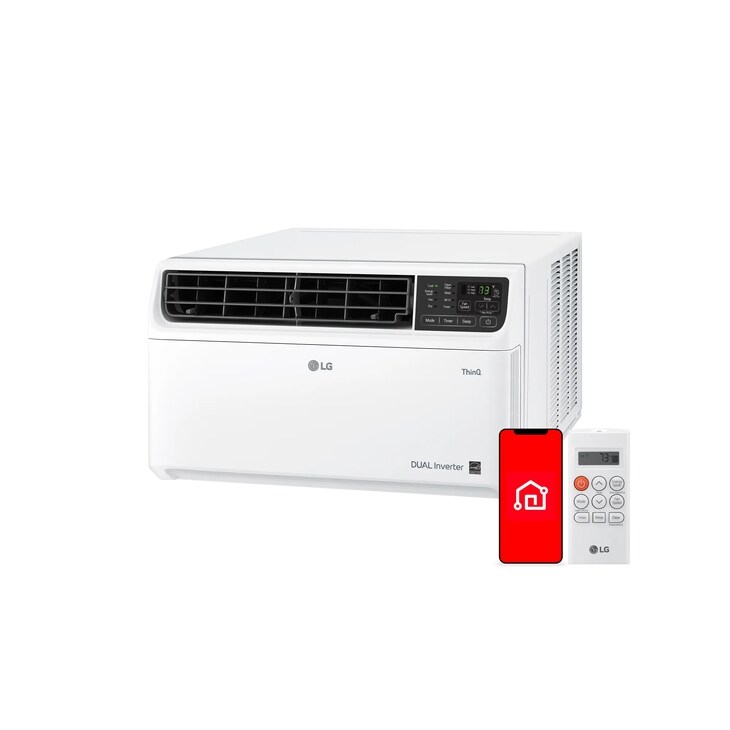
Window AC vs Portable AC: Which to Buy for a Bedroom
By Teo Varnadoe · Updated October 2026
Independent editorial guide. We never accept payment for coverage, though we may earn a commission if you purchase through our links.
Quick Take
Buy a window unit if your window will take one. For a bedroom, that means an inverter window AC, ideally a U-shaped or saddle-style model that puts a closed sash between you and the compressor. A window unit keeps the compressor and its heat outdoors, drains outside, can carry ENERGY STAR certification (portables can't), and the window units we recommend cost less than the inverter portables we recommend.
A portable is the right answer when a window unit can't go in: a horizontal slider, a casement, a window too narrow or too short, or a lease or HOA that bans anything hanging outside the glass. Then buy an inverter portable with a dual-hose or hose-in-hose design, shop by its SACC rating instead of the bigger number on the box, and plan where the water goes before it arrives.
Our picks cover both cases: a U-shaped window unit for a typical bedroom, a saddle unit for windows the U won't fit, two inverter heat-pump portables for rooms that can't take either, and the pump that solves the portable's water problem. See picks ↓

For a bedroom with a standard single- or double-hung window, we would buy the Midea 6,000 BTU U-Shaped Window Air Conditioner over any portable we cover. The best inverter portables now rate close to a good window unit on paper, and some owners are happy with theirs. But a portable keeps its compressor in the room with you, takes up floor space, needs a hose and a window panel, and in humid weather often needs its water emptied. It also usually costs more than a window unit with the same DOE rating.
Owners who switch from a portable to a window unit give different reasons: the noise of a compressor indoors, a room that got warmer and more humid as the portable pulled outside air in, or a window unit that drew about half the current and cooled the room far better. One owner kept awake all night by a loud portable was shopping for a window unit the next day.
The other side is just as real. A window unit needs a window that fits it, and plenty of rooms don't have one. A sliding or narrow window rules out a window unit for a lot of people, a U-shaped unit won't seal on a side-sliding window, and some HOAs ban window units outright. For those rooms a good portable is the right buy, and the type you choose matters more than the brand.
Why the window unit usually wins
An air conditioner moves heat from inside to outside, and the compressor and condenser coil are where that heat ends up. A window unit keeps both outdoors. A portable keeps them in your room and relies on a hose to carry the heat out the window, so the cabinet, the exhaust hose and the compressor all live in the space you're trying to cool. Even a two-hose portable sheds heat from its hoses into the room, which is why we don't expect it to cool as well as a window unit of the same BTU. Not every owner sees it that way. One portable owner felt the whole cabinet on a 98°F day and found it cool to the touch, though they had wrapped the exhaust hose in an insulation sleeve because they knew it gets hot.
Certification is the other split. ENERGY STAR's room air conditioner specification lists portable air conditioners among its excluded products, so no portable can carry the label. Every window unit we recommend for a bedroom is certified: the current Midea U at CEER 15 to 15.1, LG's Dual Inverter line at 15 to 15.5, and GE's inverter ClearViews at 14.7. Portable makers can still publish a CEER, and the good ones do (more on that below), but you won't find an ENERGY STAR portable.
Price usually points the same way. Midea's 10,000 BTU U-shaped window unit (MAW10V1UWT) carries the same 10,000 BTU DOE rating as the smaller Midea Duo portable (MAP12S1TBL), and Midea lists both for rooms up to 450 square feet. Both window units we link cost less than either inverter portable we link, though those portables are a size up at 12,000 BTU SACC. A window unit also keeps the floor clear and drips outdoors.
The owners who switched back this up. One who went from a DeLonghi portable to a Midea U always had to turn the TV up, or shut the portable off and sweat, whenever they needed to hear. One who tried a portable says it pulled in so much outside air that the room slowly got warmer and more humid even though the unit blew very cold air; they returned it for two window units that keep the room cold and dry. And a 9,500 BTU LG Dual Inverter window unit drew a hair over 5 amps, by its owner's report, against a steady 10 amps on the 10,000 BTU Honeywell portable it replaced, which hardly moved the room temperature. Those are owner-reported figures on older units, the owner doesn't say which standard the Honeywell's 10,000 BTU comes from, and the two units aren't the same size, so read it as one owner's experience rather than a measurement.
Compare the right BTU numbers
This is where most window-vs-portable comparisons go wrong. Portables usually carry two cooling numbers, and the box leads with the bigger one. The lower figure is the SACC rating from the DOE's 2017 portable test; the bigger one comes from the ASHRAE method. Whynter's ARC-14S spec page names both standards. The gap varies a lot by model:
Portable | ASHRAE (box) | SACC (DOE 2017) | Gap |
|---|---|---|---|
Midea Duo MAP14S1TBL | 14,000 BTU | 12,000 BTU | 2,000 BTU |
Midea Duo MAP12S1TBL | 12,000 BTU | 10,000 BTU | 2,000 BTU |
Whynter ARC-1230WNH | 14,000 BTU | 12,000 BTU | 2,000 BTU |
Whynter ARC-14S | 14,000 BTU (ASHRAE-128) | 9,500 BTU | 4,500 BTU |
So two portables with "14,000 BTU" on the box can be 2,500 BTU apart in rated cooling. Ignore the ASHRAE number. Window units are rated under the DOE's room air conditioner test, and Midea's US store labels both product types "BTU DOE," so the closest like-for-like comparison is a portable's SACC figure against a window unit's box number: a 10,000 BTU SACC portable against a 10,000 BTU window unit. The two test procedures aren't identical, so treat that match as approximate. What you should never do is hold a portable's 14,000 against a window unit's 12,000 and conclude the portable is bigger.
You'll read that the SACC rating is everything: a dual-hose portable won't cool better than a single-hose one with a higher SACC. Between two portables, we agree that SACC is the number to shop by, and a single-hose unit with a higher SACC can out-cool a dual-hose unit with a lower one on rated capacity. Where we part ways is on what happens to the rest of your home while a single-hose unit runs, which we cover in the hose section below.
What the efficiency gap costs
CEER, the combined energy efficiency ratio, is the DOE's efficiency figure for room air conditioners, and it's the number portable makers publish too: more cooling per watt-hour reads higher. Energy use for the same cooling scales with 1 divided by CEER, so you can compare any two units by dividing. Here are the figures we can source:
Unit | Type | CEER | Electricity vs a CEER 15 window unit |
|---|---|---|---|
Midea U MAW06V1UWT | Window | 15.1 | No figure |
Midea U MAW10V1UWT | Window | 15 | Same |
LG Dual Inverter 6,000 BTU / 8,500-12,000 BTU | Window | 15.5 / 15 | No figure |
GE Profile ClearView inverter | Window | 14.7 | No figure |
Whynter ARC-1230WNH | Portable, inverter | 14.2 | About 6% more (15 ÷ 14.2 = 1.06) |
Whynter ARC-1280WX | Portable, inverter | 12.1 | About 24% more (15 ÷ 12.1 = 1.24) |
Whynter ARC-147WF | Portable, no inverter claimed | 7.83 | Nearly double (15 ÷ 7.83 = 1.92) |
Midea Duo (heat model) | Portable, inverter | 14.2 (DOE certification) | About 6% more (15 ÷ 14.2 = 1.06) |
Do the division and the picture is more interesting than the usual "portables are terrible" line. On the rated figures, the best inverter portable we cover is close to a window unit, and a fixed-speed portable isn't. Put it in a season. Run 12,000 BTU an hour of cooling for 1,000 hours and you've moved 12 million BTU. At CEER 15 that's about 800 kWh. At 14.2, about 845 kWh, a 45 kWh difference you'll barely see on a bill. At 7.83, about 1,533 kWh, roughly 733 kWh more than the window unit. Multiply those differences by your own electric rate. A rating isn't a meter, and window and portable CEERs come from different DOE test procedures, so treat the comparison as approximate.
Noise: where the compressor sits
For a bedroom, this decides more than efficiency does. There are three layouts. A portable puts the compressor in the room with you. A conventional box window unit runs straight through the opening, so there's no closed sash between the room and the compressor; its own cabinet insulation has to keep the noise out. A U-shaped unit like the Midea U, or a saddle-style unit like GE's ClearView, straddles the sash or sill so the window closes between the indoor half and the compressor. ENERGY STAR says U-shaped and saddle-style units "provide greater noise reduction."
The published figures don't settle it on their own. Midea's listing says the U runs "as low as 32 dBA," while a retailer spec for the original 8,000 BTU U lists 42 dB on low. LG lists 44 dBA in sleep mode on its Dual Inverter window units and GE lists 40 dBA in quiet mode on its inverter ClearViews. On the portable side, Midea says the Duo runs "as low as 42 dBA," and Whynter lists under 42.5 dB on low, 49.5 on medium and 56.5 on high for the ARC-1230WNH. No two makers state the same test conditions, and we don't measure sound, so don't line these up decimal for decimal. On paper, the best portables' low settings sit close to the window units' figures.
In the room, portables lose. Noise is the complaint portable owners make most: the DeLonghi owner who switched to a U, a Black and Decker portable on a window its owner says won't take a window unit, which they call very loud, a reconditioned Midea portable that kept its owner awake all night, and a dual-hose inverter portable that's on the quiet side but not silent and has a higher-pitched hum at times. Window units aren't silent either. Our Midea U vs LG comparison counts 12 or more Midea U owners who describe a high-pitched whine, so a U is not a guarantee. But if quiet is the reason you're shopping, a U-shaped or saddle unit is where we'd start.
Single hose, dual hose and hose-in-hose
If you end up with a portable, this is the choice that matters most after SACC. A single-hose portable pulls air from your room across its hot condenser coil and blows it out the window. That air has to be replaced, so outdoor air leaks back in through door gaps, window cracks and vents somewhere in the house, carrying heat and humidity with it. The owner who returned their portable for two window units describes a room that slowly got warmer and more humid, though they don't say which hose type it had. In wildfire season, the same effect draws smoky outdoor air into the house while a single-hose unit runs.
A dual-hose portable runs a second hose that brings outdoor air in to cool the condenser and sends it back out, so it isn't exhausting the air you just cooled. Whynter's ARC-14S, ARC-147WF and ARC-1280WX use two separate hoses (5.9 inches across on the first two, 7.5 inches on the ARC-1280WX). A hose-in-hose design does the same job through one concentric duct: the Midea Duo and Whynter's ARC-1230WNH both use one. One duct means one connection at the window panel, but the Duo's oval duct doesn't bend much, so the unit has to sit close to and more or less in front of the window.
Our pick is an inverter portable with either dual-hose layout. A single-hose unit isn't useless: one owner's single-hose Hisense, rated 8,000 BTU SACC, keeps a 300-square-foot living room cool, and they recommend buying extra window foam because the foam in the box seems inadequate. But for a bedroom you'll cool every night, we'd pay for the second hose and the inverter, and we'd only buy a model whose maker publishes its SACC and CEER.
Fit, weight and the install
Neither type involves refrigerant work or wiring; both are sealed plug-in appliances. The work is in the window, and the window is where the two types part company. What window units ask of your window, from the makers' figures:
Window unit | Window width | Min opening | Other |
|---|---|---|---|
Midea U (V1UWT listings) | 22-36 in, single- or double-hung | 13.75 in | Outside bracket that Midea's manuals have you screw to the sill; 8,000 BTU is 53.1 lb (ENERGY STAR) |
GE Profile ClearView | 20-40 in | 13 in | At least 10 in from the floor; inverter sizes weigh 80 lb |
LG Dual Inverter 10,000 BTU | 22-36 in | 13 in | No figure |
LG Dual Inverter 12,000 BTU | 27-39 in | 16 in | 85 lb |
Midea's listing names single- and double-hung windows only, and a U-shaped unit won't seal on a side-sliding window. A box unit in a slider needs a framed panel above it, built from wood and plexiglass cut to size. That works, but it's a project. Midea's manual recommends two people for the U install.
Portables trade the bracket for a window panel and floor space. Midea lists the Duo's kit for openings from 19.1 to 63.8 inches. Whynter's ARC-1230WNH kit runs 28-82 inches with a 9.5-inch-wide panel, and the ARC-1280WX's panel is 6.5 inches wide, which on a slider is glass you give up. Don't let the word "portable" fool you about moving them, either. The Duo weighs 72.75 to 77.16 pounds and the ARC-1280WX 55 pounds, and Whynter's hoses run up to 47-60 inches depending on the model, so the unit sits within a few feet of the window. You'll roll it across a floor, not carry it room to room every evening.
Power comes from the manuals and nameplates. Both types plug into a standard 115V outlet. Midea's U manuals say not to use an extension cord or adapter plug and point you to the serial plate for your unit's electrical figures. GE's ClearView manual says the unit "should always be plugged into its own individual electrical outlet." Whynter's ARC-1280WX manual lists 11.9 amps at 115V. Read the nameplate on whatever you buy, and ask an electrician if you don't know what else shares that outlet.
One more window-unit check. Earlier Midea U models (the 8,000-12,000 BTU V1QWT, AV1QWT, W1QWT and U1QWT) are on CPSC recall #25320 over mold from pooled water. The V1UWT models we link are not, and no 6,000 BTU model is on the list. Confirm the model suffix on the listing and again on the box label.
Where the water goes
Every air conditioner pulls water out of the air. A window unit sends it outside: tilt it the way the manual says and the condensate drips off the outdoor half. That isn't trouble-free either. The Midea U recall was about water pooling inside the unit, and one LG unit was dripping a few cups a day onto the building steps. But you never carry a bucket.
Portables handle water inside the room. The Midea Duo and Whynter's dual-hose units are designed to throw cooling-mode condensate onto the hot condenser and blow it out with the exhaust. In dry or mild climates, the Duo runs two and three summers without draining a drop. In humid weather the design often can't keep up, and more than half a dozen Duo owners drain by hand. A Whynter ARC-14S in a humid Chicago basement apartment runs a drain hose that carries 5-8 gallons a day. In a Florida workshop, another ARC-14S needed draining several times a day until its owner found the splash motor had come unplugged at the factory; once it was connected, it got through the whole Florida summer without draining. Whynter's manual says the ARC-1230WNH's built-in pump only runs in heat mode, and Duo owners report the same of theirs. If your summers are humid, plan a gravity drain hose to a floor drain or a small condensate pump below the drain port with its line run out the window, from day one.
Water inside a warm cabinet also grows things. Seven or more Duo owners describe mold or a mildew smell, mostly on a blower wheel that's hard to reach. Midea's manual says to drain the tray and run the unit in fan mode before storage to dry it. We'd run fan-only for a while after cooling, too.
When a portable is the right call
Sometimes a window unit isn't an option, and a portable is the right answer. We'd buy one without apology if:
- Your window rules it out: a horizontal slider, a casement, or a window too narrow or short for any window unit, and you don't want to build a framed panel. One owner on their fourth portable can't get a standard window unit into their narrow window.
- The rules forbid it: your lease, building or HOA forbids units that hang outside the glass. One homeowner's HOA bans window units, which left them choosing between a portable and a mini-split.
- You can't screw into your sill: which is how Midea's manuals have you mount the U's outside support bracket.
- You want spring and fall heat from the same box: in a room with no window-unit option. The heat-pump Duo (MAP14HS1TBL) and the Whynter ARC-1230WNH both heat; the Duo's manual rates its heat pump for 41-86°F, and Whynter doesn't publish a low-temperature limit we could read.
Then buy well. Get an inverter model with two hoses or a hose-in-hose duct, pick by SACC, prefer a maker that publishes a CEER, and set up drainage before the first humid week. Between the two portables we recommend, the Whynter ARC-1230WNH publishes a CEER of 14.2 and covers the compressor for three years, though warranty service is mail-in and you pay return freight from month two to year one. The Midea Duo matches its 12,000 BTU SACC and, in DOE's certification records, its CEER, and carries a one-year warranty that leaves removal and transport costs to you. When we checked, the Duo heat model had no featured offer on Amazon, only a third-party seller listed it new, and that offer cost more than the Whynter. Whynter's warranty needs an authorized Whynter dealer, and a third-party seller sold the Whynter listing we link. We'd take the Whynter for the compressor term.
If you own the house and the room needs heat and cooling for years, look past both. A ductless mini-split is quieter than either type, and a cold-climate model heats through real winter weather. The HOA homeowner went that way, and so did an owner who installed a mini-split so they could get a two-hose portable out of their son's room. It costs more and usually means a bigger install, which is why the window unit stays our default for one bedroom.
Sizing either one for a bedroom
ENERGY STAR's sizing chart for room air conditioners assumes an 8-foot ceiling. Add 10% for a very sunny room, take 10% off for a heavily shaded one, and add 600 BTU for each regular occupant beyond two.
Room area | ENERGY STAR chart |
|---|---|
150 up to 250 sq ft | 6,000 BTU |
250-300 sq ft | 7,000 BTU |
300-350 sq ft | 8,000 BTU |
350-400 sq ft | 9,000 BTU |
400-450 sq ft | 10,000 BTU |
450-550 sq ft | 12,000 BTU |
A 12 x 14-foot bedroom is 168 square feet: a 6,000 BTU room. That's where portables run into trouble. The chart is written for room air conditioners, so holding a portable's SACC against it is an approximation, but it's the closest comparison available. The smallest inverter dual-hose portables we cover, the Duo MAP12S1TBL and the Whynter ARC-1280WX, rate 10,000 BTU SACC, about 1.67 times what the chart calls for in that bedroom (10,000 ÷ 6,000). ENERGY STAR's warning about oversizing is that a unit that's too large "will cool the room before it has a chance to remove the humidity," leaving it damp and clammy. An inverter softens that, because it throttles down, but it still has a minimum speed. A 6,000 BTU inverter window unit is sized for the room.
You'll see advice to buy more BTU than you need. We disagree; buy the size the chart gives you, and step up only when its adjustments call for it. And size for one room, whichever type you buy. One owner who cooled a laundry room with a 5,000 BTU window unit to help a hot second floor found the cold air stayed put until they added strong fans, and even then the rest of the floor only came down to the low to mid 80s on days that would have topped 90.
The picks
Products we recommend for this guide.

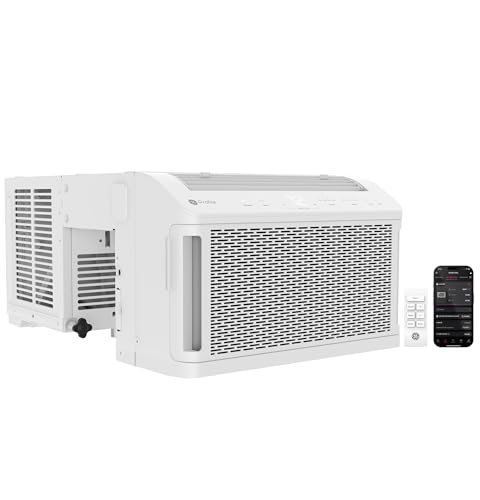
GE Profile ClearView 10,300 BTU Inverter Window AC (PHNT10CC)
The saddle-style unit for windows the U misses: GE lists 20-40 in wide with a 13 in minimum opening. The 10,300 BTU inverter, CEER 14.7, 80 lb, rated for up to 450 sq ft, so it suits a big room. No featured offer when we checked; pick a New offer.
Read our full review: we scored it 6.8/10

Midea Duo 14,000 BTU Portable AC with Heat (MAP14HS1TBL)
For a room no window unit fits: hose-in-hose inverter, 12,000 BTU SACC, heat pump rated 41-86°F. CEER 14.2 per DOE, 1-year warranty; plan a drain if summers are humid. No featured offer when we checked; only a third-party seller listed it new.
Read our full review: we scored it 6.4/10

Whynter ARC-1230WNH NEX Inverter Portable AC with Heat
The portable we'd pick when a window unit can't go in: hose-in-hose, inverter, 12,000 BTU SACC, CEER 14.2. 3-year compressor term, but service is mail-in and needs an authorized Whynter dealer; a third-party seller sold it when we checked.
Read our full review: we scored it 6.5/10

Little Giant VCMA-15ULS Condensate Pump
The add-on for a portable in a humid climate: set it below the drain port and run its line out the window; Whynter's manual and Duo owners say the built-in pump only runs in heat mode. Plugs into a 115V outlet; has an overflow safety switch.
Read our full review: we scored it 7.3/10
What owners say
Real owner reports from the threads and editorial sources we drew on for this guide.
“I tried a portable... It sucked in so much air from outside, it slowly got warmer and more humid (it put out very cold air). I was about to make a duct to pull in fresh air from outside, but then took it back and got 2 window units until I do my siding and put in a mini split. The window units make it cold and dry.”
“My portable is used in my bedroom and is the well-rated dual-hose inverter unit from Danny/Midea white label. It is certainly on the quiet side however it’s obviously not silent. It also has a higher pitched hum at times - I think the compressor? The window id be using it on is a side-sliding window. So even if I got one of those newer U-style, the window wouldn’t be able to create a true “seal”.”
“I have a vertical sliding window, so i can't find a window unit. I'm currently using a Black and decker portable ac unit and made a home made contraption to get the hose out the sliding window. It works very good keeping the room cold, but its loud AF. And I cant use the heat part of it during winter because it will trip the breaker.”
“The SACC rating is everything if you're looking for which unit will cool the largest space. Contrary to popular opinion, a dual hose model will not cool better than a single hose model with a higher SACC rating. I have the Midea 14000 BTU dual hose model with a SACC rating of 12000 BTU, and it cools my entire 600 square foot apartment very well.”
“I like it - its able to keep my 300 sqft living room cool. The single hose is a big hose but maneuvering it is easy. Whatever unit you get, I suggest getting more window sill foam (I got some from RONA) as the foam that comes with these units seem to be inadequate.”
“So a few days ago when it was 98F out, mine was running, I purposely went over and felt around the entire shell of the unit (my exhaust hose is wrapped in insulation) and I felt NO radiation of heat whatsoever. Everything was cool to the touch.”
“So I ended up changing it to a 5000-BTU window ac unit and as everyone pointed out, just using the Window AC unit alone just made a temperature front with the cold air stuck inside the laundry room. However, when I added some stronger fans to move the air, it actually did help cool the 2nd floor to some degree.”