Midea Duo Portable AC Review: Big Cooling for a Portable, Plan for Water
By Teo Varnadoe · Updated October 2026
Independent editorial review. We never accept payment for coverage, though we may earn a commission if you purchase through our links.

Spec sheet
| Capacity (MAP14S1TBL) | 14,000 BTU ASHRAE / 12,000 BTU SACC; heat model MAP14HS1TBL sold as "12,000 BTU DOE" |
| Capacity (MAP12S1TBL) | 12,000 BTU ASHRAE / 10,000 BTU SACC; Midea-rated up to 450 sq ft |
| Heat (MAP14HS1TBL only) | Heat pump, operates 41-86°F; drain hose required in heat mode |
| Hose and window kit | Hose-in-hose (one concentric duct); kit fits 19.1-63.8 in openings |
| Noise (Midea figures) | "As low as 42 dBA" (US); 43 dBA (Canada spec); no medium/high figures published |
| Weight | 72.75 lb (MAP12S1TBL) / 77.16 lb (MAP14HS1TBL) |
| ENERGY STAR | Not eligible: portable ACs are excluded from the room AC spec |
| Warranty (manual) | 1 year limited; owner pays diagnostics, removal, transport and reinstallation for service |
| Owner-reported failure | Mold on the blower wheel; cooling condensate that will not self-evaporate in humid weather |
Verdict
Owner reports on the Midea Duo come from r/hvacadvice, mostly long-running troubleshooting threads, so they lean toward problems. Owners in dry or mild climates describe strong, quiet cooling and years without draining; owners in humid ones describe P1 pan-full errors, buckets and add-on pumps, and more than half a dozen drain cooling-mode water by hand. Mold on the blower wheel (seven or more owners) and the 41°F heat-mode cutoff come up again and again. Hardware failures appear as scattered single reports.
Read full take ↓
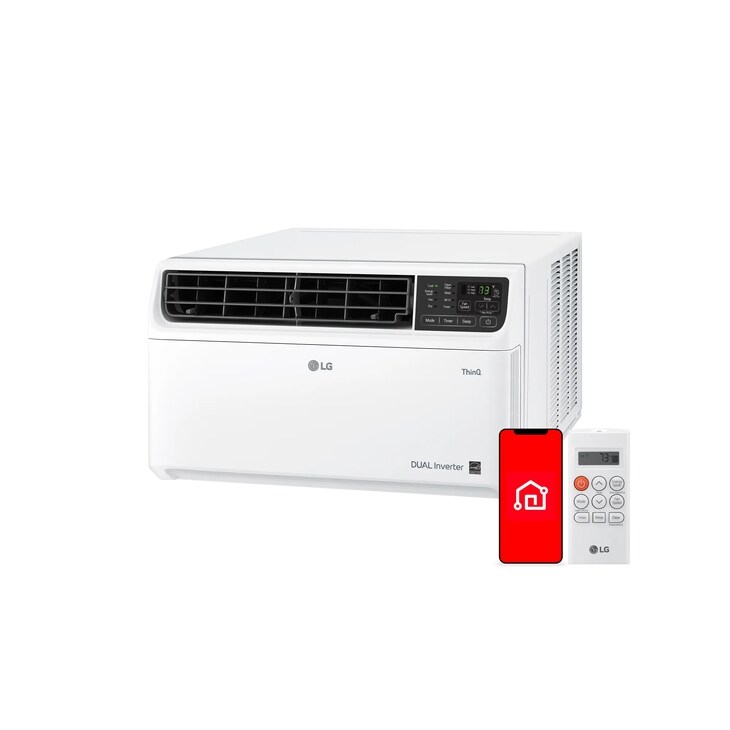


The Midea Duo Smart Inverter Portable Air Conditioner is one of the two portables we'd consider for a bedroom when a window unit is off the table, and the one we'd pick over the Whynter ARC-1230WNH when your window opening is under 28 inches or the Whynter isn't available. It runs intake and exhaust through one oversized hose-in-hose duct, uses an inverter compressor that slows down instead of slamming on and off, and the 14,000 BTU models carry a 12,000 BTU SACC rating. That SACC number is the one that matters, and it's as high as any hose-in-hose portable we cover. The heat version, the MAP14HS1TBL, adds a reverse-cycle heat pump for spring and fall. When we checked in October 2026, the heat model we link had no featured offer on Amazon; only a third-party seller listed it new, so check who's selling it and the return terms before you buy.
Plan your drainage before it arrives. The Duo is designed to throw its cooling condensate onto the hot coil and blow it out the window, and in dry or mild climates it runs for years without draining a drop. In humid weather, buckets or an add-on pump are common.
And if you have a double-hung window that fits a window unit, buy the window unit. Midea's own 10,000 BTU U-shaped window unit carries the same DOE capacity as the smaller Duo, is listed for the same 450 square feet, is ENERGY STAR certified, and costs a good deal less than the Duo we link. The Duo is for the window that can't take one: a casement, a slider, a narrow opening, or a lease that bans anything hanging outside.
What we like
- Rated cooling: 12,000 BTU SACC on the 14,000 BTU models: the DOE figure sits 2,000 BTU below the box number, against a 4,500 BTU gap on Whynter's fixed-speed ARC-14S.
- Inverter compressor: it holds a temperature instead of cycling at full blast.
- Hose-in-hose design: one duct and one window opening, with outdoor air feeding the condenser instead of your cooled room air.
- Heat pump: the MAP14HS1TBL heats with a heat pump, not a resistance coil, and has a built-in condensate pump for heat mode.
- Quiet for a portable: Midea says "as low as 42 dBA," and one owner who put one in a garage shop was amazed how quiet it is even on high.
What we'd change
- Condensate in humid weather: plenty of owners never drain it; plenty of others in the South fill buckets every day.
- Mold: mold on the blower wheel is a repeated complaint, and the wheel is hard to reach without splitting the case.
- Heat cutoff: Midea's manual rates heat-pump operation at 41-86°F, and it shuts off when outdoor air reads 41°F or below.
- Warranty: one year, and the owner pays for removal, transport and reinstallation when it needs service.
- Weight and labels: it weighs 72.75-77.16 lb, and portables can't be ENERGY STAR certified.
Which rooms and windows it fits
The Duo is a bedroom, home office or small apartment unit. For a typical 150-250 square-foot bedroom, the MAP12S1TBL is plenty; the 14,000 BTU models earn their place in a hot top-floor room, a studio, or a room where you also want the heat pump. One 600-square-foot apartment holds 69°F with the outdoor temperature near 90°F, by its owner's report.
It makes sense when:
- Your window is awkward: a casement, a horizontal slider, or too narrow for a window unit. The Duo's kit spans openings from 19.1 to 63.8 inches.
- The rules forbid hanging units: your lease, HOA or building forbids units that hang outside the glass.
- You live somewhere dry or mild: where the condensate evaporates the way Midea intends.
- You want shoulder-season heat: in a room without ductwork, and your winter lows stay above about 41°F most of the time.
Pick something else if:
- Your double-hung window fits a window unit: read the section below on when a window unit wins.
- You want real winter heat: the Duo's heat mode shuts off at 41°F outdoors and below; a cold-climate mini-split is the answer for a room you'll heat all winter.
- You can't drain it: in a humid climate, if you can't route a drain hose or set up a pump, expect to empty water by hand.
- You need to vent through a sliding patio door: off-the-shelf sliding door kits are made for standard single- or dual-hose setups, not the Duo's combined duct, by one owner's research, so expect to build a panel.
Capacity, heat and the numbers on the box
Shop on SACC and ignore the ASHRAE figure; it isn't comparable between brands, and the gap varies a lot. Every Duo carries two BTU numbers, and the model number uses the bigger one. Midea's US store prints only the second number and calls it "BTU DOE": the MAP14S1TBL-A is sold as a "12,000 BTU DOE" unit. SACC is the rating under the DOE's 2017 portable test (Whynter's spec sheets name the two standards as ASHRAE-128 and DOE 2017). ASHRAE and SACC figures below are from Midea's Canadian spec pages; room ratings and weights are Midea's.
Model | ASHRAE (box) | SACC / DOE | Drop | Room (Midea) | Weight | Heat |
|---|---|---|---|---|---|---|
MAP12S1TBL | 12,000 BTU | 10,000 BTU | 2,000 BTU, about 17% | Up to 450 sq ft | 72.75 lb | No |
MAP14S1TBL | 14,000 BTU | 12,000 BTU | 2,000 BTU, about 14% | No figure | No figure | No |
MAP14HS1TBL | 14,000 BTU | 12,000 BTU | 2,000 BTU, about 14% | Up to 550 sq ft | 77.16 lb | Heat pump, 41-86°F |
Whynter ARC-14S (for scale) | 14,000 BTU | 9,500 BTU | 4,500 BTU, 32% | No figure | No figure | No |
Two portables with "14,000 BTU" on the box can differ by 2,500 BTU of rated cooling, which is why we compare portables on SACC only.
Window units are also rated by the DOE, and Midea's US store labels both product types "BTU DOE." So the like-for-like comparison is the Duo's SACC figure against the window unit's box number: the MAP12S1TBL (10,000 BTU DOE, up to 450 square feet) against a 10,000 BTU window unit, and the 14,000 BTU Duo (12,000 BTU DOE) against a 12,000 BTU window unit. The two test procedures aren't identical, so treat it as the closest comparison available, not an exact match. Never compare the Duo's 14,000 against a window unit's 12,000 and conclude the portable is bigger.
The MAP14HS1TBL's heat is a reverse-cycle heat pump, and below 41°F you get nothing. The 2026 Duo manual lists its operating range as "Heat Pump 41°F ~ 86°F," says it produces condensate in heat mode that must be drained, and requires the drain hose whenever it heats. One retailer lists it as "Electric Heat"; the manual contradicts that, and we go with the manual. Midea's US page doesn't publish a heating BTU figure in the sources we checked (a retailer lists 12,000 BTU heating, which we can't confirm from Midea), and the manual mentions no backup resistance heater. If your January lows sit in the 20s, the Duo's heat is a spring-and-fall feature and you still need another heat source.
The manual rates cooling from 60°F to 95°F and dry mode from 55°F to 95°F. Midea lists 115V and R32 refrigerant for the cooling-only models. Midea doesn't publish rated amps or watts in the text of its pages or manual; one retailer lists 15 amps for the heat model. Treat it like any big plug-in appliance and keep space heaters and hair dryers off the same circuit.
Midea's US pages say "as low as 42 dBA" and the Canadian spec tables list 43 dBA. Midea frames it as "as low as," so read it as the quietest setting; Midea doesn't publish medium or high numbers. Whynter publishes all three for its comparable ARC-1230WNH: under 42.5 dB low, 49.5 medium, 56.5 high. We don't measure sound. Plan on hearing a compressor in the room, which a U-shaped window unit keeps outside the glass.
Portable air conditioners are excluded from ENERGY STAR's room AC specification, so no Duo can carry the label, and Midea's Canadian spec tables list "Energy Star Certified: No." Midea markets the heat model as using over 40% less energy than the federal standard, and Midea doesn't print a CEER in its own materials. DOE's certification database does list one for each Duo: 14.2 for the heat model (MAP14HS1TBL-A), 13.8 for the cool-only 14,000 (MAP14S1TBL-A) and 14.7 for the 12,000 (MAP12S1TBL-A). The heat model ties Whynter's ARC-1230WNH at 14.2. Midea's current 10,000 BTU U-shaped window unit (MAW10V1UWT) is rated CEER 15.
What setup involves
There's no refrigerant work and no wiring; it's a plug-in appliance. The work is in the window, the weight and the water. At 72.75 to 77.16 lb, getting it up a flight of stairs is a two-person job, and once it's placed you won't be rolling it room to room every evening.
The hose-in-hose duct is the Duo's biggest design choice. One duct means one window opening and a tidier install than two separate hoses. The tradeoff is stiffness: the oval duct doesn't bend much, so the unit has to sit close to and more or less in front of the window. If you were planning to park it across the room, plan again.
Spend your planning time on drainage. The Duo has three drain ports on the back. In cool mode it's meant to evaporate condensate onto the condenser and push it outside, with no drain connected. The manual requires the drain hose in heat mode, and for dry mode it says: "In dry mode, remove the upper drain plug from the back of the unit and install the drain hose." The built-in condensate pump only runs in heat mode, which annoys anyone who has a pump sitting idle while the pan fills in summer. If you live somewhere humid, set up a drain on day one: either raise the unit and run a hose by gravity to a container or floor drain, or put a small condensate pump below the drain port and run its line out the window. Several owners did exactly that.
One mode setting matters. If you keep getting P1 (pan full) errors, try Cool instead of Auto: Auto also runs the dehumidify function, and switching stopped the errors for one owner. It didn't work for everyone, but it costs nothing to try before you go buying a pump.
Water, mold and other failures
Cooling is the Duo's strength, and water is its weakness. In dry or mild places (Michigan, Iowa, the Pacific Northwest), two and three summers with no draining and no error codes are normal. The problems cluster around water, and they're common enough that we'd plan for them.
In humid weather, more than half a dozen owners drain cooling-mode water by hand, up to a 7-gallon tank three times a day in one case; in Toronto, P1 errors went from every 6-8 hours to every hour. Owners of the Duo and its Toshiba-badged twin who opened their units found two culprits: the small internal drip holes that feed the water slinger clogging with gunk, and the internal hose between the pump and the drain port arriving disconnected from the factory, which several report. Both fixes mean splitting a case held together by interlocking tabs that break easily, so on a new unit we'd make the warranty claim or return it instead.
Mold is the complaint we'd weigh most for a bedroom unit. Seven or more Duo owners describe mold or a mildew smell, mostly on the blue blower wheel under the top louver, and one who opened a year-old unit found fungus along the whole tray under the coil. The wheel is close to impossible to clean properly without disassembly. Midea's manual says to drain the water collection tray before storage to prevent mold, and to "Run the unit in FAN mode for 12 hours in a warm room to dry it and prevent mold" before you put it away. A couple of owners go further and switch to fan mode for a bit after every cooling session, and say it keeps the musty smell away. We'd do both. (Midea's 2025 CPSC mold recall covered its U-shaped window units, not the Duo; there was no Duo recall as of October 2026.)
The heat-mode cutoff surprises people. Owners of the Duo and its Toshiba-badged twin hit a P9 code and discover the 41°F floor in the middle of winter, and at least one relocated the outdoor temperature sensor to fool it into running colder. We wouldn't do that on a unit inside its warranty: it runs the heat pump outside the range Midea rates, and opening the case is a good way to break the tabs.
Smaller annoyances: the built-in temperature reading can run low, so the unit stops cooling early and owners set it a few degrees colder than they want. Pairing the unit with Midea's app can stop the handheld remote from working, though other owners use both without trouble.
Other hardware failures are scattered: a cracked blower wheel causing vibration (from a discussion shared by Duo and Toshiba-twin owners), inner hoses that crumbled after the unit was moved (an $80 part, per that owner), a refrigerant leak that showed up a month after the warranty ran out, and a two-year-old 12,000 BTU unit with a shuddering fan.
The refrigerant leak is the scary one, because Midea's warranty is one year. The manual says the consumer is responsible for "diagnostics, removal, transportation and reinstallation cost required because of service." On a 77-pound appliance, that can wipe out the case for a repair. The same warranty also lists "proper installation by an authorized service professional" among the consumer's responsibilities, an odd line for a plug-in appliance, but it's in there. Support experiences split: one owner got a full refund and kept the unit, another gave up after a long back-and-forth over photos and documents, and one was told to take a unit that needed draining constantly back to the retailer. Buy from a seller with an easy return window, and test the drainage in the first month.
How it compares
SACC and CEER are each maker's published figures or DOE certification records; "No figure" means we couldn't find one.
Unit | Hoses | Compressor | ASHRAE / SACC | CEER | Heat |
|---|---|---|---|---|---|
Midea Duo MAP14HS1TBL | Hose-in-hose | Inverter | 14,000 / 12,000 BTU | 14.2 (DOE) | Heat pump, 41-86°F |
Whynter ARC-1230WNH | Hose-in-hose | Inverter | 14,000 / 12,000 BTU | 14.2 | Heat pump, 12,000 BTU |
Whynter ARC-1280 | Two 7.5 in hoses | Inverter | 13,000 / 10,000 BTU | 12.1 | None |
Whynter ARC-147WF | Dual hose | Fixed speed | No figure | 7.83 | No figure |
Midea U window unit (MAW10V1UWT) | None (window unit) | Inverter | 10,000 BTU DOE | 15, ENERGY STAR | None |
- Whynter ARC-1230WNH: the closest match, and the one to pick if compressor coverage and published noise figures matter to you. The two certify the same CEER 14.2 with DOE, but Whynter publishes a full noise table and Midea doesn't. Its warranty covers the compressor for three years, but service is mail-in to Whynter's service center, only within the 48 contiguous states, and you pay return freight after the first two months. Its manual also gives two different ambient operating ranges, and the warranty only covers units bought from an authorized Whynter dealer; a third-party seller sold the listing we link when we checked. Price order moves: at that check, the Whynter cost less than the only new offer for the Duo heat model.
- Whynter ARC-1280: on paper, the answer to the Duo's stiff duct, since two separate hoses route more flexibly. It has no heat mode. We don't link it: when we checked, the only Amazon offer was a used unit.
- Fixed-speed portables: cheaper, and the published numbers show why. The ARC-147WF's CEER is a bit more than half the ARC-1230WNH's. For a room you'll cool every night all summer, we'd pay for an inverter.
- Mini-split: if you own the house and want real heat below 41°F, a ductless mini-split is in a different league for comfort and efficiency, and one Duo owner who returned theirs did exactly that. It costs more and usually involves a bigger install, but it's the right comparison for a room you'll heat and cool for years.
When a window unit is the better buy
Most of the time, if your window allows one. Put the MAP12S1TBL next to Midea's 10,000 BTU U-shaped window unit: both are 10,000 BTU DOE, Midea rates the Duo for rooms up to 450 square feet, and the U is listed for up to 450. The U is ENERGY STAR certified at CEER 15 (it doesn't meet ENERGY STAR's Most Efficient criteria), keeps its compressor outside the glass, drains outdoors by design, and costs a good deal less than the Duo heat model we link. The Duo can't carry the ENERGY STAR label, certifies a slightly lower CEER (14.7 for the MAP12S1TBL), keeps the compressor in the room, and needs a drainage plan in humid weather. For a 12,000 BTU comparison, the 14,000 BTU Duo matches a 12,000 BTU DOE window unit, not a 14,000 one.
The window unit has its own constraints. Midea's listing for the current U calls for a single- or double-hung window 22-36 inches wide with at least 13.75 inches of height. Older U suffixes were recalled in 2025 over mold; the MAW10V1UWT we link is not one of them. If your window doesn't meet those requirements, or you can't hang anything outside the building, the Duo's 19.1-63.8-inch kit and indoor-only footprint are why it exists. That's the buyer we'd send to the Duo.
Should you buy the Duo?
Buy it if a window unit won't work in your room and you want rated cooling as high as any hose-in-hose portable we cover. Get the MAP12S1TBL for a typical bedroom, and step up to the heat-pump MAP14HS1TBL only if you'll use heat in spring and fall above 41°F; if you buy a 14,000 BTU model, check that the model number includes the H before you assume it heats. Set up a drain hose or condensate pump from the start if your summers are humid, run fan-only after cooling, and keep the receipt. If your window takes a window unit, buy the window unit instead and keep the difference.
Score breakdown
12,000 BTU SACC on the 14,000 BTU models is as high as any hose-in-hose portable we cover, and one owner reports it holding the high 60s in a 600 sq ft apartment near 90°F. The inverter and single duct help. It loses points for heat that stops below 41°F, a CEER Midea doesn't print (DOE certifies the heat model at 14.2), and cooling-mode condensate that many humid-climate owners end up draining by hand.
Units in dry climates run for years without trouble, but water problems are common in humid ones: clogged internal drip holes, internal drain hoses arriving disconnected, and repeated reports of mold on a blower wheel that is hard to clean. At least one owner reports a refrigerant leak, a month past the one-year warranty.
When we checked, the only new offer for the heat model came from a third-party seller and cost more than the Whynter ARC-1230WNH, which certifies the same CEER and adds three-year compressor coverage. Against a window unit it loses: Midea's 10,000 BTU U window unit matches the smaller Duo's DOE rating and costs well under the Duo heat model we link. The one-year warranty, with the owner paying for removal and transport, weakens the case further.
Midea Duo Portable AC on Amazon.
The Evidence Behind Our Verdict
Owner reports on the Midea Duo come from r/hvacadvice, mostly long-running troubleshooting threads, so they lean toward problems. Owners in dry or mild climates describe strong, quiet cooling and years without draining; owners in humid ones describe P1 pan-full errors, buckets and add-on pumps, and more than half a dozen drain cooling-mode water by hand. Mold on the blower wheel (seven or more owners) and the 41°F heat-mode cutoff come up again and again.
Hardware failures appear as scattered single reports.
Our rating above is our own editorial call. What follows is the field evidence we weighed to reach it: first-hand reports from owners on Reddit and independent HVAC and DIY forums, which we lean on more than manufacturer-influenced published reviews because unsponsored owners tend to be the more candid signal.
What Reddit Is Saying
“It was near 90 yesterday, and it was 69.4 in my 600 square foot apartment. It's currently 85 outside according to my outdoor sensor, and it's 69.3 in my apartment.”
“I have the exact model, same model number. I run it all day. I've never had to drain it once. Never got an error code. I didn't even know you could drain it. I live in Michigan.”
“Amazed at how quiet the unit is even on high.”
“I had been running the AUTO system which, and it doesn't say this in the user manual, will also run the dehumidifier function. Since I switched to COOL I haven't had a P1 error and the water seems to be evaporating as promised.”
“I wish it came with a reservoir for the gajillion gallons it's emptied over the past few years.”
“Seems to have started having this issue now; started with a P1 every 6-8 hours of use initially, & now it’s down to 2 hrs then 1hr, & seems like it’ll go further given the trajectory + comments here..”
“It needs to be vented with heat too. Just a bit of warning. Both of my Midea Duos stop working when it gets below 40°F outside. I had to grab some space heaters last winter.”
“There was a very robust (and disgusting-looking) colony of multicolored fungi distributed along the entire width of the unit, on the piece of plastic (looks almost like a tray you'd see inside a desk) that sits directly underneath the fins.”
“Initially it was the best cooling unit. However last fall I moved the unit a few inches and the inner hoses started breaking/crumbling. I called midea/toshiba and it's a $80 part.”
“Yup it was leaking refrigerant. The error code finally popped up after days of running poorly. Also I could hear what was left of the refrigerant liquid in the pipes slosh around when first turning the unit on after getting home. Midea won't so anything since I'm a month out of warranty... Rip”
“After connecting my Midea MAP12S1TBL portable a/c inverter to their SmartHome app, the handheld remote stopped working.”
Frequently asked questions
Is the Midea Duo Portable AC worth it?
When we checked, the only new offer for the heat model came from a third-party seller and cost more than the Whynter ARC-1230WNH, which certifies the same CEER and adds three-year compressor coverage. Against a window unit it loses: Midea's 10,000 BTU U window unit matches the smaller Duo's DOE rating and costs well under the Duo heat model we link. The one-year warranty, with the owner paying for removal and transport, weakens the case further.
How reliable is the Midea Duo Portable AC?
Units in dry climates run for years without trouble, but water problems are common in humid ones: clogged internal drip holes, internal drain hoses arriving disconnected, and repeated reports of mold on a blower wheel that is hard to clean. At least one owner reports a refrigerant leak, a month past the one-year warranty.
How well does the Midea Duo Portable AC perform?
12,000 BTU SACC on the 14,000 BTU models is as high as any hose-in-hose portable we cover, and one owner reports it holding the high 60s in a 600 sq ft apartment near 90°F. The inverter and single duct help. 2), and cooling-mode condensate that many humid-climate owners end up draining by hand.
What do real owners say about the Midea Duo Portable AC?
Owner reports on the Midea Duo come from r/hvacadvice, mostly long-running troubleshooting threads, so they lean toward problems. Owners in dry or mild climates describe strong, quiet cooling and years without draining; owners in humid ones describe P1 pan-full errors, buckets and add-on pumps, and more than half a dozen drain cooling-mode water by hand. Mold on the blower wheel (seven or more owners) and the 41°F heat-mode cutoff come up again and again.
Options Worth Checking Out

Whynter ARC-1230WNH NEX Inverter Portable AC with Heat
The Duo's closest rival: hose-in-hose, inverter heat pump, 12,000 BTU SACC, CEER 14.2, three years on the compressor. Service is mail-in and needs an authorized Whynter dealer; a third-party seller sold it when we checked.
Read our full review: we scored it 6.5/10

You Might Also Need
Accessories worth grabbing alongside your purchase

Little Giant VCMA-15ULS Condensate Pump
The add-on humid-climate Duo owners buy so they stop emptying buckets: set it below the drain port and run its line out the window. Rated 50 GPH at 5 ft of lift, with a half-gallon tank, on a standard 115V plug.
Read our full review: we scored it 7.3/10
More Midea Reviews
See all →


How Does It Compare?
Side-by-side breakdowns featuring this product
