ACiQ Essentials Mini-Split Review: Cheap and Certified, Not DIY
By Wendell Asaro · Updated October 2026
Independent editorial review. We never accept payment for coverage, though we may earn a commission if you purchase through our links.
 ← Indoor unit 31.93 in wide (9K/12K) →
Spec sheet
| Heat at 5°F (ACiQ maximum) | 8,000 Btu/h (9K); 8,800 (12K); 12,000 (18K); 16,000 (24K); 23,000 (36K) |
| Lowest heating point | -4°F; 7,200 Btu/h max there on the 12K |
| Rated heat at 47°F / 17°F (12K) | 12,000 / 10,000 Btu/h |
| SEER2 / HSPF2 (AHRI) | 20.0 / 10.0 (12K); 21.0 / 9.5 (9K 230V) |
| Electrical (12K) | 230V 15 A breaker; 115V 25 A breaker (17 A MCA) |
| Line set | 16 ft in box; charged for 25 ft; 49 ft max (9K/12K), 65 ft (18K/24K), 98 ft (36K) |
| Install type | Flare; vacuum required; not pre-charged lines |
| Warranty | 3 yr parts / 5 yr compressor; 4 / 6 if registered in 90 days; EPA-certified tech install required; no labor or shipping |
| Certification | AHRI-certified; not on the NEEP list or ENERGY STAR (R32 units) |
Verdict
We found no owner report naming the Essentials line, so the six quotes below are about ACiQ mini-splits generally, from r/hvacadvice: a pair of single systems in Colorado, a self-installed ACiQ unit in Virginia, a two-zone system with an unresolved cooling fault, two three-head multi-zones, a rental owner running several ACiQ systems, and a five-head multi-zone owner who registered a self-install. Three are positive, one negative and two neutral. Posts about ACiQ central and ducted systems, sales claims from HVACDirect, and brand opinions from people who do not own one were left out.
Read full take ↓


The ACiQ Essentials 12,000 BTU mini-split is a fair buy for one room if you're paying an HVAC tech to install it anyway. It's AHRI-certified at 20 SEER2 and 10 HSPF2, ACiQ's own data sheet gives the 12K a maximum of 8,800 Btu/h at 5°F, and it keeps heating to -4°F. It costs less on Amazon than a Pioneer Diamante Pro and lands close to it on paper.
It's not a DIY unit, whatever "pre-charged" suggests. The refrigerant sits in the outdoor unit; the copper lines are flared and have to be evacuated, the Amazon listing says the system must be installed by a professional HVAC tech, and ACiQ's warranty requires an EPA-certified technician for the install and every diagnosis. The warranty's claim process can also have you pay for parts up front. And while ACiQ mini-splits in general have a mostly good owner record, there's no owner record yet on the Essentials line itself, so treat its long-term reliability as unproven.
One identity check before you buy. ACiQ sells two 20 SEER2 Essentials lines, an R32 version (model numbers with -32-, the one on Amazon) and an R-454B version with different numbers. This review covers the R32 units. ACiQ's Standard and Extreme mini-split series are separate lines; owners describe the Extreme models as the cold-weather ones.
For it and against it
- Certified efficiency: 20 SEER2 on every size but the 9K 230V (21), with HSPF2 of 9.5-10 on AHRI certificates.
- Low-temperature heat: 8,800 Btu/h maximum at 5°F and 7,200 at -4°F on the 12K, per ACiQ.
- Price: below the Pioneer Diamante Pro and Senville Leto on Amazon when we checked; sold by HVACDirect Online.
- Complete kit: a 16 ft line set, built-in Wi-Fi, a remote and the mounting hardware in the box.
- Not DIY: flare connections and a vacuum, and the warranty requires an EPA-certified technician.
- Warranty claims: you may pay for the part and shipping up front, and ACiQ never reimburses labor or round-trip shipping.
- Unlisted ratings: no NEEP listing and no ENERGY STAR certification for the R32 units, so the 5°F number is ACiQ's maximum, not a certified rating.
- Track record: no owner history on this line yet.
Rooms and climates it suits
The great fit is a bedroom, office or finished bonus room in a climate where winter nights stay above 0°F, with an installer lined up and a 230V circuit available. The 12K on 230V needs only a 15 A breaker. It also suits someone replacing a window unit who wants heat in shoulder seasons and doesn't need a warranty that covers their own labor.
Pick something else if you're installing it yourself. The MrCool DIY 5th Gen uses pre-charged quick-connect lines and a warranty that allows owner installs, and the Pioneer Diamante Pro is a flare unit whose warranty doesn't require a licensed installer. Pick something else, too, if your winters reach -4°F or below often: heating stops there, and a cold-climate unit like the Senville Aura keeps going to -22°F.
Heat and efficiency by size
From ACiQ's submittal data sheets (heating, in Btu/h) and the AHRI certificates ACiQ publishes (SEER2 and HSPF2). The 5°F and -4°F columns are maximums, not rated capacities, and no independent list carries them for the R32 units.
Size | Rated 47°F | Rated 17°F | Max 5°F | Max -4°F | SEER2 | HSPF2 | Breaker |
|---|---|---|---|---|---|---|---|
9K 115V | 10,000 | 9,800 | 8,000 | 6,500 | 20.0 | 9.5 | 25 A |
9K 230V | 10,000 | 9,800 | 8,000 | 6,500 | 21.0 | 9.5 | 15 A |
12K 115V | 12,000 | 10,000 | 8,800 | 7,200 | 20.0 | 10.0 | 25 A |
12K 230V | 12,000 | 10,000 | 8,800 | 7,200 | 20.0 | 10.0 | 15 A |
18K 230V | 18,000 | 15,000 | 12,000 | 11,000 | 20.0 | 10.0 | 20 A |
24K 230V | 24,000 | 18,000 | 16,000 | 13,000 | 20.0 | 9.5 | 30 A |
36K 230V | 36,000 | 28,400 | 23,000 | 16,800 | 20.0 | 9.5 | 35 A |
The 12K keeps 73% of its 47°F rating at 5°F and 60% at -4°F. The bigger sizes hold less: 67% at 5°F on the 18K and 24K, 64% on the 36K. The 9K is rated 10,000 Btu/h for heat, more than its 9,000 cooling size, and makes 8,000 at 5°F.
Two numbers on ACiQ's paperwork deserve a second look. The 115V 9K and 12K need a 25 A breaker (17 A minimum circuit ampacity), which usually means a new dedicated circuit; the 230V versions need 15 A. And the 12K data sheet says it suits a room of up to 280 sq ft, while the Amazon title says 600. Size from a load calculation, not either figure, and don't step up a size to be safe: an oversized unit short-cycles.
A cold-night check
Say a room loses 8,000 Btu/h at 5°F with the inside at 70°F. The 12K's 8,800 maximum covers it with 800 to spare. At -4°F the same room loses about 9,100 Btu/h, and the 12K's 7,200 maximum falls about 1,900 short, at the bottom of its heating range. A Senville Leto 12K on 115V, rated 6,600 at 5°F, would already be 1,400 short at 5°F. For a room like that, the ACiQ is fine with a backup heater for the few coldest nights.
What the install takes
This is a conventional flare-fitting system. The outdoor unit is charged for 25 ft of line; the 16 ft set in the box is inside that. Runs can go to 49 ft on the 9K and 12K (the data sheet says 50), 65 ft on the 18K and 24K, and 98 ft on the 36K, with 10 g of refrigerant added per meter past 25 ft. That added charge is a job for the certified technician.
ACiQ's manual calls for a vacuum pump and manifold gauge, run at least 15 minutes or until the gauge reads -0.1 MPa (-76 cmHg), then a five-minute hold before the refrigerant is released. That's a lighter spec than Senville's or Pioneer's manuals, which set a 500-micron target. Ask your installer to pull it down to a micron target anyway. Under EPA's Section 608 rules, attaching gauges and hoses to the refrigerant circuit is certified-technician work, and ACiQ's warranty and Amazon listing point the same way.
- Electrical: a dedicated circuit sized to the nameplate: 15 A on the 230V 9K and 12K, 25 A on the 115V versions. The manual says a licensed electrician should select and install the power cord, and the unit needs a disconnect.
- Indoor head: 31.93 in wide on the 9K and 12K, with a leak sensor for the R32 refrigerant.
- Outdoor unit: a pad or bracket with drainage for defrost water; the 12K outdoor unit weighs 52.9 lb (115V) and is rated 55 dB(A).
- Line set cover: optional, but it protects the insulation from sun.
It's a routine job for a tech who does flare installs. The common shortcut, buying the unit and hiring a tech only for the vacuum and startup, works with ACiQ only if that tech will sign as the installer for the warranty.
The warranty, read closely
ACiQ's Essentials warranty runs 3 years on parts and 5 on the compressor from the date of purchase. Register within 90 days of a residential install and it becomes 4 years on parts and 6 on the compressor, from the install date, for the original registrant only. A later owner gets the 3 and 5.
The conditions are stricter than the term. The certificate says the entire system must be installed, serviced and diagnosed by an EPA-certified technician, and the registration form asks for the installer's EPA certificate number. A claim starts with that technician's diagnosis, submitted to ACiQ. ACiQ may then ask you to pay for the part and its shipping, test the failed part when it comes back, and refund the part's cost if it's a factory defect. Round-trip shipping and all labor stay on you, refrigerant isn't covered, and ACiQ can ask for the install invoice and proof of yearly maintenance.
Compare that with the rivals' terms. Pioneer's Diamante Pro warranty doesn't require a licensed installer. MrCool's DIY 5th Gen allows owner installs. Della's registered DIY installs get free parts at Della's discretion. Senville's Leto, like the ACiQ, needs a licensed installer. One ACiQ multi-zone owner says HVACDirect let them register a self-install; the written warranty doesn't allow for that, so don't plan around it.
What owners say about ACiQ
No owner report names the Essentials line yet, and it now comes in R32 and R-454B versions. What follows is the record on ACiQ mini-splits generally, mostly from owners of other ACiQ single- and multi-zone systems sold through HVACDirect.
That record is mostly good. Owners describe ACiQ mini-splits running trouble-free for years, including through Colorado winters at -15°F, and support that replaces boards, air handlers and even condensers quickly once a defect is clear. Owners say HVACDirect has told them the units are made by Midea or by Carrier; ACiQ's documents don't name the manufacturer.
The worst report is about a fault nobody could find. A New Mexico owner's two-zone system shut off on hot days and cooled one room far more than the other, the installing tech couldn't find the cause, and HVACDirect didn't give a real response. The written warranty explains why that gets expensive: every diagnosis needs an EPA-certified tech, and you pay for the visits.
How it compares
The 12K of each line. ACiQ's figures are maximums from its own data sheet; the others are NEEP figures from our reviews, in Btu/h.
Unit | Heat at 5°F | Lowest heating point | SEER2 | Warranty and installer | Install |
|---|---|---|---|---|---|
ACiQ Essentials 12K | 8,800 max (ACiQ) | 7,200 max at -4°F | 20.0 | 4 yr parts / 6 yr compressor registered; EPA-certified tech required | Flare and vacuum |
9,000 | 6,800 max at -4°F | 20.0 | No licensed-installer requirement | Flare and vacuum | |
9,200 | Heating ends at 5°F | 22.0 | Registered DIY installs get free parts at Della's discretion | Flare and vacuum | |
8,400 | 3,800 max at -13°F | 23.5 | Owner installs allowed | Pre-charged quick connect | |
6,600 | Heating ends at 5°F | 21.2 | Licensed installer required | Flare and vacuum |
- Pioneer Diamante Pro: the closest match: NEEP-rated heat slightly above ACiQ's maximums, the same -4°F floor and a warranty that doesn't demand a licensed installer. It cost a little more when we checked and is sold by a third-party seller.
- Della Serena: cheaper and more efficient at 22 SEER2, with more 5°F heat, but heating ends at 5°F.
- MrCool DIY 5th Gen: costs about twice as much and gives up some 5°F heat, in exchange for a no-vacuum install you can do yourself under warranty.
- Senville Leto: similar money and the same licensed-installer rule, with 2,200 Btu/h less at 5°F on 115V.
Should you buy the Essentials?
Buy it if a licensed, EPA-certified tech is already doing the install, your winters stay above about 0°F, and you'd rather spend less than the Diamante Pro for a very similar spec sheet. Take the 230V 12K if you have the panel space, or the 230V 9K for a small room, register within 90 days, and keep the installer's invoice and your maintenance records.
Skip it if you want to do the install yourself or want a warranty that covers someone other than a certified tech's work. For the same money and nearly the same heat, the Diamante Pro's warranty is easier to live with, and the MrCool DIY 5th Gen is the honest answer for a no-tools install.
Score breakdown
AHRI-certified at 20 SEER2 and 10 HSPF2 on the 12K, with ACiQ's data sheet giving 8,800 Btu/h maximum at 5°F (73% of the 47°F rating) and heat down to -4°F. That is close to the Pioneer Diamante Pro on paper. Held back because the low-temperature figures are maximums ACiQ publishes itself, with no NEEP listing or ENERGY STAR certification for the R32 units.
No owner record on the Essentials line yet. ACiQ mini-splits in general have a mostly good record and helpful support, with one hard-to-diagnose two-zone failure that went unresolved. The warranty requires an EPA-certified tech for install and every diagnosis, may have you pay for parts up front, and never covers labor or round-trip shipping.
It cost less than the Diamante Pro and Leto 12K on Amazon when we checked, with a 16 ft line set and Wi-Fi in the box. A professional install is part of what it costs, and warranty claims carry costs the Diamante Pro's and MrCool's terms handle better. Check the current price on Amazon.
ACiQ Essentials Mini-Split on Amazon.
The Evidence Behind Our Verdict
We found no owner report naming the Essentials line, so the six quotes below are about ACiQ mini-splits generally, from r/hvacadvice: a pair of single systems in Colorado, a self-installed ACiQ unit in Virginia, a two-zone system with an unresolved cooling fault, two three-head multi-zones, a rental owner running several ACiQ systems, and a five-head multi-zone owner who registered a self-install. Three are positive, one negative and two neutral. Posts about ACiQ central and ducted systems, sales claims from HVACDirect, and brand opinions from people who do not own one were left out.
Our rating above is our own editorial call. What follows is the field evidence we weighed to reach it: first-hand reports from owners on Reddit and independent HVAC and DIY forums, which we lean on more than manufacturer-influenced published reviews because unsponsored owners tend to be the more candid signal.
What Reddit Is Saying
“We are 2 years in with a pair of ACIQ mini-split systems, one in each building. They have been trouble free and excellent. We live in the mountains of Colorado and get -15 in the winter and these systems have worked just fine. I would not hesitate to recommend. Just be aware that there are certain models that are extreme cold weather rated if that is important to you.”
“I own both mitsu and ACiq/Stealth units. I found the ACiq unit to be very well made. Media is one of the largest manufacturers of hvac in the world, with a very good international reputation. The price and free shipping from HVACdirect.com were hard to match. I bought the accessories for installation from eBay and local suppliers. I got a great deal on a lineset from Vervor that had well-made flairs. 1HVAC is the us distributor for ACiq located in Troy, Ohio, so there is a US based contact for parts and technical advice. We recently had a 100° day with high humidity and a heat index of 110° here in Virginia, and the unit kept an attic space at 75° all day long.”
“I had the technician friend complete the install. During which he raved over the basic installation features. He said, “I’m glad you got this now. It has a kickstand to hold it up while I work. Mitsubishi doesn’t have that.” He also said it was not the same to install as Mitsubishi. At first he struggled to figure it out, but after the first head, he said it was easy to install once you figure it out. One year later, my house is warm and cozy in the fall, it was cool and perfect in the summer and last winter was good.”
“Our first install we fried the outdoor board due to the provided manual. They quickly sent us a replacement and emailed us the corrected manual which was cool. Then I had one indoor unit fuse pop but when it did it burnt a circuit trace. Other than that no issues and support has always been top notch.”
“I told HVACdirect that I was self installing, and they allowed me to register the warranty on my 48K 5 head mini split.”
“I purchased a 2 zone 3.6k btu minisplit system from hvac direct and the aciq has given me nothing but issues. Inverters shut off randomly during hot summer days here in New Mexico, tried to diagnose with the wifi connected app. Did nothing, used the remote to try to keep area cool by setting it at a lower temp and it seems like 1 inverter in 1 room is cooling way more than the other they are 2 rooms next to ea other and both inverters supposed to be 1.8k btu cooling. Service tech who installed it went thru everything can't diagnose issue, contacted hvac direct no real response.”
Frequently asked questions
Is the ACiQ Essentials Mini-Split worth it?
It cost less than the Diamante Pro and Leto 12K on Amazon when we checked, with a 16 ft line set and Wi-Fi in the box. A professional install is part of what it costs, and warranty claims carry costs the Diamante Pro's and MrCool's terms handle better. Check the current price on Amazon.
How reliable is the ACiQ Essentials Mini-Split?
No owner record on the Essentials line yet. ACiQ mini-splits in general have a mostly good record and helpful support, with one hard-to-diagnose two-zone failure that went unresolved. The warranty requires an EPA-certified tech for install and every diagnosis, may have you pay for parts up front, and never covers labor or round-trip shipping.
How well does the ACiQ Essentials Mini-Split perform?
AHRI-certified at 20 SEER2 and 10 HSPF2 on the 12K, with ACiQ's data sheet giving 8,800 Btu/h maximum at 5°F (73% of the 47°F rating) and heat down to -4°F. That is close to the Pioneer Diamante Pro on paper. Held back because the low-temperature figures are maximums ACiQ publishes itself, with no NEEP listing or ENERGY STAR certification for the R32 units.
What do real owners say about the ACiQ Essentials Mini-Split?
We found no owner report naming the Essentials line, so the six quotes below are about ACiQ mini-splits generally, from r/hvacadvice: a pair of single systems in Colorado, a self-installed ACiQ unit in Virginia, a two-zone system with an unresolved cooling fault, two three-head multi-zones, a rental owner running several ACiQ systems, and a five-head multi-zone owner who registered a self-install. Three are positive, one negative and two neutral. Posts about ACiQ central and ducted systems, sales claims from HVACDirect, and brand opinions from people who do not own one were left out.
Options Worth Checking Out

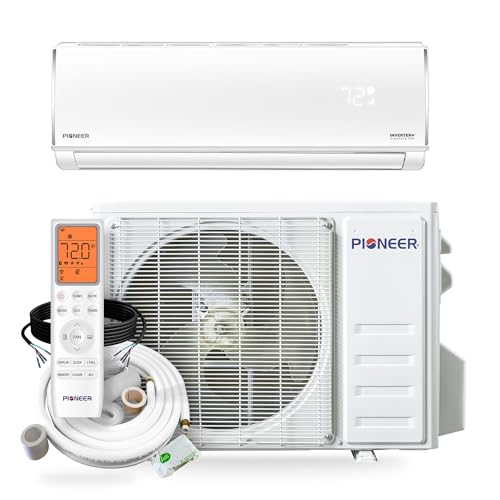


MRCOOL DIY 5th Gen 12,000 BTU 115V Mini-Split
The answer if you are installing it yourself: pre-charged quick-connect lines, no vacuum, and a warranty that allows owner installs. About twice the price, with 8,400 Btu/h at 5°F on NEEP and heat down to -13°F.
Read our full review: we scored it 6.9/10
You Might Also Need
Accessories worth grabbing alongside your purchase


