Senville Leto Mini-Split Review: A Mild-Climate Unit, Pro Install Required
By Wendell Asaro · Updated October 2026
Independent editorial review. We never accept payment for coverage, though we may earn a commission if you purchase through our links.
 ← Indoor unit 31.57 in wide (12k) →
Spec sheet
| Rated heat at 47°F (12k) | 12,000 BTU/h on 115V and 230V |
| Heat at 5°F (12k, NEEP) | 6,600 BTU/h on 115V; 8,000 BTU/h on 230V |
| Lowest heating temperature | 5°F per Senville FAQ (36k has NEEP data to -13°F) |
| SEER2 / HSPF2 (12k) | 21.2 / 8.7 on 115V; 21.3 / 9.1 on 230V |
| Electrical (12k) | 115V: 19 A MCA, 20 A max fuse; 230V: 13 A MCA, 15 A max fuse |
| Line set (9k/12k) | 25 ft pre-charge; 82 ft max run, 49.2 ft max drop |
| Install type | Vacuum pump and manifold gauge evacuation required; no quick-connect |
| Warranty | 5 yr compressor / 5 yr parts; licensed HVAC install required; labor excluded |
| Indoor / outdoor sound (12k 115V) | 17.5-45 dB indoor across fan speeds; 54 dB outdoor |
| Owner-reported issues | EL 01 communication error at 8 months (12k); smart kit pairing failures |
Verdict
Leto-specific owner discussion is thin and comes mostly from r/hvacadvice, with one thread on r/heatpumps, and most threads start with a problem: an EL 01 communication error, a leak right after install, a smart kit that only works through Alexa, a skipped vacuum. We read it as a list of failure modes to know about, not a failure rate. One owner running a watt meter was happy with its power draw.
Read full take ↓


We'd buy a Senville Leto for one job: cooling plus shoulder-season and mild-winter heat, installed by someone with a license. The Senville LETO 12,000 BTU mini-split is the cheaper of Senville's two main single-zone lines, sitting under the Aura, and on paper it's a sensible box: 21.2 SEER2 on the 12k, R-454B refrigerant, sizes from 9k to 36k, and a 115V option at 9k and 12k. What the listing doesn't lead with is who's supposed to install it. Senville's FAQ on the Leto 24k page answers "Can I install the system myself?" with a flat "No." Its warranty certificate is valid only when a licensed professional does the job, and the install manual requires a vacuum pump. You're buying a contractor-installed heat pump at a DIY-kit price. The Amazon listing we link is the 115V SENL-12CD. Amazon doesn't list the refrigerant, so check the listing's model number and refrigerant before buying.
Cold-weather output is the weak spot. The 115V 12k is certified at 6,600 BTU/h at 5°F, 55% of its 12,000 BTU/h rating and the lowest 5°F number of any 12k unit it gets cross-shopped against here. Senville's FAQ for every size we checked says the Leto is designed to heat down to 5°F. If your panel allows, look for the 230V SENL-12CD/220 instead: same nameplate, 8,000 BTU/h at 5°F. That's not the version our Amazon link goes to.
There's less owner history on the Leto than on MrCool or Pioneer, and most of it starts with something going wrong: a communication error at eight months, a water leak from day one, a Wi-Fi kit that won't pair with Senville's app. It's a small, problem-heavy sample, and we say below where the evidence runs out.
Where the Leto earns its price, and where it doesn't
What we like:
- Cooling efficiency for the money: 21.2 SEER2 on the 12k (21.3 on the 230V version) and 21.5 on the 115V 9k, ahead of the Pioneer Diamante Pro 12k 115V at 20.0.
- Long line-set allowance: up to 82 ft on the 9k and 12k (164 ft on the 24k), where the Pioneer Diamante Pro 12k tops out at 50 ft.
- Two sizes that hold their heat: the 230V 9k and the 24k keep about 70% of their rated heat at 5°F, which is respectable for a budget line.
- ENERGY STAR 9k: both 9k pairings carry the ENERGY STAR flag in the NEEP listing.
- Price: the lowest of the Amazon picks in this review (check current price).
What we'd change:
- 115V 12k heat: it drops to 6,600 BTU/h at 5°F. Treat it as a cooling unit that also heats.
- Install: no quick-connect option. The manual requires vacuum evacuation, and the warranty requires a licensed HVAC contractor.
- Warranty: 5 years on the compressor and 5 on parts, half the Aura's 10-year compressor term, and labor is never covered.
- Rebates: the 12k (both voltages), 18k and 36k are not ENERGY STAR per NEEP, which can matter for utility rebates.
- Smart kit: several owners couldn't get Senville's smart kit to work with the Senville app.
Which spaces and climates it fits
The Leto makes sense where winter rarely gets near 5°F and cooling is half the reason you're buying. Think a well-insulated house in the Pacific Northwest, the mid-Atlantic coast or the South, an upstairs bonus room that bakes in July, or a finished space where a furnace already carries the coldest nights. It also fits buyers who were going to pay an HVAC contractor anyway, because then the licensed-install rule costs you nothing extra.
Great fit
- Mild winters: homes where the design temperature stays well above 5°F.
- Cooling first: rooms and shops with another heat source for January.
- Contractor on the job: projects where a licensed contractor is already working and can sign the paperwork.
Pick something else
- Winters at 5°F or colder: the Senville Aura 12k is certified at 11,500 BTU/h at 5°F (NEEP) and heats to -22°F, under the same warranty rules.
- Installing it yourself: the MrCool DIY 5th Gen ships with a pre-charged quick-connect line set and a warranty that allows owner installs.
- DIY with lines you vacuum yourself: the Della Serena's web warranty policy promises registered owners lifetime parts, supplied free at Della's discretion on a DIY install, while the Leto's certificate gives them nothing.
- Basement humidity: buy a dehumidifier. On an older Leto 24k, dry mode just ran cold with no humidity sensing, and its owner moved to a dehumidifier on its own humidistat.
Heat by size, and what the numbers mean
Every number here is Senville's own spec table or install manual, or the AHRI-sourced NEEP cold-climate listing. Capacity at low temperature comes from NEEP, in BTU/h; nameplate heat is a 47°F rating and says nothing about your coldest night. The percentage is the 5°F figure divided by the rated heat.
Size | Rated heat (47°F) | 17°F | 5°F | 5°F as % of rating | SEER2 | ENERGY STAR (NEEP) |
|---|---|---|---|---|---|---|
9k 115V | No figure | 8,000 | 6,500 | No figure | 21.5 | Yes |
9k 230V | 10,000 | 8,000 | 7,000 | 70% | No figure | Yes |
12k 115V | 12,000 | 9,000 | 6,600 | 55% | 21.2 | No |
12k 230V | 12,000 | 9,300 | 8,000 | 67% | 21.3 | No |
18k | 18,800 | 14,000 | 11,500 | 61% | No figure | No |
24k | 24,000 | 20,800 | 17,000 | 71% | 18.7 | Cold Climate flag only |
36k | 36,000 | 24,600 | 21,400 | 59% | 18.0 | No |
The lowest heating temperature is 5°F per Senville's FAQ on the 9k, 12k, 18k, 24k and 36k pages. The 36k's NEEP listing adds a -13°F data point, a maximum of 11,200 BTU/h. On the 12k, the 115V version rates 10.1 EER2 and 8.7 HSPF2 and wants a 19 A minimum circuit ampacity and a 20 A max fuse; the 208/230V version rates 10.8 EER2 and 9.1 HSPF2 on 13 A and 15 A. Senville lists the 12k 115V at 45 dB indoors at the top fan speed and 17.5 dB at the lowest of five listed speeds, with 54 dB outdoors.
Do the arithmetic the box skips. Say a Manual J load calculation puts your room's heat loss at 8,000 BTU/h at 5°F. The 230V 12k covers it exactly. The 115V 12k comes up 1,400 BTU/h short, 17.5% of the load, on the one night you most need it. The 230V 9k makes 7,000 BTU/h at 5°F, more than the 115V 12k, and does it on a 15 A breaker. If you're choosing between those two for heat, the smaller 230V unit is the better heater.
ENERGY STAR's cold-climate test asks for at least 70% of the 47°F capacity at 5°F, and the percentage column splits the line in two. The 24k (17,000 of 24,000) and the 230V 9k (7,000 of 10,000) clear it. The 12k does not on either voltage, and neither do the 18k or the 36k. Of the sizes covered here, NEEP flags only the two 9k pairings as ENERGY STAR, and it marks the 24k as ENERGY STAR Cold Climate but not ENERGY STAR, a combination that looks inconsistent. If a rebate depends on it, check the ENERGY STAR directory before you buy.
The 115V 12k's 8.7 HSPF2 (Senville's figure) also sits just above NEEP's 8.5 floor for ductless units. Every Leto pairing is on NEEP's cold-climate list, but don't read that listing as a promise of strong heat at 5°F.
What the install involves
The Leto needs a vacuum and a commissioning step; there's no quick-connect version. The outdoor unit carries a factory charge sized for 25 ft of line (the manual says nominal efficiency is tested at 25 ft and requires a minimum run of 9.84 ft). Before that charge is released, the lines and indoor coil have to be evacuated. The manual's words: "Use a vacuum pump and manifold gauge to evacuate the refrigerant circuit, removing any non-condensable gas and moisture from the system."
Size | Max line length | Max drop |
|---|---|---|
9k, 12k | 82 ft | 49.2 ft |
18k | 98.4 ft | 65.6 ft |
24k | 164 ft | 82 ft |
36k | 213 ft | 98.4 ft |
- Longer runs: runs past the 25 ft charge are covered in the manual and are the installer's call.
- Tools: a vacuum pump, a manifold gauge and a micron gauge, since the manual calls for evacuating for at least 15 minutes or until a micron gauge reads 500 microns, and its A2L piping requirements add no rise above 1500 microns in 10 minutes once the pump is isolated. A licensed installer brings these.
- Electrical: a 20 A max fuse on the 115V 12k with a 19 A minimum circuit ampacity, which in practice means a circuit of its own. The 230V 12k calls for a 15 A max fuse. Have a licensed electrician run the circuit to your local code.
- Refrigerant: R-454B, an A2L (mildly flammable) refrigerant. Senville's product page says the system "must be installed and commissioned by a professional with the qualifications required in the installation jurisdiction."
There's a federal angle too. The EPA counts attaching hoses and gauges to a refrigerant circuit as technician work, and its Section 608 guidance says installing a stationary system like this one requires certification. Quick-connect kits are designed so the owner never attaches gauges at all; the Leto requires them.
The vacuum step exists for a reason. One Leto buyer hooked up a pump, couldn't get a seal on the stem, and released the charge anyway. The unit heats and cools, but moisture and air left in the lines can damage the system over time, which is what the vacuum step prevents. A more common plan is the middle path: run the line set yourself, then pay a local HVAC company to vacuum and start it. One buyer looking at an older-generation 12k listing planned exactly that. It runs straight into the warranty.
The warranty, read closely
Senville's spec tables list 5 years on the compressor and 5 on parts for every Leto size. The certificate that governs it is blunt. It says the warranty "must be completed by a licensed professional" to be valid, and its proper-installation clause says the limited warranty "applies only to systems that are installed by a state-certified or licensed HVAC contractor," following local codes and permits and Senville's instructions. Senville can ask for proof. Labor for diagnosing, repairing, removing or installing parts is excluded, and registration is at senville.com/warranty.
So a full DIY install leaves you with no warranty, and Senville's FAQ on the Leto 24k page says as much. The hybrid plan sits in a gray zone. "Completed by" reads as if a contractor who finishes the job could satisfy it; "installed by" reads stricter. If you go that way, get the contractor's license number on an invoice that covers the evacuation and startup, keep the micron reading, and ask Senville in writing before you count on coverage. We wouldn't buy a Leto on the assumption that the hybrid route is covered.
Reliability and living with it
Nobody has a body of multi-year Leto ownership reports to point to, us included. What's on record is recent and almost all problem-led, because people rarely post when a mini-split works fine. Treat it as a list of failure modes to know about; it can't tell you a failure rate. Most of it also predates the current R-454B Leto, and one of the units is an older SENL-24CDY.
- Communication error: a 12k threw an EL 01 indoor/outdoor communication code about eight months after install, and it came back after two power cycles. The same code has shown up on a 9k. Senville's own account responded by pointing to its troubleshooting page and support line, and no resolution was posted for either unit.
- Water leak: a couple of owners say their new Leto leaked from the day it was installed, with no diagnosis posted. A leak that starts on day one points us at the install (drain pitch, a level indoor unit) before the hardware.
- Smart kit: four owners couldn't get the SEN20-ACK1T smart kit to connect to the Senville app. Some say it works only through Alexa, and that the Alexa link doesn't update when you use the remote. Confirm which Wi-Fi accessory your model supports before you buy one.
- Dry mode: on an older Leto 24k, dry mode blows cold air with no humidity sensing, and that owner handled the basement humidity with a dehumidifier instead.
Repairability splits opinion. Some call these units rip-and-replace and warn not to count on future parts; a shopper weighing Senville against Della saw it the other way and credited Senville with better parts support. Neither side has the data to settle it, and we don't either. What we can say: the warranty covers parts for 5 years if the install qualifies, labor never, so price a service call into the decision.
On the good side, one Leto owner running a watt meter logged a peak near 704 W and an average around 155 W, and picked the Leto over the Aura on cost, without saying which size. Noise has a single owner report: in the second year with a self-installed Leto, the wall-mounted outdoor unit makes a noise in winter that carries through the wall, though it's much quieter than the PTAC it replaced. Past that we only have Senville's figures, which are in line with the MrCool DIY 5th Gen 12k (43 dB at the top indoor speed, 54 dB outdoors). There's no record yet of a completed warranty claim.
How it compares
All 12k units unless noted. Heat at 5°F is NEEP's figure, in BTU/h.
Unit | Heat at 5°F | Heating ends | SEER2 / HSPF2 | Install | Warranty |
|---|---|---|---|---|---|
Senville Leto 12k | 6,600 (115V), 8,000 (230V) | 5°F | 21.2 / 8.7 (115V) | Vacuum, licensed contractor | 5 yr compressor / 5 yr parts, licensed install only |
Senville Aura 12k | 11,500 | -22°F | 25.4 / 10.5 | Vacuum, licensed contractor, 230V only | 10 yr compressor |
Pioneer Diamante Pro 12k 115V | 9,000 | -4°F | 20.0 / 9.5 | Vacuum to 500 microns, 4-hour hold; 16 ft line set, 50 ft max run | No licensed installer required; registration |
MrCool DIY 5th Gen 12k | 8,400 | -13°F | 23.5 / No figure | Pre-charged quick connect, no vacuum | 5 yr parts / 7 yr compressor, owner install allowed |
Della Serena 12K 115V | 9,200 | No figure | 22.0 / 9.5 | Vacuum | Lifetime parts if registered; free at Della's discretion on DIY |
- Senville Aura: the step-up from the same company, with the same licensed-install rule and vacuum requirement, and it costs more. If you heat through real winters, this is the Senville to buy.
- Pioneer Diamante Pro: the closest rival on price. Pioneer's warranty does not require a licensed installer, though it excludes install faults and lost refrigerant and wants registration. Its registration deadline is stated inconsistently, so register the day you install.
- MrCool DIY 5th Gen: the true DIY route, and the most expensive of the units we link here.
- Della Serena: ENERGY STAR with the cold-climate flag. Lines must be vacuumed, but Della's current web policy promises registered owners lifetime parts, supplied free at Della's discretion on a DIY install (you pay shipping after year one).
Who builds it?
Neither Senville nor MrCool names a factory, and we won't guess one. The published data does line up. The Leto 12k, 24k and 36k indoor units list widths of 31.57, 42.52 and 49.57 in, the same figures to the hundredth of an inch that MrCool publishes for its DIY 5th Gen 9k/12k, 18k/24k and 36k wall units. The match isn't complete: the Leto 9k (28.43 in) and 18k (37.99 in) are narrower than MrCool's 9k (31.57 in) and 18k (42.52 in). On the step-up line, NEEP's ratings for Senville's Aura match MrCool's Olympus line point for point. That's a strong hint of shared cabinets and a common OEM, though it isn't confirmed. It also doesn't make a Leto a MrCool DIY: the refrigerant connections, install method and warranty terms are different, and those are what you're paying for.
Who should buy a Leto
Buy the Leto if you live where winter stays well above 5°F, you want efficient cooling and some heat in one or two rooms, and a licensed contractor is installing it. In that lane it's the lowest-priced of our Amazon picks, and if your panel allows, the 230V versions are the ones to look for (our Amazon link is the 115V 12k). The 230V 9k outheats the 115V 12k at 5°F, and the 24k keeps the most of its rated heat at 5°F of any Leto.
Skip it if you planned to install it yourself, since Senville voids the warranty on that, or if your coldest nights are the reason you're shopping. For a DIY install we'd go to the MrCool DIY 5th Gen; for winter heat from Senville, the Aura 12k makes about 75% more heat at 5°F than the 115V Leto 12k.
Score breakdown
Cooling efficiency is good at 21.2 SEER2 on the 12k, but heat falls off hard: the 115V 12k is certified at 6,600 BTU/h at 5°F, 55% of its rating, and Senville rates the line to heat only down to 5°F. The 230V 12k (8,000 BTU/h) and the 24k (71% retention) are better.
Owner evidence is thin and problem-heavy: an EL 01 communication error at eight months, a day-one leak, and a smart kit several owners could not pair with the Senville app. The 5-year compressor and parts warranty only applies to a licensed install and never covers labor.
It is the lowest-priced of the 12k units we link here, which counts. But the warranty requires a licensed HVAC contractor, so the contractor bill is part of the price unless you accept no coverage, and the MrCool DIY 5th Gen and Della Serena both cover owner installs.
Senville Leto Mini-Split on Amazon.
The Evidence Behind Our Verdict
Leto-specific owner discussion is thin and comes mostly from r/hvacadvice, with one thread on r/heatpumps, and most threads start with a problem: an EL 01 communication error, a leak right after install, a smart kit that only works through Alexa, a skipped vacuum. We read it as a list of failure modes to know about, not a failure rate. One owner running a watt meter was happy with its power draw.
Our rating above is our own editorial call. What follows is the field evidence we weighed to reach it: first-hand reports from owners on Reddit and independent HVAC and DIY forums, which we lean on more than manufacturer-influenced published reviews because unsponsored owners tend to be the more candid signal.
What Reddit Is Saying
“The max wattage that has registered was around 704watts or so. I don't think these units can hit over 1000w (closer to 800w max) even on heat mode. True energy sippers.”
“Just got a Leto installed and well one thing led to another and I released the refrigerant without doing a vacuum. Basically I hooked the pump up and it hissed when I was pulling the vaccum because the stem didn’t line up, it did pull a little vacuum so I just “sent it” and filled the lines with the refrigerant.”
“got a Senville LETO 12,000 BTU mini split installed about 8 months ago. Started throwing an EL 01 code last week.”
“It was installed like 2 weeks ago. It was leaking since the day it way installed.”
“I have a Senville Leto SENL-24CDY and recently installed the Smart Control kit - SEN20-ACK1T. I can put the unit into paring mode “AP” but the unit does not generate the wifi signal needed to connect to the Senville app.”
“I have the same problem and the Alexa connectivity sucks. It barely works. Doesn’t update when the remote is used”
“It's unfortunate that the unit doesn't measure the humidity level and make adjustments like auto on/off. Kind of seems pointless without that functionality.”
Frequently asked questions
Is the Senville Leto Mini-Split worth it?
It is the lowest-priced of the 12k units we link here, which counts. But the warranty requires a licensed HVAC contractor, so the contractor bill is part of the price unless you accept no coverage, and the MrCool DIY 5th Gen and Della Serena both cover owner installs.
How reliable is the Senville Leto Mini-Split?
Owner evidence is thin and problem-heavy: an EL 01 communication error at eight months, a day-one leak, and a smart kit several owners could not pair with the Senville app. The 5-year compressor and parts warranty only applies to a licensed install and never covers labor.
How well does the Senville Leto Mini-Split perform?
2 SEER2 on the 12k, but heat falls off hard: the 115V 12k is certified at 6,600 BTU/h at 5°F, 55% of its rating, and Senville rates the line to heat only down to 5°F. The 230V 12k (8,000 BTU/h) and the 24k (71% retention) are better.
What do real owners say about the Senville Leto Mini-Split?
Leto-specific owner discussion is thin and comes mostly from r/hvacadvice, with one thread on r/heatpumps, and most threads start with a problem: an EL 01 communication error, a leak right after install, a smart kit that only works through Alexa, a skipped vacuum. We read it as a list of failure modes to know about, not a failure rate. One owner running a watt meter was happy with its power draw.
Options Worth Checking Out
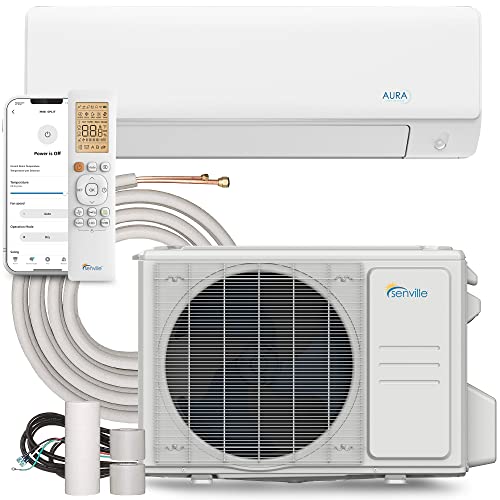
Senville AURA 12,000 BTU Mini-Split Heat Pump
The Senville to buy for real winters: 11,500 BTU/h at 5°F, heating published to -22°F and a 10-year compressor warranty. Same licensed-install rule and vacuum requirement as the Leto, 230V only, and it costs more.
Read our full review: we scored it 7.5/10

MRCOOL DIY 5th Gen 12,000 BTU 115V Mini-Split
The pick if you are installing it yourself: pre-charged quick-connect lines with no vacuum step, 8,400 BTU/h at 5°F, and a 5-year parts and 7-year compressor warranty that allows owner installs. Priced well above the Leto.
Read our full review: we scored it 6.9/10
You Might Also Need
Accessories worth grabbing alongside your purchase

More Senville Reviews
See all →

How Does It Compare?
Side-by-side breakdowns featuring this product

