Best Mini-Split for a Garage: Sizing, 115V vs 230V, DIY Picks
By Wendell Asaro · Updated October 2026
Independent editorial guide. We never accept payment for coverage, though we may earn a commission if you purchase through our links.
Quick Take
For an insulated one- or two-car garage, buy the MrCool DIY 5th Gen 12K (115V) and install it yourself. Its 25 ft line set arrives pre-charged with quick-connect fittings, its warranty allows owner installs (5 years on parts, 7 on the compressor, no registration), and NEEP lists it at 8,400 BTU/h of heat at 5°F. If your garage needs more than that on the coldest night at the temperature you plan to keep, step up to the Klimaire DIY 18K, which makes 13,600 BTU/h at 5°F on a 230V circuit; get its DIY warranty terms confirmed in writing first.
The door and the thermostat setting decide the size more than the brand does. Insulate and seal the garage door before you buy, then size to the heat loss at 5°F at the temperature you'll hold, not at 70°F and not by square footage. In our worked example below, holding 50°F instead of 65°F cuts the 5°F load by a quarter, enough to bring a 12K within reach where 65°F needed an 18K. Don't buy bigger "for the door": an oversized unit cycles through mild weather and leaves a summer garage clammy. And whatever you buy, the circuit is a licensed electrician's job.
Our garage default, the bigger quick-connect unit for a cold or large garage, two flare units for buyers who'll hire the startup, and the bracket that keeps the condenser off the driveway are below. See picks ↓

Put a pre-charged quick-connect kit in your garage and install it yourself; specifically, the MrCool DIY 5th Gen. A garage is the hardest single room to put a mini-split in. It has the biggest door in the house, a concrete slab, often nothing but rafters overhead, and an owner who wants it warm in an hour on Saturday and doesn't much care on Tuesday. It's also the job HVAC companies seem least to want: shoppers get quoted $4,775 to $15,000 to hang a single head, and some of the high numbers look like prices set to lose the job.
The MrCool is the same pick our best DIY mini-split guide makes, for reasons that matter more in a garage: the 12K runs on 115V, the warranty covers an owner install and the line set itself, and the 25 ft pre-charged line gives you room to put the outdoor unit somewhere other than the driveway apron.
Garage owners' regrets run in both directions: a unit a size bigger than needed, a head hung too high, or a unit too small to warm the space in reasonable time. Every one of those is settled before you order, by two numbers you can get today: your garage's heat loss at the temperature you'll keep, and the clear wall height you have between the shelves.
Fix the door and the leaks before you size anything
Insulate first. We said it in our garage heater guide and it matters even more here, because a mini-split has modest output and every BTU the door leaks is one it can't spare. In most garages the door is the weak spot: a big panel that's often uninsulated and rarely sealed well. One Texas owner had three contractors bid the same garage, and all three independently said to put rigid foam on the back of the door. Another Texas owner, whose 24K turned out bigger than the space needed, credits the insulated door panels for part of that.
Leave insulation out and the numbers stop working. A shop built from two shipping containers joined with the sides cut out has a large mini-split that can't keep up in Texas summer or winter, and its owner puts it down to the shop not being insulated. If you can't or won't insulate, size from a load calculation that says so, expect it to call for a bigger unit than the floor area suggests, and know that you'll be paying to condition the outdoors through the roof.
Check the walls for vents before you count leaks. Many garages have openings near the floor or ceiling that run straight outside. If a gas water heater or furnace shares the garage, those vents may be its combustion air, and covering them is off the table. We won't tell you to seal them either way. Find out what they serve from the appliance's manual or a licensed pro, and size the mini-split with them as they'll stay.
Know one more load: a heat pump water heater in the garage pulls its heat from the garage air. That cools the garage while it runs, which helps a little in summer and adds a little to your winter load. One owner who works out of a garage with both a heat pump water heater and a mini-split reports no problems running them together.
Size it to the temperature you will keep: a worked example
Size a garage the way you'd size any room: from a heat-loss number at your town's winter design temperature, from a Manual J or a careful estimate by a contractor or energy auditor. Square-foot charts are rules of thumb, and garages break them with tall ceilings and big doors. The garage-specific twist is that you pick the indoor temperature. Few people hold a garage at 70°F all winter, and the setting you choose changes the load as much as the insulation does.
Here's an illustration, not a load calculation for your garage. Say a load calculation puts an insulated two-car garage at 12,000 BTU/h of heat loss on a 5°F night with the garage held at 65°F. That's 200 BTU/h for each degree of difference between inside and outside. Using the common simplification that heat loss rises in step with that difference, here's what each setpoint asks for at 5°F, against NEEP's 5°F figures for the units in our picks:
Garage held at | Load at 5°F | MrCool 12K (8,400) | Klimaire 12K (8,900) | Pioneer 12K (9,000) | 18K units |
|---|---|---|---|---|---|
65°F | 12,000 BTU/h | 3,600 short | 3,100 short | 3,000 short | MrCool 18K (12,800) covers it with 800 to spare; Klimaire 18K (13,600) with 1,600 |
50°F | 9,000 BTU/h | 600 short | 100 short | Matches it exactly | Both cover it easily |
40°F (keeps paint, glue and water lines from freezing) | 7,000 BTU/h | 1,400 to spare | Covers it | Covers it | Both cover it |
So pick the setpoint before you pick the size. If you want 65°F through a 5°F night, this garage needs an 18K. If you keep it at 50°F and warm it up when you work, a 12K gets you close: on that 5°F night the MrCool 12K's 8,400 would hold about 47°F in this example (8,400 / 200 = 42 degrees above outside), and every milder night it has room to spare. The published minimums show why we'd stop there rather than buy the 18K. At 17°F, holding 50°F takes about 6,600 BTU/h in this example. NEEP lists the MrCool 18K's minimum output at 17°F as 8,000 BTU/h, so it can't turn down that far and will cycle on and off on every night that mild or milder. The Klimaire 18K's 17°F minimum is 5,400, so it can throttle down to that load, and the MrCool 12K runs anywhere from 2,600 to 8,500 at 17°F. If you need an 18K for the cold nights but expect to keep the garage cool most of the winter, that turndown is a reason to pick the Klimaire.
The catch with a low setpoint is the warm-up. A heat pump holds a temperature better than it recovers one, and some owners now leave the unit running rather than shut it off. One unit takes about 2 hours to bring a garage from 45°F to 60-65°F, and its owner wishes they'd bought larger. A 3rd Gen MrCool DIY 18K takes over an hour to go from 40°F to 60°F in an insulated garage with 12 ft ceilings. Another 18k runs day and night while its owner is working, because recovering from below freezing takes forever, and a no-name 18K runs around the clock at 62°F, the lowest setting its thermostat allows. That last detail matters if you planned on a 50°F hold: check the lowest setpoint your unit's remote allows in normal heat mode. MrCool's DIY 5th Gen service manual lists an "FP" indoor display for heating with the room under 46.4°F (8°C) and calls it a normal display, not an error, and Cooper & Hunter lists a 46°F freeze-protection mode on its 12K. Check your unit's owner's manual for how to set a low hold before you plan around one.
If a 12K leaves you short on the few coldest mornings, backup heat is cheaper than a bigger heat pump that cycles the rest of the winter. One watt of resistance heat makes 3.412 BTU/h, so the MrCool 12K's 3,600 BTU/h gap at 65°F in this example is about 1,050 W. Any heater you add brings its own manual's rules about gasoline, paint and clearances, which we cover in our best garage heater guide. And if your winters go well below zero, read the -13°F column too: the MrCool 12K's NEEP maximum there is 3,800 BTU/h against the Klimaire 12K's 6,680. Our cold-climate mini-split guide covers that end of the curve.
Cooling a hot garage
For an insulated garage, a 12K cools more space than most people expect; for a hot, leaky one, get a load calculation. Garage cooling questions come mostly from Texas, Arizona, Florida and Southern California, and they start with square footage. ENERGY STAR's sizing chart for room air conditioners is the closest published rule of thumb: 10,000 BTU/h for 400-450 sq ft and 12,000 for 450-550 sq ft, with 10% more for a very sunny room. A 20 x 22 ft two-car garage is 440 sq ft, so the chart says 10,000 to 11,000 BTU/h, and a 12K fits. That chart assumes an 8 ft ceiling and an ordinary room, though. A garage with a west-facing steel door, an uninsulated roof and 10 ft ceilings isn't one, so treat the chart as a floor for a well-insulated garage.
Owners back the chart for insulated garages: a 12K or smaller is plenty in a one- or two-car garage or a shop of roughly 300-500 sq ft, from a Senville Leto 12K in south Texas to a small Amazon unit its owner called a 9K in one comment and a 12K in another. The hot, poorly insulated garages went bigger, and some went too far. A Texas owner with a 458 sq ft garage and uninsulated walls bought a 24K, then said an 18K would have been fine, which their installer confirmed. A Florida owner with a Mitsubishi 18K in a garage of about the same size would buy one size down next time. On the other hand, a 400 sq ft garage held at 68°F through 92-95°F weather with little insulation is doing fine on a 24K.
The case against going big is humidity. ENERGY STAR warns that an oversized unit cools the room before it removes the humidity, leaving it damp and clammy, and the owner of that small Amazon unit in a 400-500 sq ft garage found the same thing. You'll also hear the other side: a slightly oversized inverter recovers faster when the door has been open or a hot car pulls in, then throttles down. We'd size for the garage with the door shut. The door is open for minutes; the humidity is there all summer.
If you only need cooling and the budget is tight, a mini-split isn't the only answer. If your garage has a window or a wall you can sleeve, a window or through-the-wall unit like the LG through-the-wall air conditioner is a far simpler install. You give up heat, and those LG units have no inverter.
115V or 230V, and the circuit you will need
The 115V question decides more garage purchases than it should. Here's what the units in our picks ask for, from the manufacturers' spec tables:
Unit | Voltage | Minimum circuit ampacity | Maximum breaker or fuse |
|---|---|---|---|
MrCool DIY 5th Gen 12K | 115V | 18 A | 20 A breaker |
MrCool DIY 5th Gen 18K | 208/230V | 18 A | 20 A breaker |
Klimaire DIY 12K | 115V | 16 A | 25 A fuse |
Klimaire DIY 18K | 208-230V | 12 A | 20 A |
Pioneer Diamante Pro 12K (115V version) | 115V | No figure | 25 A single-pole breaker |
So 115V buys you a 12K and nothing larger in these lines, and in the 12K class that means 8,400 to 9,000 BTU/h at 5°F. If your load at the temperature you'll hold is more than that, you're on 230V whether the panel likes it or not.
Either way, these aren't plug-in appliances in the way a window unit is, even though some owners run a 115V garage unit off an existing outlet or one they added. Whether your garage's existing circuit can carry an 18 A minimum circuit ampacity on top of the door opener and whatever else is on it is a licensed electrician's call, not ours, and your town may want a permit. Budget for it before you choose a unit: one owner paid $1,100 for a new 240V dedicated circuit with a run of about 30 ft in Arizona, and a Texas shopper was quoted $700 for the wiring and install together. Get your own quote for both voltages, because the gap between them can be smaller than the gap between the units.
Where the units go in a garage
Start with the indoor head, because garage walls fill up. The MrCool DIY 5th Gen and Klimaire DIY manuals both set the R-454B rules: the indoor unit at least 6.0 ft above the floor, a room at least 7.3 ft tall, and a minimum room area from the manual's table. The MrCool 12K's wall unit is 31.57 in wide and the 18K's is 42.52 in, so measure the clear wall you'll have once the shelves, pegboard and garage-door track are up. One Florida owner put shelves on the wall first, hung the head at about 9 ft, and calls it a mistake; next time it goes at about 7 ft. A head near a high ceiling sits in the warmest air in the room and can decide the garage is warm while you're cold at the bench.
Plan the line set route once. MrCool includes 25 ft of pre-charged line and its install manual lists a 75 ft maximum run. The manual says the quick-connect line sets are for one-time installation and that disconnecting and reconnecting them can leak and voids the warranty; it gives a 4 in minimum bend radius and says to coil any extra line flat behind the condenser. Klimaire's manual says the same about its one-time fittings. Pick the outdoor spot, measure the route, then make each connection once.
Keep the outdoor unit off the driveway and walkways. A heat pump drips water in heating mode, and during defrost it melts the frost off its outdoor coil: MrCool's DIY 5th Gen service manual describes the compressor running with both fans stopped for up to 15 minutes. That water lands on concrete and freezes in January. A 3rd Gen MrCool 18K in one garage defrosts about once an hour and dumps a lot of water when it does. The DIY 5th Gen manual notes that units with built-in base pan drain holes don't need the drain joint installed, so plan where that water runs. In snow country, a wall bracket keeps the coil above drifts and out of the way of cars, mowers and the snowblower. Our wall bracket guide matches brackets and stands to unit weight.
Wall mounting has a trade-off: the wall can carry the unit's noise into the building. A Senville Leto owner hears it through the wall in winter; a Pioneer owner whose unit hangs on a garage wall shrugs at the compressor noise since it's the garage; one owner's first garage unit rattled the siding loose until it was remounted on standoffs. On a detached garage, that rarely matters. If a bedroom sits over the garage or shares the wall, use a ground pad tall enough to clear your snow instead.
If the garage is a woodshop, plan for dust and clean the filter more often than you think you need to. A woodshop owner with a Zone Air system says dust matters more than the brand, and that the filter needs rinsing more often than you'd think; one shopper was told by an installer that dust kills the units. Follow the filter-cleaning steps in your unit's owner's manual, and run your dust collection hard.
Quick-connect, flare or a contractor: the garage install math
Pro quotes for a single garage head are all over the map, and the high end is high. Here's what eight shoppers were quoted, against what owners who found the right person paid:
Job | Price |
|---|---|
Contractor, 400 sq ft two-car Texas garage, electrical not included | $7,000 |
Contractor, disconnect already on the wall | $8,600 and $9,800 |
Contractor, three bids for an 18K | $4,775 to $7,500 |
Contractor, a small, simple job | As much as $15,000 |
Small HVAC company, full install of an Amazon-bought Daikin | $600 |
Installer found on Facebook Marketplace, total | $700 |
Tech to connect the lines, pressure-test and pull the vacuum on an owner-mounted, owner-wired unit | $350 |
22-year installer, a customer's Amazon unit | $965 |
A second company told one shopper why the quotes run so high: a mini-split job splits up crews that would otherwise be doing whole-house installs. Splitting the work is another route; some owners do the mounting and line routing themselves and hire a pro for the refrigerant side. Hiring has its risks too. Most pros don't want to touch equipment bought online, and one owner who paid an HVAC person for their first unit had it fail after a year because the vacuum wasn't held long enough, and then nobody would come look at it.
That's the case for quick-connect in a garage. If the cheapest flare unit plus a local startup quote costs less than a quick-connect kit, buy the flare unit and hire the startup. If you can't find anyone to take the job, the quick-connect premium buys you a garage you can finish yourself. Before you choose, read each warranty for what an owner install does to it:
- MrCool DIY 5th Gen: owner installs allowed, 5 years parts and 7 compressor, no registration, line sets covered. MrCool says a licensed contractor "may be necessary" when required by law or for diagnostics it directs.
- Klimaire DIY 5th Gen: the current DIY warranty allows owner installs on DIY-designated models (5 years parts and 7 compressor if registered within 45 days), but its claim procedure asks for an installation invoice from a licensed HVAC technician, and it excludes refrigerant line sets. Get Klimaire's answer for your model in writing.
- Pioneer Diamante Pro: no licensed-installer requirement, but faulty installation and refrigerant loss are excluded, and a claim starts with an installer or qualified contractor diagnosing the failure. Its manual calls for a nitrogen-assisted evacuation to 500 microns with a 4-hour hold, by qualified personnel.
- Della Serena (flare): the Amazon listing says it mandates professional installation, but Della's web warranty policy gives a registered non-professional install free replacement parts at Della's discretion.
- Senville and Cooper & Hunter: coverage requires a licensed HVAC install; Cooper & Hunter also wants the installer's license number at registration within 60 days.
No warranty here pays labor, so a covered failure still costs a service call. On the refrigerant side, EPA's Section 608 Q&A says "Any person servicing, installing or disposing of stationary appliances (except the disposal of small appliances) must be a section 608 certified technician." EPA hasn't published a plain statement on whether connecting a factory-charged quick-connect line set counts as installing in that sense, and we won't tell you it does or doesn't. A flare system's evacuation means attaching hoses and gauges to the refrigerant circuit, one of the activities EPA's technician definition names, which is why we'd hand that step to a certified tech if you don't hold the card.
Is a premium brand worth it in a garage?
In a garage, the premium buys you a contractor, not a better garage. Mitsubishi comes up in nearly every garage discussion, usually right after a five-figure quote, and its garage owners are happy. So are garage owners running MrCool, Cooper & Hunter, Pioneer, Senville Aura, Zone Air, Blue Ridge and a Menards house brand. The warnings against budget units come from pros, one of them citing thousands of service calls, early major failures and parts that can't be found. Nobody on either side offers a failure rate we could compare.
Mitsubishi sells through contractors, not Amazon, so the price includes an install and, from what shoppers were quoted, a long warranty through its dealer network. We haven't reviewed those warranty terms, so get them in writing if you go that way. If you want the job turnkey and a company to call when it fails, that's a fair thing to pay for. If you're a weekend user who can hang a head and hire an electrician, a quick-connect DIY unit heats and cools the same garage for a fraction of the quotes above.
What we'd put in your garage
- Insulated one- or two-car garage, on 115V, you install it: the MrCool DIY 5th Gen 12K, sized against your 5°F load at the temperature you'll hold.
- Colder or bigger garage you keep warm, with a 230V circuit: the Klimaire DIY 18K. It makes more heat at 5°F than the MrCool 12K and turns down further than the MrCool 18K. Get Klimaire's DIY warranty terms confirmed in writing.
- Bigger garage, winters that bottom out near 5°F, and a tech lined up for the startup: the Della Serena 18K, with 13,500 BTU/h at 5°F per ENERGY STAR for far less than the Klimaire. Della publishes nothing below 5°F.
- Smaller garage, a tech lined up for the startup, and only 115V: the Pioneer Diamante Pro 12K costs far less than the MrCool and makes 9,000 BTU/h at 5°F, but heating ends at -4°F and the line set is a fixed 16 ft.
- Three-car garage or a shop in sub-zero country: get a load calculation first. If it lands near 18,000 BTU/h at 5°F, our cold-climate mini-split guide covers the 24K quick-connect class.
- Heat only, a few Saturdays a winter: a 240V garage heater, from our heater guide, is the cheaper buy.
Whichever you choose, insulate the door before it arrives, measure the wall height between your shelves, and get the electrician's quote first.
The picks
Products we recommend for this guide.

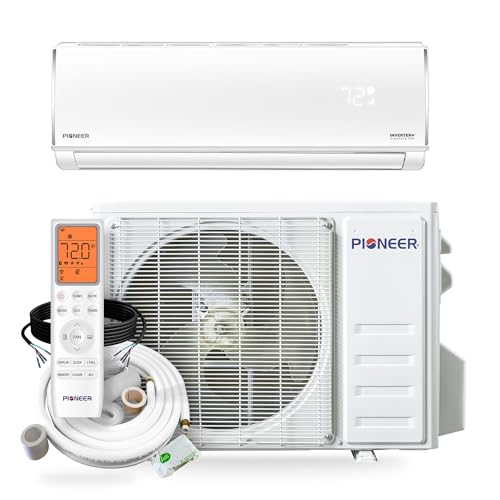
MRCOOL DIY 5th Gen 12,000 BTU 115V Mini-Split
Our garage default: runs on 115V (18 A MCA, 20 A max breaker), 8,400 BTU/h at 5°F, and a 25 ft pre-charged quick-connect line. The warranty allows owner installs, 5 years parts and 7 compressor. Labor is never covered.
Read our full review: we scored it 6.9/10

Klimaire DIY 18,000 BTU 23 SEER2 Quick Connect Mini-Split (230V)
For a garage that needs more than a 12K at 5°F: 13,600 BTU/h there per NEEP, and a 5,400 minimum at 17°F against the MrCool 18K's 8,000, so it cycles less. Needs 230V. DIY installs allowed; claims ask for a licensed installer's invoice.
Read our full review: we scored it 6.7/10

DELLA Serena 22 SEER2 18,000 BTU Mini-Split (230V)
For a bigger garage where winter bottoms out near 5°F and you'll pay for the startup: 13,500 BTU/h at 5°F per ENERGY STAR, close to the Klimaire 18K. Flare lines need a vacuum, and the listing says it mandates professional install.
Read our full review: we scored it 7.3/10

What owners say
Real owner reports from the threads and editorial sources we drew on for this guide.
“Can you DIY? I've done three of these at my place. It's actually quite simple. 12K in a two-car garage works great for me.”
“I bought a mini-split from Amazon for my 2- car garage (about 400-500 sq ft) with half the capacity (9k BTU), and it worked great. Better still, it was a 19 SEER2 and required only 110V to operate, so I just installed a regular outlet for it off teh power panel. Good thing about it being this size is that it works longer, drying the air inside the garage. I'm afraid a 18k BTU system would cool too fast to remove much water, leaving your garage cold and clammy.”
“So I’ve been using the mini split for a few months now and it is working flawlessly. I think 24K is overkill and would have been just fine with a 18K btu unit, in fact I can confirm this because the hvac tech I had install it told me that 24K was too much lol. But I also insulated the garage door panels which definitely helped.”
“My garage is the roughly the same footage with 10’ ceiling height. I did the Mitsubishi 18,000. I live in Florida with an diy insulated garage door and minimal insulation above the garage area. The unit works very very well. I don’t have any feedback on the heat pump performance but if I had to do it again , I’d have done the 1 step down sized unit and mounted the unit at 7’ above the garage floor. I had shelves on the wall so I mounted it around 9’ and made a mistake.”
“I put a 12k in my 320 sq ft shop out here and its plenty, 18k for 300 sq ft with that ceiling is oversized unless youre losing a ton through the garage door.”
“We only heat our garage to mid fifties most of the time, mid 60’s at most if I’m doing some work out there. Can save a lot of money if you don’t try and heat it to room temp.”
“I bit the bullet and got a mini-split installed a few years ago for my garage. It does cost a lot but the savings in power bill over a traditional electric unit helps offset the cost a little. They are super efficient and quiet. My only regret was not getting a larger unit because heating the garage takes a little longer than I would like.”
“Did my garage the diy way with a Zone Air and honestly for a wood shop dust is the real enemy, not the brand. Just pull that filter and rinse it way more often than you think you need to and you'll be fine”
“$1100 to install a new 240v dedicated circuit, about 30 foot run. Otherwise I did the install on the hvac but they did hook it up electrically to the new wire. This is in AZ.”
“They quoted $7,000 which sounds like a “we don’t want the job” price. She did mention they are a small company and preferred to prioritize repair calls this time of year which I totally get.”
“I went with a Senville 18K system for a 700 sq ft above-the-garage design studio that's used daily. Really happy with it. Finished the install late last year, so about 6 months of use. The space is well insulated but the staircase is currently open to the garage below (I'm making a door by hand but have been a bit busy). I installed the system myself including running the lineset and electrical cable, but I left the "real" HVAC work (nitrogen purge, pumping down the lines, etc.) to a pro. My part was dead easy.”
“Yup, I'm not even completely done insulating my 40x72 building and I have an 18k mini split that keeps it above 60f when it's about 25f outside. I leave it on all day / night if I'm working a few days in a row ofc. It would take forever recover to that temp from below freezing.”

