Santa Fe Ultra70 Review: Small Ducted Unit, Big Coil Question
By Ingrid Tamsett · Updated October 2026
Independent editorial review. We never accept payment for coverage, though we may earn a commission if you purchase through our links.
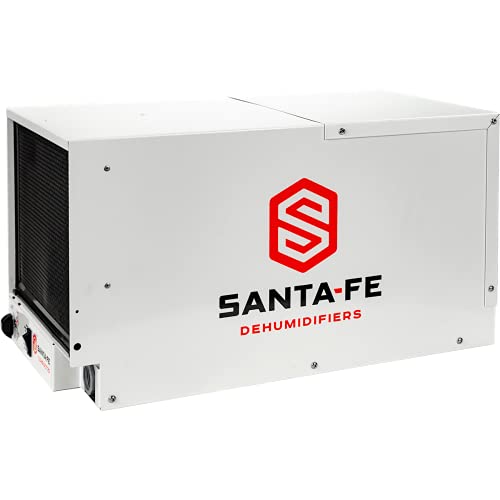
 ← 12 in wide, 12 in high, 28 in long (Santa Fe) →
Spec sheet
| Capacity at 73°F / 60% RH (Santa Fe data sheet) | 52.45 pints/day; not on ENERGY STAR's list |
| Legacy rating (80°F / 60% RH) | 70 pints/day |
| Efficiency | 2.04 L/kWh (4.31 pints/kWh) at 73°F |
| Operating range | 49-95°F inlet air |
| Airflow and ducts | 150 CFM at 0.0 in.; 130 at 0.4 in.; 0.5 in. max; 8 in collars |
| Size and weight | 12 W x 12 H x 28 D in; 55 lb |
| Electrical | 115 V, 4.1 A, 492 W at 73°F; 9 ft cord; 15 A circuit |
| Filter and ventilation | MERV-13; optional outdoor-air duct |
| Noise | 55.3 dBA average (Santa Fe) |
| Owner-reported issue | Evaporator refrigerant leaks; units failing within the first year |
Verdict
Owner reports come from r/hvacadvice, r/HVAC and GreenBuildingAdvisor, and the record is thin: owners name the Ultra70, the Ultra 70 or the Ultra-Aire 70H it replaced. Three are positive (two Ultra70s that took a house from 65% to the high 40s, units used commercially for drying, and a ventilation setup fixed with scheduled exhaust fans). Others describe noise and installation issues: louder than the air conditioner at the return, humidity re-evaporating from the AC coil on a return-to-return install, and how to set up the drain trap. Failures: two units that lost their charge to evaporator leaks within a year, one that failed at 11 months, and mold on the filter of an Ultra70 in a sealed crawl space. Most posts predate the current R454B part.
Read full take ↓


The Santa Fe Ultra70 is the whole-house dehumidifier for a small, tight house or a single floor where nothing bigger will fit. It's a 12 by 12 inch box, 28 inches long, that hangs in an attic or sits in a closet, ducts with 8 in collars, filters through MERV-13, and can pull in outdoor air for ventilation. Santa Fe rates it at 52.45 pints a day at 73°F and 60% humidity, the same condition ENERGY STAR uses for whole-home units.
For most buyers, though, we'd spend about the same money on an AprilAire E080, which ENERGY STAR certifies at 65 pints at that condition, or step up to the E100 at 85. The Ultra70 earns its place when its size, its fresh-air port or its filter is what you need. Expect it to be heard through the ductwork, and keep the warranty paperwork: early evaporator leaks run through its owner record.
One naming note. Santa Fe's data sheet says the Ultra70 was previously the Ultra-Aire 70H, and the current version is part 4044100. The Compact70 is a different, crawl space unit, and the Ultra98, Ultra120 and Ultra155 are bigger machines with their own records.
Where it fits
- Tight spaces: a 12 in square cross-section and a rotating outlet panel that sends air out horizontally or straight up.
- Ventilation: an optional outdoor-air duct turns it into a ventilating dehumidifier, useful in an airtight house.
- Filtration: a MERV-13 filter in the cabinet, finer than the washable MERV 8 in AprilAire's units.
- Low power draw: 492 W and 4.1 A at the 73°F rating point, on an ordinary 15 A, 115 V circuit.
Where it doesn't
- Capacity: 52.45 pints at 73°F is modest for a whole house; AprilAire's E080 and E100 certify 24% and 62% more at the same condition.
- Efficiency: an integrated energy factor of 2.04 L/kWh against 2.35 for the AprilAire units, so it spends about 15% more electricity per pint.
- Noise in the ducts: owners hear it through the ductwork, and one finds it louder than their air conditioner.
- Coil failures: evaporator leaks and dead units in the first year or two come up in the owner record.
The ratings, and how they compare
Santa Fe publishes two numbers: 70 pints a day at 80°F and 60% humidity, the old industry rating, and 52.45 at 73°F and 60%, the DOE's whole-home condition. Size by the 52.45. At 73°F the unit removes 75% of what it does at 80°F, and less again in a 60°F basement. The Ultra70 isn't on ENERGY STAR's dehumidifier list, so the 73°F figure is Santa Fe's own.
Unit | Pints/day at 73°F | Efficiency (L/kWh) | Airflow | Duct size | Lowest inlet air |
|---|---|---|---|---|---|
52.45 (Santa Fe) | 2.04 | 150 CFM | 8 in | 49°F | |
AprilAire E080 | 65.00 (ENERGY STAR) | 2.35 | 185 CFM | No figure | 50°F |
85.00 (ENERGY STAR) | 2.35 | 280 CFM | 10 in | 50°F | |
Honeywell DHM065 | 52.09 (ENERGY STAR) | No figure | No figure | No figure | No figure |
43.7 at 65°F (portable test) | 1.96 at 65°F | 150 CFM | 8 in | 49°F |
On energy, 52.45 pints is about 24.8 liters. At 2.04 L/kWh that's roughly 12.2 kWh to remove a full day of rated capacity, close to what 492 W draws over 24 hours. The unit cycles off at its setpoint, so most days use less. The Compact70's 43.7 is measured at 65°F under the portable test, so it isn't directly comparable with the Ultra70's 73°F figure.
How much house it covers
Santa Fe says up to 1,800 sq ft, and its data sheet bases that on 10 ft ceilings (18,000 cubic feet). Treat it as a ceiling, not a target: one owner needed two of them, one on each floor of a two-story house, to bring humidity from 65% to the high 40s. A leaky house in a humid climate will keep a single unit running. If you're drying a whole house in the Gulf South or Southeast, size up to an E100 or a larger Santa Fe.
Where to put it and how to duct it
Santa Fe's manual says a qualified service technician should install it, and that matches how most of them go in: tied into an attic or closet air handler. Here's what the manual asks for, so you can judge a quote or plan the space:
- Recommended ducting: a dedicated 8 in return from a central spot in the house, never a bathroom or kitchen, with the dehumidifier's supply feeding the HVAC supply through a backdraft damper.
- Duct size and static: 8 in duct for up to 25 ft of total run, 10 in beyond that, and never more than 0.5 in. of static pressure. Airflow falls from 150 CFM to 130 at 0.4 in.
- Drain: a P-trap is required because the drain pan runs under negative pressure; without it water can back up and leak. Use 3/4 in pipe sloped 1 in per 10 ft, or a condensate pump.
- Over finished space: a secondary drain pan with a float switch under the unit.
- Power: a 9 ft cord to a 115 V outlet on a 15 A circuit; the manual calls for a dedicated GFCI-protected outlet near any water source.
- Control: the onboard humidistat sits in the unit; for an attic or crawl space install, a remote DEH300 or DEH300R control in the living space reads the house, not the attic.
The supply connection matters more than it looks. Feed dry air into the return side while the air conditioner's fan runs after a cooling cycle and the air picks the water back up off the wet coil, so humidity jumps. Ducting into the supply, with a backdraft damper, avoids that. The manual's preferred setup does exactly this.
If you use the outdoor-air port, plan for exhaust. A ventilating dehumidifier only pushes air in, and in a very tight house the incoming air needs somewhere to go; one owner with two units brought indoor CO2 under control only after setting exhaust fans to run on a schedule.
Without a nearby drain, a small pump such as the Little Giant VCMA-15 does the lifting, with the trap still in place between the unit and the pump.
Noise and reliability
Expect to hear it. The cabinet is rated 55.3 dBA on average, but owners say most of the sound arrives through the ductwork, with air rushing at the return grille; one crawl space owner adds that the fan cycles on every half hour to sample humidity even when the unit isn't drying. In an insulated attic or crawl space it fades into the background; next to a bedroom with a stud wall between, you'll notice it. Flexible duct at the collars, which the manual recommends, keeps vibration out of rigid ductwork.
Reliability is the bigger question. The most specific Ultra70 reports are about refrigerant leaks in the evaporator: two units that lost their charge within a year, and a new-construction unit that failed at 11 months. Owners of Santa Fe's larger Ultra models describe the same coil failures. Santa Fe's warranty has handled these with replacement units, by owners' accounts without much argument, but labor isn't included, and once an installer's own labor coverage runs out, swapping an attic unit is a paid service call. One owner of a ducted Santa Fe whole-house unit, model not named, also found mold on the coil side of the filter in a sealed crawl space, possibly because the filter sits close enough to the cold fins to drop below the dew point.
Most of these reports predate the current R454B unit, part 4044100, and there isn't enough owner history on it yet to say whether the coil record has changed.
The warranty
Santa Fe markets 6 years. The manual's written terms are 5 years on the product and 6 on its components, from the date of purchase, with Santa Fe choosing whether to replace a part or the whole unit. Labor, shipping, removal, reinstallation and installer-supplied materials aren't covered, and neither are used units bought from third parties. The warranty is void if a defect results from not following the installation instructions, and running without the recommended filter voids it outright. Register the unit at santa-fe-products.com, keep the receipt, and keep the recommended filter in it.
How it compares
- AprilAire E080: the one we'd cross-shop first. ENERGY STAR certifies it at 65 pints at 73°F, 24% more than the Ultra70, with a better efficiency figure and similar pricing when we checked. It has no ventilation port and a coarser filter.
- AprilAire E100: our pick for ducting into a whole house: 85 pints at 73°F, 280 CFM and 10 in ducts, at a higher price and in a bigger cabinet.
- Santa Fe Compact70: the crawl space version, rated 43.7 pints under the 65°F portable test, with the same MERV-13 filter and 49°F floor. Buy it for a sealed crawl space; buy the Ultra70 when you're ducting into living space.
Should you buy the Ultra70?
Buy it for a small or very tight house, a single floor, or an attic with no room for a bigger cabinet, especially if you want the fresh-air port or the MERV-13 filter. Duct it into the supply with a backdraft damper, give it a trapped drain, put the control in the living space, and register it the day it's installed.
If you're drying a whole house, or you have room for a bigger cabinet, the AprilAire E080 or E100 removes more water for the money. And if the noise matters, keep the return grille away from bedrooms.
Score breakdown
Santa Fe rates it at 52.45 pints/day at the 73°F whole-home condition, with a 2.04 L/kWh energy factor, 150 CFM, a MERV-13 filter, an outdoor-air port and a 49°F floor. That's modest capacity for a whole house next to the AprilAire E080 and E100, and owners hear it through the ductwork.
The owner record includes evaporator refrigerant leaks and units that failed within a year, which Santa Fe has handled with replacements. The written warranty runs 5 years on the product and 6 on components, but labor, shipping and reinstallation are on you. There's little owner history yet on the current R454B version.
It costs about the same as an AprilAire E080, which ENERGY STAR certifies to remove 24% more water at 73°F with better efficiency. The Ultra70's compact cabinet, ventilation port and MERV-13 filter are worth paying for only if you need them. Check the current price on Amazon.
Santa Fe Ultra70 on Amazon.
The Evidence Behind Our Verdict
Owner reports come from r/hvacadvice, r/HVAC and GreenBuildingAdvisor, and the record is thin: owners name the Ultra70, the Ultra 70 or the Ultra-Aire 70H it replaced. Three are positive (two Ultra70s that took a house from 65% to the high 40s, units used commercially for drying, and a ventilation setup fixed with scheduled exhaust fans). Others describe noise and installation issues: louder than the air conditioner at the return, humidity re-evaporating from the AC coil on a return-to-return install, and how to set up the drain trap.
Failures: two units that lost their charge to evaporator leaks within a year, one that failed at 11 months, and mold on the filter of an Ultra70 in a sealed crawl space. Most posts predate the current R454B part.
Our rating above is our own editorial call. What follows is the field evidence we weighed to reach it: first-hand reports from owners on Reddit and independent HVAC and DIY forums, which we lean on more than manufacturer-influenced published reviews because unsponsored owners tend to be the more candid signal.
What Reddit Is Saying
“Post-installation, I noticed the humidity levels were around 65%, which was higher than comfortable. Quickly, I added two Santa Fe Ultra70 whole house dehumidifiers and they've brought the humidity down to our ideal target of 47-50%.”
“These work great for supplemental dehum for drying cannabis I will tell you that. Workhorses. A little on the “not quiet but not that loud.” side I would say.”
“I mean I understand how it works, but because the dehumidified air passes over the AC coil while the AC is off (right after it turns off), the leftover water on the coil re-evaporates. I can show you my graphs - it's quite apparent. I just need to pipe into the supply instead of the return, to avoid this.”
“It's my understanding that I'm supposed to create a trap for my ultra 70 as it has negative pressure (if my terminology is correct).”
“I've had two of these things lose their charge over the span of a year. Both of them have had leaks in the evaporator. Manufacturer has replaced them both under warranty without any hassle, but wondering if there's a more widespread problem here?”
“It failed 11 months after we moved in; thankfully, all parts and labor for this unit were covered by a 2-year parts and labor warranty, so I paid nothing. In May 2024, it only took two A/C technicians about 45 minutes to unbolt the old unit in the attic and install a brand new one in its place.”
“The point of all this information is that this relatively little thing is kind of loud (relatively speaking), way louder than the air conditioner. The instructions suggest using at least a little bit of flex duct as a means of preventing noise/vibration from directly transmitting through rigid metal ducts, which I have done (there's about 8 feet of flex duct including a bend that leads into the intake register box), but still it is by no means quiet.”
What Owner Forums Say
“I have set the exhaust fans to run at intervals every hour for 30 min. This has helped tremendously. Our CO2 readings are now consistently below 700, and we feel generally "better" in the house, even if it is all psychosomatic.”
“My sealed/encapsulated crawl space has a ducted Santa Fe whole house dehumidifier with filter. Today I changed the OEM Santa Fe filter, and was shocked to discover the outgoing side next to the fins is covered in mold.”
Frequently asked questions
Is the Santa Fe Ultra70 worth it?
It costs about the same as an AprilAire E080, which ENERGY STAR certifies to remove 24% more water at 73°F with better efficiency. The Ultra70's compact cabinet, ventilation port and MERV-13 filter are worth paying for only if you need them. Check the current price on Amazon.
How reliable is the Santa Fe Ultra70?
The owner record includes evaporator refrigerant leaks and units that failed within a year, which Santa Fe has handled with replacements. The written warranty runs 5 years on the product and 6 on components, but labor, shipping and reinstallation are on you. There's little owner history yet on the current R454B version.
How well does the Santa Fe Ultra70 perform?
04 L/kWh energy factor, 150 CFM, a MERV-13 filter, an outdoor-air port and a 49°F floor. That's modest capacity for a whole house next to the AprilAire E080 and E100, and owners hear it through the ductwork.
What do real owners say about the Santa Fe Ultra70?
Owner reports come from r/hvacadvice, r/HVAC and GreenBuildingAdvisor, and the record is thin: owners name the Ultra70, the Ultra 70 or the Ultra-Aire 70H it replaced. Three are positive (two Ultra70s that took a house from 65% to the high 40s, units used commercially for drying, and a ventilation setup fixed with scheduled exhaust fans). Others describe noise and installation issues: louder than the air conditioner at the return, humidity re-evaporating from the AC coil on a return-to-return install, and how to set up the drain trap.
Options Worth Checking Out

AprilAire E100 Whole-House Dehumidifier
Our pick for ducting into a whole house: 85 pints/day at 73°F on ENERGY STAR, 62% more than the Ultra70, with 280 CFM and 10 in collars. Bigger cabinet and higher price; sold by Amazon itself. We reviewed it in full.
Read our full review: we scored it 7.2/10
Santa Fe Compact70 Dehumidifier (4044110)
Santa Fe's crawl space unit and cheaper when we checked: 43.7 pints/day under the 65°F portable test, the same MERV-13 filter and 49°F floor. Better for a sealed crawl space than for ducting into living space.
Read our full review: we scored it 7.0/10
You Might Also Need
Accessories worth grabbing alongside your purchase

Little Giant VCMA-15ULS Condensate Pump
For an attic or closet install with no drain below the unit. Keep Santa Fe's required P-trap between the dehumidifier and the pump. We reviewed this one; its overflow switch can drive a separate high-water alarm.
Read our full review: we scored it 7.3/10
More Santa Fe Reviews
See all →
How Does It Compare?
Side-by-side breakdowns featuring this product

