Senville Aura vs Leto: Your Coldest Night Picks the Winner
By Wendell Asaro · Updated October 2026
Independent editorial review. We never accept payment for coverage, though we may earn a commission if you purchase through our links.

Verdict
Senville Aura (12k)
Senville Leto (12k)
We read owner threads on r/hvacadvice, r/heatpumps and r/woodworking. No one owned both lines. Reports from Senville owners who didn't name their line are covered in the text, not shown as cards, and the problem reports on each line (an F5 code, two DIY vacuum mistakes, a Leto owner who chose it over the Aura on cost) are carded in our two single-product reviews. Aura cards here: three owners whose units run or installed well. Leto cards: four owners reporting units working well, two of them on 24ks. Neither line's owners describe performance on single-digit nights, so the cold-weather verdict rests on NEEP's figures.
Read full take ↓


Pick by your coldest night. If winter regularly reaches the single digits and the heat pump has to carry the room, buy the Senville AURA 12,000 BTU mini-split. If your winters stay well above 5°F and cooling is half the reason you're shopping, buy the Senville LETO 12,000 BTU mini-split. They come from the same company, sit under the same warranty certificate and go in the same way: a vacuum pump, a manifold gauge and a licensed HVAC contractor if you want the warranty. What separates them is heat in the cold. NEEP's cold-climate list certifies the current Aura 12k at 11,500 BTU/h at 5°F. The Leto 12k makes 8,000 on its 230V version and 6,600 on the 115V version our Amazon link goes to, and Senville says the Leto is designed to heat down to 5°F, where the Aura is published to -22°F.
The Aura keeps 96% of its 47°F heating rating at 5°F, and Senville's spec tables back its compressor for 10 years against the Leto's 5. The Leto cost a good deal less when we checked, and in a mild climate you'd rarely touch the heat it lacks. The installer's bill is the same on both, which narrows the Leto's price edge on the whole job more than the box prices suggest.
Check both Amazon listings before you pay. The Aura listing is the 208/230V SENA-12HF-16 with a 16 ft line set; its 25.5 efficiency figure matches the older R-410A Aura 12k, and its warranty field reads 2 years parts and 7 compressor. The Leto listing is the 115V SENL-12CD, with no refrigerant listed. Confirm the model number and refrigerant with the seller.
What the two lines share
More stays the same between them than most shoppers expect. Senville's product FAQs answer "Can I install the system myself?" with "No." on both lines. Both install manuals have the installer evacuate the lines with a vacuum pump and manifold gauge before the refrigerant valves open, and neither line has a quick-connect version. Both outdoor units carry a factory charge for 25 ft of line, need at least 9.84 ft, and allow the same maximum runs: 82 ft on the 9k and 12k, 98.4 ft on the 18k and 164 ft on the 24k. Both use R-454B in their current versions.
Both are also governed by the same Senville warranty certificate. It says that for the warranty to be valid it "must be completed by a licensed professional," and its proper-installation clause limits coverage to systems "installed by a state-certified or licensed HVAC contractor," with Senville able to ask for proof. Labor is excluded on both.
What changes is cold-weather capacity, efficiency, the compressor term, the voltage options and the size range. The Aura is 208/230V at every size we checked and runs 9k to 24k as a single-zone wall unit in the sizes we rate. The Leto adds 115V versions at 9k and 12k and goes up to 36k. There's no single-zone Aura 36k that we could find; Senville's 36k Aura address redirects to the Leto 36k.
Side by side: the 12k against the 12k
Figures are Senville's spec tables and install manuals unless a row says NEEP, whose figures come from the AHRI certification. Where the Leto has two numbers, the 115V version comes first, then the 230V.
Spec | Aura 12k | Leto 12k (115V / 230V) |
|---|---|---|
Rated heat at 47°F | 12,000 BTU/h on NEEP (Senville's site lists 13,000) | 12,000 on both voltages |
Heat at 17°F (NEEP) | 12,000 | 9,000 / 9,300 |
Heat at 5°F (NEEP) | 11,500 | 6,600 / 8,000 |
Lowest published heating point | -22°F, where NEEP lists a 5,900 BTU/h maximum | 5°F per Senville's FAQ |
SEER2 | 25.4 | 21.2 / 21.3 |
HSPF2 (NEEP) | 10.5 (Senville's site says 13.7) | 8.7 / 9.1, the same as Senville's site |
ENERGY STAR / Cold Climate (NEEP) | Yes / yes | No / no on either voltage |
Electrical | 208/230V only, 12 A minimum circuit ampacity, 15 A max fuse | 115V at 19 A and 20 A, or 208/230V at 13 A and 15 A |
Sound | Indoor 24 to 47 dB, outdoor 57 dB | Indoor 17.5 to 45 dB, outdoor 54 dB (115V) |
Indoor unit width | 33.40 in | 31.57 in |
Compressor / parts warranty (spec tables) | 10 years / 5 years | 5 years / 5 years |
Single-zone wall sizes | 9k to 24k in our ratings (NEEP and Amazon also list 6k, 15k and 33k) | 9k to 36k |
What's the same on both: the line set (charged for 25 ft, 9.84 ft minimum, 82 ft maximum with 49.2 ft of height difference), the licensed HVAC install the warranty requires, and the labor exclusion.
Heat in the cold, size by size
The box number is a 47°F rating. Here's NEEP's rated heat at 5°F for each size, in BTU/h, with the share of each unit's 47°F rating it keeps. Percentages use the AHRI 47°F figures on NEEP; for the Leto those match Senville's own rated heating.
Size | Aura at 5°F | Leto at 5°F |
|---|---|---|
9k | 11,500 (96%) | 6,500 (65%) on 115V; 7,000 (70%) on 230V |
12k | 11,500 (96%) | 6,600 (55%) on 115V; 8,000 (67%) on 230V |
18k | 18,000 (100%) | 11,500 (61%) |
24k | 24,200 (83%) | 17,000 (71%) |
36k | No single-zone Aura | 21,400 (59%); NEEP adds a -13°F maximum of 11,200 |
Among other requirements, ENERGY STAR's cold-climate criteria ask for at least 70% of the 47°F capacity at 5°F. NEEP flags all four Aura wall pairings as ENERGY STAR Cold Climate. On the Leto, only the 230V 9k and the 24k carry that flag. If a utility rebate rides on it, check the exact pairing before you buy.
Put a room on it. Say a heat-loss estimate puts a bedroom addition at 10,000 BTU/h on a 5°F night (an illustration; your number comes from a Manual J or a careful load calculation). The Aura 12k covers it with 1,500 to spare. The 230V Leto 12k comes up 2,000 short, a fifth of the load, and the 115V Leto 12k comes up 3,400 short, about a third. You'd cover that gap with resistance heat on the nights you need heat most.
The obvious workaround is a bigger Leto, and on paper the Leto 18k matches the Aura 12k at 5°F, 11,500 BTU/h each. We wouldn't do it. An 18k in a room that needs a 12k short-cycles through the mild months, which is most of the heating season and all of summer, and pulls less humidity while it does. And 5°F is where the Leto's published data stops. Senville says the line is designed to heat down to 5°F, while the Aura 12k still lists up to 5,900 BTU/h at -22°F. If your winters go below zero, a bigger Leto gets you a bigger unit with the same floor.
Below zero, neither is a whole-room answer on its own. The Aura 12k's 5,900 BTU/h at -22°F is about half its rating, and a room that needs 10,000 at 5°F needs more than that at -22°F, so plan backup heat for those nights with either unit. The difference is how often the backup runs. With the Aura it covers the deep-cold nights. With a 115V Leto 12k it's already carrying a third of that room's load at 5°F, and Senville publishes nothing about what the Leto does below that.
One caveat on the Aura's numbers. MrCool's submittal for its Olympus 9k and 12k, which share the Aura's NEEP ratings value for value, prints 9,800 BTU/h at 17°F rather than NEEP's 12,000. Both sources agree on 11,500 at 5°F, which is why we compare at 5°F. Even at 9,800, the Aura 12k beats both Leto 12ks at 17°F.
Efficiency and what it costs to run
In cooling the gap is plain. On the 12k, 25.4 SEER2 against the 115V Leto's 21.2 means the Leto uses about 20% more electricity for the same cooling on the ratings (25.4 divided by 21.2). On the 9k it's 27.4 against 21.5 for the 115V Leto, about 27% more.
Heating efficiency is harder to pin down, because Senville's published HSPF2 for the Aura didn't hold up. Its product pages list 13.9, 13.7 and 13.4 for the 9k, 12k and 18k, while the AHRI-certified figures on NEEP's listings are 12.5, 10.5 and 11.0. We use the certified ones. For the Leto 12k, NEEP's certified figures match Senville's own: 8.7 on the 115V and 9.1 on the 230V. Against the Aura's certified 10.5, the 115V Leto uses about 21% more electricity for the same seasonal heat (10.5 divided by 8.7), and the 230V about 15%. On Senville's site figures for both, 13.7 against 8.7, the 115V gap would be about 57%. We'd plan on the smaller gaps, since Senville's Aura figure came in high once AHRI certified it. Either way the Aura costs less to run in both modes on the ratings.
Over years of running, that pays back part of the Aura's higher price. How much depends on your rates and hours; in a room you mostly cool in a mild climate, the payback is slow, and the Leto's lower price is the better bet.
Install, voltage and the warranty
The install is the same job on either: connect the lines, evacuate them and the indoor unit, then open the valves. The Leto manual calls for evacuating for at least 15 minutes or until a micron gauge reads 500 microns, and its A2L requirements add no rise above 1500 microns in 10 minutes once the pump is isolated; in our view the Aura deserves the same check with a micron gauge. Under EPA's Section 608 rules, attaching gauges and hoses or adding and removing refrigerant is technician work that requires certification, and the regulatory definition of a technician can include owners. A licensed contractor brings the tools and the card, and Senville's warranty asks for that contractor on either line.
Voltage is where the Leto has a real advantage. Every Aura size we checked is 208/230V, which in most houses means a new circuit. The Leto 9k and 12k come in 115V. That isn't a plug-in: the 115V Leto 12k lists 19 A minimum circuit ampacity and a 20 A max fuse, which in practice means a circuit of its own, but not a 240V one. If your panel can take a 240V breaker, the 230V Leto 12k makes 8,000 BTU/h at 5°F against the 115V version's 6,600, on a 15 A max fuse. Have a licensed electrician size and run either circuit to your local code.
The warranty gap is the compressor. Senville's spec tables list 10 years on the Aura's compressor and 5 on the Leto's, with 5 years on parts for both. A compressor that fails in years six through ten is covered on a qualifying Aura install and not on a Leto. Nothing else in the terms differs. The Amazon Aura listing we link gives its warranty as 2 years parts and 7 compressor, so confirm the term for the model you receive when you register at senville.com/warranty; even 7 years beats the Leto's 5.
None of that applies if you do the whole job yourself. Read plainly, a full DIY install leaves either unit without coverage. The middle path, running the lines yourself and paying a contractor to evacuate and start the system, is a gray area on both: "completed by" could fit a contractor who finishes the job, while "installed by" reads tighter. You'll read that Senville will honor the warranty "in most jurisdictions" if you get your EPA 608 certification online and install it yourself. We read the certificate's "state-certified or licensed HVAC contractor" as asking for more than a 608 card. Ask Senville in writing before you count on coverage from either route.
That cuts in an odd direction. If you're going to self-install anyway, and plenty of owners on both lines do, the Aura's longer compressor term is worth nothing to you, and the Leto's lower price limits what's riding on your own connections and vacuum work. We'd still hire it out. Two self-installers, one on each line, ended up asking whether their system had to be recovered and recharged after a vacuum step went wrong.
What owners report
Owner reports can't settle the cold-weather question for either line, because almost nobody says what their unit did on a single-digit night. They're more useful on ownership, and the record looks better for both than the problem reports in our two reviews suggest, once you count owners who mention their Senville in passing. Nobody on record owns both lines.
Letos mostly keep working. A 24k has run hard for five years since its owner installed it and is called flawless. A 2-ton Leto keeps a shop its owner puts at 2,400 square feet warm in Canada, though with no word on how cold it gets or how well the shop is insulated, we can't check that against the specs. A Leto 12k did just fine in South Texas, and one in its second year works great apart from a winter noise from the wall-mounted outdoor unit that carries through the wall. One owner picked the Leto over the Aura on cost and is pleased with its power draw (they put the Aura close to 30 SEER; Senville's best published figure is 27.4 SEER2, on the 9k). The problems: an EL 01 communication error on a 12k at eight months and the same code on a 9k, a water leak from day one for two owners, four owners who couldn't get the SEN20-ACK1T smart kit to pair with the Senville app, and the skipped vacuum.
Aura owners with a track record report no trouble, including one who installed seven Auras over two years across a house, a pole barn and a solar shed, and one whose basement unit has run flawlessly in heating and cooling for six months. A first-timer installed an 18k in about six hours, with no word since on how it runs. The problems are single cases: an F5 code with no airflow on first use that wasn't covered by warranty, a four-month-old 24k shutting off seconds after starting, a 33k condenser damaged in shipping, mismatched wiring labels, and a Texas garage 9k self-installed in August, after no tech would call back, that turned up a leak after a vacuum mistake. Only the Leto smart-kit trouble shows up with more than two owners on either line.
The rest is brand-level. Two Senville owners who didn't name their line ran the lines themselves and paid a pro for the vacuum, and both units work well; one 18k handled a 98°F day and a 21°F low in its first six months. That route has another side: a shopper looking at an Aura 24k found local techs didn't want to touch systems they don't sell, and a self-install wouldn't be warrantied, so they bought something else. The one cold-weather complaint is a Senville owner, line not named, who calls the defrost logic in cold conditions very poor. Opinions on Senville parts and support split, as they did in both reviews.
Where the Olympus and MrCool DIY fit
If you've spotted the overlap with MrCool, you're right. Each 9k to 24k Aura wall pairing on NEEP's list carries the same ratings, value for value, as the matching MrCool Olympus E Star 4th Gen pairing. The Leto 12k, 24k and 36k indoor units list the same widths to the hundredth of an inch as MrCool's DIY 5th Gen 9k/12k, 18k/24k and 36k wall units, though the Leto 9k and 18k are narrower. Both brands are often said to come from Midea. Neither Senville nor MrCool names a factory, and we haven't confirmed one. Shared hardware, if it is shared, doesn't carry over the install method or the warranty, and those are what differ.
That gives you three outside options. If a contractor is installing it anyway, the MrCool Olympus has identical published ratings to the Aura, with a 7-year compressor term and a warranty that says a licensed contractor "may be necessary" rather than requiring one, though MrCool still says an HVAC professional must install it; it sells mainly through HVAC retailers, so compare quotes. If you'll install it yourself and want a warranty that survives, the MrCool DIY 5th Gen 12k ships pre-charged quick-connect lines and allows owner installs, at 8,400 BTU/h at 5°F: more than either Leto 12k, less than the Aura. The Pioneer Diamante Pro 12k cost between the two Senvilles when we checked and makes 9,000 BTU/h at 5°F, rated to heat only down to -4°F; Pioneer's policy doesn't require a licensed installer, but it's still a vacuum install. Our best cold-climate mini-split guide covers the wider field.
Pick by your coldest night
Buy the Aura if your winters reach 5°F or below, or if you want one unit to carry a room without backup most nights. On the 12k it makes 4,900 more BTU/h at 5°F than the 115V Leto and 3,500 more than the 230V, keeps heating to -22°F, costs less to run in both modes on the ratings, and carries twice the compressor term. Pay the licensed contractor, register it, and keep the invoice. The full numbers are in our Senville Aura review.
Buy the Leto if winter stays well above 5°F, cooling is the bigger job, and a contractor is installing it. It cost a good deal less when we checked, it's the only one of the two with a 115V option, and its indoor unit is quieter on paper. Look for the 230V version if your panel allows; our link goes to the 115V 12k, which keeps 55% of its rating at 5°F. If you want a Leto mainly for heat, the 24k holds 71% and carries the cold-climate flag, and the five-year owner and the Canadian shop owner above both run 24ks. More in our Senville Leto review.
If you live in between, with a handful of single-digit nights a winter and a furnace or baseboard that can cover them, either works and the choice is money against margin. We'd lean Aura for a room you heat every day and Leto for a room you mostly cool.
Scores at a Glance
Senville Aura (12k)
Our pick
Senville Leto (12k)
Filled circle = category winner. Scores are our editorial assessments on a 1 to 10 scale.
Reliability & Durability
Same install, same warranty certificate, same licensed-installer rule, and neither line has a large owner record. Across all the reports, the Leto's record is a little better than its review sample suggested, including a 24k running five years, and the Aura's is about as thin. We kept both reviews' scores because the compressor term separates them: 10 years on the Aura against 5 on the Leto, labor excluded on both.
Performance & Results
The Aura 12k is certified at 11,500 BTU/h at 5°F, 96% of its rating, and is published to -22°F; the Leto 12k makes 8,000 on 230V and 6,600 on 115V, and Senville rates it to heat only down to 5°F. The Aura also leads on efficiency, 25.4 SEER2 against 21.2. These are the same scores as our two reviews.
Value
The Leto cost a good deal less when we checked, but the licensed contractor costs the same on both, which narrows the gap on the whole job. In a mild climate the Leto is the better value. In a cold one, the 3,500 to 4,900 BTU/h it gives up at 5°F on the 12k turns into a backup-heat bill, and the Aura's lower running cost on the ratings pays back part of its price.
The Evidence Behind Our Verdict
We read owner threads on r/hvacadvice, r/heatpumps and r/woodworking. No one owned both lines. Reports from Senville owners who didn't name their line are covered in the text, not shown as cards, and the problem reports on each line (an F5 code, two DIY vacuum mistakes, a Leto owner who chose it over the Aura on cost) are carded in our two single-product reviews.
Aura cards here: three owners whose units run or installed well. Leto cards: four owners reporting units working well, two of them on 24ks. Neither line's owners describe performance on single-digit nights, so the cold-weather verdict rests on NEEP's figures.
Our rating above is our own editorial call. What follows is the field evidence we weighed to reach it: first-hand reports from owners on Reddit and independent HVAC and DIY forums, which we lean on more than manufacturer-influenced published reviews because unsponsored owners tend to be the more candid signal.
Senville Aura (12k) owners
“I bought and installed 7 sennville aura mini splits from amazon for my house, pole barn and solar shed over the past 2 years. Very efficient and have had no issues.”
“I installed a Senville Aura in my basement six months ago and the unit is pre charged for up to a 25 ft line set. Pressurized line set with nitrogen a couple of times and then vacuumed. Unit runs flawlessly in cooling and heating.”
“They are not difficult to install at all. I’ve never installed one before and it took me about 6 hours. A lot of the time was spend reading through the instructions and watching YouTube videos to make sure I did everything correct. It’s a 18000 btu Senville aura.”
Senville Leto (12k) owners
“I have had a Senville unit I’ve been running hard for five years and it’s flawless.”
“A 2 ton Senville Leto keeps my 2400 sq shop warm in MF Canada.”
“On my 2nd year with a Senville Leto DIY. Works great. Replaced a PTHC/PTAC, that worked well enough, but was expensive in the winter. You do need to vacuum lines with the Senville. It's wall mounted and does have a noise in winter that transmits through the wall. However, if you are used to the PTAC this is much less noise.”
“My last house with a 20x20 garage had only 1 side not insulated but the house was 2 story so insulated above the garage and my door was insulated an the cheapest leto series Seville 12K unit did just fine in my south texas home.”
Frequently asked questions
Should I buy the Senville Aura (12k) or the Senville Leto (12k)?
Check both Amazon listings before you pay. 5 efficiency figure matches the older R-410A Aura 12k, and its warranty field reads 2 years parts and 7 compressor. The Leto listing is the 115V SENL-12CD, with no refrigerant listed.
How do the Senville Aura (12k) and Senville Leto (12k) compare on construction?
Same install, same warranty certificate, same licensed-installer rule, and neither line has a large owner record. Across all the reports, the Leto's record is a little better than its review sample suggested, including a 24k running five years, and the Aura's is about as thin. We kept both reviews' scores because the compressor term separates them: 10 years on the Aura against 5 on the Leto, labor excluded on both.
What do real owners say about the Senville Aura (12k) and the Senville Leto (12k)?
We read owner threads on r/hvacadvice, r/heatpumps and r/woodworking. No one owned both lines. Reports from Senville owners who didn't name their line are covered in the text, not shown as cards, and the problem reports on each line (an F5 code, two DIY vacuum mistakes, a Leto owner who chose it over the Aura on cost) are carded in our two single-product reviews.
Top Picks
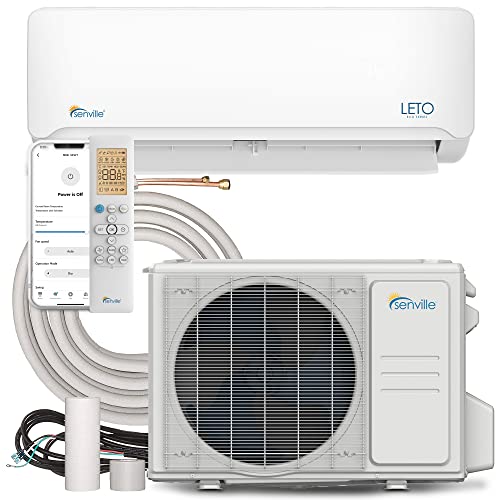
Senville LETO 12,000 BTU Mini-Split Heat Pump
The mild-winter pick: cost a good deal less than the Aura when we checked and cools at 21.2 SEER2, but this 115V SENL-12CD makes 6,600 BTU/h at 5°F and heats only to 5°F. Same vacuum install and licensed-installer warranty rule.
Read our full review: we scored it 6.4/10

MRCOOL DIY 5th Gen 12,000 BTU 115V Mini-Split
If you will install it yourself: pre-charged quick-connect lines, no vacuum step, and a warranty that allows owner installs. Its 8,400 BTU/h at 5°F beats both Leto 12ks and trails the Aura. It cost more than the Aura when we checked.
Read our full review: we scored it 6.9/10
You Might Also Need
Accessories worth grabbing alongside your purchase

Full Individual Reviews
Deep-dive on each, individually
