Senville Multi-Zone Review: Big Cold-Weather Heat, Pro Install Only
By Wendell Asaro · Updated October 2026
Independent editorial review. We never accept payment for coverage, though we may earn a commission if you purchase through our links.
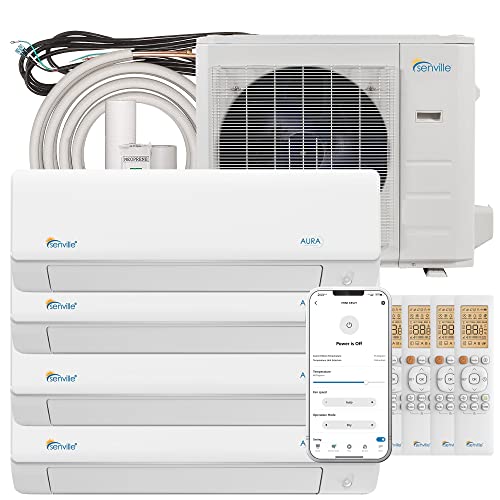
 ← 28K outdoor unit 37.24 in W x 31.89 in H (Senville) →
Spec sheet
| Heat at 5°F (NEEP, system total) | 19,000 (18K); 27,000 (28K); 36,000 (36K); 47,000 (48K) |
| Lowest heating point | -22°F; 10,000 (18K) to 24,600 (48K) max there |
| SEER2 / HSPF2 (wall heads) | 23.0-25.0 / 10.4-11.0; ENERGY STAR Cold Climate |
| Min heat output at 47°F (NEEP) | 5,700 (18K); 8,400 (28K); 10,000 (36K); 13,000 (48K) |
| Zones | 2-3 (18K), 2-4 (28K), 2-5 (36K), 2-6 (48K) |
| Refrigerant lines | Flare and vacuum; 16 ft kit per head; 28K pre-charged for 100 ft total |
| Electrical (28K) | 208/230V; 30 A MCA, 35 A max fuse |
| Warranty | 10 yr compressor / 5 yr parts; licensed installer required; no labor |
| Owner-reported issue | Idle heads and small rooms overheat; head sensors read high in heat mode |
Verdict
Owner reports come from r/DIYHeatPumps, r/hvacadvice, r/heatpumps and r/Senville. Owners of the current R-454B generation report one 27K tri-zone that couldn't keep a floor warm at 20-40°F, one new 18K dual zone that came with more pre-charge than documented, and one installer-owner who found master valves the manual didn't mention. Owners of earlier and R-410A systems fill in the long-term picture. Positive reports cover years of hard use, cold-weather heat, DIY savings, helpful support and a service-mode fix for overheating rooms; negative ones cover temperature control, a system that started blowing cold air after about three years, support that swapped boards without curing the problem, and a voided warranty after an owner install.
Read full take ↓


If you want one outdoor unit to heat three or four rooms through a cold winter, and you'll pay a pro to set it up, the Senville Aura multi-zone is the strongest cold-weather multi-zone we can point you to on Amazon for the money. NEEP rates the 28K condenser behind the tri-zone bundle at its full 27,000 Btu/h at 5°F, about 50% more than MrCool's DIY 27K manages at the same temperature, and every size keeps heating to -22°F. That's our pick for a bedroom floor in a cold climate.
It isn't a DIY system, whatever the forums say. The lines are flared and evacuated with a vacuum pump, Senville's own FAQ answers "Can I install the system myself?" with "No," and the warranty requires a licensed installer. Zone control has the same weakness every budget multi-zone has: an idle head can keep warming its room, and the built-in sensors read high. If you want to do all the work yourself with a warranty behind you, a pre-charged quick-connect system is the safer buy.
Check the model and refrigerant before you order. Senville's current outdoor units end in MOA and run on R-454B. NEEP lists the matching MOB units as R-410A, and the owner of an earlier SENA-28HF-MOA reports R-410A on theirs, so the label on the unit is the only proof. The Amazon listing doesn't name the refrigerant; ask Senville, which sells it there directly.
What it does well, and what it doesn't
- Cold-climate heat: every MOA condenser is ENERGY STAR Cold Climate certified and holds 95-100% of its rated heat at 5°F on NEEP.
- Efficiency: 23.0 SEER2 on the 28K, 36K and 48K and 25.0 on the 18K, with all wall heads.
- Pre-charge for long runs: the 28K carries refrigerant for 100 ft of combined line, so three heads can average about 33 ft each before anyone adds charge.
- Head choice: wall heads from 6K up, plus ceiling cassettes and slim-duct units on the same condensers.
- Professional install: flare connections, a vacuum and leak test, and a warranty that needs a licensed installer.
- Zone control: heads that aren't calling can still push warm air, and the head sensors read high in heat mode.
- Turndown: the 28K can't run below 8,400 Btu/h on a mild day, more than a small bedroom needs.
- Documentation: the multi-zone manuals have gaps owners fill with calls to support.
The condensers, by the numbers
From NEEP's cold-climate list, R-454B MOA condensers with wall heads only, in Btu/h. These are whole-system figures; the heads share them.
Condenser (bundles) | Zones | 47°F | 17°F | 5°F | Max at -22°F | SEER2 | HSPF2 | Min at 47°F |
|---|---|---|---|---|---|---|---|---|
18K (SENA-18HF/D, /T) | 2-3 | 20,000 | 20,000 | 19,000 | 10,000 | 25.0 | 10.4 | 5,700 |
28K (SENA-30HF/D, /T, /Q) | 2-4 | 27,000 | 30,000 | 27,000 | 14,000 | 23.0 | 10.5 | 8,400 |
36K (SENA-36HF/D, /T, /Q) | 2-5 | 36,000 | 38,000 | 36,000 | 22,400 | 23.0 | 10.7 | 10,000 |
48K (SENA-48HF) | 2-6 | 49,000 | 45,000 | 47,000 | 24,600 | 23.0 | 11.0 | 13,000 |
Read the 5°F column against the 47°F one: 95% on the 18K, 100% on the 28K and 36K, 96% on the 48K. That's what earns the Cold Climate label, and it's the reason to buy this over the DIY multi-zones. The 28K and 36K also list more heat at 17°F than at 47°F, which looks odd but is how the ratings came out; plan around the 5°F number. Ducted heads cost efficiency: the 28K drops from 23.0 SEER2 with wall heads to 21.0 with a mix and 19.0 all ducted.
Don't treat those ratings as a promise on every install. When the owner of an R-454B 27K tri-zone complained that two 12K heads couldn't warm about 800 sq ft at 20-40°F, Senville's own support told them total output falls to roughly 16,000-20,000 Btu/h in 20-25°F weather and that the heads share it. That's well under NEEP's 30,000 at 17°F, so leave yourself a margin.
Size the condenser for your coldest night
Say a room-by-room heat-loss calculation puts three rooms at 22,000 Btu/h together at 5°F. The 28K makes 27,000 there and leaves about 5,000 to spare. MrCool's DIY 27K four-zone makes 18,200 and falls 3,800 short. Pick the smallest condenser whose 5°F figure covers the total, and don't step up a size to be safe; the bigger condensers turn down less, and the minimum output column is already the 28K's weak spot.
That minimum matters more than the box size for comfort. At 8,400 Btu/h, a single 9K bedroom head calling on a 45°F night gets more heat than the room can use. Expect some overshoot in small rooms, and put the condenser on rooms that tend to want heat at the same time.
What the installer has to do
This is a flare-and-vacuum job. Senville sells it online, but it doesn't ship pre-charged quick-connect lines, and the warranty depends on a licensed professional. Find the installer before you order; plenty of HVAC companies won't work on equipment a homeowner bought.
- Refrigerant side: each head's lines are flared, pressure-tested and evacuated with a vacuum pump and micron gauge before the outdoor valves are opened. The Aura install manual calls for 500 microns and at least 15 minutes.
- Line lengths: three 16 ft installation kits come with the tri-zone. The 28K's factory charge covers 100 ft of combined line; the service manual Senville links caps a four-port condenser at 262 ft total, 115 ft per head, 49 ft of height between the outdoor unit and a head and 33 ft between heads. Runs past the pre-charge need refrigerant added by the installer.
- Electrical: a dedicated 208/230V circuit for the condenser: 30 A minimum circuit ampacity and a 35 A maximum fuse on the 28K, 17.5/20 A on the 18K, 37/40 A on the 36K and 48K. The manual wants a licensed electrician for the wiring.
- Weight and mounting: the 28K outdoor unit weighs about 168 lb, the 36K about 212 lb. A pad or a bracket rated for it, and two people.
- Multi-zone valves: some condensers have master valves above the zone ports, and the printed manual doesn't always cover them. Get Senville's multi-zone instructions to the installer before the vacuum.
The upside of the vacuum route is flexibility. Lines can be cut to length, and owners have added a head to an unused port later by evacuating only that line, after confirming the steps with Senville.
Living with it
Owners who heat with these mostly like them. Systems installed in 2015-2018 have run hard for years, a 36K four-zone in Iowa kept the main rooms in the high 60s through a week of single-digit lows, and people who did the work themselves report saving thousands over contractor quotes. The R-454B generation has been shipping since at least mid-2025, so its own record is short.
The recurring complaint is control, and it's a multi-zone trait more than a Senville defect. The head's sensor sits in warm air and reads high, an idle head can keep pushing warm air while another room calls, and small bedrooms overheat. Two fixes come up again and again: turn on Follow Me so the remote's sensor runs the room, and use the service-mode fan setting that stops the fan once a head is satisfied. Neither is in the box manual in plain language.
Support gets mixed marks. Senville answers the phone and ships boards readily, sometimes before anyone has diagnosed the problem, and owners who called about install questions describe helpful answers. The trouble is the paperwork: missing multi-zone steps, printed torque values at least one owner found too high, and remotes that don't match the manual. When a system does fail, as with a three-cassette unit that started blowing cold air after about three years, you need a technician, and finding one for a brand they didn't sell is its own job.
The warranty
Senville's spec tables give 10 years on the compressor and 5 on parts, and the Amazon listing matches. The catch is the certificate: the warranty is valid only when a licensed professional completes the install, Senville reserves the right to ask for proof of a proper installation, and labor is never covered. If you install it yourself, assume you have no warranty. One owner who reflared a leaking line in a fly-in-only area said exactly that; no registered installer could reach them, so they were on their own.
How it compares
Option | Heat at 5°F | Lowest point | Min at 47°F | SEER2 | Install and warranty |
|---|---|---|---|---|---|
Senville 28K (tri-zone bundle) | 27,000 | 14,000 max at -22°F | 8,400 | 23.0 | Flare and vacuum; licensed installer required |
Senville 18K (dual zone) | 19,000 | 10,000 max at -22°F | 5,700 | 25.0 | Flare and vacuum; licensed installer required |
18,200 | 9,700 max at -13°F | 8,400 | 23.0 | Quick connect; owner installs allowed | |
Klimaire DIY 18K two-zone | 16,000 | 11,000 max at -13°F | 3,500 | 24.0 | Quick connect; DIY allowed, but claims ask for a licensed installer invoice |
- MrCool DIY 5th Gen multi-zone: the one to buy if you're doing the install yourself: pre-charged quick-connect lines and a warranty written for owner installs. You give up a lot of cold-weather heat, about a third less on the 27K than Senville's 28K at 5°F, and its heating stops at -13°F. Our MrCool multi-zone review has the details.
- Klimaire DIY two-zone: the best turndown here at 3,500 Btu/h and quick-connect lines. The warranty PDF linked from Klimaire's two-zone page says DIY-designated models don't need a licensed contractor, with 5 years on parts and 7 on the compressor if you register within 45 days, though its claim procedure still asks for a licensed installer's invoice and line sets aren't covered. It tops out at two rooms.
- Two single-zone systems: better control and a backup when one fails, at the cost of two condensers and two circuits. Some multi-zone owners say they'd go this way next time.
Who should buy the Senville multi-zone
Buy it if you're heating three or four rooms through real winters, you've lined up an installer who'll evacuate and commission it, and you want the most cold-weather heat per dollar on one condenser. The 28K tri-zone is the bundle we'd start with; size it on the 5°F column, budget for the electrician, and confirm R-454B on the label.
If you plan to do the work yourself, buy MrCool's DIY multi-zone or Klimaire's two-zone instead and keep your warranty. And if each room has to hold its own temperature, two single-zone systems will make you happier than any multi-zone.
Score breakdown
NEEP rates every R-454B MOA condenser ENERGY STAR Cold Climate at 95-100% of its rated heat at 5°F, with heating to -22°F and 23-25 SEER2; the 28K makes 27,000 Btu/h at 5°F against 18,200 for MrCool's DIY 27K. Held back by the usual multi-zone limits: an 8,400 Btu/h minimum on the 28K and heads that overshoot small rooms.
Older Senville multi-zones have run hard for years, and support ships parts readily. Against that: board swaps that didn't fix control problems, sensors that read high, multi-zone manuals with missing steps, and a three-year-old system that lost heat. The R-454B generation's record is short, and the warranty disappears on an owner install.
The 28K tri-zone cost less than MrCool's 18K three-zone bundle when we checked and makes about twice its heat at 5°F. Add the cost of an installer, or a vacuum pump, micron gauge and flaring tools if you're qualified, plus the electrician. Check the current price on Amazon.
Senville Multi-Zone on Amazon.
The Evidence Behind Our Verdict
Owner reports come from r/DIYHeatPumps, r/hvacadvice, r/heatpumps and r/Senville. Owners of the current R-454B generation report one 27K tri-zone that couldn't keep a floor warm at 20-40°F, one new 18K dual zone that came with more pre-charge than documented, and one installer-owner who found master valves the manual didn't mention. Owners of earlier and R-410A systems fill in the long-term picture.
Positive reports cover years of hard use, cold-weather heat, DIY savings, helpful support and a service-mode fix for overheating rooms; negative ones cover temperature control, a system that started blowing cold air after about three years, support that swapped boards without curing the problem, and a voided warranty after an owner install.
Our rating above is our own editorial call. What follows is the field evidence we weighed to reach it: first-hand reports from owners on Reddit and independent HVAC and DIY forums, which we lean on more than manufacturer-influenced published reviews because unsponsored owners tend to be the more candid signal.
What Reddit Is Saying
“Took a little longer than I thought but overall was well worth the $8000 or so that I saved.”
“I'm covering some small bedrooms on one side of the house and the 6000 BTU indoor units are perfect and were previously hard to find outside of Mitsubishi units. However, after receiving the unit, I have two unexpectedly positive surprises. Documentation on the website seems a little rushed on this unit. It lists a pre charge total of 50ft. Actual unit nameplate is pre charged for 75ft so this saves me having to do that step for my total 54 ft lineset.”
“I love my Senville units and would Purchase again l. But they do have issues. First and for most is the temperature settings. I replaced LG units during my install and the temp Settings and thermostat worked well on those. They are somewhat arbitrary with Senville. You just have to find a setting that works for your needs and don’t pay much attention to the exact setting.”
“I have installed 3 senville minisplits since 2015. One was a 3ton single zone, one was a 3ton dual zone, and one was a 3ton triple zone. They all worked flawlessly. Quite and reliable. I installed them in 2015,2017,2018. They all work their asses off every day since they where for my legal Marijuana business that we sold last year.”
“We installed one 12k unit in the living room, 1 12k unit in the basement, 1 9k unit in our bedroom, and 1 9k unit in one of the upstairs bedrooms that gets really hot in the summer. These units are paired with a 36k unit; too small for the entire house, but perfectly adequate (so far) to keep the temp in the high 60's low 70's even in the cold weather in the rooms where we spend 90% of our time (we just had a week of lows in the single digits, highs in the 20s, we're in Iowa) so the two 12k units never even shut off, as they can never get to temperature.”
“I did this on two of my indoor units and it fixed my issues. A three zone heat pump where one zone was in the basement was pumping too much heat and the ground floor and our bedroom was getting too hot all the time. This fixed the issue.”
“At least Senville answers the phone and sends out parts no questions asked.”
“I am just finishing an Install on a 18HF MOA with R454b. 2 zones out of 3 in use + there are master valves present, that the manual says nothing about.”
“I think these are good units, it just took some getting used to. If I could do it over again, every room would be a single zone system - which then allows them to operate in 'Auto' mode.”
“The printed manual they supply with at least some of them has torque values that are too high. I ran into this and called them, they basically said to send them an email to document it in case there was a warranty issue later. They seem very reasonable in my experience.”
“Happy to help! and their customer service was great for questions (I wish their instruction manuals were better so I wouldn't need to ask all that, but still).”
“I recently installed a Senville Aura 27k 3 zone R454B unit with 3x 12K heads. I wanted two heads to heat the first floor (~800 sqft) and I figured I would throw a third in the basement while I was there, knowing that it wouldn't get much use. Install seems to have gone fine, got the right tools and was very meticulous, but from the first day it felt like the units could not heat the downstairs when it was cold outside (20~40F), even with the downstairs unit completely off.”
“I also have this exact problem and the temperature control is horrendous. I have a unit on each floor (Basement, main and upstairs) the top two floors don't need heat nearly as much as the basement because of passive solar heating. When the top two floors are set as low at 18 C they can still be felt blowing HOT air even though they show a temp as high at 28-30.”
“I have a Senville mini split with three ceiling cassettes connected to one outdoor unit. It's about three years old, and both heat and AC worked until recently. AC worked fine all summer, but now when I switch to heat for the first time in 3-4 months , the cassettes I'm using blow distinctly cold air instead of warming up.”
“As for documenting the issue my warrenty is void anyways, i am not a registered installer nor is there one anywhere within hours by helicopter or plane for me to get one, so im on my own for that.”
Frequently asked questions
Is the Senville Multi-Zone worth it?
The 28K tri-zone cost less than MrCool's 18K three-zone bundle when we checked and makes about twice its heat at 5°F. Add the cost of an installer, or a vacuum pump, micron gauge and flaring tools if you're qualified, plus the electrician. Check the current price on Amazon.
How reliable is the Senville Multi-Zone?
Older Senville multi-zones have run hard for years, and support ships parts readily. Against that: board swaps that didn't fix control problems, sensors that read high, multi-zone manuals with missing steps, and a three-year-old system that lost heat. The R-454B generation's record is short, and the warranty disappears on an owner install.
How well does the Senville Multi-Zone perform?
NEEP rates every R-454B MOA condenser ENERGY STAR Cold Climate at 95-100% of its rated heat at 5°F, with heating to -22°F and 23-25 SEER2; the 28K makes 27,000 Btu/h at 5°F against 18,200 for MrCool's DIY 27K. Held back by the usual multi-zone limits: an 8,400 Btu/h minimum on the 28K and heads that overshoot small rooms.
What do real owners say about the Senville Multi-Zone?
Owner reports come from r/DIYHeatPumps, r/hvacadvice, r/heatpumps and r/Senville. Owners of the current R-454B generation report one 27K tri-zone that couldn't keep a floor warm at 20-40°F, one new 18K dual zone that came with more pre-charge than documented, and one installer-owner who found master valves the manual didn't mention. Owners of earlier and R-410A systems fill in the long-term picture.
Options Worth Checking Out

MrCool DIY 5th Gen 18K Three-Zone Bundle (3 x 6K, 25 ft Line Sets)
What we would buy to install ourselves: pre-charged quick-connect lines and a warranty that allows owner installs. It makes 13,300 Btu/h at 5°F, half the Senville 28K, so it suits three small rooms in milder winters.
Read our full review: we scored it 6.3/10

You Might Also Need
Accessories worth grabbing alongside your purchase

More Senville Reviews
See all →
How Does It Compare?
Side-by-side breakdowns featuring this product


