What Size Mini-Split Do I Need? Sizing a Single-Zone Unit to the Load
By Wendell Asaro · Updated October 2026
Independent editorial guide. We never accept payment for coverage, though we may earn a commission if you purchase through our links.
Quick Take
Size a single-zone mini-split to the room's load, not its floor area. Get a Manual J load calculation (or an equivalent one), then buy the smallest unit whose published heat output at your winter design temperature covers the heating load and whose cooling covers the summer load. For most single rooms that's a 9K or 12K, for a large open area an 18K, and a 24K only for a big open zone. Our default is the MrCool DIY 5th Gen 12K on 115V: NEEP lists it at 8,400 BTU/h of heat at 5°F, with the same minimum output as the 9K.
Check two published numbers before you settle. In a cold climate, the 5°F figure decides, not the 47°F rating on the box. And before you size up, look up the unit's minimum output on NEEP's list: at 17°F, going from a 9K to a 12K barely moves it in the lines we cover, while going from a 12K to an 18K can triple it, which means more on-off cycling and a clammier room in summer. On 115V, none of the lines in our picks goes past 12K.
Our 12K default, a 9K for small rooms with mild winters, the 18K that turns down further than its quick-connect rival, and a 24K for big cold-climate zones are below. See picks ↓

Ignore the square-foot number on the listing; it can be off by a whole size. MrCool's listing for its DIY 12K claims coverage up to 550 square feet. Pioneer's listing for its Diamante Pro 9K recommends 250 to 350 sq ft, and its 24K listing 750 to 1,000. ENERGY STAR's sizing chart, which it publishes for room air conditioners, puts that same 750 to 1,000 sq ft at 18,000 BTU/h, not 24,000.
We size single-zone units the way a load calculation does: from the heat a room gains on a summer afternoon and loses on your coldest night. Then we check two figures the box doesn't print, both from NEEP's cold-climate heat pump list: what the unit makes at your winter design temperature, and how far down it can throttle. Those two numbers settle most 9K-versus-12K and 12K-versus-18K arguments.
Settle the size first. The brand question gets easier once you know you're shopping a 12K and not an 18K, and our best DIY mini-split guide picks up from there.
Why square-foot charts mislead
ENERGY STAR's square-foot chart is for room air conditioners, not mini-splits, and it sizes cooling only:
Cooling capacity | Room area on the chart |
|---|---|
9,000 BTU/h | 350 up to 400 sq ft |
12,000 BTU/h | 450 up to 550 sq ft |
18,000 BTU/h | 700 up to 1,000 sq ft |
24,000 BTU/h | 1,400 up to 1,500 sq ft |
ENERGY STAR says the capacities assume an 8-foot ceiling, and it adjusts them: 10% less for a heavily shaded room, 10% more for a very sunny one, 600 BTUs for each person beyond two who regularly uses the room, and 4,000 more in a kitchen.
That's a fair sanity check for cooling an ordinary room. It says nothing about heat, nothing about how cold your winters get and nothing about your insulation. For a home's heating and cooling equipment, ENERGY STAR's help center says that short-cuts or rules of thumb typically result in equipment that's incorrectly sized for your home.
Listings are looser still. MrCool's 550 sq ft claim for the 12K sits at the top of ENERGY STAR's 12,000 BTU/h band. Pioneer's 250 to 350 sq ft for the 9K is a 7,000 to 8,000 BTU/h room on the chart, and its 750 to 1,000 sq ft for the 24K is an 18,000 BTU/h room, 6,000 BTU/h below what Pioneer sells for it. Everyone has a rule of their own, too: 500 sq ft per ton (usually way wrong, in one local's experience), or 12,000 BTU/h per 2,800 cubic feet. When two published sources disagree by 6,000 BTU/h on the same room, neither is a sizing method.
Heating or cooling: which load sets the size
Size to whichever load the unit has a harder time meeting. A mini-split is a heat pump, so it has two jobs and two loads: the heat your room gains on a hot afternoon and the heat it loses on your coldest night.
In a hot, humid climate where you barely heat, that's the cooling load, and humidity is the risk of going big. ENERGY STAR's warning about oversized room air conditioners is that the unit "will cool the room before it has a chance to remove the humidity," leaving it damp and clammy. That page is about room units, but the physics carries over to a mini-split cooling a humid room, and the owner reports below bear it out.
In a cold climate, heating often decides, and the number on the box misleads. Nameplate heat is rated at 47°F, and output falls as the outdoor air gets colder. Size against the unit's capacity at your winter design temperature, the cold-night temperature a load calculation uses. NEEP's list carries each matched pair's rated output at 17°F and 5°F, along with a maximum and a minimum at each temperature. The MrCool DIY 5th Gen 12K makes 8,400 BTU/h at 5°F; the current Senville Aura 12k makes 11,500. Both carry the same 12,000 BTU label, and they're 3,100 BTU/h apart on the night that matters.
Below zero the gap grows, and some units stop publishing data altogether: the MrCool 12K's NEEP maximum at -13°F is 3,800 BTU/h, and the Pioneer Diamante Pro's heating range ends at -4°F. If your design temperature is below 5°F, read our cold-climate mini-split guide before you choose a size; it covers the backup heat for the hours below the curve.
You'll hear that this is a reason to oversize every inverter system, since heating loads run higher and cold eats capacity. We'd put it another way. Size to the heating load at your design temperature, using the unit's published output at that temperature, and you've covered the cold without buying a unit that can't throttle down in May.
Get a load calculation before you pick a size
ENERGY STAR's help center answers the sizing question for home heating and cooling equipment directly. Its short answer is that you should get a contractor to determine the size. It says the calculation requires an engineering procedure such as ACCA/ANSI Manual J, and that your contractor should use Manual J or an equivalent sizing tool that takes your home's specifics into account. It also notes that homeowners interested in sizing calculations can buy the procedures from ACCA. We'd follow that on a DIY install too: pay for the calculation, or buy the procedure and run it yourself.
A load calculation typically takes the room's dimensions, insulation in the walls, ceiling and floor, window area and type, which way the room faces, how leaky it is, how many people use it and your location's summer and winter design temperatures. It returns a cooling load and a heating load in BTU/h, and those are the numbers you hold up against published capacity. It's the first thing anyone who knows HVAC will ask you for, and it catches real mistakes. One homeowner ran the first two floors of their house through an online tool (loadcalc.net) and it confirmed the 4-ton system they were planning for those floors; a quick calculation on a 430 sq ft bedroom in Puerto Rico showed the 3-ton unit in it was excessive.
Take two cautions with it. Size the room you'll have, not the one you've got: a Houston owner with no roof or floor insulation worried that sizing before insulating would leave them with the wrong unit, and they were right to. Insulate and seal first, then calculate. And treat a contractor's number as a starting point you can question. One shopper had two contractors recommend a 12K for a hot, west-facing bedroom over a garage, the second citing their software, and then the second suggested an 18K because they like it under 70°F at night. The software answer and the 18K can't both be right for the same room.
A worked example: one bedroom, two loads
This is an illustration with made-up but plausible numbers, not a calculation for your room. Every assumption is ours:
- The room: a 15 x 20 ft bedroom (300 sq ft) with an 8 ft ceiling and a sunny west wall.
- Cooling load: 7,000 BTU/h on a design summer afternoon, per the load calculation.
- Heating load: 9,000 BTU/h on a 5°F design night, holding 70°F inside, from the same calculation.
- Scaling: heat loss rises in step with the indoor-outdoor temperature difference, a common simplification: 9,000 / 65 = about 138 BTU/h per degree.
Start with the chart. ENERGY STAR's room-AC table gives 8,000 BTU/h for 300 up to 350 sq ft; add 10% for the sunny wall and it's 8,800. The hypothetical cooling load of 7,000 sits under that, and any 9K covers it.
Now winter. At 5°F the room needs 9,000 BTU/h. Here are NEEP's 5°F figures for the units we'd consider:
Unit | Heat at 5°F (BTU/h) | Against the 9,000 load |
|---|---|---|
Pioneer Diamante Pro 9K (115V) | 7,300 | About 1,700 short |
MrCool DIY 5th Gen 12K (115V) | 8,400 | 600 short |
Klimaire DIY 5th Gen 12K (115V) | 8,900 | 100 short |
Senville Aura 12k (230V) | 11,500 | 2,500 to spare |
Klimaire DIY 5th Gen 18K (230V) | 13,600 | 4,600 to spare |
So cooling says 9K and heating says 12K or bigger, and heating wins. On the MrCool, the 600 BTU/h shortfall for the few hours at 5°F is about 180 W of resistance heat (one watt makes 3.412 BTU/h, so 600 / 3.412 = 176 W), which an existing baseboard or a small plug-in heater covers.
Then check the mild end, where oversizing bites. At 17°F this room needs about 7,300 BTU/h (53 degrees x 138), and at 47°F about 3,200 (23 x 138). The MrCool 12K's NEEP minimum at 17°F is 2,600, far below the load, so it can throttle down and run. The MrCool DIY 5th Gen 18K would cover 5°F easily at 12,800, but its 17°F minimum is 8,000, above this room's 7,300: it can't turn down far enough on a 17°F night and would cycle from there up. The Klimaire 18K's 17°F minimum is 5,400, under the load, but its 47°F minimum of 4,000 sits above the 3,200 mild-day load, so expect it to cycle in spring and fall. The Klimaire 12K's 47°F minimum is 3,100, right at that load.
Our answer for this room is a 12K. If the 5°F load had come out at 12,000 instead of 9,000, we'd step up to the Klimaire 18K over the MrCool 18K on turndown alone.
Oversizing: what short cycling costs you
Every heat pump cycles on and off once the load drops below its minimum output, and in spring and fall most of them do some of it. Oversizing makes it happen on more days. The first cost is humidity. The coil only pulls water from the air while it's running cold, so a unit that satisfies the thermostat in a few minutes and shuts off leaves the moisture in the room.
The clearest proof is a swap: one owner put a 12K in a 320 sq ft garage and saw humidity in the 70s, then went down to a 9K and got it to 40-50%. In Puerto Rico, where the smallest 120V option one owner could find was a 12K, it went into a 9 x 9 ft office and cycles off before any dehumidifying happens. A 12K in a 350 sq ft loft in Ontario handles summer humidity well but struggles in the shoulder seasons even when it turns down.
Inverters soften the penalty, and plenty of owners with a unit bigger than the room needed are happy. Those who sized up for winter heating loads say their units turn down enough in summer. A 12K in a 16 x 16 ft four-season room, an 18K in 576 insulated sq ft, and a 12K at the top of a townhouse stairwell where a 9K would do all work fine for their owners.
The spec that separates the happy owners from the unhappy ones is one nobody prints on the box: minimum output, the lowest capacity the unit runs at before it has to shut off. NEEP's list shows it for each matched indoor and outdoor pair. Across the lines we've reviewed, the published minimums at 17°F follow a pattern:
Line | 9K | 12K | 18K | 24K |
|---|---|---|---|---|
MrCool DIY 5th Gen | 2,600 (1,900 at 5°F) | 2,600 (1,900 at 5°F) | 8,000 (6,600 at 5°F) | No figure |
Senville Aura (current R-454B) | 5,300 | 5,300 | 8,000 | 11,500 |
Klimaire DIY 5th Gen | 4,000 | 4,100 | 5,400 | 9,700 |
Pioneer Diamante Pro | 4,000 (115V) | 4,100 | 4,200 | No figure |
NEEP lists the Aura 9k and 12k with identical ratings at 47°F, 17°F and 5°F. So in these lines, stepping from a 9K to a 12K costs you almost nothing in turndown at 17°F, and you'll hear the same point made about 9K and 12K units in general. Stepping from a 12K to an 18K roughly triples the minimum on the MrCool and barely moves it on the Pioneer. Look up the exact pair before you size up. An inverter ramps down only as far as that published minimum.
Cooling has the same limit. Senville publishes cooling ranges: 3,500 to 13,500 BTU/h for the Aura 12k and 9,800 to 20,200 for the 18k. In our example bedroom, with its 7,000 BTU/h peak cooling load, the 18k's minimum is above the load, so it would cycle even on the hottest afternoon. Pioneer's 9K cools from 2,050 BTU/h.
Energy cost is the smaller issue, and the studies people cite on it disagree with each other. Comfort in a humid room is where oversizing shows, so if you mostly cool and your summers are humid, size close to the load and pick a unit with a low published minimum.
What 9K, 12K, 18K and 24K usually cover
A load calculation outranks everything in this section. As a rough guide, here's where each size tends to land for one room or open zone, using ENERGY STAR's room-AC chart for the cooling side and owners' reports for the rest:
- 9K: a bedroom, home office or small addition. The chart's 9,000 BTU/h band is 350 up to 400 sq ft. A 12 x 18 ft shed studio in Florida calls for about 6,000 by one estimate, though the same person leaned toward the 9K for a Florida shed, and a Boston owner heats a 600 sq ft basement, foamed throughout, with a 7K and some help from the boiler on the coldest days.
- 12K: a large bedroom, a living room, or a one- or two-car garage. The chart's 12,000 band is 450 up to 550 sq ft. A Phoenix owner's 12K pulls a two-car garage from over 110°F to 79°F in 25 minutes once the door is shut. In a cold climate, the 12K units we've reviewed are rated anywhere from 6,200 BTU/h (MrCool DIY Select) to 12,200 (Gree Sapphire) at 5°F on NEEP's list, depending on the model and voltage.
- 18K: a large open living area or a big room with lots of glass. The chart's 18,000 band is 700 up to 1,000 sq ft. One owner uses an 18K bought for cooling as supplemental heat for 1,100 sq ft and says it cools the 780 sq ft main floor more than adequately.
- 24K: a big open zone, a large garage or shop, or a great room with tall ceilings, and only after a load calculation. ENERGY STAR's room-AC chart doesn't reach 24,000 until 1,400 sq ft. For a single room, a 24K's minimum output is the problem: the Klimaire DIY 24K's lowest is 8,700 BTU/h even at 47°F, and the Aura 24k's is 11,500 at 17°F.
Tall ceilings, a wall of west glass, a kitchen and poor insulation push a room up a size. Shade, a tight envelope and below-grade walls push it down; a couple of owners found an 18K overkill in a basement.
A bigger unit won't fix reach. A wall head conditions the room it's in, and a closed bedroom down the hall needs its own head or its own heat. One owner with a 9K serving three rooms had to boost its air into the other two, and would have bought three 6K units if 6K systems didn't cost more than the 9K.
115V or 230V: the circuit caps the size
Voltage can settle the top size before the load does. In the four lines in our picks, 115V stops at 12K: the MrCool DIY 5th Gen, the Klimaire DIY 5th Gen and the Pioneer Diamante Pro come in 9K and 12K on 115V and move to 208/230V at 18K, and the Senville Aura is 208/230V at every size. In a cold climate, the 115V units in those lines are rated 7,100 to 9,000 BTU/h at 5°F, per NEEP.
The 115V units in our picks still need a real circuit. MrCool lists an 18 A minimum circuit ampacity and a 20 A maximum breaker for the 12K; Pioneer calls for a 25 A single-pole breaker on the 115V 9K. Whether an existing circuit can carry that, or whether you need a new one, is a licensed electrician's call, and your town may require a permit.
So if your load calculation comes back above about 9,000 BTU/h at your design temperature, plan on 230V, and get the electrician's price for both voltages before you choose the unit. The opposite problem turns up too. That Puerto Rico owner could only find a 12K on 120V, far too big for a 9 x 9 ft office. Pioneer's Diamante Pro 9K, our budget pick, runs on 115V, and so do the 9K versions of the MrCool DIY 5th Gen and the Klimaire DIY 5th Gen.
The size we'd buy for each job
- One room you heat and cool, a 5°F load up to about 8,400 BTU/h, installed yourself: the MrCool DIY 5th Gen 12K on 115V. Its minimums match the 9K's, so the extra capacity costs nothing in mild weather, and its warranty allows owner installs.
- A small bedroom or office, mild winters, and a tech lined up for the startup: the Pioneer Diamante Pro 9K (115V), with 7,300 BTU/h at 5°F and a published heating range that starts at 2,050 BTU/h. Heating ends at -4°F, and the 16 ft line set is fixed.
- A large room or open zone with a 5°F load between about 9,000 and 13,600 BTU/h: the Klimaire DIY 18K on 230V. Its 17°F minimum of 5,400 BTU/h is well under the MrCool DIY 18K's 8,000. Get Klimaire's DIY warranty terms in writing first.
- A big open zone in a cold climate, with a contractor doing the install: the Senville Aura 24k. NEEP rates the current R-454B version at 24,200 BTU/h at 5°F, with heat down to -22°F, and its 11,500 BTU/h minimum at 17°F makes it wrong for anything smaller. The Amazon listing we link gives model SENA/24HF, but its efficiency and warranty fields don't match Senville's current figures, so confirm the model and refrigerant with the seller.
Whichever size you land on, write down three numbers before you order: your room's load at your design temperature, the unit's NEEP output at that temperature, and its NEEP minimum at 17°F. For a garage, where you also pick the temperature you hold, our garage mini-split guide runs the same math with the setpoint as a variable.
The picks
Products we recommend for this guide.

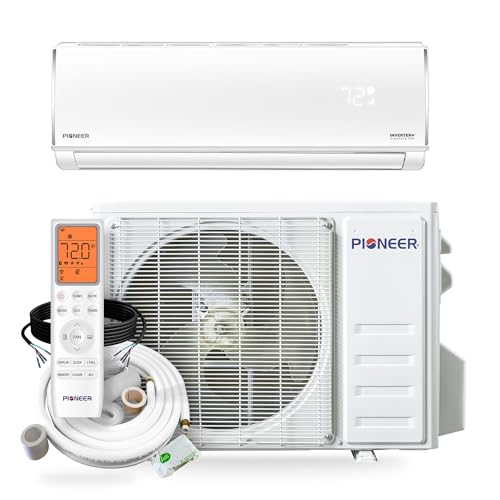
MRCOOL DIY 5th Gen 12,000 BTU 115V Mini-Split
Our default size for one room: 115V (18 A MCA, 20 A max breaker), 8,400 BTU/h at 5°F per NEEP, and the same 2,600 BTU/h minimum at 17°F as the 9K, so the extra size costs nothing in mild weather. Owner installs allowed.
Read our full review: we scored it 6.9/10

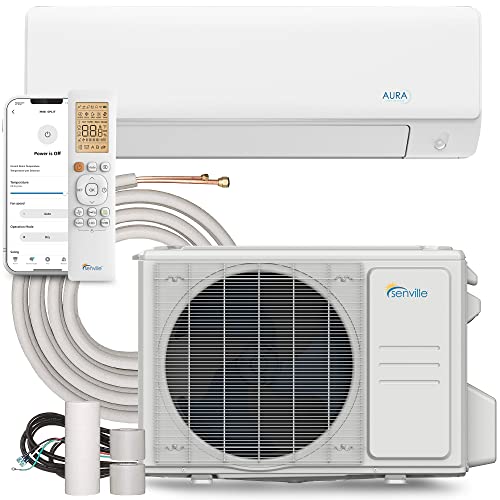
Klimaire DIY 18,000 BTU 23 SEER2 Quick Connect Mini-Split (230V)
When a 12K comes up short at 5°F: 13,600 BTU/h there per NEEP, and a 5,400 BTU/h minimum at 17°F against the MrCool 18K's 8,000, so it cycles less. Quick-connect, 230V. DIY allowed; claims ask for a licensed installer's invoice.
Read our full review: we scored it 6.7/10
What owners say
Real owner reports from the threads and editorial sources we drew on for this guide.
“Did a 12k for 320ft garage. The air was cool, the humidity was in the 70s. Went down to 9k, the air is cool and humidity is 40-50s”
“I’m heating/cooling a 350 ft loft above a garage in Ontario and I went with a 12000 btu unit. It’s great at humidity in the summer but struggles to regulate it in the shoulder seasons even when it turns down. For a space that small you’re going to want to find a 6-9000 Btu inverter unit that can do a low minimum BTU. They’re hard to find in that size with a cold climate rating.”
“Have a small office space that is 9x9x9 block construction located in PR. The smallest 120v unit available was 12k btu. The unit cools the space and cycles off before any dehumidifying happens.”
“I oversized mine quite a bit for winter. 1600sqft house, (1) 24k btu and (2) 12k btu units, so 4 tons all together. They get close to max when it gets to like -10F out. They turn down enough to keep humidity in the 50s in the summer. Im in the NE so I was pretty worried about oversizing for the summer, but it ended up being a non issue. If the summer weather forecast is mild I just turn off one of the 12k btu units.”
“Up sized to 12k for 16×16 4 seasons room. Didn't regret for a minute”
“I have a 30KBTU Mitsubishi that was properly sized to my installation resulting in my family (9KBTU minisplit) room never getting enough heat during winters. I now have an 18KBTU minisplit on order to replace it.”
“I have basically the same basement- 600sf in Boston 7’ ceilings a bunch of windows above grade and closed cell foam everywhere. 7k heats it fine, we also get residual heat when boiler is running when it’s really cold. 18k is overkill basements don’t get that cold.”
