Best Window Air Conditioner: Picks by Window, Room and Season
By Teo Varnadoe · Updated October 2026
Independent editorial guide. We never accept payment for coverage, though we may earn a commission if you purchase through our links.
Quick Take
For most bedrooms, buy the Midea U, and in a typical bedroom of 150 to 250 square feet that means the 6,000 BTU MAW06V1UWT. It straddles the sash, so the compressor sits outside a closed window, its inverter throttles down instead of cycling, and ENERGY STAR certifies it at CEER 15.1. It scores 7.5 in our review, the highest of the nine window units we rate. No 6,000 BTU Midea U is on the 2025 recall list.
Two things can rule it out: a window it won't fit (it needs a single- or double-hung opening 22 to 36 inches wide and at least 13.75 inches tall) or a room that needs heat. For a short window, the LG Dual Inverter 10,000 needs 13 inches. For a window outside the U's width range, the GE Profile ClearView inverter takes 20 to 40 inches. For spring and fall heat, the Midea 8,000 BTU with Heat is a real heat pump that stops below 41°F.
Our bedroom default, the box and saddle units for windows the U can't take, the heat pump model and the budget remote unit are below. See picks ↓

The window air conditioner we'd buy first is the Midea U, sized to the room. It's the quietest layout a plug-in unit has, because the closed sash sits between your bed and the compressor, and its CEER of 15 to 15.1 sits within half a point of the most efficient box unit we cover, LG's 6,000 at 15.5. It's for bedrooms, home offices and small living rooms with a standard sash window. Check the model suffix on the listing and the box before you install it; earlier 8,000 to 12,000 BTU models were recalled over mold.
If the U isn't your answer, the window and the season decide the rest:
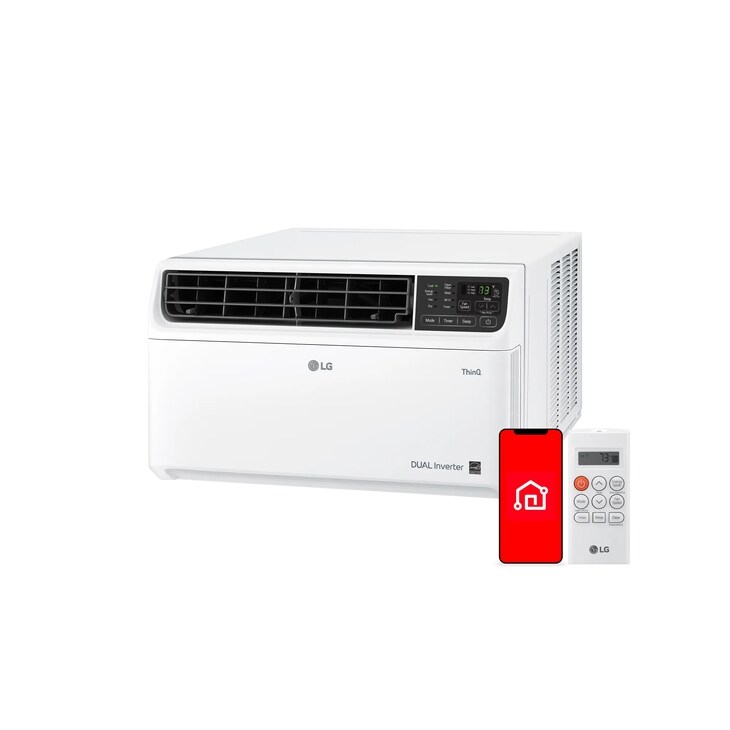
- Short window: the LG Dual Inverter 10,000 BTU needs a 13-inch opening against the U's 13.75, and it's a box unit that drops straight in.
- Narrow or very wide window: the GE Profile ClearView 10,300 BTU inverter is a saddle unit that fits openings 20 to 40 inches wide. It's 80 pounds and sized for a big room.
- You hear high-pitched whine: the LG is the safer bet. Owners who ran both mostly found the inverter whine worse on the Midea.
- You want heat in spring and fall: the Midea 8,000 BTU Smart Inverter with Heat. Its heat pump shuts off below 41°F outside, so it isn't winter heat.
- Fixed budget: the Frigidaire 6,000 BTU with remote (FHWC063TC1) for a 150 to 250 square foot room: CEER 11.0, a digital thermostat and three speeds. Under 150 square feet, the knob FFRA051WAE 5,000 costs less. Fine for the money; louder and less efficient than an inverter.
- Sliding or casement window, or a lease that bans window units: read our window AC vs portable AC guide; a portable is the fallback, not the first choice.
Our scores, ranked
These are the scores from our full reviews: Performance 40%, Reliability 35%, Value 25%. Efficiency is ENERGY STAR's CEER listing; window figures are each maker's.
Window unit | Our score | Key spec | Best for | Where we cover it |
|---|---|---|---|---|
Midea U | 7.5 | U-shaped inverter; CEER 15.1 (6,000) and 15 (8,000-12,000) on the V1UWT; 22-36 in wide, 13.75 in opening | Most bedrooms with a single- or double-hung window | |
7.2 | Box inverter; CEER 15.5 (6,000, Most Efficient) or 15; the 10,000 fits a 13 in opening | Short windows, whine-sensitive sleepers | ||
Midea 8,000 BTU with Heat | 6.9 | Inverter heat pump; CEER 14.5 (Most Efficient); heat stops below 41°F | Cooling plus shoulder-season heat | |
6.8 | Saddle inverter (10,300 and 12,200 only); CEER 14.7; 20-40 in wide, 13 in opening; 80 lb | Big rooms, windows outside the U's range | ||
Frigidaire 6,000 BTU | 6.5 | Box unit with remote; CEER 11.0, not ENERGY STAR; 250 sq ft; 13 in opening | A 150-250 sq ft bedroom on a budget | |
6.3 | Box unit with remote; CEER 11.4; 340 sq ft; 58 lb | A 300-340 sq ft room without an inverter budget | ||
6.3 | Box unit with remote; CEER 11.0; not a Midea U, not recalled | The Frigidaire 6,000 when it costs less | ||
6.3 | Knob controls; CEER 11.0, not ENERGY STAR; 150 sq ft | A small room on a fixed budget | ||
5.7 | Box inverter; CEER 15 (8,000 and 10,000); 14 in opening | Buyers who want the look and accept the record |
For every size and suffix side by side, including through-the-wall units and portables, see every model ranked. Our comparison of the top two scores the Midea U at 7.4 against the LG's 7.2 at a matched 8,000-8,500 BTU size; the review score above is for the U line as a whole.
The Windmill's efficiency is as good as the leaders' on paper. Its score is low because of the owner record: failed electronics (random beeping, settings changing on their own, dead control boards) and units that stopped cooling, a couple within the first six weeks, on a one-year warranty.
Pick the shape before the brand
Three chassis styles sell as window units, and where the compressor ends up matters more than the logo on the front.
- U-shaped (Midea U): the unit straddles the sash, and the window closes down into the notch between the indoor and outdoor halves. Glass and frame sit between the room and the compressor.
- Saddle (GE Profile ClearView): also straddles the sill with the compressor outside, and GE's listings say the window can open and close freely after install. More of the glass stays clear than with a box unit.
- Box (LG Dual Inverter, Windmill, Frigidaire): the chassis runs straight through the opening, so there's no closed sash between the room and the compressor and the cabinet insulation does all the work. The trade is a simpler drop-in install.
Measure the window before you pick a model: the width, and the opening height with the sash raised.
Unit | Window type | Width | Minimum opening height | Weight |
|---|---|---|---|---|
Midea U 6,000-10,000 (V1UWT) | Single- or double-hung | 22-36 in | 13.75 in | 53.1 lb (8,000, ENERGY STAR) |
LG Dual Inverter 10,000 (LW1022FVSM) | No figure | 22-36 in | 13 in | 62 lb |
LG Dual Inverter 6,000 (LW6023IVSM) | Double-hung (LG's Amazon listing) | 22-36 in | 13 in | 63 lb |
GE Profile ClearView 10,300 (PHNT10CC) | Saddle over the sill | 20-40 in | 13 in | 80 lb |
Midea 8,000 with Heat (MAW08HV1CWT) | Double-hung | 24-38.5 in | 14.5 in | 56 lb |
Windmill WhisperTech 8,000 (08W2Wi) | Double-hung | 23-37 in | 14 in | 61 lb |
Frigidaire 6,000 (FHWC063TC1) | Double-hung | 23-36 in | 13 in | 38.2 lb (Amazon data) |
LG 8,000 (LW8024RD) | Single- or double-hung | 22-36 in | 13 in | 58 lb |
Frigidaire 5,000 (FFRA051WAE) | Double-hung | 23-36 in | 13 in | No figure |
The U's install is the fussiest of the group. It hangs on an outside support bracket screwed to the sill, the bracket has to be perfectly level or the window won't open and close, and Midea's U1QWT manual limits the bracket to walls 3 to 10.5 inches thick from the inside of the window to the outside wall. Old sills with small lips mean trial and error. A box unit sets in, the sash closes on it, and you seal the gaps; the heavy ones (85 pounds for LG's 8,500 and 12,000) are two-person lifts, and so is the 80-pound ClearView.
Size it to the room, not the sale price
ENERGY STAR's sizing chart puts a room of 150 up to 250 square feet at 6,000 BTU, 350 up to 400 at 9,000 and 400 up to 450 at 10,000, and adds 10 percent for a very sunny room. Most bedrooms land in the 6,000 BTU row. ENERGY STAR also warns that an oversized unit cools the room before it removes the humidity, which leaves it cool and clammy.
An inverter softens that, because it can slow down instead of switching off, but bigger units are still louder on the settings you sleep on. A retailer spec table for the original Midea U puts the 8,000 BTU at 47 dB on high and the 12,000 at 52, with both at 42 on low, and owners who've run both sizes say the 12,000's fan is a lot louder and never throttles down as far. LG's own figures show the same thing: the 10,000 BTU unit's low fan step is 50 dBA against 46 for the 6,000.
So buy the 6,000 for a typical bedroom, the 8,000 for a top-floor or west-facing bedroom near the top of that range, and the 10,000 class for a living room or a primary suite of 400 to 450 square feet. Save the 12,000 for an open room around 500 square feet.
What the efficiency numbers are worth
CEER is the room air conditioner rating: more cooling per watt reads higher, and energy use scales with 1 divided by CEER. That makes the gaps easy to price.
Unit | CEER | ENERGY STAR | Compressor |
|---|---|---|---|
LG Dual Inverter 6,000 | 15.5 | Yes, Most Efficient | Inverter |
Midea U 6,000 (MAW06V1UWT) | 15.1 | Yes | Inverter |
Midea U 8,000 (MAW08V1UWT) | 15 | Yes, not Most Efficient | Inverter |
LG Dual Inverter 8,500, 10,000, 12,000 | 15 | Yes | Inverter |
Windmill WhisperTech 8,000 and 10,000 | 15 | Yes, not Most Efficient | Inverter |
GE Profile ClearView 10,300 and 12,200 | 14.7 | Yes | Inverter |
Midea 8,000 with Heat | 14.5 | Yes, Most Efficient | Inverter heat pump |
GE Profile ClearView 6,100 and 8,300 | 11.5 and 11.4 | No | Fixed-speed rotary |
LG 8,000 (LW8024RD) | 11.4 | No | Fixed-speed |
Frigidaire 6,000 (FHWC063TC1) and Midea EasyCool 6,000 | 11.0 | No | Fixed-speed |
Frigidaire 5,000 (FFRA051WAE) | 11.0 | No | Fixed-speed |
In dollars, the gap is smaller than the noise gap. Frigidaire's EnergyGuide label puts the 5,000 BTU unit at $44 a year at the label's assumptions; the same cooling at CEER 15 comes to about $32. Pay for the inverter to get the quiet and the steadier temperature, unless you run the unit around the clock all summer.
Don't buy a ClearView by the name alone. The 6,100 and 8,300 BTU sizes are fixed-speed rotary units, and the 10,300 inverter uses about 22% less electricity than the 8,300 for the same cooling (11.4 ÷ 14.7 = 0.78). The Frigidaire's CEER of 11.0 is exactly DOE's minimum for its size class until May 26, 2026; the minimum for units manufactured from that date is 13.1, so what's on sale now is older stock.
The same rule reaches the bigger units. For louvered window units of 8,000 to 13,900 BTU, DOE's minimum rises to CEER 16.0 for units manufactured from May 26, 2026, above every 8,000-plus unit in this guide as currently rated, inverters included. Units on the shelf were built before the cutoff and are still legal to sell, and makers are re-rating and replacing models, so read the model number and CEER on the listing and the box rather than assuming last year's numbers.
Noise: the whine, the rattle and the thermostat
The most common quiet-unit complaint is a thin, high-pitched tone from the inverter drive. Some people hear it clearly and others never notice it. It's common on earlier Midea U models, and owners who had a U and an LG at the same time mostly found it worse on the Midea, six to two. Every whine report predates the V1UWT now on Amazon, but ENERGY STAR lists the current 8,000 at the same cabinet size and weight as the original, so we wouldn't assume it's gone. Buy where returns are easy and spend the first night listening with the fan on low.
Rattle and vibration usually start with the install. The GE ClearView's known complaint is a low drone that shakes the wall, reported by people who have the problem, so we can't size it. Level the unit, support it with foam where the sill is uneven, and test it at night inside the return window.
Thermostats are the other weak spot. The Midea U's built-in sensor reads the air right at the unit; its Comfort Sense setting turns the remote into the thermostat and fixes it. LG's 2017-2022 Dual Inverters often read the room 5 to 8°F off, mostly in Energy Saver mode. The Frigidaire's knob thermostat has no readout at all. A cheap room thermometer across the room tells you which one you've got.
Recalls, warranties and the model number
CPSC recall #25320, announced June 5, 2025, covers about 1.7 million Midea U and U+ units, the 8,000 to 12,000 BTU V1QWT, AV1QWT, W1QWT and U1QWT models, because pooled water inside the unit can fail to drain fast enough and lead to mold. The V1UWT models now on Amazon, the U2QWT, the U1KWT and every 6,000 BTU U are not on the list. Some older Amazon listings still showed recalled model numbers when we checked, so read the model in the listing details and on the box, not the title.
Warranties on window units are short, and they differ in what they cover:
Unit | Warranty |
|---|---|
Midea U 6,000 (MAW06V1UWT) | 2 years, per its listing |
Midea U 8,000 (MAW08V1UWT) | 1 year limited per its listing; the V1QWT and U1QWT manuals add 5 years sealed system and 3 years compressor |
Midea 8,000 with Heat | 1 year on the unit, 5 years sealed system, 3 years compressor, per its manual |
LG Dual Inverter | 1 year parts and labor; no separate compressor term |
GE Profile ClearView | 1 year replace, repair or refund; no labor coverage |
Windmill | Limited one year; no longer compressor term published |
Frigidaire 5,000 | 1 year functional repairs; units transferred from the original owner excluded |
With a year of coverage on most of these, the return window is the cheapest time to find a bad unit. Run it hard in the first weeks, keep the receipt and photograph the finished install.
If the room needs heat too
None of the cooling-only units here heats, and no U-shaped Midea on Midea's US store has a heat mode. The Midea 8,000 BTU Smart Inverter with Heat is a reverse-cycle heat pump, not a heating coil, and its manual runs heat from 41 to 75°F outdoors. Below 41°F it shuts off and reads LO. Midea publishes no heating capacity, so you can't size it for heat. It covers spring and fall, mild-winter places, and rooms where you'd otherwise run a space heater on cool mornings.
For real winter heat from a window, our window heat pump guide covers the cold-climate options. For a room you'll heat and cool for years in a house you own, read mini-split vs window AC first. If the room has a wall sleeve instead of a usable window, see our through-the-wall air conditioner guide, and if no window unit will fit at all, window AC vs portable AC covers what you give up.
Which one we would buy
- Typical bedroom, single- or double-hung window: the Midea U 6,000 BTU (MAW06V1UWT).
- Hot top-floor bedroom near 250 square feet: the Midea U 8,000 BTU, checking the V1UWT suffix.
- Window opens less than 13.75 inches: the LG Dual Inverter 10,000 for a larger room; the LG 6,000 from LG's store for a small one.
- Window under 22 or over 36 inches wide, big room: the GE Profile ClearView 10,300 inverter, with a helper for the lift.
- Cooling plus mild-weather heat: the Midea 8,000 BTU with Heat.
- A 150-250 square foot room and the lowest price: the Frigidaire 6,000 BTU with remote, or the knob Frigidaire 5,000 under 150 square feet, knowing both are louder and use more power.
We'd skip the Windmill until its reliability record improves. Its WhisperTech units match the leaders on CEER, but the owner reports don't give you a reason to expect it to outlast a Midea U or an LG at the same price.
The picks
Products we recommend for this guide.


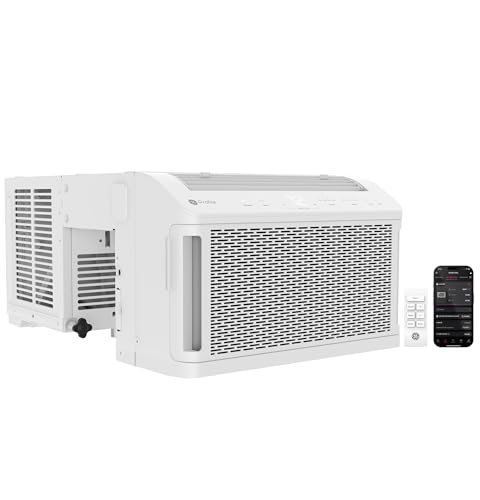
GE Profile ClearView 10,300 BTU Inverter Window AC (PHNT10CC)
The saddle unit for windows outside the U range: 20-40 in wide, 13 in opening. Inverter, CEER 14.7, up to 450 sq ft, 80 lb, no labor warranty. Only a third-party seller had it new when we checked; pick an offer marked New.
Read our full review: we scored it 6.8/10

Midea 8,000 BTU Smart Inverter Window AC with Heat (MAW08HV1CWT)
For a room that wants spring and fall heat: a true inverter heat pump at CEER 14.5 with Most Efficient status. Heat shuts off below 41°F outside. Needs a 14.5 in opening; the manual adds 5 years on the sealed system.
Read our full review: we scored it 6.9/10

Frigidaire 6,000 BTU Window Air Conditioner with Remote (FHWC063TC1)
The budget pick for a 150-250 sq ft bedroom: remote, digital thermostat, three speeds, auto restart and 265 CFM on high, at CEER 11.0. Fits a 23-36 in double-hung window with a 13 in opening. Louder than any inverter here.
Read our full review: we scored it 6.5/10
What owners say
Real owner reports from the threads and editorial sources we drew on for this guide.
“The Midea U window air conditioner. The loud parts stay outside with the sound mostly blocked by the window.”
“If you don't have a window that will support the U-shaped unit, look into getting a standard unit that has an inverter. I have gone through a half dozen window ACs in the last decade and the Midea U-Shaped inverter units are the quietest AC units I have ever used.”
“I couldn’t love our U-shaped Midea more. And, yes, it is a PITA to get sealed properly.”
“Have had the LG for over a year and it's been waaaaaay better. Very quiet. And most importantly, no high pitched whine like on the Midea's I had”
“with LG dual inverter units, they are built in a way where you can easily pull out the guts of it an see whats going on / clean it. Midea is a B** ish to take apart and clean”
“I’ve had the Midea U Shaped AC unit for two summers now and have had to constantly battle mold formations in the unit.”
“I ended up returning the Windmill AC -- it's too expensive with too few features imo and mine also had an issue with the thermostat reading a much lower temp than the room actually was.”
“The inverter is nice and it keeps the temperature a lot more steady. Instead of running at 1,500 watts every 10 minutes for 10 minutes at a time to try and hold the set point, it just runs at around 250 watts continuously.”
“my unit still enters “Lo” mode under 41. I was already aware of this limitation when I purchased it, but it would be a nice bonus if a firmware update unlocked the ability to heat into lower temperatures.”